Advertisement
Advertisement
September 2023
Interview With Manj S. Gohel, MD, FRCS, FEBVS
Dr. Gohel discusses the importance of the patient perspective in clinical decision-making, improvements needed in the venous leg ulcer care pathway, thoughts on the state of deep venous intervention, and more.

How would you break down your current research and/or clinical interests, and how have they evolved since the start of your career?
As with many clinicians and medical academics, my interest in venous disease was sparked by an enthusiastic and passionate supervisor and trainer when I was a junior surgeon. It became very clear to me that the populations of patients with venous disease, particularly advanced stages of venous disease, were poorly served by current care pathways. Throughout my career to date, my specific focus has evolved from clinical trials and evidence synthesis to implementation of the high-quality evidence that already exists. It is an uncomfortable reality that we are generally more enthusiastic about performing clinical trials than embedding the results of clinical research into daily practice (which is often much more difficult).
You’ve discussed the importance of patient voice and shared decision-making in vascular care. What have you found to be helpful when encouraging this approach in practice, both among fellow physicians as well as patients?
The concept of involving patients in clinical decision-making is not new but may feel very different to the paternalistic health care systems in which many of us work. A shared decision-making approach is imperative when treating patients with venous disease because the natural history of the disease process is not usually life or limb threatening, and there are many potential treatment strategies available (many of which may be appropriate).
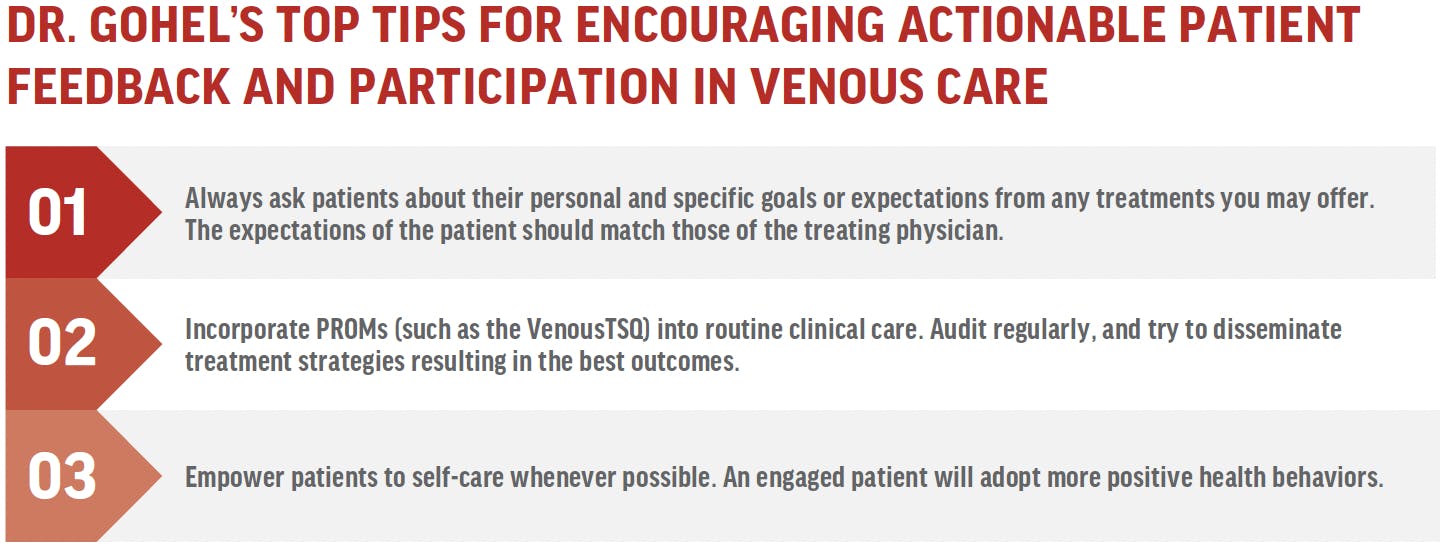
I have been pleasantly surprised how engaged patients can become in their own management. The best treatment approach may not be clear, and it is important (and ethical) to share any clinical uncertainty with the patient. In a clinical field that remains at high risk of medicolegal litigation, physicians are increasingly cognizant that the expectations of the patient should match those of the clinician to avoid unhappiness.
Along those lines, you’ve been involved in the VenousTSQ, a questionnaire aimed at measuring condition-specific patient satisfaction with varicose vein treatment. How has your approach to treatment decision-making for varicose veins changed as a result of this project?
The term patient-reported outcome measures (or PROMs) is frequently used and may refer to an enormous range of currently available tools. In reality, even the most widely used PROMs have significant limitations. For superficial venous interventions, currently available PROMs have a major blind spot because they do not assess the periprocedural period particularly effectively. This is important as the saphenous ablation procedure and postprocedure period may vary enormously between modalities and treatment strategies, even if the eventual outcomes are similar.
By creating the VenousTSQ, in collaboration with recognized health psychologists, we have been able to appreciate which factors are truly important to patients during this treatment phase. The intention is for this tool (which only takes 2 minutes to complete) to become widely available and used in routine clinical practice to encourage assessment and optimization of outcomes from a patient perspective.
What are your biggest takeaways from your time as President of the Royal Society of Medicine (RSM) Venous Forum? From a leadership perspective, what have you learned about the role and responsibility of societies in promoting optimal care, particularly in the venous realm?
My period as President of the RSM Venous Forum has coincided with a period of enormous disruption due to COVID-19. In many ways, the impact of the pandemic has been to reverse much of the progress that has been made in the appreciation and treatment of venous disease over the previous 5 to 10 years.
However, I am regularly surprised and humbled by the strength of passion and dedication among multidisciplinary venous specialists in primary and secondary care. I strongly believe that the key to advancing venous care is to engage patients, nurses, doctors, and anyone else involved in the care of this group of patients. The positive impact on patient quality of life when we get it right is staggering.
You were a lead investigator in the EVRA trial, which provided us with a better understanding of optimal venous leg ulcer (VLU) care. Now that we are 5 years out from the trial publication, how have practices changed because of EVRA and related trials, and where are improvements still most needed?
The EVRA trial was a landmark study and demonstrated that early endovenous ablation (within 2 weeks) in addition to compression resulted in faster ulcer healing, fewer recurrent ulcers, and cost savings. As a result, early superficial venous interventions for patients with C6 disease have been included in international guidelines. Real-world practice has been stubbornly slow to shift, and a range of levers need to be used to implement the EVRA recommendations into practice.
One potential reason is the confusing range of superficial venous ablation options that are now available. However, the message from EVRA has always been clear: Prompt intervention, ideally within 2 weeks, is much more important than the modality used.
At the RSM Venous Forum meeting this year, you spoke on improving patient access to specialist services for VLUs. What are the hindrances to access for the affected patient population, and what are some keys to improving this problem?
It is mind-boggling how some largely unproven interventions are rapidly introduced into routine clinical practice, whereas other treatments are not implemented despite unequivocal, level 1 supportive evidence. The solution is multifaceted, with clinical audit, patient/physician/nurse education, and pathway/guideline development all playing a role.
However, the reality for most health care systems is that reimbursement is the most influential driver of behavior. In the United Kingdom, as part of a multifocused approach, financial incentives and rewards for timely referral of patients with VLUs are currently being evaluated.
Along with your efforts in VLU and varicose vein management, you have also been involved in the management of deep venous occlusive disease. What projects do you have in store in this area, or what aspect of research would you be most interested in pursuing if given the opportunity?
Compared to superficial venous interventions where multiple, large, randomized controlled trials have shown clear clinical benefit, the evidence for deep venous interventions for acute deep vein thrombosis and chronic postthrombotic syndrome is underwhelming. However, for those of us involved in treating this patient group, there is no doubt that tremendous quality-of-life benefits can be achieved in appropriately selected patients.
The increasing widespread availability of mechanical thrombectomy devices for early thrombus removal is very exciting. Similarly, there are some fantastic developments for treating deep venous reflux, and several venous stenting options are now established. The key remains patient selection. I hope that the next 5 to 10 years of research will help us decide which patients to treat, rather than how to treat.
Besides the technical knowledge you impart when training surgeons in your role at Cambridge, what is a piece of general life advice you share with physicians?
Although we all may feel frustrated and tired with work, it is important to remember that treating and operating on patients is an enormous privilege. We must never lose our humility or desire to learn and improve.
Advertisement
Advertisement
Interested in reading more interviews?
To read more interviews with thought leaders in the vascular field, check out our Profiles & Perspectives hub.
Read More