Advertisement
Advertisement
August 2024
An Interview With Judy Wawira Gichoya, MD, MS, FSIIM
Dr. Gichoya shares insights into her work using data science to promote equity and understand AI in real-world settings, the importance of “open-source” tools for collaborative research and global health, her foundational paper on AI recognition of patient race, and more.
You’ve undergone training in both interventional radiology (IR) and health informatics. Can you pinpoint the experiences that led you to these paths? In what ways do the two fields intersect?
The intersection of IR and health care informatics is exemplified by the lab that I cofounded. Although I didn’t fully understand this when I started, I now believe that this is the future of technology in our field. As interventional radiologists, we truly are unique. We often refer to our work as the “IR-ness” of health care due to its specialized nature.
When considering how artificial intelligence (AI) is deployed in real-world settings, it’s not just about a single application. As interventional radiologists, we need a variety of advanced tools to provide the best care for our patients. I envision the future as a space where innovation is at the forefront, particularly here at Emory. AI is one of the key tools, alongside data science, virtual reality, and three-dimensional printing.
Although I did not start with this vision, I increasingly see the importance of creating an inclusive space that integrates all these fields and allows for the development of innovations such as robotic systems. In this space, one could find all the necessary resources and expertise in a single place.
At Emory, you codirect the Healthcare AI Innovation and Translational Informatics (HITI) lab. How would you summarize the lab’s core principles and the vision you have for its impact on interventional medicine specifically and health care in general?
The HITI Lab at Emory is focused on building and using data science to promote equity and understanding how AI performs in real-world settings. Therefore, we spend a lot of our time doing four things: (1) building robust data sets for machine learning, (2) examining bias and fairness as core themes, (3) conducting real-world validation (including some FDA validations) of AI algorithms, and (4) training the next generation of data scientists, who are both clinicians and computer scientists. We have been very fortunate in our endeavors. We adopt a village mentality in our work, collaborating with numerous colleagues around the world. We believe that science is much more interesting and effective when performed this way. As a result, we have become known for our very robust data sets.
Until now, we have not worked extensively on data sets for IR because the technologies for building AI data sets have made it difficult to standardize and enrich data sets for AI in IR. Further complicating this, certain IR procedures such as inferior vena cava filter placement can be done from various anatomic sites. However, with the advent of generative adversarial networks, which can capture fluoroscopy images and transform them into digital subtraction angiograms, we anticipate significant advancements in this area. We also foresee extensive developments in cancer work within the interventional oncology (IO) space with the creation of cancer-based data sets, such as those for hepatocellular carcinoma (HCC).
Our goals are to ensure that AI can be safe for every patient and fully harness the promise of AI. Specifically, our group has demonstrated that hidden signals in medical images can be harnessed to transform population health and achieve what is not possible with just a radiologist.
In 2022, you and colleagues published a study in The Lancet Digital Health that found AI deep learning models could accurately predict self-reported race from a radiologic image, sparking many discussions in the health care world.1 What would you say are the main implications of these findings, particularly regarding health equity and bias in AI? In what ways have the findings advised clinical practice, for you or for the field in general?
For those who are not familiar, we demonstrated through multiple medical imaging techniques (chest x-rays, CT scans, mammograms, cervical radiographs, and hand radiographs) that you can determine whether a patient is Asian, Black, or White with amazing accuracy and strong performance across other metrics.
I’d like to stress that the recognition of race is a social and legal construct. This is not intended to imply that there are biologic differences. Of course, when you can show that this finding is possible across multiple data sets, most people might say, “You’re then proving that there is a biological difference.” When I summarize this work today, nearly 2 years after the publication, I say that there are hidden signals in medical imaging. In fact, I usually show a chest x-ray and demonstrate that if you showed me “Judy’s” chest x-ray, I could tell that Judy is female, Black, and aging faster based on her chest x-ray age compared to her chronological age. Additionally, her disease conditions (chronic obstructive pulmonary disease and congestive heart failure) and projected health care costs (equating to $15,000 in the next 3 years) can also be inferred. This has been corroborated mostly by our group but also by other groups globally, showing that demographic and some clinical features can be encoded in images despite our lack of understanding as to why this is possible or how this information is used.
The significant contribution today is that this finding has stood the test of time. I’ve learned a lot about how to communicate my science more effectively and how to make it simpler for others to understand. This work has also helped frame new areas for research that need to be addressed. As I mentioned, we don’t know why these signals exist, so we need better explanatory tools, better data sets, and better infrastructure to connect real-world impact to this information. Also, even with clinical notes you can predict patient race, although perhaps not as good as with chest x-rays. Unfortunately, in these cases, this is often because the AI systems rely on certain words, such as “difficult” or “aggressive.”
What subsequent questions for further study have sprouted from the initial study?
This highlights another issue with how we train machine learning models because AI systems tend to use shortcuts. Consider a scenario where an AI system learns to associate the presence of a chest tube with pneumothorax instead of identifying the underlying disease. This is a common issue, as seen in pneumonia cases where AI systems learn that the patient is from the intensive care unit (ICU) based on location and the presence of certain medical devices. We must consider whether the AI is using relevant patient characteristics or unrelated factors. Some studies, such as those by Emma Pierson, show that using a patient’s pain score to assess the severity of osteoarthritis can reduce pain disparities but also performs very well in identifying the patient’s race.2 The question then becomes whether the AI is accurately identifying osteoarthritis severity or being misled by racial indicators.
Identifying race is not inherently problematic; the challenge arises as the population changes and more people identify as mixed race. What happens if AI systems rely solely on that one component? This is a crucial question that needs to be addressed as we continue to develop and refine these technologies.
Evaluating AI for bias and fairness is a thread seen not only in the aforementioned piece but also woven throughout your research efforts. What conversations should an IR team have about this when considering a new AI tool for their clinical practice?
The challenge of thinking about equity, not just in AI but also in our work as interventional radiologists, is significant. IR tends to be the last line of defense; when no one else can do anything, IR is called. This means we do not really have a say in the patients who come to us. For example, during my training across three different institutions, I observed that the patients referred through the tumor board were highly dependent on the relationships with the tumor board personnel. At the first institution, we predominantly performed yttrium-90 (Y90) with TheraSphere (Boston Scientific Corporation). At the second institution, we primarily followed-up conventional transarterial chemoembolization with ablation. At my current institution, we predominantly use Y90 for the same type of disease. If we were to build an AI system to predict outcomes for conditions like HCC, the AI would encode patterns of practice specific to each institution. This makes it difficult to create an application that can work across multiple institutions.
Another example is placing a dialysis access for patients with end-stage kidney disease where a quick chart review will show that these patients are never considered for transplant. Just as we aim to make patients tube-free, equity should be a consideration in every aspect of patient care, including pain management and sedation practices. When examining your own sedation practices, consider whether they are equitable. Reflect on whether you are unconsciously changing your behavior based on biases and not offering equitable care. As interventional radiologists, we should be ambassadors of health equity, especially since we are often the last resort for patients. By prioritizing equity in our practices, we can help ensure that all patients receive fair and just treatment.
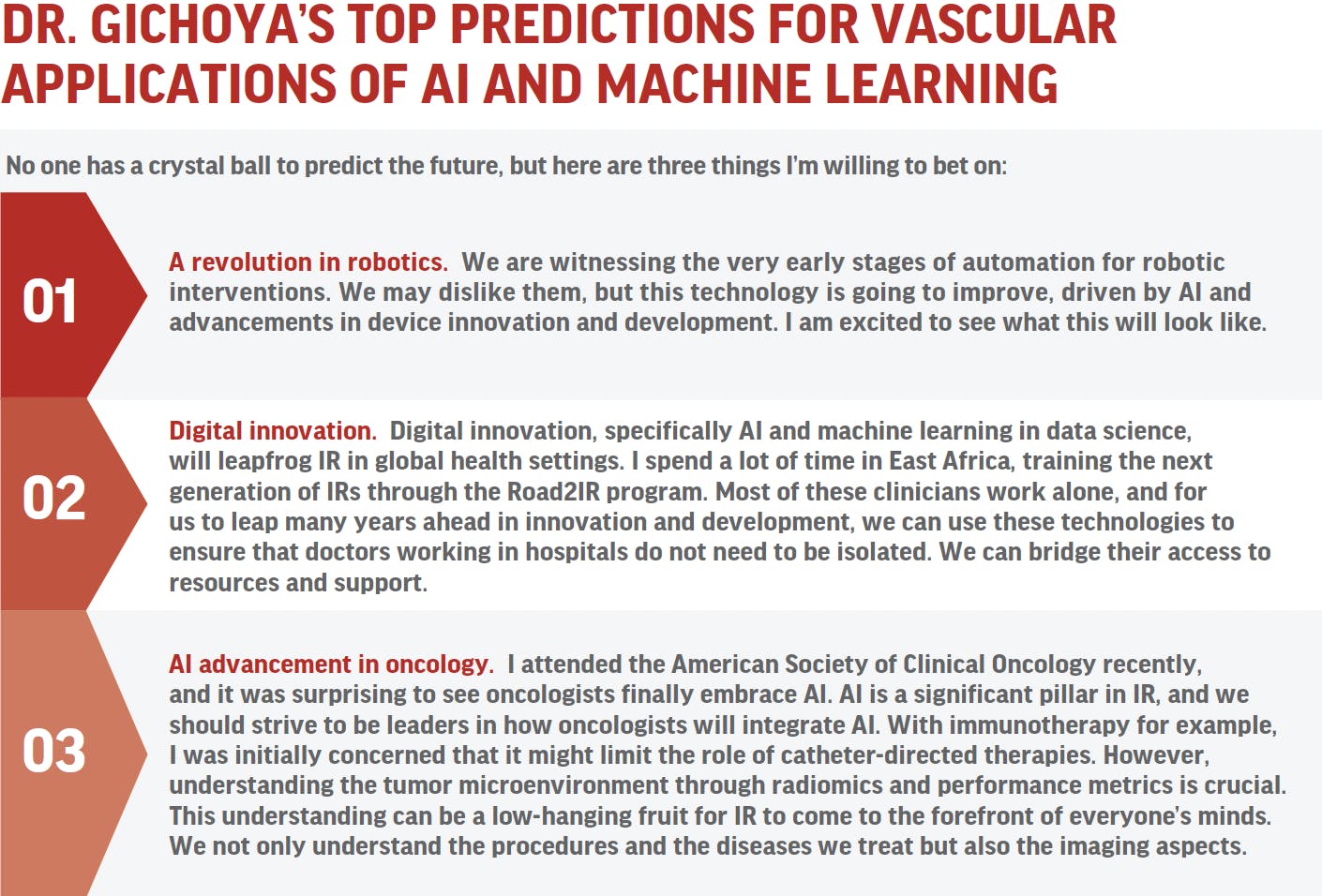
On the other side of that, in what ways might AI be used as a solution to mitigate some of the bias and health disparities seen in IR?
The work of IR is centered around imaging and procedures. It requires extensive chart reviews, and unfortunately, providers sometimes struggle with the perception of the field. I always say that IR has a branding problem. With the advent of new technologies that allow us to mine patient charts, we can start to think about how to use the same technology as a bridge for health equity.
In our own work, we have been making significant efforts to help patients understand their IR reports. It is important that patients who do not speak English as their first language can access our services and understand what is going on. We have seen the same concerns in other areas, including the need for multimedia report explainers. I believe AI serves as an amplifier for IR. As we consider how to better educate referring doctors and patients, we should definitely view AI as a valuable tool in our toolbox.
Another important piece of the puzzle when discussing AI is your work building diverse data sets, such as in EMBED, the Emory breast imaging data set. What is the overall goal for how these data sets might be used?
One of the areas we focus on is building diverse data sets. The reason we started building data sets is to address existing gaps. Over the past 5 years, we have learned a lot about AI data sets in medical imaging. One example is that when we convert images to JPEG or PNG formats, we lose a lot of metadata from their original DICOM images. This is why we spend a significant amount of time building data sets. Currently, we have four: EMBED; Emory CXR, which contains 1 million images; a knee radiograph data set; and an ICU data set. Although the latter is not strictly a medical imaging data set, it reflects the growing importance of multimodal AI systems.
This year has seen a significant focus on multimodal AI systems. This is not surprising for radiologists, as it is common to have both an x-ray and a CT scan for a patient. However, when building AI systems, we have traditionally developed them for specific tasks, such as detecting pneumothorax from chest x-rays. Multimodal data, which involves integrating information from various sources, has been facilitated by the advent of transformer architectures. These architectures allow us to extract features from multiple data sets, presenting a rich dimension of patient information. We are seeing increased activity in combining radiology and genomics data, as well as radiology and pathology data. This necessitates the continued development of diverse data sets. Additionally, we have observed the emergence of novel data sets. Initially, I was skeptical about synthetic data sets and model embeddings, which are numeric representations of original data sets, but their development has proven valuable, and we are adding these to our data set repository.
You have a passion for open-source tools and global health, with your LibreHealth work as an example. How did this organization get started? What global health needs do you hope to address with this?
My open-source journey began in medical school, where I was involved in an open-source medical record system used to care for patients with HIV. Perhaps this interest stems from my upbringing as a student from a less-developed region and growing up in a village. I have a deep understanding of community-based learning, and my love for open source is fundamentally centered about people. It saves time and fosters collaboration.
I embody many open-source principles in my own work and research. Conducting science in isolation is very lonely, and I enjoy collaborating with others, receiving feedback on my ideas, providing feedback, and building useful things. This is the essence of the open-source mantra. Currently, we are witnessing the value of open source not only in medical record systems but also in large language models. For example, our understanding and adoption of some models have been facilitated by Meta’s release of various large language models.
For me, the idea of being embedded in a community is crucial for making an impact. A few years ago, I spent some time talking to people working on the open-source medical record system I mentioned previously and asked them why they contributed. It turns out that problem-based leaders who inspire people to work on a common issue are essential. I consider this one of my leadership styles. Additionally, managing the growth of a community through governance is vital.
In summary, my love for open source is driven by the collaborative spirit and the belief that together, we can make a significant impact.
You also place an emphasis on mentoring students and colleagues on your teams. What are some tactics you’ve found helpful in fostering these relationships?
Frequently, you will hear me described myself as someone who loves science and loves students. I believe that there are very few amazing teachers out there. I come from a strong family of teachers. I would not have seen myself as a teacher if it were not for the peer mentorship from one of my close friends Saptarshi, who is a professor at Indiana University, and my mentor and former boss, Dr. Janice Newsome. I love to see the light bulb go on in students’ minds when they finally make a connection. I promote a culture of learning within my group where everyone is empowered to provide feedback. I reward collaboration, not competition. It is not uncommon for a student to correct a statement or some of the work that I’m presenting.
As someone who was really a last-mile student, I strive to be a bridge, not only as a role model but also as one of the few Black professors and academicians. This is just one aspect of my identity, but I know that I have changed many students’ lives. When they send me emails or frequently invite me to meals, it really fills my cup. If I am ever very ill or deceased, I want my students to take a moment and send a letter to me or my parents about how I impacted their lives. This is something I already know, and they do this frequently.
1. Gichoya JW, Banerjee I, Bhimireddy AR, et al. AI recognition of patient race in medical imaging: a modelling study. Lancet Digit Health. 2022;4:e406-e414. doi: 10.1016/S2589-7500(22)00063-2
2. Pierson E, Cutler DM, Leskovec J, et al. An algorithmic approach to reducing unexplained pain disparities in underserved populations. Nat Med. 2021;27:136-140. doi: 10.1038/s41591-020-01192-7
Advertisement
Advertisement
Interested in reading more interviews?
To read more interviews with thought leaders in the vascular field, check out our Profiles & Perspectives hub.
Read More