Advertisement
Advertisement
December 2024 Supplement
Sponsored by Surmodics, Inc.
Reducing the Need for Overnight Thrombolysis in ALI With the Pounce™ Thrombectomy Platform
A conversation with Dr. David J. O’Connor.
Dr. David J. O’Connor is a vascular surgeon with 11 years of experience in both open surgical and endovascular interventions, having completed his training at Mount Sinai Medical Center in New York. He practices primarily at Hackensack University Medical Center in New Jersey, where he serves as Director of Vascular Research. His practice and research have spanned a broad range of vascular conditions, including aortic aneurysms, carotid disease, chronic peripheral artery disease (PAD), and venous and arterial thrombosis.
For the past 2.5 years, Dr. O’Connor has used the Pounce™ Thrombectomy System (suitable for 3.5-6 mm peripheral arteries) (Surmodics, Inc.) for clot removal in the management of acute limb ischemia (ALI). More recently, he added the Pounce™ LP (Low Profile) Thrombectomy System (suitable for 2-4 mm peripheral arteries) (Surmodics, Inc.) to his toolkit. We spoke with Dr. O’Connor about his approach to treating ALI and his use of the Pounce™ Platform.
How would you describe your PAD and ALI patient population?
Most of the patients we receive for interventions have critical limb ischemia. These are people with chronic ischemic rest pain and nonhealing wounds. They sometimes present with gangrene. They’re our more critical patients in need of urgent revascularization. We do treat a smaller subset of patients with claudication.
We also handle various emergencies. We often see patients with atheroembolism from a cardiac source, such as atrial fibrillation (AFib), that embolizes to the lower extremities. We also have patients with acute-on-chronic disease, often older patients with preexisting disease who have a critical stenosis that becomes thrombogenic, leading to ALI.
How do you select between surgical and endovascular approaches to ALI?
I’ll nearly always take a surgical approach for patients who present with what we call “hard signs” of ischemia, such as decreased motor function, decreased sensation, or severe mottling of the leg. These are Rutherford class IIb cases, where the leg is in immediate jeopardy, especially if the patient has had those symptoms for more than 6 hours. It’s almost like a heart attack—we need to get blood to that leg as quickly and successfully as possible because they may have already developed permanent motor or sensory dysfunction that could lead to amputation. We often perform a prophylactic fasciotomy for these patients at the time of revascularization to reduce risk of compartment syndrome.
For more stable patients, such as those with class I or IIa ischemia where motor sensation is intact, there’s some form of Doppler signal in the leg, and baseline viability of the extremity is present, we have more options. In these cases, we usually consider endovascular therapy as first-line treatment. This is because we have more time—although the leg does need revascularization, typically within 24 hours, we don’t need as rapid a restoration of flow if motor sensation is intact. This allows us to try less invasive approaches.
How do you select between endovascular treatments?
The decision between thrombolysis or mechanical thrombectomy really depends on the distribution and severity of disease we see on angiography. In patients with severe outflow disease—meaning there is complete thrombosis below the knee, with no reconstitution of a tibial vessel—we’ve found that patients tend to do better with thrombolysis. The thrombolytic tissue plasminogen activator (tPA) can get into the capillary microcirculation to dissolve, at least initially, a lot of clot. That may not be the only procedure the patient receives, but when we’re facing a thrombotic state that extensive, we really want to do some form of thrombolytic therapy to get into that microvascular circulation.
In these situations, you can sometimes try doing mechanical thrombectomy first, especially if the patient is in a significant amount of pain and we don’t want to wait 6 to 12 hours for the tPA to start doing its work. But in general, those patients are going to need some form of thrombolytic therapy.
For cases where there is reconstitution, I’ll typically try to use mechanical thrombectomy in a single-session procedure. I may take this approach for anything from a focal thrombus to entirely occluded superficial femoral artery (SFA) or proximal tibial vessels. I’ll sometimes start with some initial aspiration if I think there’s a component of fresh thrombus—for example, if there appears to be no calcification in the wall of the vessel and a wire passes through the clot easily. Aspiration can help get rid of a lot of the easily removed material before we re-image. But in the vast majority of cases, there’s going to be clot left over.
In the past, this is the time when we would often turn to overnight thrombolysis, with the potential for subsequent surgery. Now, using the Pounce™ Thrombectomy Platform, we can get rid of that more organized thrombus we just can’t remove with aspiration.
How does the Pounce™ Platform help in this respect?
The problem with aspiration has always been removing that thicker, more fibrotic clot. I’ve found that there is usually a component of organized thrombus with ALI patients. There are very few cases that will allow me to use an aspiration catheter to clear out all the clot I encounter.
With the Pounce™ Platform, the baskets open and grab that more fibrous or rubbery clot as you pull up the device. That’s enabled us to get over the edge with a lot of patients who would otherwise have needed follow-up procedures. The number of overnight thrombolysis cases I’m doing has gone down significantly over the past few years because of the Pounce™ Platform—I’d say at least by 70% to 75%.
I’ve also found the Pounce™ Platform useful for follow-up procedures after an initial thrombolytic intervention. For example, I may be covering for one of my partners who has used an EKOS™ Endovascular System (Philips) for an ALI patient. I’m on call and I bring the patient back for the second procedure. Sometimes it looks great. The patient may have had an AFib embolus but has no underlying calcification or atherosclerotic disease. They came in early after experiencing symptoms and the tPA got rid of everything. We see a good number of these.
But there are also many cases where we find clot with underlying disease—let’s say, a stenosis in the SFA. Do we really want to go in and just balloon and stent that stenosis? This could introduce the risk of “toothpasting” any existing clot and embolizing it downstream. In these cases, I will nearly always go in with the Pounce™ System to try to differentiate between chronic and subacute disease.
When you choose mechanical thrombectomy for ALI patients, how often are you using the Pounce™ Platform compared with other percutaneous devices?
I’d say 70% to 80% of the time I’ll choose the Pounce™ Platform for mechanical thrombectomy.
Have you found other useful applications for the Pounce™ Platform?
I’ve found the Pounce™ Platform to be helpful in some iatrogenic cases. For example, if someone’s doing a transcatheter aortic valve replacement procedure or other endovascular procedure and they didn’t give enough heparin or they dissect a vessel, this can lead to thrombosis that travels downstream. You often can’t give tPA to these patients because of preexisting conditions like stroke, and they may not be stable enough to go to the operating room. So, you need to find some way to restore flow to their legs without thrombolytics or a major operation. The Pounce™ Platform can really help to get rid of that thrombus that has acutely closed the vessel.
Atherosclerotic debris or calcium can also get dislodged during these procedures and go downstream into, say, the popliteal artery. That material may be too big to fit into a small-caliber aspiration catheter, and aspiration isn’t going to break it up. Thrombolysis won’t dissolve it. The Pounce™ Platform can often grab it in one piece and pull it out.
What has been your experience using the Pounce™ LP Thrombectomy System?
I use that device for disease that goes to the trifurcation. So, if there’s clot in the below-knee popliteal, anterior tibial, or popliteal to tibioperoneal trunk (TPT), especially if it’s an embolus that’s traveled to that last distal bifurcation point, I’ve found the Pounce™ LP System to be helpful.
But clot may not be isolated to that area. Often, I’m dealing with additional thrombus higher up in that column of the leg. In that case, I may use both the larger Pounce™ System and smaller Pounce™ LP System. Other times a patient will have large enough tibial vessels to allow me to use just the larger Pounce™ System—for example, if the patient has a TPT that is 4.5 mm. It really depends on the case.
Caution: Federal (US) law restricts the Pounce™ Thrombectomy System to sale by or on the order of a physician. Please refer to the product’s Instructions for Use for indications, contraindications, warnings, and precautions. SURMODICS, POUNCE, and SURMODICS and POUNCE logos are trademarks of Surmodics, Inc. and/or its affiliates. Third-party trademarks are the property of their respective owners.
CASE REPORT
Removal of Mid-SFA Thrombus Using the Pounce™ Thrombectomy System
By David J. O’Connor, MD, FACS, RPVI
Patient Presentation
A woman in her mid 70s undergoing treatment for stage IV rectal cancer presented with simultaneous acute pulmonary embolism (PE) with right heart strain and an acute ischemic left lower extremity. Symptoms included shortness of breath, chest pain, and coldness of the left leg.
Diagnostic Findings
CTA of the lower extremity showed thrombosis of the left mid-superficial femoral artery (SFA) within an apparent calcified stenosis. Thrombolytic therapy was ruled out for PE and limb ischemia treatment due to unacceptable bleeding risk.
Treatment
The patient was first treated for PE. To address the patient’s limb ischemia, right femoral artery access was obtained, and a 7 Fr sheath was advanced up and over to the left lower extremity artery. Initial angiography confirmed the CTA findings of an occlusion in the mid-SFA artery (Figure 1A). After crossing the occlusion with a Glidewire Advantage® Peripheral Guidewire (Terumo Interventional Systems) and NaviCross® Support Catheter (Terumo Interventional Systems), the Pounce™ Thrombectomy System (Surmodics, Inc.) was prepared. The Pounce™ System baskets were deployed distal to the SFA occlusion, and the funnel was deployed proximal to the occlusion in the common femoral artery/SFA junction. Two passes were performed and a moderate amount of thrombus was removed. Repeat angiography showed a reduced occlusion (Figure 1B). Plain balloon angioplasty followed by drug-coated balloon angioplasty were then performed. Repeat angiography demonstrated no residual thrombus and restoration of SFA flow with no flow-limiting dissections (Figure 2).
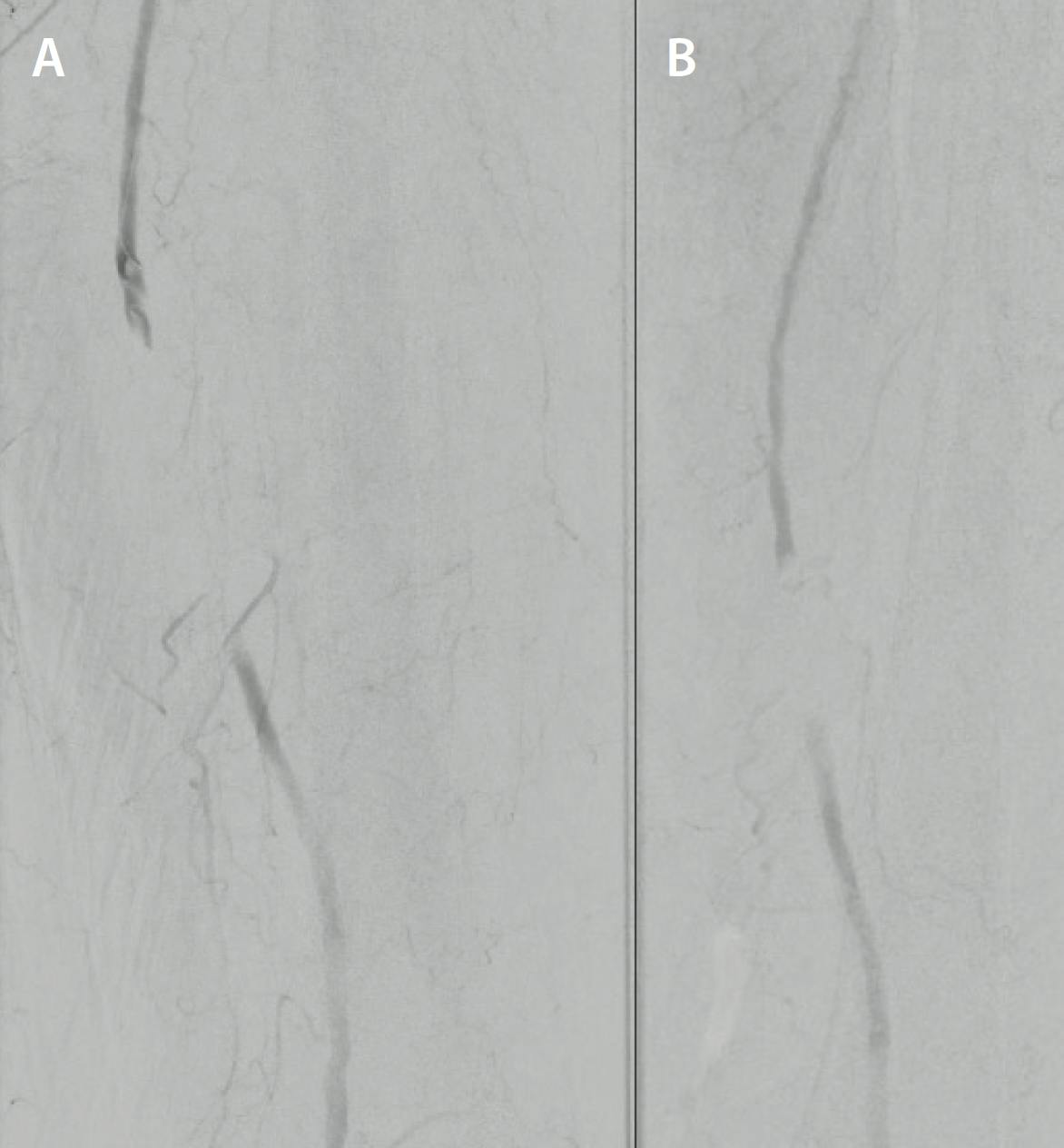
Figure 1. Calcified stenosis with thrombotic occlusion in the left mid-SFA artery before (A) and after (B) two passes with the Pounce™ Thrombectomy System.
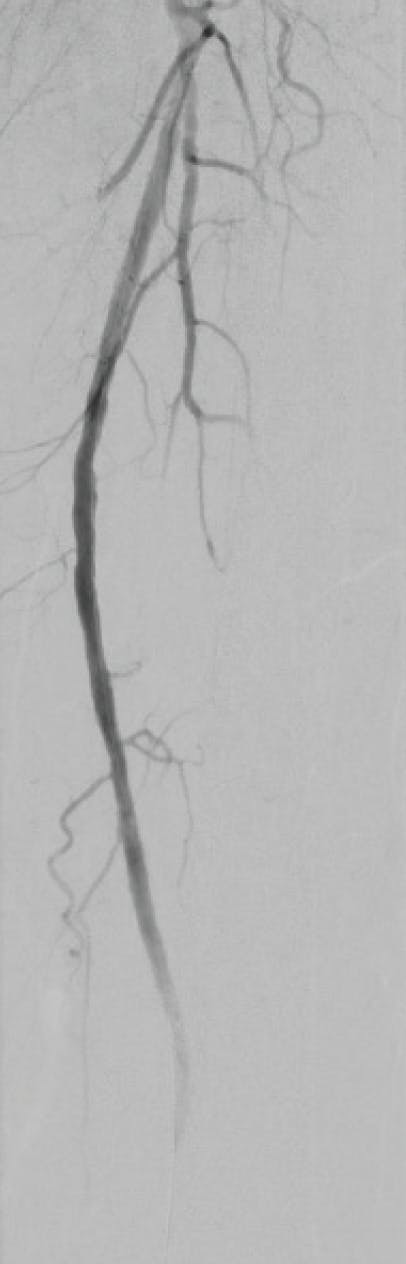
Figure 2. Postprocedure restored flow in the SFA.
Postprocedure Outcome
The patient remained hospitalized for 2 days after the procedure for monitoring and transition to oral anticoagulation. The Pounce™ Thrombectomy System allowed for rapid removal of the thrombotic portion of a calcified stenosis in a patient contraindicated for thrombolysis.
Caution: Federal (US) law restricts the Pounce™ Thrombectomy System to sale by or on the order of a physician. Please refer to the product’s Instructions for Use for indications, contraindications, warnings, and precautions. SURMODICS, POUNCE, and SURMODICS and POUNCE logos are trademarks of Surmodics, Inc. and/or its affiliates. Third-party trademarks are the property of their respective owners.

Advertisement
Advertisement