Advertisement
Advertisement
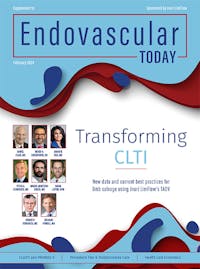
February 2024 Supplement
Sponsored by Inari LimFlow
Q&A: PROMISE II Experience and Data Overview
Coprincipal Investigators from PROMISE II discuss the uniqueness of the recently published study, patient population characteristics, key highlights from the data, and more.
With Daniel Clair, MD, and Mehdi H. Shishehbor, DO, MPH, PhD

How did you get involved in the PROMISE II trial, and what were some of the unique aspects of PROMISE II compared to other lower extremity studies you have participated in?
Dr. Clair: I was involved in the PROMISE I trial and was impressed with the success in limb preservation with Inari LimFlow that I saw in the patients I enrolled. For these patients, amputation would have been the only option. They all had wounds and previous revascularization attempts into “dead-end” vessels that did not perfuse the foot directly. Wound care alone had been unsuccessful, and the size and depth of their wounds were increasing. I believe they all would have come to amputation within 4 to 6 weeks of the time of enrollment, and our limb salvage mirrored that of the entire trial. I was looking forward to participating in the next phase of this trial and am very thankful to have been chosen to lead the trial along with Dr. Shishehbor.
Dr. Shishehbor: It’s been emotionally difficult to tell our patients that there are no options and they need an amputation. For years, I have been seeking alternative therapies that we could offer our no-option patients, and I was honored to be chosen to be part of the PROMISE I trial. Given our success in that trial, it was very exciting for me and my organization—but more importantly, for patients in Northeast Ohio—to continue with PROMISE II.
How would you describe the patient population included in the PROMISE II trial?
Dr. Clair: The PROMISE II patient population was an adjudicated group of no-option chronic limb-threatening ischemia (CLTI) patients. They were, in my view, one of the sickest patient groups ever enrolled in a trial. Having spoken with most of the investigators, the consensus was that the only other option available to these patients was a major amputation. They are likely some of the sickest patients we see in our practices.
Dr. Shishehbor: As a limb salvage operator, I am used to seeing a lot of sick patients with a number of comorbidities, but in my 20 years of experience in clinical trials, patients in this clinical trial were some of the sickest of the sick. Most trials exclude these patients, particularly the Rutherford class 5 and 6 CLTI patients with gangrene. Three-quarters of the patients had diabetes, a significant portion had some degree of chronic kidney disease, and we included patients with end-stage renal disease. It was rewarding to work with these chronically underserved patients.
How do you define procedural and longer-term success for these patients?
Dr. Clair: The definitions within the trial are noted in the paper1; however, for my practice and for practical purposes, I defined success during the procedure as the ability to establish a communication from the arterial system in the leg to the veins of the foot, with a well-perfused venous segment in the distal portion of the foot. In my opinion, seeing this in conjunction with maintenance of antegrade arterial flow similar to what existed preprocedure assured we had achieved procedural success. Longer-term success was defined by limb salvage, wound healing, and pain resolution, and we were able to achieve this in a significant majority of these patients.
Dr. Shishehbor: We know that CLTI has a poor prognosis, meaning that once patients have this condition, they don’t live for many years unless we aggressively treat the risk factors, get them to be mobile, and treat their comorbidities. We also know that when it comes to CLTI, healing the wound is paramount, and many of my patients have had their ischemic ulcers for months or even years. Healing wounds after transcatheter arterialization of deep veins (TADV) does require patience, as it takes time to mature the newly established circuit to allow for nutrient delivery to get us to a point of a healed wound. For that reason, my expectation for the therapy was that we would get enough benefit to heal the wounds. The trial obviously showed that TADV is a viable option for healing these nonhealing ulcers. I am particularly interested in the network of digital collaterals and small arteries we visualize in the foot as the arterialization matures.
What are the key highlights from the latest data from PROMISE II?
Dr. Clair: Some critical findings from this study include the ability to save limbs in patients who truly had no other method to preserve a limb that was threatened. Additionally, a “threatened limb without option” for me now means uncontrolled infection, not absence of a means of revascularization. It is also important to note the minimal learning curve since for most investigators, this was their initial experience with this procedure and the devices and techniques involved. There were no “roll-in” patients for any site, and despite this, outcomes were very favorable. This initial experience likely means we will continue to see improved outcomes for this group of patients with this technique over time. Publication of this study in The New England Journal of Medicine (NEJM) highlights the innovative nature of this technique and the value it provides for patients who previously were destined for amputation.1
Dr. Shishehbor: PROMISE II was groundbreaking research with a paradigm shift in therapy for patients who had no option. It’s a big deal to show an alternative therapy that has a 69% limb salvage rate at 12 months and a 99% technical success rate. I am particularly proud that we have refined a procedure that is so reproducible—we only had one failed procedure out of 105, and that was across operators who were learning this procedure. We also observed impressive pain resolution, with an average pain score at 1 year of 1.4 out of 10, and wound healing, with an average wound size at 1 year of 0.2 cm2.
It gives me satisfaction that NEJM recognized that this was groundbreaking. I’m glad it was published in NEJM to give this technology the attention it needed because I believe strongly that the technology will address disparities in the CLTI population. I believe one of the reasons we see higher rates of amputations in African American or Hispanic patients is because they often present later in the stage of disease than White patients. By having tools like this, a benefit may be that we can save some of those patients who present in later stages of disease where there are no targets for traditional revascularization.
What impact does this therapy have on patients facing amputation?
Dr. Clair: This therapy will provide an option for an entire group of patients who previously had no therapeutic method to provide limb salvage. These are often patients who had been living independently and would lose this ability with major amputation. For many patients, it is a light in the darkness and hope for an independent and ambulatory future.
One of the patients initially enrolled in the trial was a patient I had cared for some time ago, who had undergone a digital amputation. At the time of his initial problems (6 years earlier), I informed him that there was no further revascularization option for the foot. I felt we were fortunate to heal his foot at that time. He presented with a severely ischemic foot and no option for any standard procedure. He was enrolled in the trial, and while his progression to healing took time, we were able to heal his wounds and maintain his foot. He is now > 1 year out and walking better than he had been for several years before this event. This was a very gratifying result for this patient who traveled quite a distance to receive the procedure.
Dr. Shishehbor: Although we had great successes in the PROMISE II trial, the person I think about most often is a patient of mine from the PROMISE I study; she is now 5 years out from her index procedure and doing so well, showing the durability of outcomes from TADV. She came to me having already had a major amputation on her left leg because she had no options for revascularization. She had developed an ulcer on her right leg and had two unsuccessful revascularization attempts, leaving her in the same situation and facing amputation of her only remaining leg. She responded beautifully to TADV and is doing fantastic, walking and living independently. It’s difficult to not have tears in your eyes when she tells you her story.
How is PROMISE III progressing?
Dr. Clair: We are actively enrolling in PROMISE III, initiating sites and evaluating patients. With the results we have seen from PROMISE II, I am sure we will continue to see increased experience and improved outcomes for patients moving forward.
Dr. Shishehbor: The site principal investigators across the country are all very excited to be able to continue offering TADV with the LimFlow System (Inari Medical, Irvine, CA) to their patients, and we look forward to continuing to learn from one another and help patients!
1. Shishehbor MH, Powell RJ, Montero-Baker MF, et al; PROMISE II Investigators. Transcatheter arterialization of deep veins in chronic limb-threatening ischemia. N Engl J Med. 2023;388:1171-1180. doi: 10.1056/NEJMoa2212754
Advertisement
Advertisement