Advertisement
Advertisement
February 2024 Supplement
Sponsored by Inari LimFlow
TADV Treatment Effect
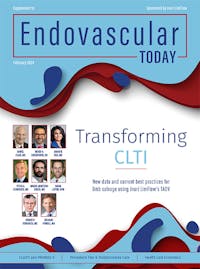
Results of a propensity stratification against the CLariTI study, a prospective cohort study of the natural history of patients with no-option CLTI.
By Anahita Dua, MD, and Richard Powell, MD


By 2045, every single country in the world will have a > 15% increase in diabetes.1 People with diabetes are living longer and hence have complications that we as a medical community have yet to overcome. Specifically, for those of us who care for patients with chronic limb-threatening ischemia (CLTI), the difficulty of managing a patient with no named vasculature of the foot due to microvascular dissemination is daunting. The typical armamentarium of open bypass, advanced endovascular revascularization, and hybrid techniques are not useful when facing a patient with severe calcification of the foot arterioles coupled with loss of all capillaries to the distal foot. These patients, who often also have severe atherosclerotic tibial disease, are relegated to the “no-option” category and almost always end up with a major amputation below or above the knee. Up to 50% of this patient population will die within 1 year of their major amputation2; therefore, quickly identifying a solution for limb salvage in this cohort is key. But before we can begin the process of “making things better,” it is imperative to define the current state of affairs in the United States.
It is surprising that with all the data we have about the incidence of peripheral artery disease and its impact on our society, we have yet to define (1) the natural history of CLTI and (2) the classical practice patterns of interventionalists treating this disease in our country. Because the approach to CLTI has never been standardized and is heavily dependent on provider skill, patient compliance, and logistical support, it has been long known that which part of the country a patient resides in has a direct impact on their likelihood of amputation. However, the objective evaluation and quantification of this phenomenon has not been previously described.
This makes it difficult for us as physicians to get an idea of what is happening to this population in terms of outcomes, particularly in disparate regions of the country. We often resort to generalizing based on our own experiences and fail to see the bigger picture. For example, up to 50% of patients who undergo amputation have never had an angiogram, and while there are indeed patients who have septic presentations that require an immediate source control procedure, there are undoubtedly patients in that statistic who may have had their limb salvaged if seen by a different provider in a different part of the country. It is important to quantify what the actual amputation rate is in the United States, who is undergoing those amputations, and what the true root cause of amputation is in real-world patients to be able to look at a potential solution like transcatheter arterialization of deep veins (TADV) and see a real benefit. This lack of natural history context can make interpreting the impact of TADV using Inari LimFlow in the PROMISE II single-arm study less intuitive because if we say that TADV can save X% of patients facing amputation, we must show that a similar patient cohort would have gone on to amputation if they did not have TADV as an option.
Given the practical and ethical unfeasibility of randomly assigning patients destined for major amputation, we undertook an alternative approach to providing the important information that a control arm can offer and simultaneously enrolled the largest study of the natural history of no-option CLTI patients to date.
The CLariTI registry was designed to capture the standard of care across the country for this patient population. The registry tracked the natural progression of this patient population across both sites in the PROMISE II study and those not participating in PROMISE II.
At the 1-year time point, the outcomes of CLariTI demonstrated a low limb salvage rate of 48.4% with the current standard of care. Additionally, the survival rate at the end of the first year stands at 66.6%, and the amputation-free survival rate is only 32.6%.
Within the CLariTI registry, we were able to illuminate the real-world outcomes faced by CLTI patients who are deemed “no-option” or have experienced multiple failed revascularizations. This benchmarking allows us to contextualize the results of the PROMISE family of trials within a comprehensive and granular study of the natural history of the disease state and current standard-of-care practice for no-option CLTI patients.
Given the parallel nature, both temporally and in population, of the PROMISE II and CLariTI studies, we were able to evaluate the treatment effect of TADV with Inari LimFlow by utilizing patient-level data from each.3 This propensity stratification allowed us to address the limitation of the single-arm nature of PROMISE II. We adjusted for potential differences in significant comorbidities, such as gender, age, race, and diabetes status. The propensity stratification demonstrated a significant improvement for those patients who underwent TADV as part of the PROMISE II study. These “treatment arm” patients had a 29% improved (P < .0001) propensity-adjusted risk difference in amputation-free survival, and a relative event rate reduction of 45% compared to the CLariTI no-option “control arm” patients. The treated patients also had a 29% improved (P = .0003) propensity-adjusted risk difference for major amputation.
The real-world patient-level data in the same patient population afforded by the CLariTI study allowed us to utilize it as an external control group to further prove TADV as an appropriate therapy in patients with CLTI.
1. Saeedi P, Petersohn I, Salpea P, et al; IDF Diabetes Atlas Committee. Global and regional diabetes prevalence estimates for 2019 and projections for 2030 and 2045: results from the International Diabetes Federation Diabetes Atlas, 9th edition. Diabetes Res Clin Pract. 2019;157:107843. doi: 10.1016/j.diabres.2019.107843
2. Kristensen MT, Holm G, Kirketerp-Møller K, et al. Very low survival rates after non-traumatic lower limb amputation in a consecutive series: what to do? Interact Cardiovasc Thorac Surg. 2012;14:543-547. doi: 10.1093/icvts/ivr075
3. Powell RJ, Mullin CM, Clair DG, et al. Comparison of transcatheter arterialization of deep veins to standard of care in patients with no-option chronic limb threatening ischemia. Ann Vasc Surg. 2024;99:50-57. doi: 10.1016/j.avsg.2023.08.010
Advertisement
Advertisement