Advertisement
Advertisement
February 2024 Supplement
Sponsored by Inari LimFlow
Health Economics: Inari LimFlow Procedure
Highlights from a recent study demonstrating the cost-effectiveness of TADV for no-option CLTI patients.

Major shifts in treatment algorithms such as the introduction of transcatheter arterialization of deep veins (TADV), while clearly dependent upon the clinical results, must realistically provide health economic value to be viable. The efficacy of the TADV procedure with Inari LimFlow in chronic limb-threatening ischemia patients with “desert foot” occlusive anatomy was proven in the PROMISE family of trials. My colleagues and I undertook a study to explore the potential cost-effectiveness of TADV in the United States health care system to complete the picture of the value of this paradigm shift. That study was published in Journal of Critical Limb Ischemia, and the highlights are summarized herein.1
COST-EFFECTIVENESS ANALYSIS
A model was developed to project costs and outcomes over patients’ lifetimes and calculate the incremental cost-effectiveness ratio (ICER) in dollars per quality-adjusted life-year (QALY) gained. We used 1-year data from the PROMISE I early feasibility study and will soon publish an updated model using results from the PROMISE II pivotal trial.2 Within this model, amputation-free survival, reintervention, and wound healing data for both TADV and status quo historical control for treatment of no-option patients were utilized, and associated costs were obtained from Medicare and published rates. We conducted extensive sensitivity and scenario analyses, including various worst-case scenarios where survival benefit beyond 1 year was not assumed.
The decision-analytic model demonstrated that in comparison to status quo, which involved major amputation events per historical control data, TADV added 1.45 QALYs and incurred $23,903 in additional costs in the base case analysis, resulting in an ICER of $16,522 per QALY gained. The model also projects an approximate lifetime survival gain of 3 years for TADV patients over the status quo.
Willingness-to-pay thresholds are the standard parameters by which the cost-effectiveness of a given procedure is judged. American College of Cardiology/American Heart Association has defined an intervention costing $50,000 per QALY as “high value” and an intervention costing $150,000 per QALY gained as “intermediate value.”3 The observed $16,522 per QALY for TADV in the base case scenario places it well within the high-value range, indicating that TADV with the Inari LimFlow System (Inari Medical, Irvine, CA) is highly cost-effective. Even after assuming the addition of an add-on payment for the TADV procedure, TADV remained highly cost-effective in the medical care of these highly vulnerable patients.
As a comparison, the life-year gains, QALY gains, and ICERs projected for TADV are more favorable than what has been projected for transcatheter aortic valve replacement versus surgical aortic valve replacement for high-risk and inoperable patients and for transcatheter mitral valve repair (now also referred to as transcatheter edge-to-edge repair) versus medical therapy (Figure 1).
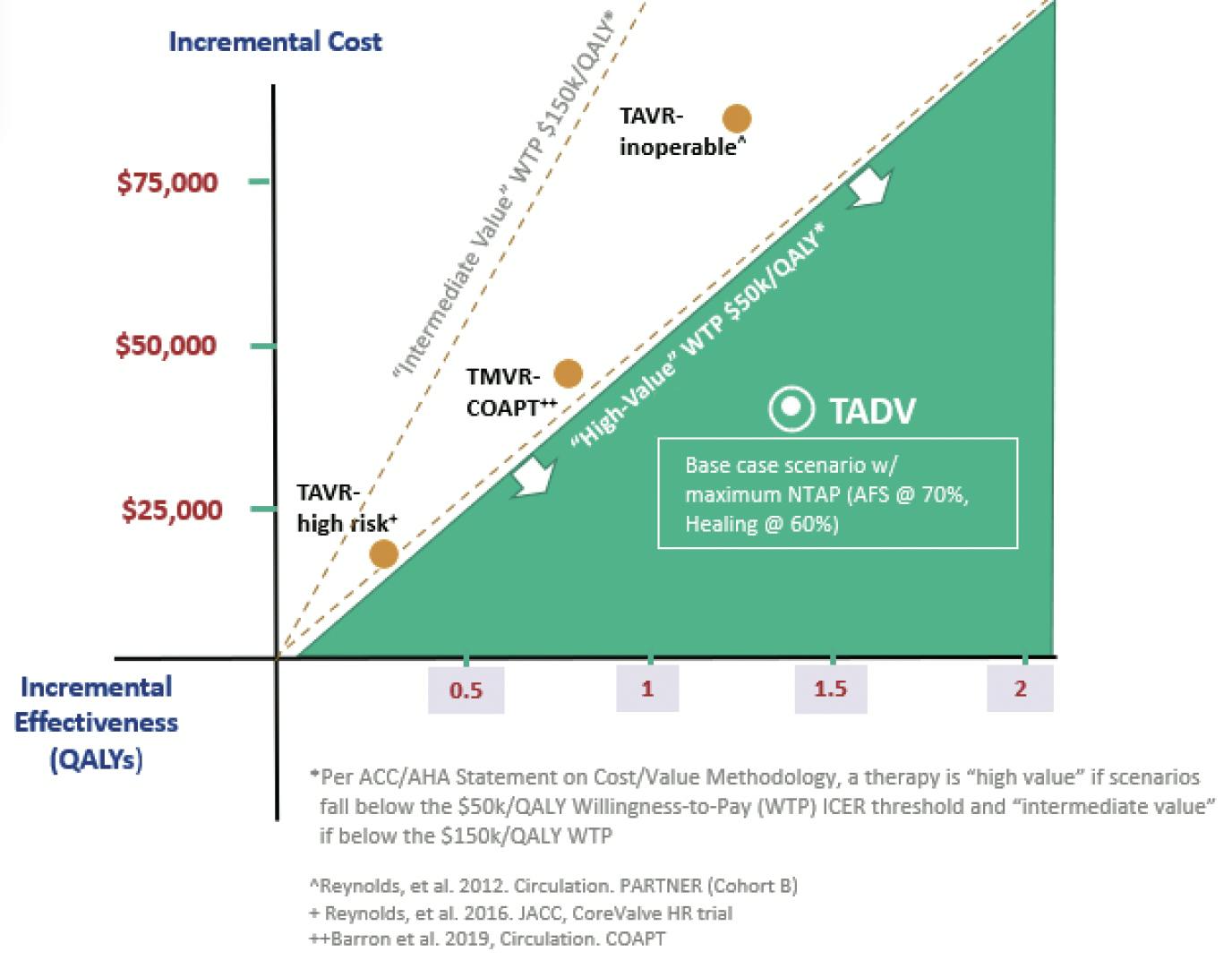
Figure 1. TADV’S cost-effectiveness profile relative to well-established therapies. NTAP, New Technology Add-On Payment; TAVR, transcatheter aortic valve replacement; TMVR, transcatheter mitral valve repair.
CONCLUSION
We anticipate an update of this cost-effectiveness evaluation with the inclusion of the 12-month data from PROMISE II. The updated analysis plan includes site-of-service considerations and a variety of alternative assumptions about long-term amputation event incidence. It will provide additional data to further assess and corroborate the health economic value proposition of TADV for no-option patients.
1. Pietszch JB, Ederhof M, Geisler BP, Schneider PA. Cost-effectiveness of percutaneous deep vein arterialization for patients with no-option chronic limb-threatening ischemia: an exploratory analysis based on the PROMISE I study. J Crit Limb Ischem. 2021;1:E148-E157.
2. Clair DG, Mustapha JA, Shishehbor MH, Schneider PA, et al. PROMISE I: early feasibility study of the LimFlow system for percutaneous deep vein arterialization in no-option chronic limb-threatening ischemia: 12-month results. J Vasc Surg. 2021;74:1626-1635. doi: 10.1016/j.jvs.2021.04.057
3. Anderson JL, Heidenreich PA, Barnett PG, et al; ACC/AHA Task Force on Performance Measures; ACC/AHA Task Force on Practice Guidelines. ACC/AHA statement on cost/value methodology in clinical practice guidelines and performance measures: a report of the American College of Cardiology/American Heart Association Task Force on Performance Measures and Task Force on Practice Guidelines. Circulation. 2014;129:2329-2345. doi: 10.1161/CIR.0000000000000042
Advertisement
Advertisement