Advertisement
Advertisement
February 2024 Supplement
Sponsored by Inari LimFlow
TADV Circuit Maturation and Pressure Wire Experience
How pressure gradient measurements can monitor remodeling during TADV.

Transcatheter arterialization of deep veins (TADV) with Inari LimFlow is a promising new technique for saving limbs of patients with no-option chronic limb-threatening ischemia (CLTI).1,2 The traditional method of diverting blood flow from the diseased arterial system to the healthy vein system is now presented in a new totally percutaneous scenario, without surgical wounds and in a standardized and reproducible procedure across centers and countries.
There is a fundamental difference between traditional revascularization procedures and TADV. After a successful bypass or angioplasty, the functional result of the procedure is immediately visible angiographically and clinically: The reestablishment of distal blood flow achieves sudden relief of ischemia. That is not the case with TADV. At the end of a TADV procedure, we generally observe a roundabout of blood in the foot without any blood flow reaching the tissues. The so-called vein “fortress” is locked by a multitude of small vein valves. In some cases, patient symptoms can worsen in the short term, and pain control is a fundamental part of the postprocedural care.
In their first-in-human study, Kum et al observed the rise of transcutaneous oxygen tension (TcPO2) levels starting 2 to 4 weeks after treatment and reaching > 40 mm Hg only 6 to 8 weeks later,3 demonstrating a time-lapse between the acute TADV procedure and the physiological effect. Clair et al affirmed that management of the maturation process to achieve maximum effectiveness and minimal ischemic complications will be more frequent in TADV than in conventional open and endovascular arterial reconstruction.1
All authors agree that TADV needs time for perfusing the deep tissue—waiting for a remodeling process that relies on the residual biological adaptation capacity of the patient’s vascular system, which we should be able to monitor, guide, and promote. In addition to TcPO2, we should have other parameters to detect TADV maturation and guide possible reinterventions.
Looking for this quantitative evaluation of vascular remodeling, we performed intravascular pressure measurements in some TADV patients using a pressure wire (Philips).4 We recorded the pullback of the wire from the venous plantar arch to the proximal superficial femoral artery (pSFA) and compared it with the pressure recorded inside the sheath in the pSFA. We selected and measured the ratio between the mean pressures because these types of measurements can be easily obtained with a simple 4-F catheter, avoiding the cost of the dedicated equipment.
PATIENT HISTORY AND TADV PROCEDURE
A man in his early 60s with type 2 diabetes, high blood pressure, and previous coronary artery bypass graft was admitted to our hospital with gangrene of the second toe and pain at rest. TcPO2 was 7 mm Hg and the baseline angiographic study demonstrated diffused disease of the foot vessels (Figure 1A), leading to the diagnosis of no-option CLTI.
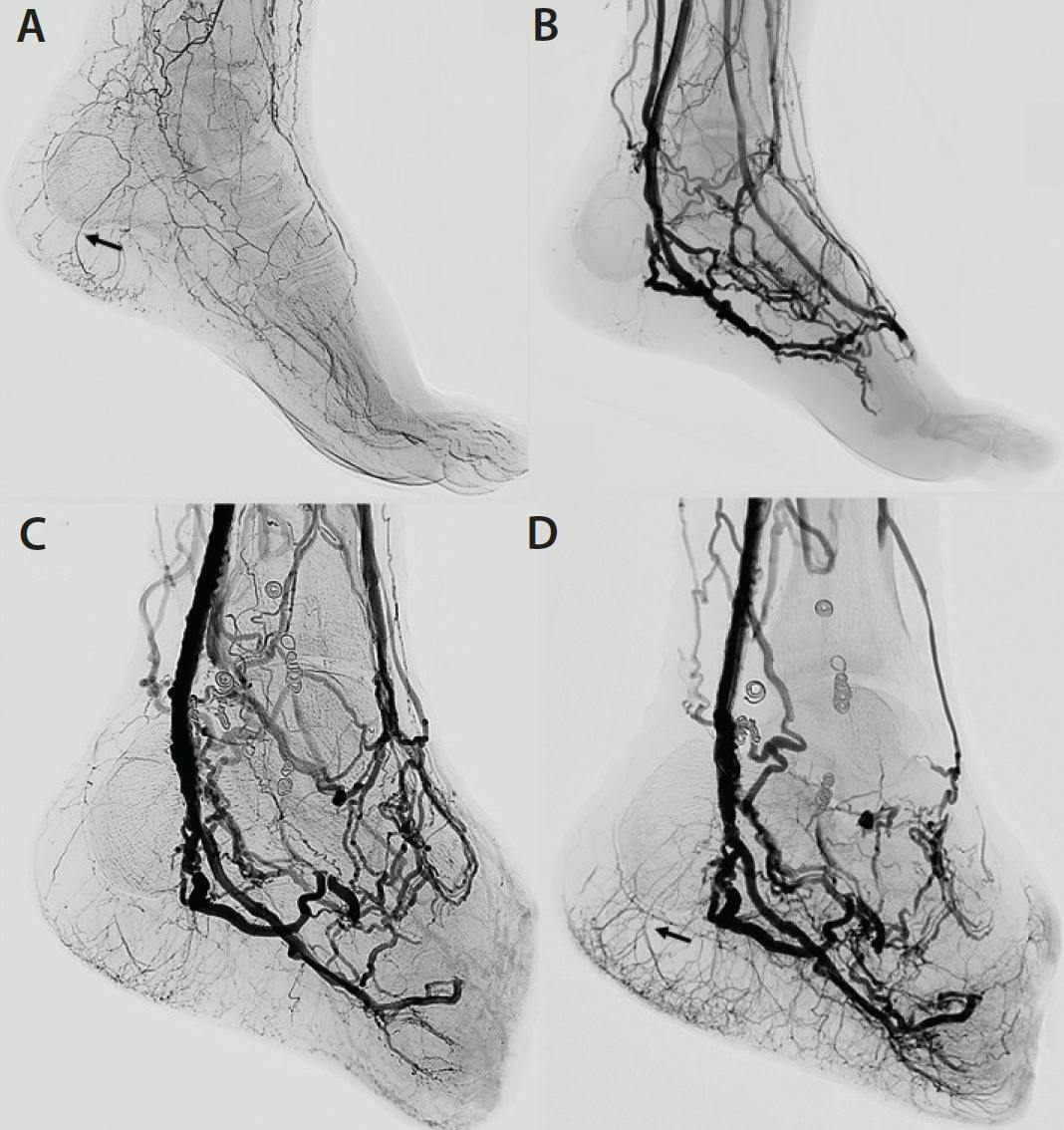
Figure 1. Angiographic images of the foot. Baseline (A); acute TADV result (B); 4 months later, before skin graft (C); 1 year later (D). Black arrows indicate an arterial calcaneal branch.
A TADV procedure was performed, and Figure 1B shows the final result. A good arterialized circuit was achieved with direct blood flow inside the foot vein fortress and outflow in the great saphenous vein (GSV) and deep dorsal vein. The arterialized circuit did not give any blood flow to the tissues. Pressure wire pullback showed a progressive drop of mean value from the pSFA to the plantar arch, with a maximum gradient above the conical stent (Figure 2). The high blood flow due to the low resistance of the fortress vein outflow typically increases the functional effect of mild or moderate inflow stenosis. In the first procedure, we generally stop here because a sudden and extreme increase in foot vein pressure could lead to worsening ischemia, counterbalancing the gradient between the poor arterial inflow (which is still the only tissue flow) and the venous outflow of the capillary system.
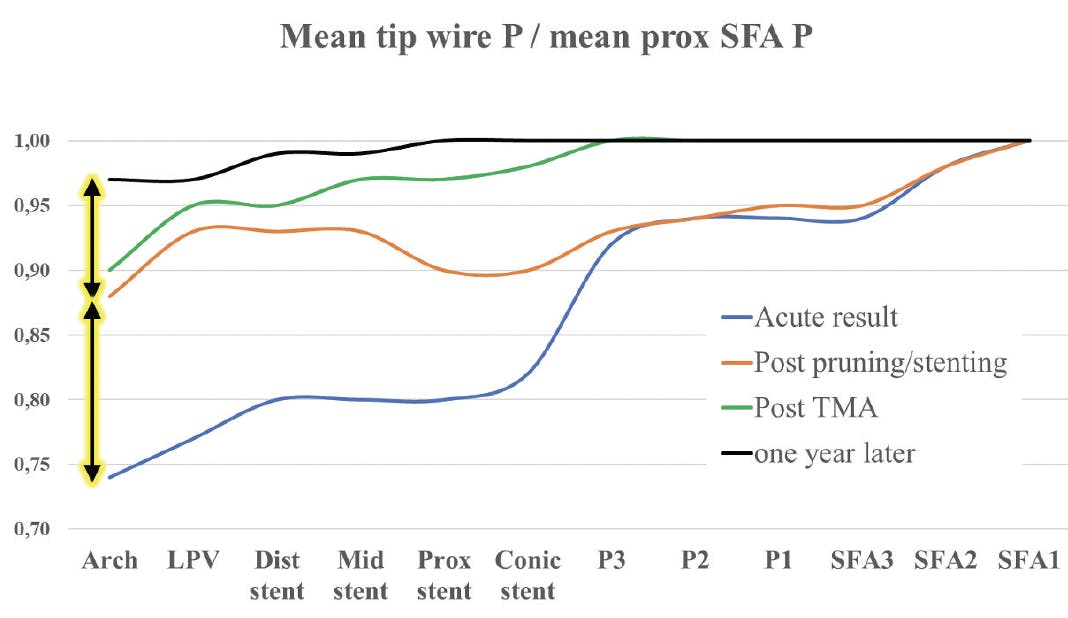
Figure 2. The ratio between mean SFA pressure and tip wire pressure in the arterialized circuit. LPV, lateral plantar vein.
ONE MONTH LATER: BEFORE TRANSMETATARSAL AMPUTATION
Pain and progression of gangrene continued in the next month. A second angiographic study was obtained before performing a transmetatarsal amputation (TMA). Initially, the inflow was treated by stenting the tibioperoneal trunk; however, that did not result in any particular improvement of the pressure gradient. The vein outflow was then reduced by “pruning” with coil embolization of some posterior collaterals and the root of the GSV. This significantly reduced the gradient (Figure 2).
FOUR MONTHS LATER: BEFORE SKIN GRAFT
In subsequent months, the pain slowly disappeared, the wound presented with good granulation tissue, and TcPO2 increased to 56 mm Hg. Four months after the initial intervention for “pruning,” a new angiographic study showed a patent arterialization circuit with recruitment of small distribution vessels and initial tissue blush of the wound (Figure 1C). The pressure gradient improved, with no significant gradient above the covered stent and mild residual gradient in the plantar venous arch (Figure 2).
ONE YEAR LATER: MATURE REMODELING OF THE ARTERIALIZED CIRCUIT
One year post–index procedure, the patient had no pain and showed minimal residual wound dehiscence, and transcutaneous oxygen tension had increased to 65 mm Hg. At that point, angiography was performed via injection of contrast dye through a catheter inside the distal covered stent to visualize only the purely arterialized vasculature. The angiogram revealed complete remodeling of the arterialized circuit, with a well-developed arterial distribution system (Figure 1D). Some of these arteries, perfused by connection with the arterialized veins, can be morphologically identified as residual arterial segment and visible and recognizable in the baseline angiographic study (Figure 1, black arrows). Others are impossible to distinguish as preexisting hibernated and recruited arteries or entirely newborn arteries. Remodeling affected not only the arterial circuit but also the venous outflow, as visible in Figure 1B to 1D.
In the acute phase, the vein fortress was filled by the posterior tibial vein and the dorsal systems were a huge outflow. After pruning and TMA, the vein outflow of the circuit was represented by the deep dorsal veins. At 1 year, only a few residual collaterals were stealing blood in some small superficial veins.
Regarding the pressure wire, the last pullback did not show any residual significant gradient (Figure 2).
DISCUSSION
Immediately after the TADV procedure, the arterialized circuit did not have any positive physiological effect; the gradient between the plantar arch and the pSFA was the consequence of the low resistance of vein outflow and consequent high blood flow.
After pruning some of the vein outflow, the blood flow and gradient reduced, as shown in Figure 2, bottom double-tip arrow). Subsequent remodeling was only due to the adaptability of the patient’s vasculature, leading to expansion of the vein-dependent arterial distribution system, further self-pruning of the outflow veins, and progressive normalization of the distal gradient (Figure 2, top double-tip arrow).
In our experience, when an arterialized circuit is completely developed, every gradient disappears, such as in a healthy arterial segment. This clinical case is an example of how pressure gradient measurements could monitor the remodeling process of TADV, giving important clues on the progress of the spontaneous biological remodeling and the need to potentially help this process with targeted interventions.
1. Clair DG, Mustapha JA, Shishehbor MH, et al. PROMISE I: early feasibility study of the LimFlow System for percutaneous deep vein arterialization in no-option chronic limb-threatening ischemia: 12-month results. J Vasc Surg. 2021;74:1626-1635. doi: 10.1016/j.jvs.2021.04.057
2. Shishehbor MH, Powell RJ, Montero-Baker MF, et al. Transcatheter arterialization of deep veins in chronic limb-threatening ischemia. N Engl J Med. 2023;388:1171-1180. doi: 10.1056/NEJMoa2212754
3. Kum S, Tan YK, Schreve MA, et al. Midterm outcomes from a pilot study of percutaneous deep vein arterialization for the treatment of no-option critical limb ischemia. J Endovasc Ther. 2017;24:619-626. doi: 10.1177/1526602817719283
4. Garcia LA, Carrozza JP Jr. Physiologic evaluation of translesion pressure gradients in peripheral arteries: comparison of pressure wire and catheter-derived measurements. J Interv Cardiol. 2007;20:63-65. doi: 10.1111/j.1540-8183.2007.00213.x
Advertisement
Advertisement