Advertisement
Advertisement
February 2024 Supplement
Sponsored by Inari LimFlow
Latest Postprocedure Wound Care: Best Practices
The first 2 months after TADV are a critical time for monitoring wound progression and infection control.

While all the transcatheter arterialization of deep veins (TADV) patients at our institution are cared for by our comprehensive limb salvage team throughout their course, the first 2 months after the TADV procedure with Inari LimFlow are the most critical time for our multidisciplinary team to work together. The arterialized circuit matures over approximately 4 to 6 weeks, and it is critical that we keep a close eye on the wound during that time frame, with particular focus paid to infection control.
Wound management in the revascularized patient can either help or hinder the overall healing process. Proper wound care techniques are a necessary entity when dealing with this high-risk patient population where functional and expedited limb preservation is needed. For some, adequate product selection for best wound management can prove to be a challenging task. It is not a matter of what you are putting on the wound that will assist with patient care; it’s more about what’s being taken off the wound that will ultimately promote healing, mitigate infection, and lead to a positive outcome. It can be a daunting task given the expansive options for wound care products. The ultimate end goal is to select the appropriate product that will assist with healing and lead to a functional outcome for the patient.
GUILLOTINE TRANSMETATARSAL AMPUTATION
Given the severity of the wound present in many TADV patients, there will be cases in which foot-sparing minor amputations must be performed to remove nonviable tissue. Formalization of any foot surgeries should be delayed until that 4- to 6-week circuit maturation time point, if possible. For patients who require a transmetatarsal amputation (TMA), the traditional option of primary closure is not an appropriate technique for patients with a TADV circuit, as the tension hinders microvascular perfusion, leading to flap necrosis. For TADV patients requiring a TMA, I have instituted the practice of performing guillotine TMA (gTMA), followed by definitive soft tissue coverage within my own practice (Figure 1), as well as in recently published long-term outcomes.1 We have found great success with gTMA, followed by the application of a dermal substitute and low-pressure negative pressure wound therapy and, after full granulation, application of split-thickness skin graft. Utilizing this approach, we are also able to get our patients ambulating quite quickly, with a median of 2 days to ambulate.
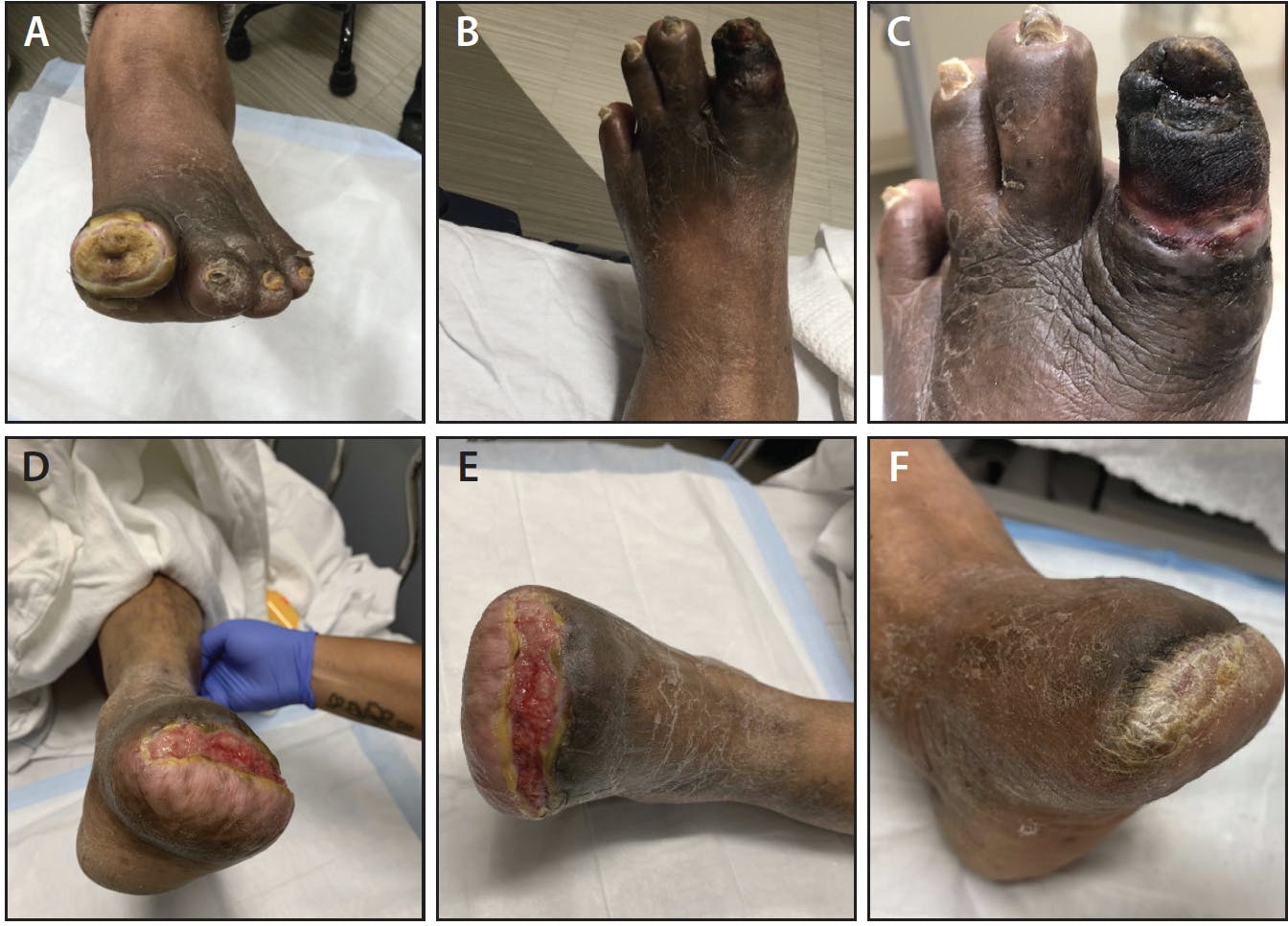
Figure 1. Images of wound progression after gTMA: baseline (A), 2 weeks (B), 1 month (C), 2 months (D), 3 months (E), and 6 months (F).
1. Lepow BD, Zulbaran-Rojas A, Park C, et al. Guillotine transmetatarsal amputations with staged closure promote early ambulation and limb salvage in patients with advanced chronic limb-threatening ischemia. J Endovasc Ther. Published online December 24, 2022. doi: 10.1177/15266028221144587
Advertisement
Advertisement