Advertisement
Advertisement
February 2024
An Interview With Franziska Dorn, MD
Prof. Dorn discusses findings and potential future impacts of the TENSION trial and German Stroke Registry, thoughts on female representation and prioritizing families in the interventional neuroradiology profession, improvements needed in stroke protocol in Germany, and more.

To start off, tell us about your journey to neurointervention. What drew you to the specialty, and how have your research interests and projects evolved over the years?
I initially wanted to become a neurologist and spent the first 3 years of my residency in neurology. From the start, I was fascinated by the subject of stroke, but I quickly realized that the therapeutic options were rather limited. Switching to neuroradiology was the best step! I was lucky that I was able to do angiographies from my first day in neuroradiology and was also soon allowed to do interventions on my own.
What is your favorite aspect of your professional life at the moment?
I love that every day is different and brings new challenges. I very much enjoy the contact with patients, some of whom I have known for years now. I cannot think of any other specialty in which so much has happened in recent years, and so many innovations have found their way into everyday clinical practice! In addition to the incredible development in the field of stroke treatment, the possibilities for treating aneurysms and complex malformations have improved so much. Thanks to new technologies and devices, the treatment is much safer and more efficient than it was some years ago (eg, for complex aneurysms). I think the mixture of seeing patients, technical challenges, scientific engagement with open and relevant questions, and, last but not least, being part of a super inspiring community with many great personalities is why I love interventional neuroradiology (INR) so much.
You’ve been involved in the recently published TENSION trial, which found improved functional outcomes and lower mortality in acute ischemic stroke (AIS) patients with extended lesion and extended time window treated with endovascular thrombectomy.1 How has your experience with this trial informed your treatment algorithm for patients with large core AIS? What impact do you hope to see from TENSION on guidelines and overall approaches to treatment?
Our stroke team is happy and honored that we were one of 40 centers to contribute to this highly relevant study. Together with the other randomized studies on mechanical thrombectomy in patients with large vessel occlusion (LVO) and established infarction, the TENSION study confirms what probably all of us have long suspected: Endovascular treatment is actually beneficial for this group of patients, with an 18% increase in patients who can walk unaided and a reduction in mortality of 11% after 90 days.1 One thing that is special about the TENSION study is that the enrollment was based on visual assessment of the Alberta Stroke Program Early CT Score (ASPECTS) using noncontrast CT in the majority of participating centers. Therefore, it reflects clinical practice worldwide. Unlike in previous studies, perfusion imaging or postprocessing using commercial software was not required, and the results were still very similar. Thus, we obviously do not need advanced and often time-consuming imaging techniques to make our decisions about thrombectomy. By keeping the processes simple, we can likely help more patients to a good clinical outcome.
In my center, we changed our regimen after the completion of TENSION and now treat all LVO patients with ASPECTS ≥ 3. Because we now have consistent results of six randomized trials for patients with LVOs and already established infarct, I am sure that we will find this recommendation in our guidelines very soon.
Recent years have also seen several papers from the German Stroke Registry (GSR) Endovascular Treatment study, which you are a part of. Can you tell us a bit about the purpose of this registry and some of its impactful research outputs? What are you currently working on within the registry?
The GSR was founded in 2015 with the idea of creating a prospective multicenter registry on endovascular stroke therapy in Germany. Our primary goal was to assess practices and safety of endovascular treatment in routine care. From the start, it was important to us to operate without any funding and thus be fully independent from third parties. As of today, > 10,000 patients from 15 centers have been enrolled, and various papers have been published from the data.
I believe that real-world data are still necessary to learn about stroke care and evaluate if the good results from clinical trials can be translated into our everyday practice. For example, we were able to show that the clinical outcomes in patients undergoing thrombectomy in an unknown or late time window are not as good in the real world as in certain randomized trials (DAWN and DEFUSE 3). In addition, patients from the GSR who were selected for endovascular treatment based on unenhanced CT without any perfusion imaging tended to show better outcomes and have a shorter time between arrival and reperfusion.2 Thus, again, “keep it simple” was beneficial for the patients. It will certainly be exciting to analyze the current results of the studies on thrombectomy in low ASPECTS patients in the real-world GSR collective.
You and colleagues recently published a paper in Journal of NeuroInterventional Surgery on post–mechanical thrombectomy subarachnoid hyperdensities, noting that these are a common finding on flat-detector CTs and are associated with neurologic decline and worse functional outcome. How would you advise physicians proceed with mechanical thrombectomy and next steps postintervention with these findings in mind?
Subarachnoid hyperdensities are a frequent finding when performing flat-panel CTs directly after mechanical thrombectomy. Until recently, we assumed that these hyperdensities were not significant for clinical outcome and did not give them any specific consideration. However, in our paper, we saw that patients actually had a worse outcome when they had this finding immediately after thrombectomy.3 It is not clear yet how we can help these patients to a better outcome, but one idea is consistent monitoring and strict blood pressure management. One point that was also interesting is that these hyperdensities were more frequent after thrombectomy of distal occlusions; with the increasing number of distal thrombectomies, this will definitely play a more important role.
With the German Society for Neuroradiology, you’ve been involved in the Chancengleichheit Equal Opportunities committee. What are the fundamental objectives behind this group, and what are the issues within the neuroradiology community that it hopes to solve?
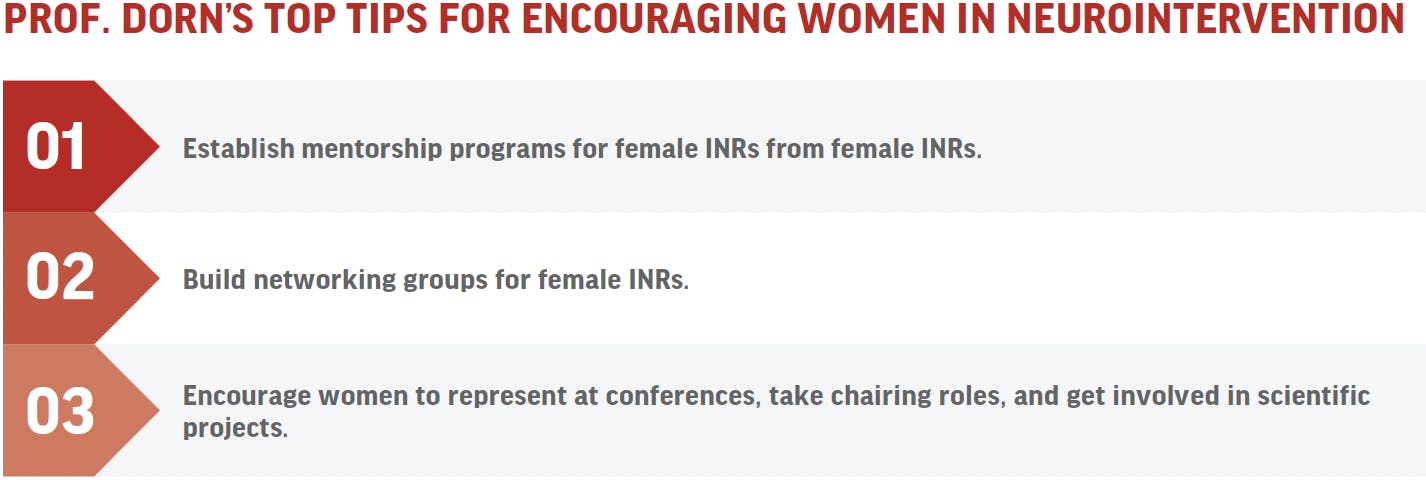
The idea is that we all benefit from a diverse society. We can achieve more when we work together and each contribute our skills. There are great female neurointerventionalists, but it is sometimes difficult to gain visibility in a strongly male-dominated specialty like INR. On the other hand, it is especially important for young female INRs to have a role model. The idea of this initiative, which was founded by Dr. Uta Hanning, Prof. Carolin Brockmann, and myself, is to strengthen the representation of women in our field.
As another societal role, you Chair the European Society of Minimally Invasive Neurological Therapy Women in Intervention (WIN@ESMINT) group. What are some of the group’s goals for the year ahead?
The focus of this group of fantastic women is to connect with each other, share our experiences, and improve the development of women in the field of INR. All INRs are confronted with difficult decisions every day in the angio suite, but women also encounter very specific challenges on their career path that are different from our male colleagues. Women can learn a lot from other women, so we are planning, for example, an e-fellowship hosted by female INRs for female fellows. We also had a very fruitful evening at last year’s ESMINT Congress in Marseille, France, so there is definitely a plan to repeat this at the next ESMINT Congress in September. I hope that with small steps, we can increase the number of female INRs and enrich our society!
How do these two society positions translate to how you approach training and leadership at your institution?
A very important issue for me is the compatibility of family and career—not only for mothers but also fathers. We strive to create an environment in which it is possible for everyone to have both an exciting job and a family, for example, by allowing working hours to be relatively flexibly adapted. Neurointervention is a very demanding specialty, with sometimes unpredictable working hours and many nights and weekends on call. However, my own experience shows that it is possible to combine INR and being a parent to young children. I try to show that it is possible if you want it and aim to help young mothers in particular continue on their clinical and scientific career path.
Regional context is an important aspect of the discussion surrounding stroke protocol. How would you describe the average stroke presentation and care pathway in Bonn, Germany? Where are improvements most needed?
Approximately one-third of the patients who are treated in our center are transferred from other hospitals. The biggest problem here is the time lost for transportation, which, in the end, affects patients' clinical outcome. However, I don’t think it is efficient to equip more hospitals with thrombectomy units. Rather, we should put energy and money into improving the transport to high-volume centers. In Germany, a number of regional stroke networks have been set up to improve logistic processes and save time. In Bonn, this concept has almost doubled the number of thrombectomies in the last 3 years. Currently, we are planning to expand our service so that the interventionalist drives to the patient in peripheral hospitals and not vice versa in order to save more time.
What should be the top priority for the neurointervention field in the next 5 years? What innovations do you think we have to look forward to?
We will see further increases in thrombectomy numbers and will be able to help more people with AIS. Who would have thought 10 years ago that low ASPECTS patients with peripheral occlusions or in the late time window could have such a benefit from our treatment? We will certainly have sufficient evidence soon regarding the superiority of mechanical thrombectomy for extensive infarcts with even ASPECTS < 3, as well as for peripheral occlusions.
In addition, new fields of activity are constantly being added, such as embolization in patients with chronic subdural hematoma, cerebrospinal fluid venous fistulas, and treatment of venous stenoses in patients with intraparenchymal hemorrhage or tinnitus. We will also likely have a more important role in tumor treatment and hopefully have better data on the treatment of arteriovenous malformations.
Where would you most like to travel for a week off the grid?
To northern Scandinavia to see the northern lights!
1. Bendszus M, Fiehler J, Subtil F, et al; TENSION Investigators. Endovascular thrombectomy for acute ischaemic stroke with established large infarct: multicentre, open-label, randomised trial. Lancet. 2023;402:1753-1763. doi: 10.1016/S0140-6736(23)02032-9
2. Herzberg M, Scherling K, Stahl R, et al; GSR investigators. Late thrombectomy in clinical practice: retrospective application of DAWN/DEFUSE3 criteria within the German Stroke Registry. Clin Neuroradiol. 2021;31:799-810. doi: 10.1007/s00062-021-01033-1
3. Zidan M, Ghaei S, Bode FJ, et al. Clinical significance and prevalence of subarachnoid hyperdensities on flat detector CT after mechanical thrombectomy: does it really matter? J Neurointerv Surg. Published online August 30, 2023. doi: 10.1136/jnis-2023-020661
Advertisement
Advertisement
Interested in reading more interviews?
To read more interviews with thought leaders in the vascular field, check out our Profiles & Perspectives hub.
Read More