Advertisement
Advertisement
February 2024
Current Role and Future Needs of PAE in 2024: A Urologist’s Perspective
In light of its inclusion in recent American Urological Association guidelines, a group of urologists share a commentary on prostatic artery embolization and its efficacy, safety, and technical aspects, as well as future perspectives and the role of interdisciplinary collaboration.
By Alessandro Marquis, MD; Thomas R. Williams, MD; Timothy D. McClure, MD; and Ardeshir R. Rastinehad, DO
Lower urinary tract symptoms (LUTS) secondary to benign prostatic hyperplasia (BPH) is the most common urologic disease in men aged > 50 years. Prostatic artery embolization (PAE) is a minimally invasive treatment that has become a promising modality to treat LUTS/BPH.
Historically, PAE was used to control persistent or massive prostatic bleeding not otherwise amenable to surgical or alternative management.1,2 In addition to its early applications for hematuria, associated outcomes showed a significant reduction in prostate size, prostate-specific antigen, and LUTS. Since the 2000s, PAE has gained widespread interest and popularity due to its favorable side effect profile compared to alternative procedures (ie, transurethral or robotic).3 However, PAE has been a controversial topic among the urologic community due to a cited lack of high-level evidence and unfamiliarity with a procedure that is performed mainly by interventional radiologists. Nevertheless, the growing body of compelling evidence with favorable results has led to the inclusion of PAE in urology guidelines, including the United Kingdom in 2018,4 Europe (European Association of Urology) in 2021,5 and, most recently, the American Urological Association (AUA) in September 2023.6 Previously “deficient in a lack of supporting data,” the 2023 AUA update now states that PAE can be offered for treatment of LUTS/BPH.6
This article aims to highlight a urologist’s perspective on the current role of PAE and its future in treating LUTS secondary to BPH.
EFFICACY
Evaluating BPH can be challenging due to the subjective nature and perception of patient symptoms. The same issues also translate to difficulties in measuring procedural success. Objective scores using standardized questionnaires, such as the International Prostate Symptom Score (IPSS) and Sexual Health Index for Men, are routinely used to track outcomes, specifically after an intervention.
Historically, the gold standard for bladder outlet procedures has been transurethral resection of the prostate (TURP). This is true also for PAE, where outcomes have been compared to TURP in five RCTs.7-12 However, one challenge with the current body of literature is the use of TURP as the primary comparator to assess the efficacy of PAE, since this may minimize the true clinical value PAE can provide. PAE can indeed treat a wide range of prostate sizes. In larger prostates (> 80 g), it may be best compared to enucleation (suprapubic prostatectomy or holmium/thulium laser enucleation of the prostate), against which it is a valuable minimally invasive option with a favorable side effect profile. PAE consistently demonstrates similar outcomes to TURP in improving patient perception of symptoms and quality of life (QOL) in the intermediate-term follow-up. Clinical parameters include patient questionnaires, uroflowmetry, postvoid residual, prostate volume, and, when performed, urodynamics. Although several studies showed noninferiority for several parameters, there was a more significant improvement in uroflowmetry and less frequent retreatment rates in the TURP group.7-12 Although these comparative studies are helpful, results are hard to generalize due to clinical heterogeneity and the nature of retrospective matching. Therefore, it is hard to quantify the real impact of these differences from a clinical point of view, especially when both options show significant improvement from baseline.
In a single-blind RCT, 80 patients with severe LUTS (IPSS ≥ 20 and QOL score ≥ 3) and unresponsive to medical therapy were randomized to PAE or sham treatment (angiography without embolization). After 6 months, the patients underwent crossover: Those who initially received the sham procedure underwent PAE. Compared to sham, the PAE group had significantly decreased prostate volume and significantly improved IPSS, IPSS QOL, and flow rate (Qmax).13
Several studies demonstrate the importance of patient selection in PAE efficacy. Men with large prostates without unfavorable anatomy (ie, severe vascular changes) benefit most from PAE.14,15 In these patients, PAE may not be simply an intermediate strategy between medical therapy and minimally invasive surgery but an elegant, first-line, tailored treatment option.16
As evidenced by the acceptance of PAE in several guidelines, high-quality studies have shown promise for PAE as a first-line treatment for LUTS/BPH, with exceptional efficacy and minimal risk. Future research efforts are required to expand high-level evidence in the field of PAE, and long-term outcomes are needed. Including PAE in the AUA guidelines will hopefully generate more urology referrals and offer the opportunity to raise the quality and number of comparative studies.
SAFETY
When counseling on the risk profile of PAE, it is essential to address all reported adverse events. One of the most common is postembolization syndrome (12.5%-45.8%), as characterized by influenza-like symptoms, dysuria, and transient worsening of LUTS, likely secondary to increased biochemical parameters of inflammation. This constellation of symptoms is mainly self-limiting, with the minority of patients requiring pharmacologic intervention (nonsteroidal anti-inflammatory drugs, steroid dose pack).17 Ecchymosis at the endovascular access site, groin hematoma, and local arterial dissection are other reported events after PAE. These are rare and typically only warrant observation.13,18 Nontarget embolization events (eg, penile, bladder, rectal, pelvic bone ischemia) are significant potential complications of PAE. However, using cone-beam CTA and advanced imaging analysis makes these events extremely rare, and there is often minimal clinical correlation.7,9,11,18
A favorable safety profile was found for PAE compared to TURP. According to a recent meta-analysis including selected high-quality studies, only 31% of patients undergoing PAE experienced complications compared to 64% in the control group, and of these, 2.5% and 6.2%, respectively, were severe adverse events (Clavien-Dindo grade ≥ 3).19 PAE and TURP do share some complications. Irritative LUTS and urinary tract infections occur in a nonnegligible number of patients in both groups.19 Hematuria after PAE is generally mild and self-limiting, even in patients taking anticoagulant drugs. At the same time, hematuria after TURP can be severe and potentially increase the length of hospital stay and transfusions, at a rate of 2% to 8.4% versus 0% after PAE.7-12,20 Acute urinary retention (AUR) after PAE is generally due to urethral compression by ischemic edema, which occurs in the early postoperative time and usually resolves within a few days after catheterization.8 On the contrary, AUR after TURP is typically related to clot retention and urethral or bladder neck stricture and has been reported in up to 30% of cases.9,11
After TURP, almost all patients can experience ejaculatory dysfunction, while after PAE, this is less common (up to 50% of cases) and predominantly related to diminished ejaculation volume. The retrograde ejaculation rate is lower for PAE than for TURP (0%-16% vs 52%-100%).7,10 Erectile dysfunction is unusual after both procedures.21
The safety profile of PAE is framed mainly in comparison to TURP complications. No urinary incontinence and urethral strictures were observed after PAE, while they are described in up to 4.5% and 6.2% of cases, respectively, after TURP.22,23 The same applies to transurethral resection syndrome, a rare but emergent systemic complication of monopolar TURP caused by excessive absorption of electrolyte-free irrigation fluids.
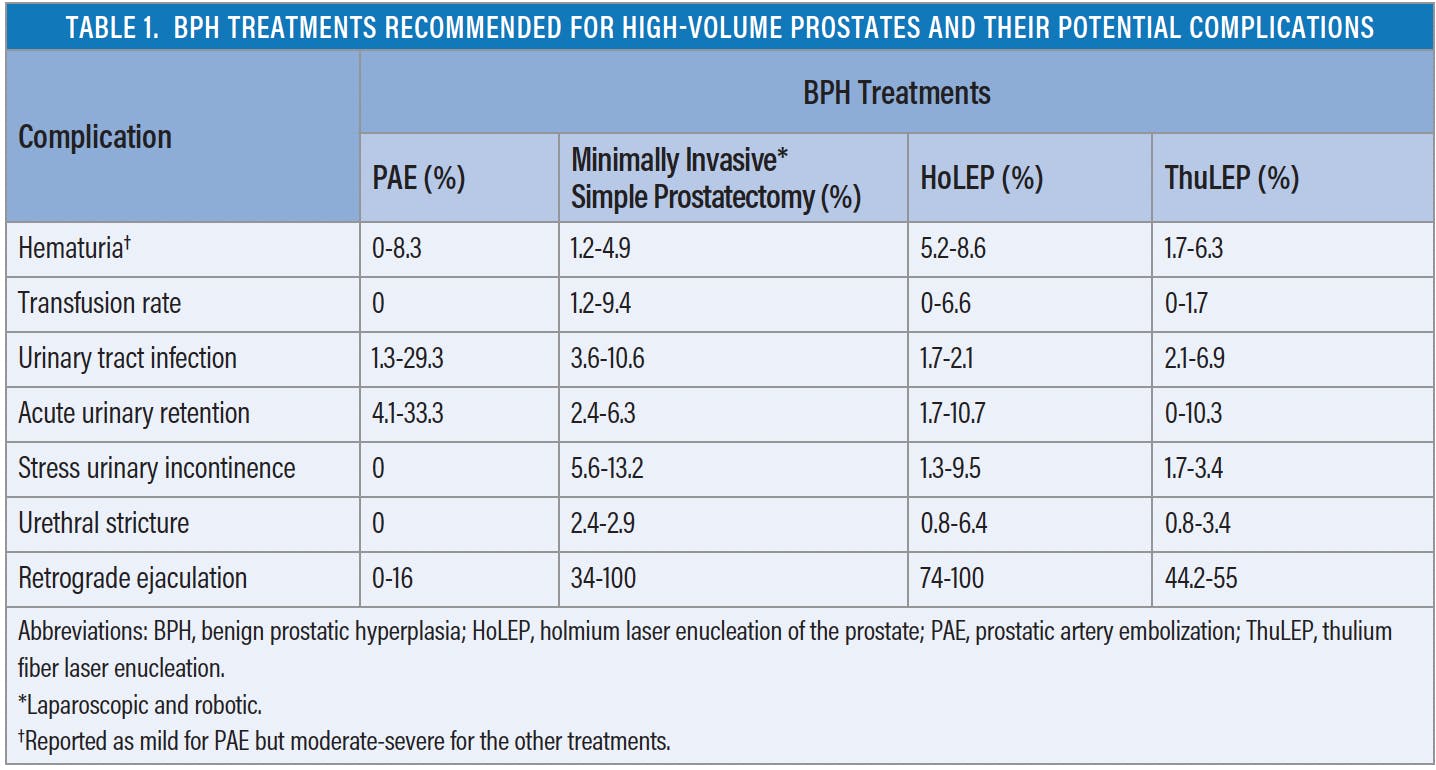
Although the comparison between PAE and TURP is well studied, the evidence comparing PAE to enucleation techniques is scarce. Table 1 summarizes complications described in the available prospective controlled trials from the BPH treatments recommended for high-volume prostates.7-13,24-36
Along with its intrinsic safety profile, the strength of PAE also lies in the fact that it is typically performed under local anesthesia or sedation. In comparison to spinal or general anesthesia, which is required for TURP, these anesthesiologic regimens reduce intraoperative risk and extend the indication for PAE to old and comorbid patients who otherwise would not have the opportunity to undergo BPH surgery. Another advantage of PAE is that it can be performed in patients who cannot discontinue anticoagulant or antiplatelet therapy, as it does not require their discontinuation to be performed safely. Interestingly, while these wider inclusion criteria highlight the safety profile of PAE, they also imply that a large number of PAEs is performed in this frail and comorbid population, where PAE inevitably has greater surgical complexity, thus potentially underestimating the real benefit it would have in a cohort of younger, healthier men.
Despite its optimal safety profile, the primary concern of PAE is radiation exposure. However, this concern is probably exaggerated. In fact, a recent systematic review revealed that the amount of ionizing radiation exposure derived from PAE corresponds to an effective dose of 28.3 mSv, which is two to three times higher than that of a standard CT scan of the abdomen and pelvis.37 Furthermore, it is well demonstrated that fluoroscopy time is significantly reduced in experienced hands.38,39 Nevertheless, although radiation exposure during PAE is a relatively low risk to patients, it should be an integral part of patient counseling, especially in young men.
Overall, the strength of PAE lies in its low morbidity and the possibility of performing under local anesthesia or sedation. Although radiation exposure is relatively low, radiation protocols should be optimized to minimize exposure.
TECHNICAL ASPECTS
Although PAE is a technically demanding procedure, endovascular instrumentation has dramatically improved over the last decade. The refinement of angiography equipment, catheters, and wires has contributed to familiarization with materials and devices, making this interventional procedure feasible and safe in less experienced hands.40 This improvement is applied for all endovascular procedures but particularly for PAE, whose framework is characterized by numerous vascular anastomoses and complex anatomic variants and often consists of patients with significant atherosclerosis and tortuous arteries.
A wide variety of embolic agents are used for PAE, including, among others, microspheres (typically 100–500 µm) and liquid embolics. Theoretically, the choice of embolic material or microsphere size could influence the success and safety of the procedure, but no consensus exists today.18,41 Similarly, studies comparing microspheres and liquid embolics revealed inconclusive superiority.42 It has not yet been determined whether permanent or temporary embolic agents are most effective. Recently, investigators have been using liquid embolic agents (N-butyl-cyanoacrylate) as an alternative.43
PAE advancements have paralleled the concordant developments in imaging. Transitioning from transrectal ultrasound to high–magnetic field, multiparametric MRI has led to better patient selection based on anatomic and functional information. Patients who demonstrate low prostate volume, predominant intravesical involvement, and anomalous (high) bladder neck insertion are examples of clinical scenarios that may not have success rates that are equal to patients without anatomic concerns.44 Preoperative high-resolution CTA can assess smaller arterial branches (with a reported 97.3% accuracy in one study45). Therefore, it can predict future problems such as atherosclerotic occlusion or vascular tortuosity.40 Compared to the past, intraoperative fluoroscopy now affords higher resolution at lower radiation doses. Additionally, the image-save function has been shown to decrease fluoroscopy time, further decreasing overall radiation exposure. Intraoperative cone-beam CTA has become a standard adjunctive technique to assess the risk of nontarget embolization.46 For patients with concerns about radiation exposure, intraoperative contrast-enhanced MRA has been studied as an alternative to CT, revealing high sensitivity (91.5%) in the identification of prostatic arteries.47
As described, PAE is a technically demanding procedure that has already benefited from past improvements in materials and imaging. In the future, further amelioration of the instrumentation and implementation of new embolic agents may contribute to a positive impact on both the outcomes and profile risk of PAE.
INTERDISCIPLINARY COLLABORATION
Although BPH represents a common urologic disease, treatment options have classically existed as a dichotomy between urologists and interventional radiologists. PAE presents the opportunity for multidisciplinary care among these specialties that share many common interests and patients. PAE necessitates appropriate consultation at the pre- and postprocedural levels to ensure exceptional patient care. The success of PAE is initially attributed to appropriate patient selection. Accurately assessing the nature and severity of symptoms, which is typically done by a urologist, is crucial to discussing management options. Subsequently, validated image interpretation is imperative to assess or rule out malignancy and confirm the feasibility of PAE. Anatomic concerns such as prostate size, anatomic configuration, and vascular variations should be correctly identified and included in the shared decision-making consultation process. The multidisciplinary approach is also a priority for the procedural success of PAE.
Recent collaborative efforts have given rise to the interventional urologist—a proceduralist with a crossover between endovascular and urologic training. Regardless of whether an interventional radiologist or interventional urologist performs PAE, as stated in AUA guidelines, it is imperative that the operator receives dedicated training to render this therapy safely and effectively.6
The multidisciplinary nature of PAE is crucial for several reasons. The connection between urology and radiology should always be constant in centers performing PAE because this may improve patient selection and success rates. Regularly scheduled meetings where clinical cases are discussed and experiences of complications and long-term outcomes are shared could help ensure reciprocal growth and patient care.
INCLUSION IN GUIDELINES AND FUTURE PERSPECTIVES
In September 2023, PAE was recognized by the AUA as a minimally invasive treatment option for LUTS/BPH. From a clinical perspective, this could potentiate the spread and experience with PAE, allowing more familiarity with PAE and potentially broadening its inclusion and usage. Notably, the enthusiasm that comes with this novelty needs to be carefully guided to avoid compromising outcomes. In light of this, training and fellowship programs should be encouraged to allow for clinical excellence.
From a research perspective, despite the introduction of PAE in the AUA guidelines, the evidence level of recommendation still needs to be higher. Therefore, high-quality studies and research collaborations are needed to support the affirmation of this technique. Comparisons to contemporary treatment modalities such as laser enucleation and suprapubic prostatectomy would better guide patient selection criteria. Among others, the long-term outcomes and safety profile are areas of interest to be addressed.
From a patient perspective, the recognition of PAE by several guidelines has offered the opportunity for a new option, the purpose of which is not to replace existing techniques but to enrich the landscape of minimally invasive treatments for BPH with an alternative option that is efficacious and safe. Future directions include using PAE to help decrease the size of the prostate before radiation therapy, as well as evaluating the use of liquid embolics as alternatives to particle-directed embolization.
1. Mitchell ME, Waltman AC, Athanasoulis CA, et al. Control of massive prostatic bleeding with angiographic techniques. J Urol. 1976;115:692-695. doi: 10.1016/s0022-5347(17)59339-8
2. Rastinehad AR, Ost MC, VanderBrink BA, et al. Persistent prostatic hematuria. Nat Clin Pract Urol. 2008;5:159-165. doi: 10.1038/ncpuro1044
3. DeMeritt JS, Elmasri FF, Esposito MP, Rosenberg GS. Relief of benign prostatic hyperplasia-related bladder outlet obstruction after transarterial polyvinyl alcohol prostate embolization. J Vasc Interv Radiol. 2000;11:767-770. doi: 10.1016/s1051-0443(07)61638-8
4. National Institute for Health and Care Excellence. Prostate artery embolization for lower urinary tract symptoms caused by benign prostatic hyperplasia. April 25, 2018. Accessed January 8, 2024. www.nice.org.uk/guidance/ipg611
5. European Association of Urology Guidelines. EAU Guidelines Office; 2021.
6. Sandhu JS, Bixler BR, Dahm P, et al. Management of lower urinary tract symptoms attributed to benign prostatic hyperplasia (BPH): AUA guideline amendment 2023. J Urol. 2024;211:11-19. doi: 10.1097/JU.0000000000003698
7. Carnevale FC, Iscaife A, Yoshinaga EM, et al. Transurethral resection of the prostate (TURP) versus original and perfected prostate artery embolization (PAE) due to benign prostatic hyperplasia (BPH): preliminary results of a single center, prospective, urodynamic-controlled analysis. Cardiovasc Intervent Radiol. 2016;39:44-52. doi: 10.1007/s00270-015-1202-4
8. Gao YA, Huang Y, Zhang R, et al. Benign prostatic hyperplasia: prostatic arterial embolization versus transurethral resection of the prostate--a prospective, randomized, and controlled clinical trial. Radiology. 2014;270:920-928. doi: 10.1148/radiol.13122803
9. Abt D, Hechelhammer L, Müllhaupt G, et al. Comparison of prostatic artery embolisation (PAE) versus transurethral resection of the prostate (TURP) for benign prostatic hyperplasia: randomised, open label, non-inferiority trial. BMJ. 2018;361:k2338. doi: 10.1136/bmj.k2338
10. Abt D, Müllhaupt G, Hechelhammer L, et al. Prostatic artery embolisation versus transurethral resection of the prostate for benign prostatic hyperplasia: 2-yr outcomes of a randomised, open-label, single-centre trial. Eur Urol. 2021;80:34-42. doi: 10.1016/j.eururo.2021.02.008
11. Insausti I, Sáez de Ocáriz A, Galbete A, et al. Randomized comparison of prostatic artery embolization versus transurethral resection of the prostate for treatment of benign prostatic hyperplasia. J Vasc Interv Radiol. 2020;31:882-890. doi: 10.1016/j.jvir.2019.12.810
12. Radwan A, Farouk A, Higazy A, et al. Prostatic artery embolization versus transurethral resection of the prostate in management of benign prostatic hyperplasia. Prostate Int. 2020;8:130-133. doi: 10.1016/j.prnil.2020.04.001
13. Pisco JM, Bilhim T, Costa NV, et al. Randomised clinical trial of prostatic artery embolisation versus a sham procedure for benign prostatic hyperplasia. Eur Urol. 2020;77:354-362. doi: 10.1016/j.eururo.2019.11.010
14. Bhatia S, Sinha VK, Harward S, et al. Prostate artery embolization in patients with prostate volumes of 80 mL or more: a single-institution retrospective experience of 93 patients. J Vasc Interv Radiol. 2018;29:1392-1398. doi: 10.1016/j.jvir.2018.05.012
15. Abt D, Müllhaupt G, Mordasini L, et al. Outcome prediction of prostatic artery embolization: post hoc analysis of a randomized, open-label, non-inferiority trial. BJU Int. 2019;124:134-144. doi: 10.1111/bju.14632
16. Abt D, Schmid HP, Müllhaupt G. Prostatic artery embolization: a curse or a blessing? Eur Urol. 2020;77:363-364. doi: 10.1016/j.eururo.2019.11.031
17. Svarc P, Taudorf M, Nielsen MB, et al. Postembolization syndrome after prostatic artery embolization: a systematic review. Diagnostics (Basel). 2020;10:659. doi: 10.3390/diagnostics10090659
18. Ray AF, Powell J, Speakman MJ, et al. Efficacy and safety of prostate artery embolization for benign prostatic hyperplasia: an observational study and propensity-matched comparison with transurethral resection of the prostate (the UK-ROPE study). BJU Int. 2018;122:270-282. doi: 10.1111/bju.14249
19. Zumstein V, Betschart P, Vetterlein MW, et al. Prostatic artery embolization versus standard surgical treatment for lower urinary tract symptoms secondary to benign prostatic hyperplasia: a systematic review and meta-analysis. Eur Urol Focus. 2019;5:1091-1100. doi: 10.1016/j.euf.2018.09.005
20. Theurich AT, Leistritz L, Leucht K, et al. Influence of prostate artery embolization on different qualities of lower urinary tract symptoms due to benign prostatic obstruction. Eur Urol Focus. 2022;8:1323-1330. doi: 10.1016/j.euf.2022.01.011
21. Manfredi C, García-Gómez B, Arcaniolo D, et al. Impact of surgery for benign prostatic hyperplasia on sexual function: a systematic review and meta-analysis of erectile function and ejaculatory function. Eur Urol Focus. 2022;8:1711-1732. doi: 10.1016/j.euf.2022.06.007
22. Bachmann A, Tubaro A, Barber N, et al. A European multicenter randomized noninferiority trial comparing 180 W GreenLight XPS laser vaporization and transurethral resection of the prostate for the treatment of benign prostatic obstruction: 12-month results of the GOLIATH study. J Urol. 2015;193:570-578. doi: 10.1016/j.juro.2014.09.001
23. Gilling PJ, Barber N, Bidair M, et al. Five-year outcomes for Aquablation therapy compared to TURP: results from a double-blind, randomized trial in men with LUTS due to BPH. Can J Urol. 2022;29:10960-10968.
24. Fuschi A, Al Salhi Y, Velotti G, et al. Holmium laser enucleation of prostate versus minimally invasive simple prostatectomy for large volume (≥120 mL) prostate glands: a prospective multicenter randomized study. Minerva Urol Nephrol. 2021;73:638-648. doi: 10.23736/S2724-6051.20.04043-6
25. Bozzini G, Berti L, Aydoğan TB, et al. A prospective multicenter randomized comparison between holmium laser enucleation of the prostate (HoLEP) and thulium Laser Enucleation of the Prostate (ThuLEP). World J Urol. 2021;39:2375-2382. doi: 10.1007/s00345-020-03468-6
26. Enikeev D, Taratkin M, Babaevskaya D, et al. Randomized prospective trial of the severity of irritative symptoms after HoLEP vs ThuFLEP. World J Urol. 2022;40:2047-2053. doi: 10.1007/s00345-022-04046-8
27. Becker B, Herrmann TRW, Gross AJ, Netsch C. Thulium vapoenucleation of the prostate versus holmium laser enucleation of the prostate for the treatment of large volume prostates: preliminary 6-month safety and efficacy results of a prospective randomized trial. World J Urol. 2018;36:1663-1671. doi: 10.1007/s00345-018-2321-8
28. Briganti A, Naspro R, Gallina A, et al. Impact on sexual function of holmium laser enucleation versus transurethral resection of the prostate: results of a prospective, 2-center, randomized trial. J Urol. 2006;175:1817-1821. doi: 10.1016/S0022-5347(05)00983-3
29. Zhang F, Shao Q, Herrmann TR, et al. Thulium laser versus holmium laser transurethral enucleation of the prostate: 18-month follow-up data of a single center. Urology. 2012;79:869-874. doi: 10.1016/j.urology.2011.12.018
30. Kuntz RM, Ahyai S, Lehrich K, Fayad A. Transurethral holmium laser enucleation of the prostate versus transurethral electrocautery resection of the prostate: a randomized prospective trial in 200 patients. J Urol. 2004;172:1012-1016. doi: 10.1097/01.ju.0000136218.11998.9e
31. Xia SJ, Zhuo J, Sun XW, et al. Thulium laser versus standard transurethral resection of the prostate: a randomized prospective trial. Eur Urol. 2008;53:382-389. doi: 10.1016/j.eururo.2007.05.019
32. Fu WJ, Zhang X, Yang Y, et al. Comparison of 2-microm continuous wave laser vaporesection of the prostate and transurethral resection of the prostate: a prospective nonrandomized trial with 1-year follow-up. Urology. 2010;75:194-199. doi: 10.1016/j.urology.2009.07.1266
33. Umari P, Fossati N, Gandaglia G, et al. Robotic assisted simple prostatectomy versus holmium laser enucleation of the prostate for lower urinary tract symptoms in patients with large volume prostate: a comparative analysis from a high volume center. J Urol. 2017;197:1108-1114. doi: 10.1016/j.juro.2016.08.114
34. Zhang MW, El Tayeb MM, Borofsky MS, et al. Comparison of perioperative outcomes between holmium laser enucleation of the prostate and robot-assisted simple prostatectomy. J Endourol. 2017;31:847-850. doi: 10.1089/end.2017.0095
35. Martín Garzón OD, Azhar RA, Brunacci L, et al. One-year outcome comparison of laparoscopic, robotic, and robotic intrafascial simple prostatectomy for benign prostatic hyperplasia. J Endourol. 2016;30:312-318. doi: 10.1089/end.2015.0218
36. Simone G, Misuraca L, Anceschi U, et al. Urethra and ejaculation preserving robot-assisted simple prostatectomy: near-infrared fluorescence imaging-guided Madigan technique. Eur Urol. 2019;75:492-497. doi: 10.1016/j.eururo.2018.11.051
37. Zumstein V, Binder J, Güsewell S, et al. Radiation exposure during prostatic artery embolisation: a systematic review and calculation of associated risks. Eur Urol Focus. 2021;7:608-611. doi: 10.1016/j.euf.2020.04.012
38. Powell T, Rahman S, Staib L, et al. Operator learning curve for prostatic artery embolization and its impact on outcomes in 296 patients. Cardiovasc Intervent Radiol. 2023;46:229-237. doi:10.1007/s00270-022-03321-w
39. Enderlein GF, Lehmann T, von Rundstedt FC, et al. Prostatic artery embolization-anatomic predictors of technical outcomes. J Vasc Interv Radiol. 2020;31:378-387. doi:10.1016/j.jvir.2019.09.005
40. Carnevale FC, de Assis AM, Moreira AM. Prostatic artery embolization: equipment, procedure steps, and overcoming technical challenges. Tech Vasc Interv Radiol. 2020;23:100691. doi: 10.1016/j.tvir.2020.100691
41. Torres D, Costa NV, Pisco J, et al. Prostatic artery embolization for benign prostatic hyperplasia: prospective randomized trial of 100-300 μm versus 300-500 μm versus 100- to 300-μm + 300- to 500-μm Embospheres. J Vasc Interv Radiol. 2019;30:638-644. doi: 10.1016/j.jvir.2019.02.014
42. Salet E, Crombé A, Grenier N, et al. Prostatic artery embolization for benign prostatic obstruction: single-centre retrospective study comparing microspheres versus n-butyl cyanoacrylate. Cardiovasc Intervent Radiol. 2022;45:814-823. doi: 10.1007/s00270-022-03069-3
43. Sanghvi J, Bamshad D, Galla N, et al. Fluoroscopy time and radiation dose using liquid embolic (n-butyl-2-cyanoacrylate) versus microspheres for prostatic artery embolization. J Vasc Interv Radiol. 2024;35:147-151.e1. doi: 10.1016/j.jvir.2023.09.019
44. Powell T, Kellner D, Ayyagari R. Benign prostatic hyperplasia: clinical manifestations, imaging, and patient selection for prostate artery embolization. Tech Vasc Interv Radiol. 2020;23:100688. doi: 10.1016/j.tvir.2020.100688
45. Maclean D, Maher B, Harris M, et al. Planning prostate artery embolisation: is it essential to perform a pre-procedural CTA? Cardiovasc Intervent Radiol. 2018;41:628-632. doi: 10.1007/s00270-017-1842-7
46. Uflacker A, Haskal ZJ, Patrie J, et al. Improving cone-beam CT angiography for prostatic artery embolization: is a low-dose protocol equivalent to the standard? J Vasc Interv Radiol. 2021;32:562-568. doi: 10.1016/j.jvir.2020.12.016
47. Zhang JL, Wang MQ, Shen YG, et al. Effectiveness of contrast-enhanced MR angiography for visualization of the prostatic artery prior to prostatic arterial embolization. Radiology. 2019;291:370-378. doi: 10.1148/radiol.2019181524
Advertisement
Advertisement