Advertisement
Advertisement
February 2024
Y90 With Arterioportal Shunt Balloon Occlusion: How We Do It
A step-by-step approach to temporary portal vein balloon occlusion to mitigate arterioportal shunting during hepatic transarterial therapy.
Transarterial locoregional liver therapies rely on preferential hepatic arterial blood flow to a tumor. In some cases, altered flow dynamics may be encountered due to arterioportal shunting. An arterioportal shunt (APS) can result from abnormal tumor vasculature or be iatrogenic after a biopsy, and it can direct blood away from the tumor and into nontumoral hepatic tissue. Although an APS doesn’t necessarily exclude patients from getting transarterial treatment, interventionalists should be able to recognize it in order to adjust their approach to maximize treatment efficacy and decrease toxicity to normal hepatic parenchyma.
When a hepatic APS is identified on preprocedure cross-sectional imaging, intraprocedural angiography, or cone-beam CT (CBCT), careful planning must be undertaken to ensure efficacious and safe transarterial treatment. This is particularly important in radioembolization, where administering a dose above a threshold is essential for complete tumor necrosis. A small APS may not require intervention prior to locoregional therapy, and intraprocedural contrast-enhanced CBCT can assist in confirming adequate perfusion of the intended treatment zone despite the presence of an APS. On the other hand, a larger APS to more central portal veins may require advanced flow-redirection techniques. Temporary balloon occlusion of the involved portal vein is an effective method for mitigating arterioportal shunting during hepatic transarterial therapy.
PATIENT SELECTION
Anticoagulation therapy does not need to be held for typical transarterial intervention via 5-F access; however, if transhepatic or transsplenic portal venous balloon occlusion is pursued, anticoagulation should be held as per Society of Interventional Radiology guidelines. As is the case for other deep visceral interventions, patients with uncorrectable coagulopathy and abdominal ascites are at increased bleeding risk from the percutaneous access required for this procedure.
CASE EXAMPLE
A man in his early 70s with metabolic dysfunction–associated steatohepatitis cirrhosis and preserved liver function (Child-Pugh A, albumin-bilirubin grade 1) was found to have an infiltrative segment 6 liver mass with imaging features concerning for but not diagnostic of hepatocellular carcinoma (HCC) and no elevated tumor markers. After a multidisciplinary discussion at the institutional liver tumor board, the patient underwent a liver biopsy for definitive diagnosis at the time of macroaggregated albumin (MAA) liver mapping for radiation segmentectomy. During the technetium Tc99m-MAA procedure, selective angiography and CBCT were performed with contrast injection at 0.5 mL/seconds for 10 seconds to mimic yttrium-90 (Y90) glass microsphere flow, demonstrating adequate perfusion to the tumor (Figure 1A). Pathology was consistent with moderately differentiated HCC. When the patient returned for Y90 administration a week later, angiography demonstrated a new hepatic APS (Figure 1B) that was diverting flow away from the tumor, which was presumed to be iatrogenic due to the biopsy. Despite multiple attempts to bypass the shunt and direct flow toward the tumor, most of the flow was still going toward the portal system. As such, the plan turned to radioembolization with concurrent APS mitigation.
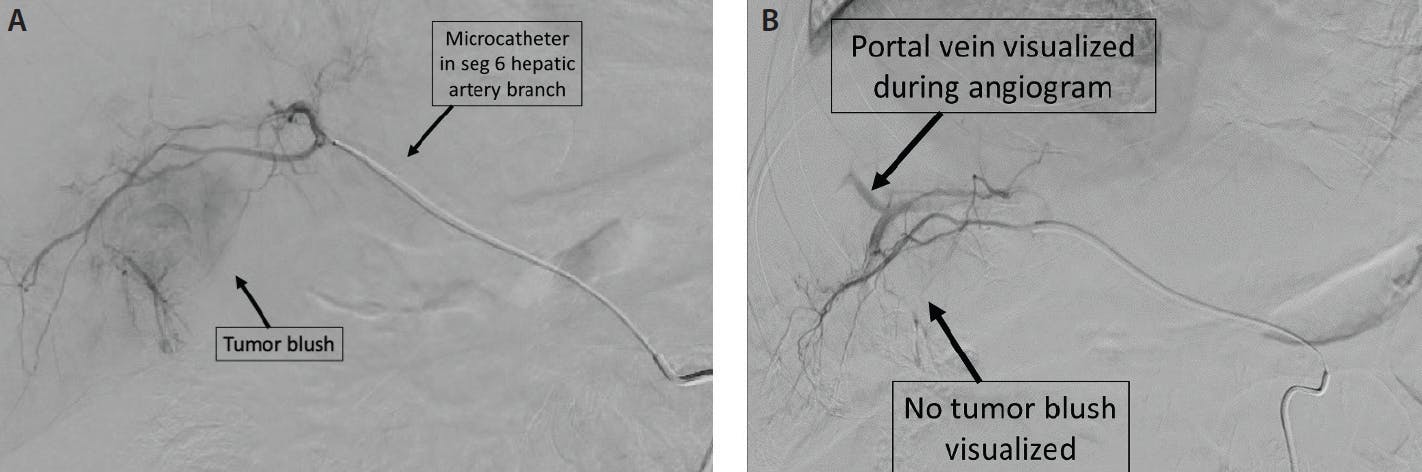
Figure 1. Initial Tc99m-MAA mapping selective angiography at 0.5 mL/second for 10 seconds of contrast demonstrated adequate perfusion to the tumor (A), which was confirmed with CBCT (not pictured). During the subsequent radioembolization procedure, selective angiography showed an APS (top arrow) diverting flow away from the tumor (B).
STEP-BY-STEP APPROACH TO APS BALLOON OCCLUSION
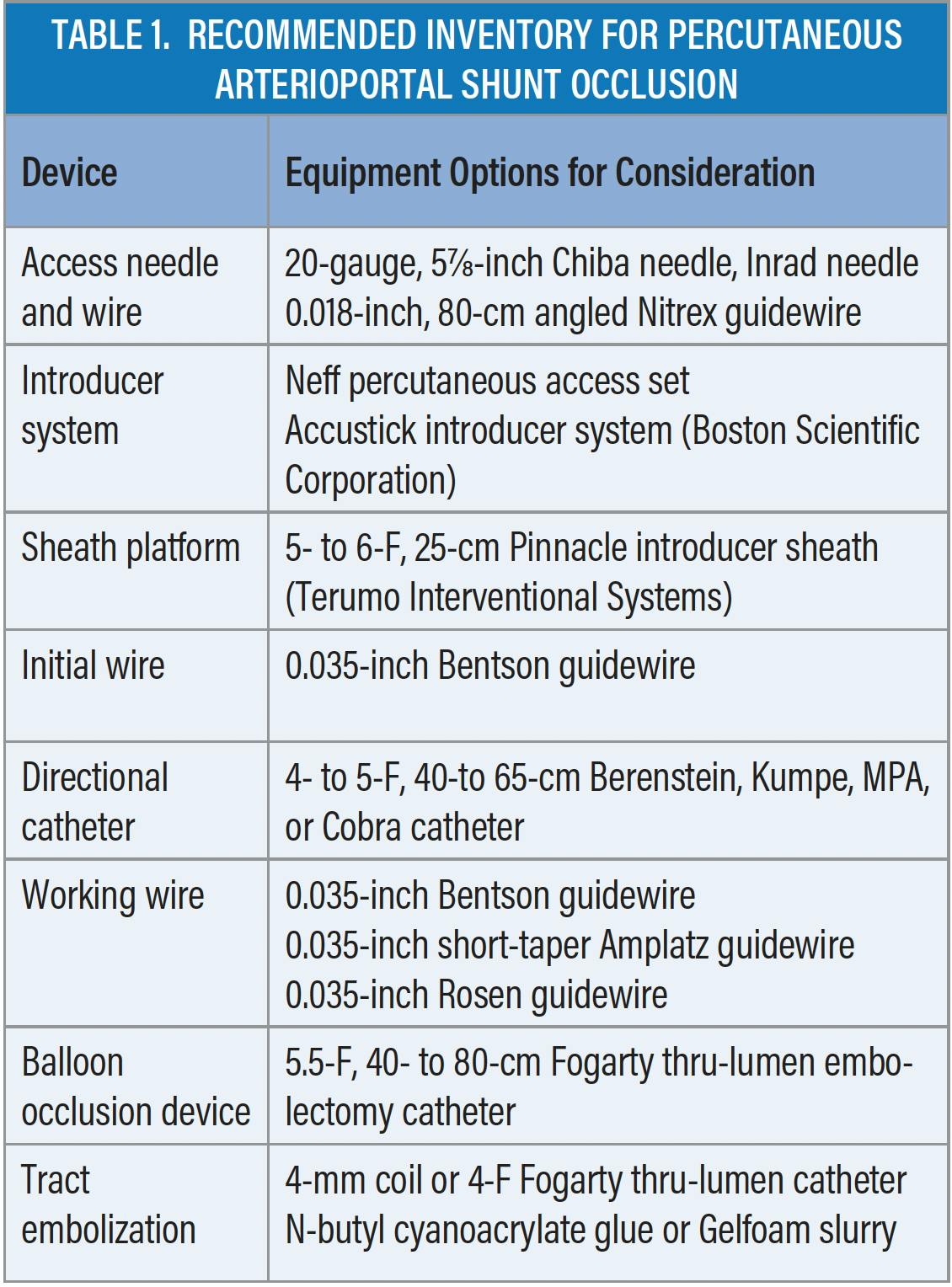
A recommended inventory for percutaneous APS occlusion is listed in Table 1.
Step 1: Arterial Access Into Tumor Feeding Vessel to Confirm APS Location
This case was performed under monitored anesthesia care. The arterial access site and upper abdomen were prepped and draped in sterile fashion. Right common femoral artery access was achieved, and the celiac artery was selected. A microcatheter system was used to access the segment 6 hepatic artery branch feeding the tumor. Angiography was performed through the microcatheter, and the location of the APS was identified.
Step 2: Percutaneous Access to Prepare for Balloon Placement
Attention was then directed to the abdominal percutaneous access site. We chose transsplenic access because it provided a less tortuous pathway to the right-sided shunt. However, the decision whether to access the portal venous system via a transhepatic or transsplenic approach is based on tumor location, portal anatomy, and spleen size. The splenic vein was accessed under ultrasound guidance with a 20-gauge Inrad needle (INRAD, Inc.), and a 0.018-inch Nitrex guidewire (Medtronic) was advanced into the portal venous system via fluoroscopic guidance. The needle was removed and a 4-F Neff percutaneous access set (Cook Medical) was advanced over the wire into the portal vein. A 0.035-inch Bentson wire and a 4-F Berenstein catheter were directed to the portal confluence. Over a stiffer working wire, a 6-F, 25-cm sheath was advanced into the portal venous system to allow for balloon placement.
Step 3: Perform APS Balloon Occlusion and Administer Y90
Portal venography was performed, and the Berenstein catheter was advanced into the location of the APS. Over an Amplatz wire, the catheter was then exchanged for a 5.5-F over-the-wire Fogarty balloon, which was advanced to the site of the shunt. A hepatic arteriogram was then obtained via the microcatheter with the balloon deflated to identify the shunt origin, and the Fogarty balloon was precisely positioned in this region. The Fogarty balloon was then inflated, and a hepatic angiogram was again obtained to confirm cessation of flow through the APS and redistribution of flow into the tumor (Figure 2A). A CBCT was then obtained for further confirmation of adequate tumor coverage (Figure 2B). Transarterial Y90 was then administered through the microcatheter with the portal venous balloon in place. After treatment was administered, the Fogarty balloon was deflated. All catheters were then removed per radiation safety protocol.
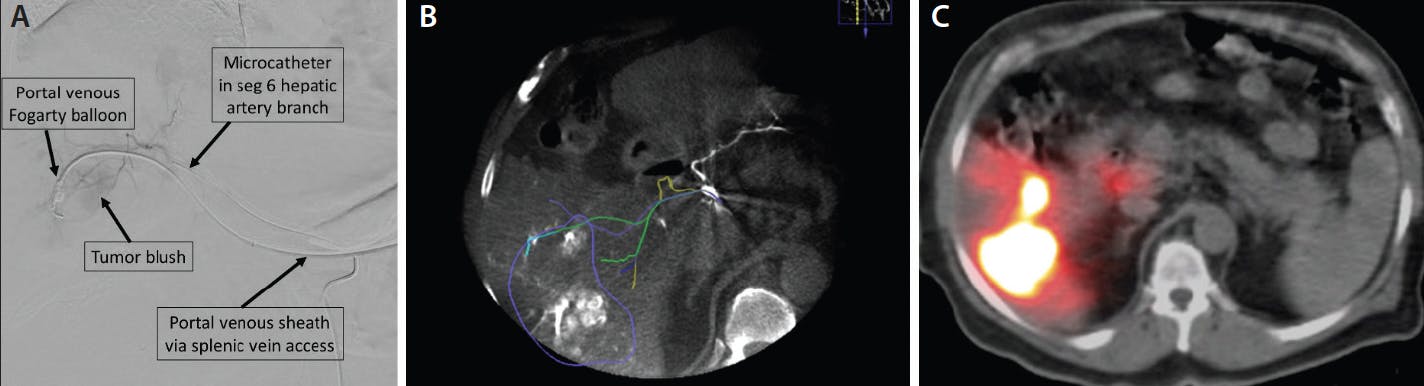
Figure 2. Angiogram with portal venous balloon inflated demonstrating redirection of arterial flow into the tumor and cessation of flow to the portal venous system (A). Intraprocedural pretreatment CBCT with portal venous balloon inflated to mitigate the APS, demonstrating perfusion of the tumor (B). Immediate posttreatment SPECT/CT with Y90 microsphere deposition into the intended treatment zone (C).
Step 4: Embolize Transsplenic Access Site
To embolize the transsplenic access site, the access sheath was retracted to the soft tissue tract just peripheral to the venotomy site, which was identified via injection of contrast. A 4-F Fogarty balloon was inflated at the edge of the sheath, and a thick Gelfoam (Pfizer, Inc.) slurry was injected as the sheath was pulled back. The Fogarty balloon was deflated and removed. Alternatively, a coil may be used as a backstop and Gelfoam or a liquid embolic, such as a 1:1 N-butyl cyanoacrylate/Lipiodol (Guerbet LLC) mixture, may be used as a tract embolic. A celiac artery angiogram was obtained to confirm no extravasation from the splenic access site.
Step 5: Postoperative Care and Follow-Up
Postoperatively, Bremsstrahlung single photon emission CT (SPECT)/CT was performed to evaluate Y90 microsphere deposition (Figure 2C). The patient was then monitored in our postoperative care unit to recover from anesthesia and monitor for immediate complications. A contrast-enhanced MRI of the abdomen obtained 6 weeks after radioembolization demonstrated an mRECIST (modified Response Evaluation Criteria in Solid Tumors) complete response (Figure 3), which persisted at 3 months. The patient reported he was feeling well at his interventional radiology follow-up office visits.
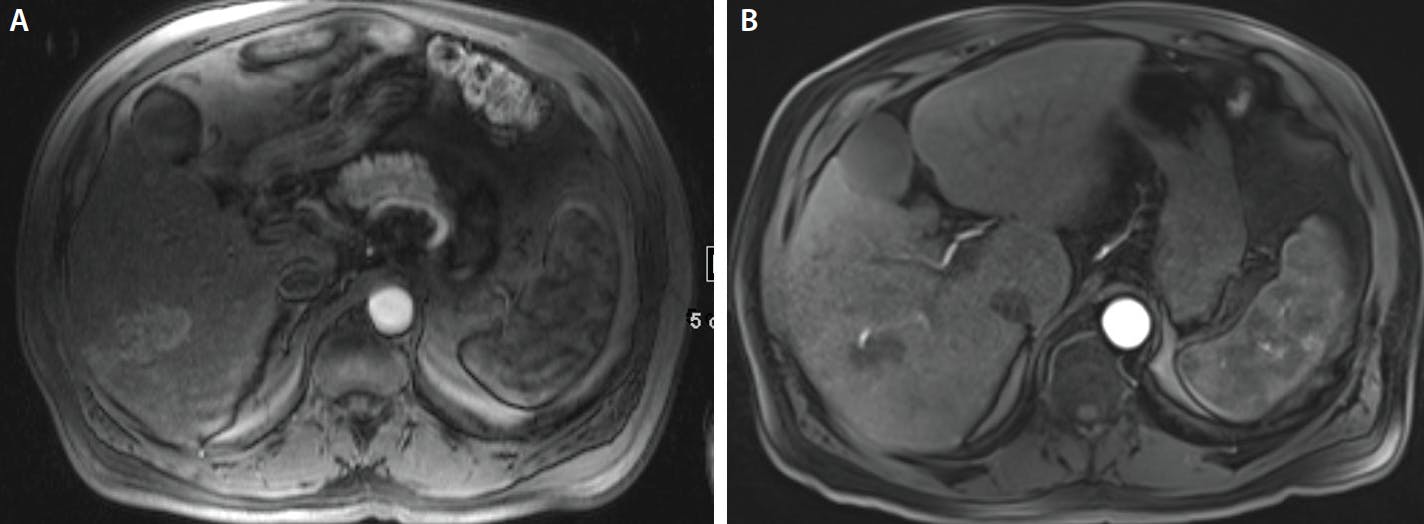
Figure 3. Pretreatment arterial phase MRI abdomen demonstrating 4.5-cm segment 6 HCC (A). Eight-week posttreatment arterial phase MRI of the abdomen demonstrating a nonenhancing treated lesion in segment 6 (B).
SUMMARY
APSs can disrupt hepatic arterial flow into tumors, rendering transarterial treatments ineffective. Temporary portal venous balloon occlusion for APS mitigation is an effective technique to redistribute flow into the tumor to increase treatment efficacy and decrease toxicity to normal hepatic parenchyma.
Advertisement
Advertisement