Advertisement
Advertisement
January 2024
Sponsored by Medtronic
Initial Experiences With the Next-Gen ClosureFast™ 6-Fr Radiofrequency Ablation Catheter
With Karem Harth, MD, MHS, RPVI; Misaki Kiguchi, MD, MBA, FACS; and Raghu Kolluri, MD, MS, RVT, MSVM



This past August, Medtronic announced several updates to the ClosureFast RFA catheter, including a smaller 6-Fr size designed for better flexibility, easier navigation, and improved kink resistance. The heating element length was also increased from 7 to 8 cm for procedural efficiency. In this article, leading CVI experts discuss their initial experience with the updated ClosureFast 6-Fr RFA catheter.
Please summarize your experience with the ClosureFast RFA system (including the ClosureRFG™ radiofrequency generator [Medtronic] and ClosureFast™ 7-Fr endovenous RFA catheter) prior to the availability of the 6-Fr catheter.
Dr. Kolluri: I’ve been using the ClosureFast RFA generator since it was commercially available in 2006, and I’ve performed > 4,000 cases with it.
Dr. Harth: I have been using the ClosureFast RFA generator since 2015. I perform > 100 RFA cases per year.
Dr. Kiguchi: I was trained using the ClosureFast RFA generator during residency and have been using it as my main endovenous thermal ablation mode since 2015. As part of a multidisciplinary wound center treating primarily CEAP 6 (clinical, etiologic, anatomic, pathophysiologic) patients (ie, venous leg ulcers), I perform approximately 300 RFAs per year.
What experience have you had with the new 6-Fr catheter, and how does it compare to the 7-Fr catheter?
Dr. Harth: I’ve used the new 6-Fr device in 10 cases to date. The aspects of the 6-Fr catheter that are notably different from the 7-Fr catheter include increased flexibility of the catheter and a longer ablation segment, which could potentially cut back on procedural time. The smaller profile has a role to play in challenging anatomy, including patients with postphlebitic disease, fibrotic valves, and tortuous segments.
Dr. Kiguchi: I’ve used the updated 6-Fr catheter in 10 cases. I appreciate its flexibility compared to the 7-Fr catheter. It is flexible enough to navigate mild tortuosity but stiff enough to navigate those tortuous veins.
Dr. Kolluri: I’ve completed three cases with the new 6-Fr catheter thus far. The smaller profile is certainly appealing, offering enhanced steerability and flexibility. In one instance, I successfully navigated a slight vein curve that was pushing the catheter into a perforator instead of advancing through the great saphenous vein (GSV) as intended, without the need for a guidewire (Figure 1). A gentle bend to the tip and a bit of torque was enough to get through.

Figure 1. Ultrasound images of the ClosureFast 6-Fr catheter navigating a vein bend without a guidewire. Catheter enters the mid-thigh perforator (A); catheter pulled back into the GSV (B); gentle torque applied (C); advanced cephalad into the GSV (D).
What would you say is the main advantage of using the ClosureFast 6-Fr catheter over the 7-Fr catheter?
Dr. Kolluri: The main advantages are the smaller profile and improved flexibility, without compromising visibility on ultrasound. The ability to pass a guidewire if needed, despite the smaller profile, is a plus.
Dr. Harth: I agree, the smaller profile with more flexibility is a key benefit. This enables navigation through challenging anatomy. The longer heating element is also advantageous.
Dr. Kiguchi: The ability of the 6-Fr catheter to be flexible without compromising its directional capability is the main advantage. The flexibility often eliminates the need for a wire and/or multiple access points, making for a much more pleasant procedure for both the provider and patient. When I’d normally have to remove the 7-Fr RFA catheter to backload a Glidewire™* (Terumo Interventional Systems), the updated 6-Fr version can easily traverse these minor turns, eliminating the need for a wire or multiple access points.
Are there any highlights from the cases you’ve performed so far where the benefits of 6-Fr stood out?
Dr. Harth: I think this updated RFA catheter will be particularly beneficial in patients needing ablation after a phlebitic event and in those with fibrotic valves. It will also help in cases where one needs to cross an axial vein, as it comes out of the fascia and that crossing point is fibrotic. In these cases, I find that its flexibility allows the advancement of the catheter to feel more “slick.”
Dr. Kolluri: Venous specialists may initially find the 6-Fr appealing due to the physical attributes, low profile, and ability to use a guidewire (if the physician desires) due to presence of a lumen, without compromising the visibility on ultrasound.
Dr. Kiguchi: As a multidisciplinary wound center, many of our CEAP 6 patients are complex. Often, these patients have been treated before and have recanalized. They are generally not simple, straightforward cases. Given that the recanalized veins are often tortuous, having the 6-Fr catheter on hand as our working catheter has allowed a decrease in multiple access points and use of guidewires to treat the entirety of the vein. I’ll present an example of a patient case for which I chose the 6-Fr catheter.
A patient in his mid-40s with a history of left GSV stripping presented with an ulcer on his left medial ankle (Figure 2A), woody skin, and edema. He had a previous history of pulmonary embolism and was diagnosed with a hypercoagulable disorder. He wears compression socks (20-30 mm Hg), but his left leg was heavy, achy, and swollen after standing all day at work. Ultrasound imaging revealed chronic nonocclusive deep vein thrombosis in the left mid to distal femoral veins. Reflux in the recanalized GSV was noted, with mild tortuosity and numerous large varicosities coming from the GSV (Figure 2B). I treated the patient with the new ClosureFast 6-Fr catheter. I chose the 6-Fr catheter due to the mild tortuosity of the recanalized GSV (Figure 2C). The patient returned to work the night of the procedure and continued with compression therapy. His ulcer healed within 4 weeks (Figure 2D), and his Venous Clinical Severity Score improved dramatically.
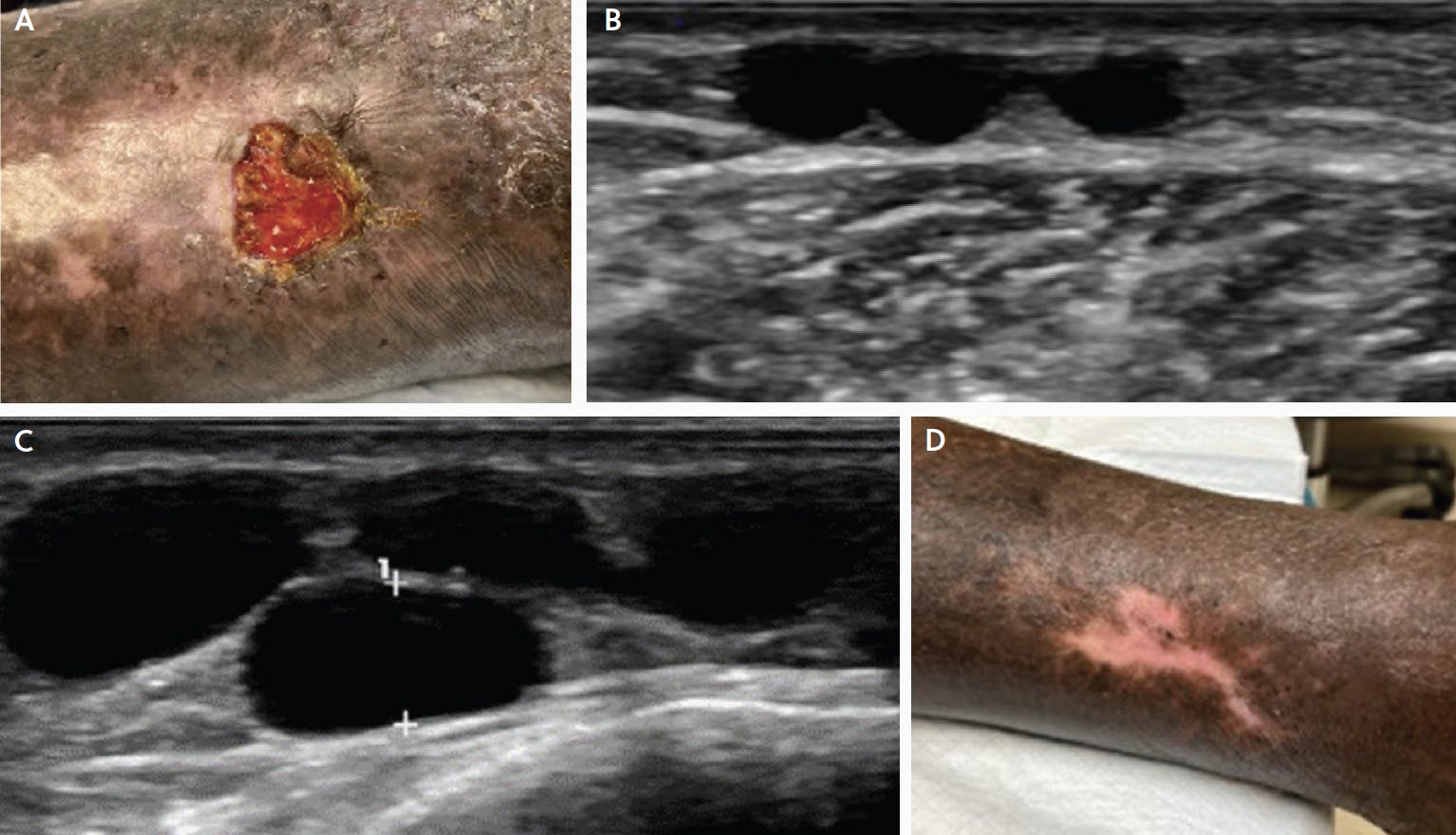
Figure 2. Left medial ulcer (A). Numerous superficial varicosities coming off the recanalized GSV (B). Large, mildly tortuous recanalized GSV associated with large superficial varicosities (C). Healed ulcer 4 weeks postprocedure (D).
Disclosures
Dr. Harth: Consultant to Medtronic, Boston Scientific Corporation, Cook, GE, and Inari.
Dr. Kiguchi: Consultant to Medtronic and Boston Scientific.
Dr. Kolluri: Consultant, advisor, data and safety monitoring board, and clinical events committee services for Medtronic, Philips, Thrombolex, Vesper Medical, Inari, Abbott, Surmodics, Penumbra, and Mercador; Executive Board Member, VIVA Physicians, Inc., a 501(c)(3) corporation; President, Syntropic Core Lab.
1. Proebstle TM, Alm BJ, Göckeritz O, et al. Five-year results from the prospective European multicentre cohort study on radiofrequency segmental thermal ablation for incompetent great saphenous veins. Br J Surg. 2015;102:212-218. doi: 10.1002/bjs.9679
2. Almeida JI, Kaufman J, Göckeritz O, et al. Radiofrequency endovenous ClosureFAST versus laser ablation for the treatment of great saphenous reflux: a multicenter, single-blinded, randomized study (RECOVERY Study). J Vasc Interv Radiol. 2009;20:752-759. doi: 10.1016/j.jvir.2009.03.008
3. Morrison N, Gibson K, Vasquez M, et al. Five-year extension study of patients from a randomized clinical trial (VeClose) comparing cyanoacrylate closure versus radiofrequency ablation for the treatment of incompetent great saphenous veins. J Vasc Surg Venous Lymphat Disord. 2020;8:978-989. doi: 10.1016/j.jvsv.2019.12.080
ClosureFast™ endovenous radiofrequency ablation (RFA) Catheter
Reference Statement
Indications for Use: The ClosureFast™ endovenous radiofrequency ablation (RFA) catheter is intended for endovascular coagulation of blood vessels in patients with superficial vein reflux.
Contraindications: The ClosureFast catheter is contraindicated for use in patients with thrombus in the target vein segment.
Potential Adverse Effects of the Device on Health: The potential complications include, but are not limited to, the following: adjacent nerve injury, hematoma, pulmonary embolism, thrombosis, infection, phlebitis, skin burn or discoloration, and vessel perforation.
Important: Please reference the Instructions For Use (IFU) for a complete listing of indications, contraindications, warnings and precautions, adverse effects, and suggested procedure.
CAUTION: Federal (USA) law restricts this device to sale by or on the order of a physician.
ClosureRFG™ Radiofrequency Generator
Reference Statement
Indications for Use: The ClosureRFG generator is used with radiofrequency catheters intended for vessel and tissue coagulation.
Contraindications: Refer to the applicable radiofrequency catheter instructions for use for a list of contraindications related to a ClosureFast system procedure.
Potential Adverse Effects of the Device on Health: Refer to the applicable radiofrequency catheter instructions for use for a list of potential complications related to a ClosureFast system procedure.
Important: Please reference the Operation Manual for a complete listing of indications, warnings, precautions safety notices, and operational information.
CAUTION: Federal (USA) law restricts this device to sale by or on the order of a physician.
501397 ©2023 Medtronic. Medtronic, Medtronic logo are trademarks of Medtronic. TM* third party brands are trademarks of their respective owner. All other brands are trademarks of Medtronic. For global distribution. 12/2023
Advertisement
Advertisement