Advertisement
Advertisement
January 2024
Prediction Models for Pulmonary Embolism
Considering the available prediction models for estimating the pretest probability and posttest severity of patients with PE, how these models can be applied in clinical practice, and the potential for intervention prediction models.
By Drew A. Birrenkott, MD, DPhil, and Christopher Kabrhel, MD, MPH
For over 50 years, pulmonary embolism (PE) and venous thromboembolism (VTE) have been recognized as a major cause of morbidity and mortality, with the annual incidence of VTE ranging from 0.2 to 1.1 per 1,000.1-5 Despite this recognition, PE remains the third-leading cause of cardiovascular death worldwide behind ischemic heart disease and stroke.6,7 The challenge of diagnosing and treating PE is a major contributing factor to this divide, and the clinical decision-making surrounding PE is complicated. The disease presentation can vary widely, from patients who are asymptomatic to patients with significant right ventricular (RV) dysfunction and hemodynamic collapse.8 Due to challenges in diagnosing and treating PE, there has been significant interest and work in creating prediction models for determining both the pretest probability and posttest severity of patients with PE to guide diagnosis and therapeutic strategy.
PREDICTING PE: MODELS FOR ESTIMATING PE PRETEST PROBABILITY
Dyspnea, chest pain, and hemoptysis have been considered the hallmark presenting symptoms of patients with PE. However, this classic triad of symptoms is only present in 5% to 7% of patients with PE and represents manifestations of severe PE.9 Unfortunately, the most common signs and symptoms of PE—dyspnea, pleuritic chest pain, cough, leg swelling, tachypnea, tachycardia—are neither sensitive nor specific to the diagnosis of PE.10 As a result, throughout the last 25 years, there has been significant work in deriving clinical decision rules to help clinicians estimate the pretest probability of PE and guide diagnostic strategy.
To date, there are at least five clinically validated tools for determining the pretest probability of PE: the PERC rule (ie, PE rule out criteria), Wells criteria, YEARS algorithm, revised Geneva score, and 4-Level PE Clinical Probability Score (4PEPS).11-15 Of these rules, the PERC rule is the only validated tool for ruling out PE with no objective testing. This rule uses eight clinical features, any of which if present indicate that PE cannot be safely ruled out and should be further considered.11 The remainder of these validated tools rely on diagnostic testing such as D-dimer, CT pulmonary angiography (CTPA), or ventilation/perfusion scan. Most recently, the 4PEPS was developed with the specific goal of integrating previously clinically validated rules to achieve a posttest probability of PE of < 2%. 4PEPS categorizes patients into four levels and specifies the testing required at each level. The very low clinical pretest probability (CPP) group can be ruled out for PE without diagnostic testing, the low CPP group can be ruled out with a D-dimer < 1.0 µg/mL, the moderate CPP group can be ruled out based on an age-adjusted D-dimer, and the high CPP group requires diagnostic imaging.15 The overall value of these pretest probability models is that they can help clinicians in acute care and outpatient settings determine appropriate testing strategies. Given that each of these rules has been clinically validated, they can, if accurately applied, be used as a clinical diagnostic tool when evaluating patients for PE.
PREDICTING OUTCOMES: MODELS FOR CLASSIFYING PE SEVERITY
Once a PE has been diagnosed, the next critical decision is treatment strategy. Given the variation in the presentation and severity of patients with PE, treatment strategies can range from outpatient treatment with direct oral anticoagulants to emergent surgical thromboembolectomy. PE is categorized based on severity. High-risk PE is defined as PE with sustained hypotension (systolic blood pressure < 90 mm Hg) for at least 15 minutes or a vasopressor requirement without another reasonable explanation for ongoing shock. Intermediate-risk PE has evidence of RV dysfunction or myocardial necrosis without persistent hypotension. Low-risk PE does not meet either the high- or intermediate-PE definitions. Although useful, these categorizations are not prescriptive, which has led many authors to develop prediction models and rules to help determine which patients may be appropriate for outpatient management or which stable patients are more likely to have acute worsening or hemodynamic collapse that requires advanced therapy.
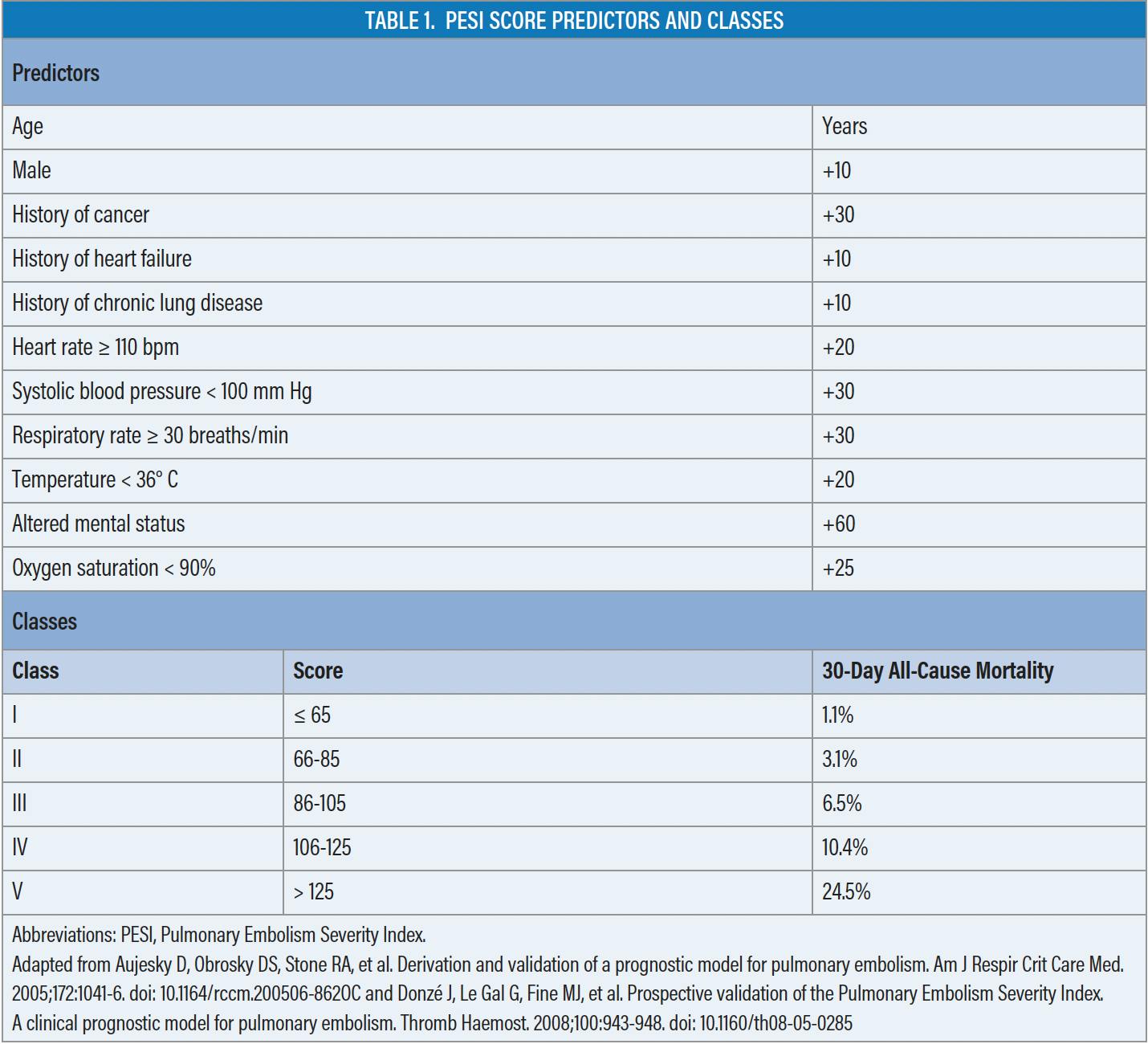
Of these prediction models, there has been significant work to identify patients who are at low risk and can be discharged with outpatient therapy. The most well-known and utilized of these scores is the PE Severity Index (PESI).16 The PESI score was derived from a stepwise regression of 24 variables. Using a point-based scoring system of 11 clinical factors, one can accurately determine which patients are low risk and can be eligible for outpatient treatment. Based on these 11 factors, the PESI score categorizes patients into five classes. Categories I and II are considered low risk and are associated with 1.1% and 3.1% rates of all-cause mortality at 30 days, respectively) (Table 116,17).16 Importantly, these results have been prospectively validated with similar results.17 Other authors have found that the PESI score can predict mortality and readmission rates.18-20 The simplified PESI (sPESI) score was published in 2010 to simplify the required information and outcome.21 Unlike the PESI score, the sPESI variation uses only five features and two binary outcomes: low and high risk.21 Only if all five features are absent is the patient classified as low risk.21 The authors found that the all-cause 30-day mortality in the low-risk group was 1.1% compared to 8.9% in the high-risk group, which is not statistically significantly different from the PESI score.21 These results were validated in a large meta-analysis of 21 studies.22 One criticism of PESI and sPESI is that these scores were derived and validated using an outcome of all-cause mortality. Therefore, they identify patients who are generally ill but do not include factors known to be associated with mortality from PE (eg, RV dysfunction), and their association with PE-specific outcomes is less clear.23
The Hestia criteria were designed to identify low-risk PE patients who are suitable for outpatient management. Unlike PESI and sPESI, the 11-feature Hestia criteria encompass not only elements of a patient’s medical history and objective clinical data but also features that make patients poor candidates for outpatient management, such as estimation of bleeding risk, evaluation of PE complexity (eg, PE diagnosed on anticoagulation), assessment of patient pain levels, and consideration of other medical or social factors necessitating admission.24 Initial evaluation of the Hestia criteria at 3 months postdischarge found that among all discharged patients, the rate of recurrent venous thromboembolism was 2%, occurrence of intracranial bleeding was 0.7%, and all-cause mortality was 1%.24
A randomized trial comparing the sPESI score versus Hestia criteria in determining appropriateness for outpatient PE management found similar results between the two methods.25 Interestingly, the study allowed physicians to overrule the decision for any reason and found that physicians overruled sPESI categorization significantly more often than Hestia, in 28.5% compared to 3.4% of cases, respectively.25 This suggests that the qualitative appropriateness measures included in the Hestia criteria are of significant clinical importance.25 The 2019 European Society of Cardiology (ESC) guidelines incorporate the PESI score, sPESI score, and Hestia criteria into their clinical practice guidelines when considering a patient’s appropriateness for outpatient management.26 Although all three have been well-validated and can be incorporated into clinical practice, work remains ongoing to continue to develop and improve prediction scores that accurately assess which patients with PE can be safely discharged. Notably, a 2016 review identified 17 unique prediction models for PE prognostication and found that many, while not externally validated, are effective at identifying low-risk PE.27
In addition to prediction models to determine which patients may be safe for outpatient management, many authors have also attempted to create models to determine which non–high-risk PE patients are at the greatest risk for hemodynamic collapse and reclassification as high-risk PE. This work has not been nearly as successful as low-risk PE classification, and none of the methods described were recommended for use in clinical practice in the 2019 European Society of Cardiology (ESC) guidelines.26 The most well-known of these scores, known as the Bova score, intends to identify intermediate-risk (hemodynamically stable) PE patients who may benefit from more invasive and risky interventions than anticoagulation alone.28 The score was derived from a retrospective meta-analysis of data sets from six studies and includes four features: systolic blood pressure, heart rate, troponin, and RV dysfunction (assessed on transthoracic echocardiography or CTPA).28 The results demonstrated adverse events in 4.2% of patients with a Bova score of 0 to 2 (stage I), 10.8% with a Bova score of 3 to 4 (stage II), and 29.2% with a Bova score > 4 (stage III).28 In addition to the Bova score, several other models have been described: the heart-type fatty acid-binding protein, syncope, and tachycardia (FAST) score; PE Mortality Score (PEMS); and PE Risk Score for Mortality (PERFORM).29-31
INTERVENING: APPLYING MODELS TO CLINICAL PRACTICE
As previously described, the PESI score, sPESI score, and Hestia criteria are incorporated into the 2019 ESC guidelines for identifying patients who can be safely discharged with outpatient management.26 The 2019 ESC guidelines also incorporate the PESI and sPESI scores into the classification of PE severity.26 In addition to classifying low- and high-risk PEs, the 2019 ESC guidelines divide intermediate-risk PE classification into intermediate-high and intermediate-low risk. The change in classification from low to intermediate-low risk is based on a PESI score > 85, sPESI score ≥ 1, presence of RV dysfunction on echocardiogram or CTPA, or elevated cardiac troponin. The combination of RV dysfunction and elevated cardiac troponin elevates a patient’s classification to intermediate-high risk.26 This is useful and has been incorporated into several comparative analyses, but the 2019 ESC guidelines only use these classifications in a limited manner to suggest interventions.26,27,32 For high-risk PEs, the guidelines recommend parenteral anticoagulation and systemic thrombolysis or surgical pulmonary embolectomy when systemic thrombolysis is contraindicated (class I). Percutaneous catheter-directed treatment is advised for consideration if systemic thrombolysis is contraindicated or has failed (class IIa). For all intermediate- and low-risk PEs, the guidelines recommend either parenteral anticoagulation or oral anticoagulation (class I); however, routine use of systemic thrombolysis is not recommended (class III). The guidelines also recommend rescue systemic thrombolytic therapy for intermediate- and low-risk PEs if hemodynamic instability develops. For patients who develop hemodynamic instability, the guidelines recommend systemic thrombolysis (class I), with consideration of surgical embolectomy or percutaneous catheter-directed therapy as possible alternatives (class IIa).26 Despite classifying patients as intermediate-high, intermediate-low, and low risk, the ESC guidelines only recommend management variations based on these classifiers when pertaining to early discharge versus hospitalization and monitoring.26
Although the guidelines for management for high- and low-risk PE are clear, treatment recommendations for borderline cases are more nuanced. Unfortunately, the rate of clinical decompensation for intermediate-risk PE is estimated to be as high as 5%; however, to date, there has not been a validated predictive model to identify the subpopulation of intermediate-risk PE patients most likely to clinically decompensate or die.33
To address this uncertainty, many hospitals have implemented a PE response team (PERT), a hospital-based team of experts across several medical specialties (including cardiovascular medicine and surgery, emergency medicine, hematology, pulmonary/critical care, radiology, and vascular medicine) that is activated by the diagnosing physician and can consider the available patient data and scientific evidence to derive a tailored treatment strategy.33 Implementation of a PERT has resulted in increased use of advanced therapies for PE and decreased mortality in patients with severe PE.34 Interestingly, one study of eight hospitals, all of which had implemented a PERT, found that for all patients in which the PERT was activated, the PESI score, sPESI score, Bova score, and ESC guideline classifications had only modest discriminatory power to estimate 7- and 30-day mortality.32 Although not conclusive, this suggests that further work is still required to improve outcome prediction and guide therapeutic strategies for intermediate-risk PEs.
THE FUTURE: PE PREDICTIVE MODELS FOR INTERVENTION
The current predictive models for estimating pretest probability for PE (the PERC rule, Wells criteria, YEARS algorithm, revised Geneva score, and 4PEPS) are robust. Additionally, while the models for determining low-risk PE (PESI score, sPESI score, Hestia criteria) are clinically applicable, the models for determining the probability of clinical decompensation (Bova score) are still being clinically validated. However, none of the models for estimating PE severity truly crosses the chasm from a descriptive model to a prescriptive model.
The ideal predictive PE model would not only classify the severity of a patient’s presentation but also identify the most effective strategy to intervene. Likely, the driving reason for this gap is that data comparing different treatment strategies are still forthcoming. The mainstay of PE management remains hemodynamic support when needed, systemic anticoagulation, and systemic thrombolysis, if indicated based on severity.26
Recent years have seen significant growth in interventions including catheter-directed thrombolysis and mechanical thrombectomy, with researchers still seeking to determine whether these approaches can improve outcomes for patients with intermediate-risk PEs. Catheter-directed thrombolysis studies include the ULTIMA, SEATTLE II, OPTALYSE, SUNSET, CANARY, and RESCUE trials, as well as the ongoing HI-PEITHO and PE-TRACT trials.35-42 Mechanical thrombectomy studies include the FLARE and EXTRACT-PE trials, the ongoing STRIKE-PE trial, and the future PEERLESS II and STORM-PE trials.42-45
It remains unknown if the results of these studies and their future iterations can be used to develop predictive algorithms to suggest the optimal treatment strategy for an individual patient. One can envision a predictive model that considers individualized patient features, including demographics, patient history, and data—including biomarkers and imaging results—which can suggest a management strategy that optimizes the outcomes for that individual patient. Given the growing capacity of artificial intelligence, creating a future in which there is an effective, personalized treatment strategy for PE treatment for every patient is certainly a possibility.
1. Coon WW, Willis PW. Deep venous thrombosis and pulmonary embolism: prediction, prevention and treatment. Am J Cardiol. 1959;4:611-621. doi: 10.1016/0002-9149(59)90145-6
2. Tagalakis V, Patenaude V, Kahn SR, Suissa S. Incidence of and mortality from venous thromboembolism in a real-world population: the Q-VTE study cohort. Am J Med. 2013;126:832.e13-21. doi: 10.1016/j.amjmed.2013.02.024
3. Wendelboe AM, Raskob GE. Global burden of thrombosis: epidemiologic aspects. Circ Res. 2016;118:1340-1347. doi: 10.1161/CIRCRESAHA.115.306841
4. Silverstein MD, Heit JA, Mohr DN, et al. Trends in the incidence of deep vein thrombosis and pulmonary embolism: a 25-year population-based study. Arch Intern Med. 1998;158:585-593. doi: 10.1001/archinte.158.6.585
5. Huang W, Goldberg RJ, Anderson FA, et al. Secular trends in occurrence of acute venous thromboembolism: the Worcester VTE study (1985-2009). Am J Med. 2014;127:829-839.e5. doi: 10.1016/j.amjmed.2014.03.041
6. Goldhaber SZ, Bounameaux H. Pulmonary embolism and deep vein thrombosis. The Lancet. 2012;379:1835-1846. doi: 10.1016/S0140-6736(11)61904-1
7. Raskob GE, Angchaisuksiri P, Blanco AN, et al. Thrombosis: a major contributor to global disease burden. Arterioscler Thromb Vasc Biol. 2014;34:2363-2371. doi: 10.1161/ATVBAHA.114.304488
8. Andersson T, Söderberg S. Incidence of acute pulmonary embolism, related comorbidities and survival; analysis of a Swedish national cohort. BMC Cardiovasc Disord. 2017;17:155. doi: 10.1186/s12872-017-0587-1
9. Bĕlohlávek J, Dytrych V, Linhart A. Pulmonary embolism, part I: epidemiology, risk factors and risk stratification, pathophysiology, clinical presentation, diagnosis and nonthrombotic pulmonary embolism. Exp Clin Cardiol. 2013;18:129-138
10. Stein PD, Beemath A, Matta F, et al. Clinical characteristics of patients with acute pulmonary embolism: data from PIOPED II. Am J Med. 2007;120:871-879. doi: 10.1016/j.amjmed.2007.03.024
11. Kline JA, Mitchell AM, Kabrhel C, et al. Clinical criteria to prevent unnecessary diagnostic testing in emergency department patients with suspected pulmonary embolism. J Thromb Haemost. 2004;2:1247-1255. doi: 10.1111/j.1538-7836.2004.00790.x
12. Wells PS, Anderson DR, Rodger M, et al. Excluding pulmonary embolism at the bedside without diagnostic imaging: management of patients with suspected pulmonary embolism presenting to the emergency department by using a simple clinical model and d-dimer. Ann Intern Med. 2001;135:98-107. doi: 10.7326/0003-4819-135-2-200107170-00010
13. van der Hulle T, Cheung WY, Kooij S, et al. Simplified diagnostic management of suspected pulmonary embolism (the YEARS study): a prospective, multicentre, cohort study. The Lancet. 2017;390:289-297. doi: 10.1016/S0140-6736(17)30885-1
14. Le Gal G, Righini M, Roy PM, et al. Prediction of pulmonary embolism in the emergency department: the revised Geneva score. Ann Intern Med. 2006;144:165-171. doi: 10.7326/0003-4819-144-3-200602070-00004
15. Roy PM, Friou E, Germeau B, et al. Derivation and validation of a 4-level clinical pretest probability score for suspected pulmonary embolism to safely decrease imaging testing. JAMA Cardiol. 2021;6:669-677. doi: 10.1001/jamacardio.2021.0064
16. Aujesky D, Obrosky DS, Stone RA, et al. Derivation and validation of a prognostic model for pulmonary embolism. Am J Respir Crit Care Med. 2005;172:1041-1046. doi: 10.1164/rccm.200506-862OC
17. Donzé J, Le Gal G, Fine MJ, et al. Prospective validation of the Pulmonary Embolism Severity Index. A clinical prognostic model for pulmonary embolism. Thromb Haemost. 2008;100:943-948. doi: 10.1160/th08-05-0285
18. Moores L, Zamarro C, Gómez V, et al. Changes in PESI scores predict mortality in intermediate-risk patients with acute pulmonary embolism. Eur Respir J. 2013;41:354-359. doi: 10.1183/09031936.00225011
19. Hassine M, Kallala MY, Mahjoub M, et al. [Pulmonary embolism: the Pulmonary Embolism Severity Index (PESI) score and mortality predictors]. Pan Afr Med J. 2023;45:48. doi: 10.11604/pamj.2023.45.48.39031
20. Golamari RR, Guha Roy S, Zheng S, et al. Abstract 15537: can Pulmonary Embolism Severity Index (PESI) score predict readmission rates in patients with pulmonary embolism? Circulation. 2019;140(suppl 1):A15537. doi: 10.1161/circ.140.suppl_1.15537
21. Jiménez D, Aujesky D, Moores L, et al. Simplification of the pulmonary embolism severity index for prognostication in patients with acute symptomatic pulmonary embolism. Arch Intern Med. 2010;170(15):1383-1389. doi: 10.1001/archinternmed.2010.199
22. Zhou XY, Ben SQ, Chen HL, Ni SS. The prognostic value of pulmonary embolism severity index in acute pulmonary embolism: a meta-analysis. Respir Res. 2012;13:111. doi: 10.1186/1465-9921-13-111
23. Kabrhel C, Okechukwu I, Hariharan P, et al. Factors associated with clinical deterioration shortly after PE. Thorax. 2014;69:835-842. doi: 10.1136/thoraxjnl-2013-204762
24. Zondag W, Mos ICM, Creemers-Schild D, et al. Outpatient treatment in patients with acute pulmonary embolism: the Hestia study. J Thromb Haemost. 2011;9:1500-1507. doi: 10.1111/j.1538-7836.2011.04388.x
25. Roy PM, Penaloza A, Hugli O, et al. Triaging acute pulmonary embolism for home treatment by Hestia or simplified PESI criteria: the HOME-PE randomized trial. Eur Heart J. 2021;42:3146-3157. doi: 10.1093/eurheartj/ehab373
26. Konstantinides SV, Meyer G, Becattini C, et al. 2019 ESC Guidelines for the diagnosis and management of acute pulmonary embolism developed in collaboration with the European Respiratory Society (ERS). Eur Heart J. 2020;41:543-603. doi: 10.1093/eurheartj/ehz405
27. Elias A, Mallett S, Daoud-Elias M, et al. Prognostic models in acute pulmonary embolism: a systematic review and meta-analysis. BMJ Open. 2016;6:e010324. doi: 10.1136/bmjopen-2015-010324
28. Bova C, Sanchez O, Prandoni P, et al. Identification of intermediate-risk patients with acute symptomatic pulmonary embolism. Eur Respir J. 2014;44:694-703. doi: 10.1183/09031936.00006114
29. Lankeit M, Friesen D, Schäfer K, et al. A simple score for rapid risk assessment of non-high-risk pulmonary embolism. Clin Res Cardiol. 2013;102:73-80. doi: 10.1007/s00392-012-0498-1
30. Surov A, Akritidou M, Bach AG, et al. A new index for the prediction of 30-day mortality in patients with pulmonary embolism: the Pulmonary Embolism Mortality Score (PEMS). Angiology. 2021;72:787-793. doi: 10.1177/0003319721993346
31. Yu S, Zhou H, Li Y, et al. PERFORM: pulmonary embolism risk score for mortality in computed tomographic pulmonary angiography-confirmed patients. EClinicalMedicine. 2021;36:100897. doi: 10.1016/j.eclinm.2021.100897
32. Barnes GD, Muzikansky A, Cameron S, et al. Comparison of 4 acute pulmonary embolism mortality risk scores in patients evaluated by pulmonary embolism response teams. JAMA Netw Open. 2020;3:e2010779. doi: 10.1001/jamanetworkopen.2020.10779
33. Dudzinski DM, Piazza G. Multidisciplinary pulmonary embolism response teams. Circulation. 2016;133:98-103. doi: 10.1161/CIRCULATIONAHA.115.015086
34. Fleitas Sosa D, Lehr AL, Zhao H, et al. Impact of pulmonary embolism response teams on acute pulmonary embolism: a systematic review and meta-analysis. Eur Respir Rev. 2022;31:220023. doi: 10.1183/16000617.0023-2022
35. Kucher N, Boekstegers P, Müller OJ, et al. Randomized, controlled trial of ultrasound-assisted catheter-directed thrombolysis for acute intermediate-risk pulmonary embolism. Circulation. 2014;129:479-486. doi: 10.1161/CIRCULATIONAHA.113.005544
36. Piazza G, Hohlfelder B, Jaff MR, et al. A prospective, single-arm, multicenter trial of ultrasound-facilitated, catheter-directed, low-dose fibrinolysis for acute massive and submassive pulmonary embolism: the SEATTLE II study. JACC Cardiovasc Interv. 2015;8:1382-1392. doi: 10.1016/j.jcin.2015.04.020
37. Tapson VF, Sterling K, Jones N, et al. A randomized trial of the optimum duration of acoustic pulse thrombolysis procedure in acute intermediate-risk pulmonary embolism: the OPTALYSE PE trial. JACC Cardiovasc Interv. 2018;11:1401-1410. doi: 10.1016/j.jcin.2018.04.008
38. Avgerinos ED, Jaber W, Lacomis J, et al. Randomized trial comparing standard versus ultrasound-assisted thrombolysis for submassive pulmonary embolism: the SUNSET sPE trial. JACC Cardiovasc Interv. 2021;14:1364-1373. doi: 10.1016/j.jcin.2021.04.049
39. Sadeghipour P, Jenab Y, Moosavi J, et al. Catheter-directed thrombolysis vs anticoagulation in patients with acute intermediate-high-risk pulmonary embolism: the CANARY randomized clinical trial. JAMA Cardiol. 2022;7:1189-1197. doi: 10.1001/jamacardio.2022.3591
40. Bashir R, Foster M, Iskander A, et al. Pharmacomechanical catheter-directed thrombolysis with the bashir endovascular catheter for acute pulmonary embolism: the RESCUE study. JACC Cardiovasc Interv. 2022;15:2427-2436. doi: 10.1016/j.jcin.2022.09.011
41. Pulmonary embolism international thrombolysis study-3 (PEITHO-3). Clinicaltrials.gov website. Accessed December 8, 2023. https://clinicaltrials.gov/study/NCT04430569
42. Sista AK, Vedantham S, Kahn SR, et al. Research consensus panel follow-up: 8-year update on submassive pulmonary embolism. J Vasc Interv Radiol. 2023;34:1658-1663. doi: 10.1016/j.jvir.2023.06.032
43. Tu T, Toma C, Tapson VF, et al. A prospective, single-arm, multicenter trial of catheter-directed mechanical thrombectomy for intermediate-risk acute pulmonary embolism: the FLARE study. JACC Cardiovasc Interv. 2019;12:859-869. doi: 10.1016/j.jcin.2018.12.022
44. Sista AK, Horowitz JM, Tapson VF, et al. Indigo aspiration system for treatment of pulmonary embolism: results of the EXTRACT-PE trial. JACC Cardiovasc Interv. 2021;14:319-329. doi: 10.1016/j.jcin.2020.09.053
45. Study of the long-term safety and outcomes of treating pulmonary embolism with the Indigo aspiration system. Clinicaltrials.gov website. Accessed December 8, 2023. https://clinicaltrials.gov/study/NCT04798261
Advertisement
Advertisement