Advertisement
Advertisement

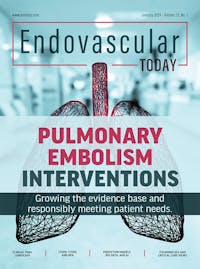
In this special issue of Endovascular Today, experts on pulmonary embolism (PE) share their perspectives on this very hot topic. PE is the third most common cardiovascular cause of death, and the association with poor health and quality of life in the years following PE is well known. PE is finally getting the attention it has needed for so long—and getting it in spades.
PE is a fascinating disease: It has an acute, dramatic presentation that is often masquerading as something else and is too often discovered while another diagnosis is assumed. Drs. Drew Birrenkott and Christopher Kabrhel, who are on the front lines of PE diagnosis and have contributed much knowledge to this topic, bring us up to speed on rules and models to determine the likelihood of PE during the frenetic and confusing initial presentation.
Furthermore, there is much controversy and many questions about aggressive management beyond anticoagulation with catheter-directed therapy (CDT), especially regarding intermediate-risk PE. Two giants in the field of venous thromboembolism, Dr. Suresh Vedantham and Prof. Stavros Konstantinides, give us their perspectives on the data to this point and the clinical trials that are underway to address gaps in knowledge. Diving deeply into one of these clinical trials, Drs. Nancy Amoroso and Bedros Taslakian describe their experience as the first clinical trial site to be activated and enrolled in PE-TRACT, the National Institutes of Health–funded randomized clinical trial of CDT plus anticoagulation versus no CDT in intermediate-risk PE patients.
But, PE management encompasses so much more than the catheters and technology that have dominated the recent conversation. Dr. Frances Mae West offers a pulmonologist’s perspective and her personal experience managing complex PE patients and what the future holds. Drs. Eugene Yuriditsky and James Horowitz, who have contributed seminal articles on managing severe PE, summarize best practices for acute intensive care medical management.
As mentioned earlier, PE becomes a chronic problem for a large minority of patients. In particular, chronic thromboembolic pulmonary hypertension (CTEPH) and chronic thromboembolic pulmonary disease (CTEPD) are highly disabling consequences of PE. Drs. Riyaz Bashir, William Auger, and Kenneth Rosenfield, who have prodigious experience using balloon pulmonary angioplasty (BPA) to treat CTEPH and CTEPD, eloquently bring us up to speed on the state of the disease, the promise of BPA, and what is needed to determine whether BPA should be part of the treatment algorithm for these most grave PE sequelae.
Finally, innovation in PE is not restricted to medical or device development. PE requires rapid diagnosis, coordination, organization, mobilization, and potentially interhospital transfer in a consolidated health care environment, markedly complicating the job of PE response teams. Managing PE has therefore become one of the tangible examples of how artificial intelligence (AI) has the potential to revolutionize health care. Dr. Parth Rali et al thoughtfully describe how AI may shape PE care and improve outcomes.
As this issue was assembled, what struck me most was: (1) how layered the diagnosis and management of PE is, (2) how far we have come, (3) how much further we have to go, and (4) how inspired I am to see physicians from multiple specialties move our knowledge forward. In the latter half of the 2010s, I was concerned that we would be in the same place 10 years later, but that is clearly not the case. I hope you enjoy this special issue, and I look forward to the discussions and conversations in the coming years in hospital hallways and national and international meetings about this vexing disease.
Akhilesh K. Sista, MD, FSIR, FAHA
Guest Chief Medical Editor
Advertisement
Advertisement