Advertisement
Advertisement
July 2024 Supplement
Sponsored by The PERT Consortium™
PERT International: Enhancing Patient Outcomes Globally
Establishing National PERT networks in Europe and around the world.
By Mona Ranade, MD; Mahir Elder, MD, FACC, FSCAI; and Stavros Konstantinides, MD
Pulmonary embolism (PE) is a life-threatening, acute cardiovascular disorder and remains a significant cause of morbidity and mortality worldwide.1 The concept of the Pulmonary Embolism Response Team (PERT) aims at establishing a multidisciplinary, multispecialty team of experts involved in the care of acute PE at each hospital, with a clear focus on challenging, potentially life-threatening cases and clinical scenarios.2 After a centralized activation process, the team convenes to provide rapid risk assessment of the patient with acute PE and reach consensus on the best individualized diagnostic and therapeutic approach, taking into account the expertise and resources available on site. This article aims to summarize the added clinical value of multidisciplinary PERTs and advocate for the establishment of National PERT networks in countries outside the United States, with the ultimate goal of building an international PERT community and collaboration.
A recent scoping review and meta-analysis suggested that PERT implementation may lead to greater use of advanced therapies and shorter in-hospital stay.3 The authors reported that, when focusing on patients with “severe” intermediate- or high-risk PE, the effect estimates for mortality tended to be lower for patients treated in the PERT era compared to those treated before PERT implementation (risk ratio, 0.71; 95% CI, 0.45-1.12). In line with these findings, an observational cohort study in the United States reported an association between the implementation of a PERT and a sustained reduction (from 24% to 14%) in mortality at 6 months for patients with submassive (intermediate-high–risk) and massive (high-risk) PE.4 Post-PERT patients received more efficient care, defined as reduced time from triage to diagnosis, from diagnosis to anticoagulation administration, and from triage to hospital admission. Post-PERT patients also had a reduced hospital length of stay (9.1 vs 6.5 days; P = .07).4 Meanwhile, favorable trends in patients’ outcomes in the PERT era compared to earlier, pre-PERT periods have also been reported from centers outside the United States.5
ADVANTAGES OF IMPLEMENTING NATIONAL AND INTERNATIONAL PERTs
Although the existing evidence does not yet directly “prove” a clear mortality benefit of PERTs for the prognosis of patients with acute PE, it has become clear that the implementation of a National PERT offers several compelling advantages in the management of PE. First, it promotes standardized care protocols and guidelines, ensuring consistency and quality across health care facilities nationwide. By leveraging the collective expertise of diverse specialists, including interventional cardiologists, radiologists, intensivists, pulmonologists, hematologists, and vascular surgeons, a National PERT can optimize resource utilization and streamline decision-making processes, particularly in cases of high-risk and intermediate-high–risk PE where time is of the essence.6-8 Moreover, a National PERT fosters collaboration and knowledge exchange among health care professionals, facilitating ongoing education and training initiatives to enhance clinical proficiency in PE management. This collaborative model also promotes research and innovation, driving advancements in diagnostic techniques and therapeutic interventions.
Finally, a National PERT serves as a vital platform for data collection and analysis, enabling continuous quality improvement and benchmarking efforts to evaluate the efficacy of interventions and refine best practices in PE management. By harnessing real-world data and insights,8 health care stakeholders can identify trends, address disparities, and implement targeted interventions to optimize patient outcomes and reduce the burden of PE-related morbidity and mortality nationwide.
The aim of PERT International is to disseminate knowledge gleaned from the formation of The National PERT Consortium™ and PERT database and allow for other countries to easily adapt the existing model and strategies to their own local environment. By advocating for the establishment of a PERT International, health care leaders can leverage interdisciplinary collaboration, standardized protocols, and data-driven strategies to enhance the quality and efficiency of PE care delivery at a global level.
FOSTERING INTERNATIONAL, MULTIDISCIPLINARY COLLABORATION: THE EUROPEAN PERSPECTIVE
In Europe, implementation of PERTs in hospitals began only recently,5,9 but it is now progressing at an increasing pace and is strongly advocated in a recently published consensus statement by working groups of the European Society of Cardiology (ESC).6 At the national level, the German Cardiac Society has published a position paper on the interventional treatment and multidisciplinary management strategies for acute PE.10 The Society acknowledged the fact that the availability of a growing number of innovative treatment options, notably catheter-directed pharmacomechanical fibrinolysis and mechanical thrombectomy, presents unprecedented opportunities for more effective and safer management of intermediate- and high-risk PE. At the same time, this innovation represents a major challenge for physicians involved in the treatment of PE in daily practice and is expected to have a major socioeconomic impact on health care systems. Accordingly, the question addressed in this consensus document was, among others, “How should a multidisciplinary PE team be structured at the local hospital level for acute situations, and what standardized processes should it use for its decisions and actions?”10 The document provides information and guidance for clinical practice based on the existing evidence, and strongly supports the implementation of multidisciplinary, multispecialty PE teams with clear activation and decision-making protocols (Figure 1).
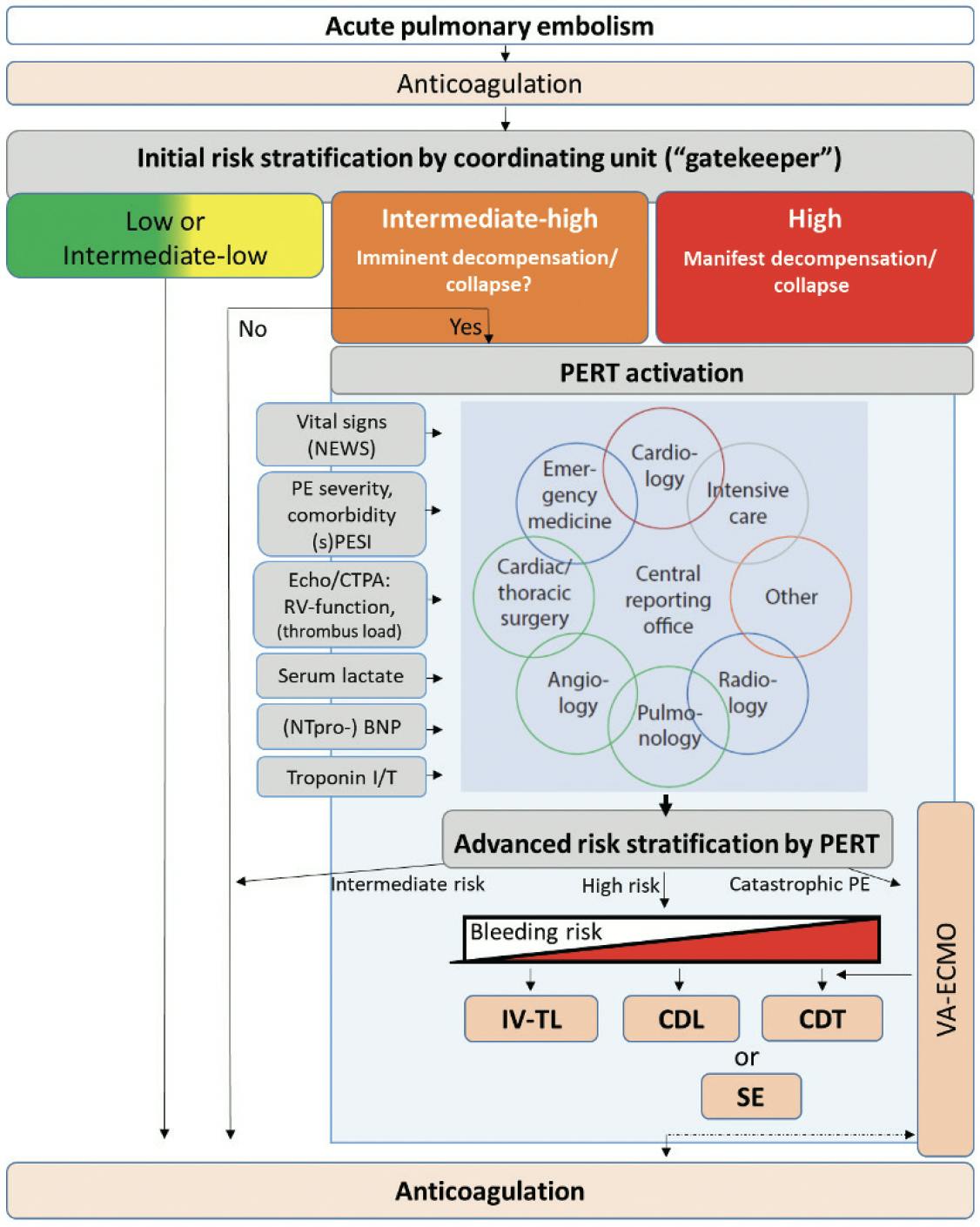
Figure 1. Proposal of the German Cardiac Society for the structure, activation, and decision-making criteria for multidisciplinary PERTs. These must be adjusted based on locally available expertise and resources. Reproduced with permission from: Ghanem A, Andrassy M, Dürschmied D, et al. Interventionelle Therapie und multidisziplinäre Managementstrategien für die akute Lungenembolie. Die Kardiologie. 2023;17:141-159. Published by Springer Medizin Verlag GmbH, a member of Springer Nature Group. CDL, catheter-directed lysis (fibrinolysis); CDT, catheter-directed thrombectomy; IV-TL, intravenous thrombolysis; LV, left ventricular; NEWS, National Early Warning Score; RV, right ventricular; SE, surgical embolectomy; sPESI, simplified Pulmonary Embolism Severity Index; VA-ECMO, venoarterial extracorporeal membrane oxygenation.
The German Society has further endorsed the initiation of PERT-DACH, a prospective, multicenter, German-Austrian-Swiss quality assurance database registry, with a concept and design analogous to that of the United States PERT Consortium™ Registry11,12; as of June 2024, funding has been secured and patient enrollment will commence shortly. Close collaboration with The PERT Consortium™ in the United States has been established, and a recent publication highlights how the United States experience with a National PERT can help generate models for the future impact of technologic innovations in PE treatment on European health care systems.13
Finally, and importantly, a new “EXPERT-PE” study group has been established within the Acute CardioVascular Care Association of the ESC.14 Its objectives are to15:
- Create a European multidisciplinary network focused on care for the PE patient with hemodynamic or respiratory compromise
- Support the establishment of multidisciplinary teams of experts across Europe
- Identify and map existing hospital and national PERTs, surveying for local practice patterns
- Disseminate knowledge on the multimodality management of PE
- Define quality indicators and levels of care for EXPERT-PE teams
- Harmonize parameters (common data elements) for use in PE clinical practice and research
- Engage in advocacy activities
The overarching aim of the new study group, which maintains close transatlantic collaboration with The PERT Consortium™ in the United States, is thus to provide a prototype of multidisciplinary and quality assurance in the practice and science of PE management. It is expected that this guidance will, as a next step, be adapted and endorsed by the European, Central Asian, North African, and Middle East scientific societies comprising the ESC and promoted for implementation at each country’s national level (Figure 2).
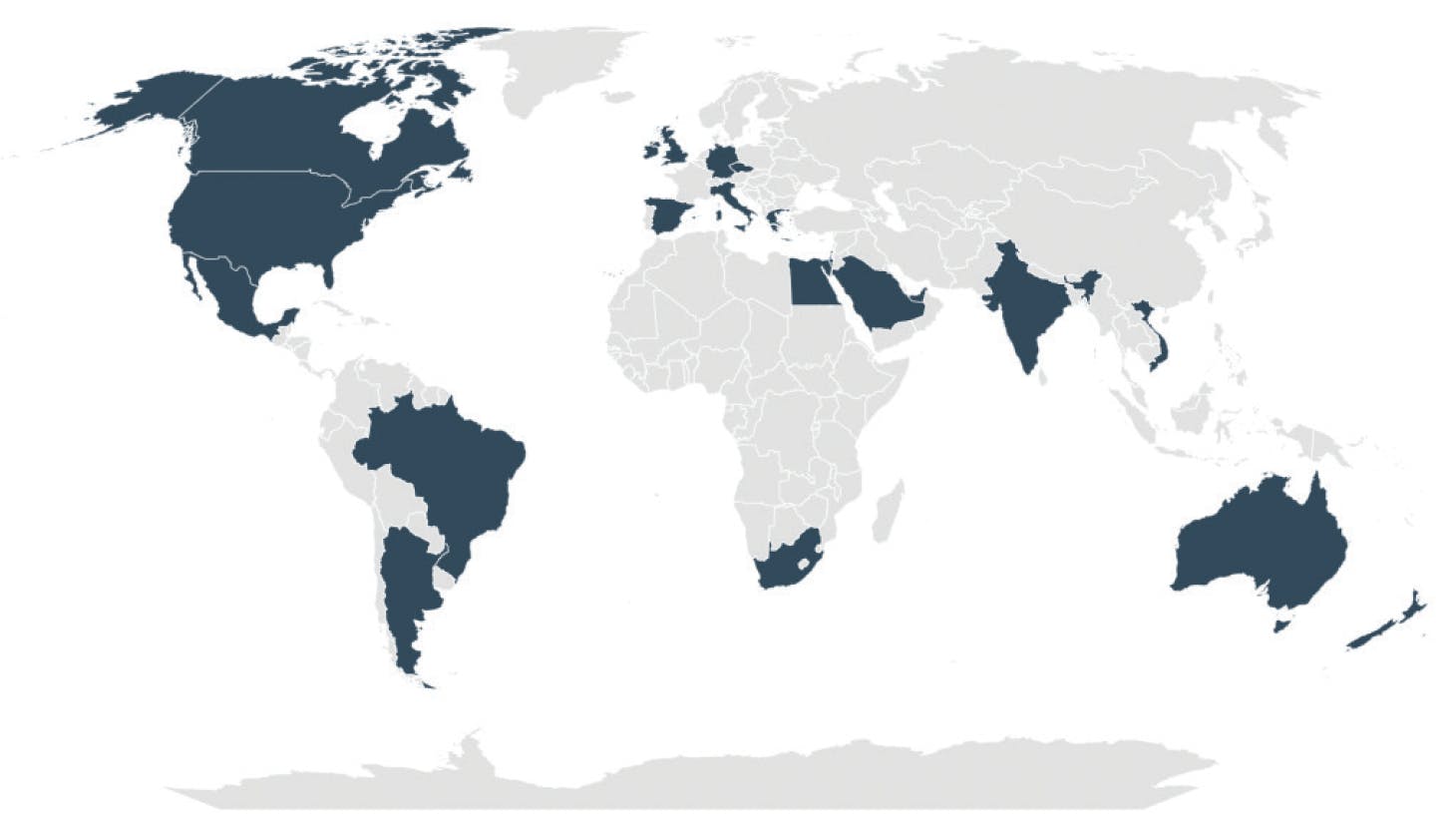
Figure 2. Countries that have expressed interest in a National PERT.
Several private groups/doctors from these regions have approached the leadership at The National PERT Consortium™ to see ways in which we can collaborate, share strategies, guide in creation of centers of excellence, and address international membership to the nonprofit organization. This is still an evolving process as the interest abroad increases and certainly an incredible opportunity for international collaboration. We are excited to see how this process unfolds in the next coming years and hopefully allows us to move the needle on mortality associated with this disease state.
1. Barco S, Valerio L, Ageno W, et al. Age-sex specific pulmonary embolism-related mortality in the USA and Canada, 2000-18: an analysis of the WHO Mortality Database and of the CDC Multiple Cause of Death database. Lancet Respir Med. 2021;9:33-42. doi: 10.1016/S2213-2600(20)30417-3
2. Porres-Aguilar M, Rosovsky RP, Rivera-Lebron BN, et al. Pulmonary embolism response teams: Changing the paradigm in the care for acute pulmonary embolism. J Thromb Haemost. 2022;20:2457-2464. doi: 10.1111/jth.15832
3. Hobohm L, Farmakis IT, Keller K, et al. Pulmonary embolism response team (PERT) implementation and its clinical value across countries: a scoping review and meta-analysis. Clin Res Cardiol. 2023;112:1351-1361. doi: 10.1007/s00392-022-02077-0
4. Wright C, Goldenberg I, Schleede S, et al. Effect of a multidisciplinary pulmonary embolism response team on patient mortality. Am J Cardiol. 2021;161:102-107. doi: 10.1016/j.amjcard.2021.08.066
5. Sagoschen I, Scibior B, Farmakis IT, et al. A multidisciplinary pulmonary embolism response team (PERT): first experience from a single center in Germany. Clin Res Cardiol. 2024;113:581-590. doi: 10.1007/s00392-023-02364-4
6. Pruszczyk P, Klok FA, Kucher N, et al. Percutaneous treatment options for acute pulmonary embolism: a clinical consensus statement by the ESC Working Group on Pulmonary Circulation and Right Ventricular Function and the European Association of Percutaneous Cardiovascular Interventions. EuroIntervention. 2022;18:e623-e638. doi: 10.4244/EIJ-D-22-00246
7. Giri J, Sista AK, Weinberg I, et al. Interventional therapies for acute pulmonary embolism: current status and principles for the development of novel evidence: a scientific statement from the American Heart Association. Circulation. 2019;140:e774-e801. doi: 10.1161/CIR.0000000000000707
8. Kobayashi T, Pugliese S, Sethi SS, et al. Contemporary management and outcomes of patients with high-risk pulmonary embolism. J Am Coll Cardiol. 2024;83:35-43. doi: 10.1016/j.jacc.2023.10.026
9. Araszkiewicz A, Kurzyna M, Kopec G, et al. Pulmonary embolism response team: A multidisciplinary approach to pulmonary embolism treatment. Polish PERT Initiative Report. Kardiol Pol. 2021;79:1311-1319. doi: 10.33963/KP.a2021.0130
10. Ghanem A, Andrassy M, Dürschmied D, et al. Interventionelle Therapie und multidisziplinäre Managementstrategien für die akute Lungenembolie. Die Kardiologie. 2023;17:141-159. https://doi.org/10.1007/s12181-023-00610-7
11. Rosovsky R, Chang Y, Rosenfield K, et al. Changes in treatment and outcomes after creation of a pulmonary embolism response team (PERT), a 10-year analysis. J Thromb Thrombolysis. 2019;47:31-40. doi: 10.1007/s11239-018-1737-8
12. Kabrhel C, Rosovsky R, Channick R, et al. A multidisciplinary pulmonary embolism response team: initial 30-month experience with a novel approach to delivery of care to patients with submassive and massive pulmonary embolism. Chest. 2016;150:384-393. doi: 10.1016/j.chest.2016.03.011
13. Mohr K, Keeling B, Kaier K, et al. Modelling costs of interventional pulmonary embolism treatment: implications of US Trends for a European healthcare system. Eur Heart J Acute Cardiovasc Care. Published online February 13, 2024. doi: 10.1093/ehjacc/zuae019
14. Pöss J, Ahrens I. The new acute cardiovascular care association study group EXPERT-PE on acute pulmonary embolism. Eur Heart J Acute Cardiovasc Care. 2023;12:411-412. doi: 10.1093/ehjacc/zuad046
15. European Society of Cardiology. ACVC Study Group EXPERT-PE on acute pulmonary embolism. https://www.escardio.org/Sub-specialty-communities/Association-for-Acute-CardioVascular-Care-(ACVC)/About/acvc-study-group-expert-pe-on-acute-pulmonary-embolism. Accessed June 16, 2024.


Advertisement
Advertisement