Advertisement
Advertisement
July 2024
An Interview With Athanasios Saratzis, MBBS, FHEA, PhD, FRCS
Prof. Saratzis considers vascular research needs, including clinical/cost-effectiveness data for PAD therapies; provides an update on the EVOCC trial and CRISP intervention; and shares advice for establishing one's research practice.
How would you characterize the main principles or foundation on which your clinical research is based?
I am a vascular surgeon with a clinical interest in treating peripheral artery disease (PAD) and new technologies (mostly endovascular devices/therapies). My academic interest(s) are therefore aligned. I mostly design and deliver effectiveness-driven randomized trials and applied research (eg, development of complex clinical interventions), all aiming to improve the life of people with vascular diseases.
I would say that the key foundation driving my research is sound methodology. It might sound strange, but a major proportion of vascular research is actually not designed or powered to deliver an answer to a meaningful hypothesis using appropriate methodology. I hope to change this.
Among the numerous clinical trials you have a hand in is EVOCC, which is evaluating the clinical and cost-effectiveness of endovascular versus open revascularization in severe occlusive aortoiliac disease. As Chief Investigator, can you summarize EVOCC’s place among the PAD landscape? What are the unanswered questions you plan to address?
EVOCC is a major randomized controlled trial (RCT), and following the delivery of the BASIL portfolio and BEST-CLI, it is essentially the only RCT assessing the effectiveness of endovascular PAD therapies versus the established open surgery. The vascular community has quickly adopted the use of endovascular techniques such as kissing stents or covered endovascular reconstruction of the aortic bifurcation for TransAtlantic Inter-Society Consensus D aortoiliac lesions; however, this is without any randomized evidence to support these techniques in terms of benefit(s) to survival, amputation rates, or quality of life.
This is the evidence that will be generated by EVOCC, which is also powered to assess differences in quality of life, amputation-free survival, and cost-effectiveness between the two approaches of open surgery versus endovascular therapy.
In terms of timeline, what are the next steps for EVOCC now that the pilot phase has been completed?
The pilot phase lasted 6 months, starting in October 2023. We recruited almost 60 patients from 10 hospitals in the National Health Service. We are now opening more sites across the United Kingdom and will recruit for another 18 months from 30 sites. All patients will be followed for a minimum of 2 years. The support from all colleagues in the recruiting sites has been amazing.
Along with running the trial, you’re also very involved in awareness efforts for the trial. What have you found to be most successful when it comes to trial promotion?
Most successful for trial promotion has been social media interaction and visiting sites to support study delivery. The latter allows us to present the study conduct and rationale to colleagues face to face, using the evidence we generated in observational studies when trying to fund EVOCC.
The Bristol University Qualitative Research Integrated within Trials (QuinteT) group is also supporting EVOCC. QuinteT conducts qualitative research such as interviews alongside trial delivery to understand the barriers/enablers in terms of recruitment and implements appropriate strategies accordingly. Their input has been crucial to the success of the pilot phase, in a study that is very difficult to deliver given issues surrounding surgeon equipoise.
Along with your personal research efforts, you are also invested in the advancement of vascular research overall, with roles in the European Society for Vascular Surgery European Research Hub and Vascular and Endovascular Research Network (VERN), to name a few. How would you describe the value of these collaboratives?
Vascular research has long suffered from poor stakeholder engagement and low recruitment rates. These collaborative approaches are a great way to address these issues. For example, VERN uses a novel model where trainees lead the way in terms of inception, design, and study delivery. The rate at which VERN has been recruiting to studies internationally, especially in prospective studies, is unique.
I also strongly feel that such collaborative approaches support the delivery of equitable research and address some long-standing issues in the global vascular community, such as lack of engagement from underrepresented groups.
Finally, collaborative research networks ensure that allied health care professionals contribute to the delivery of vascular research, which is key to the success of our future work.
Health economics for PAD and chronic limb-threatening ischemia (CLTI) is something you’ve explored frequently, in EVOCC as well as the COSTLY-TLR study, a publication in BJS Open, and as an enrolling center in BASIL-3.1,2 As we uncover more data about the impact of CLTI on health care use and the clinical and cost-effectiveness of PAD/CLTI procedures, what are the next steps we should be striving toward?
We often feel that revascularization in CLTI costs more than an early amputation and can frequently fail to offer patients complex revascularization procedures to salvage their limb(s). Our recent work shows that this is not always true, and early revascularization is cost-effective. I think that unless we properly explore cost-related issues in treating CLTI, we will never be able to fund care pathways that will improve the really high amputation and mortality rates associated with CLTI. We essentially must convince those who are funding care for these patients that they must invest in better technologies and improved pathways of care. Unless we produce relevant high-quality evidence, this will never happen.
Shifting gears to abdominal aortic aneurysm (AAA), you recently published an overview of CRISP, an intervention aimed at reducing cardiovascular risk among those in AAA surveillance programs.3 How did this project come about, and what is its basic framework? Once validated and adopted, how do you envision CRISP impacting risk management in this population?
The CRISP study aimed to develop a health optimization clinical intervention that could be used by patients with small- or moderate-sized aortic aneurysms, alongside their aneurysm surveillance. Most of these patients will have major cardiovascular events or even die due to a myocardial infarction or stroke while they are undergoing aneurysm surveillance, rather than experience an aortic aneurysm rupture.
The CRISP intervention addresses this issue by helping health care professionals (ie, aneurysm surveillance staff) and patients modify their cardiovascular risk factors based on the best available evidence and using simple tools such as the “Heart Health Manual,” which we developed with patients.
We now aim to expand the CRISP intervention to ensure it can be used by people with bigger aneurysms prior to surgery and postoperatively, as well as by people with PAD, who have similar risk factors.
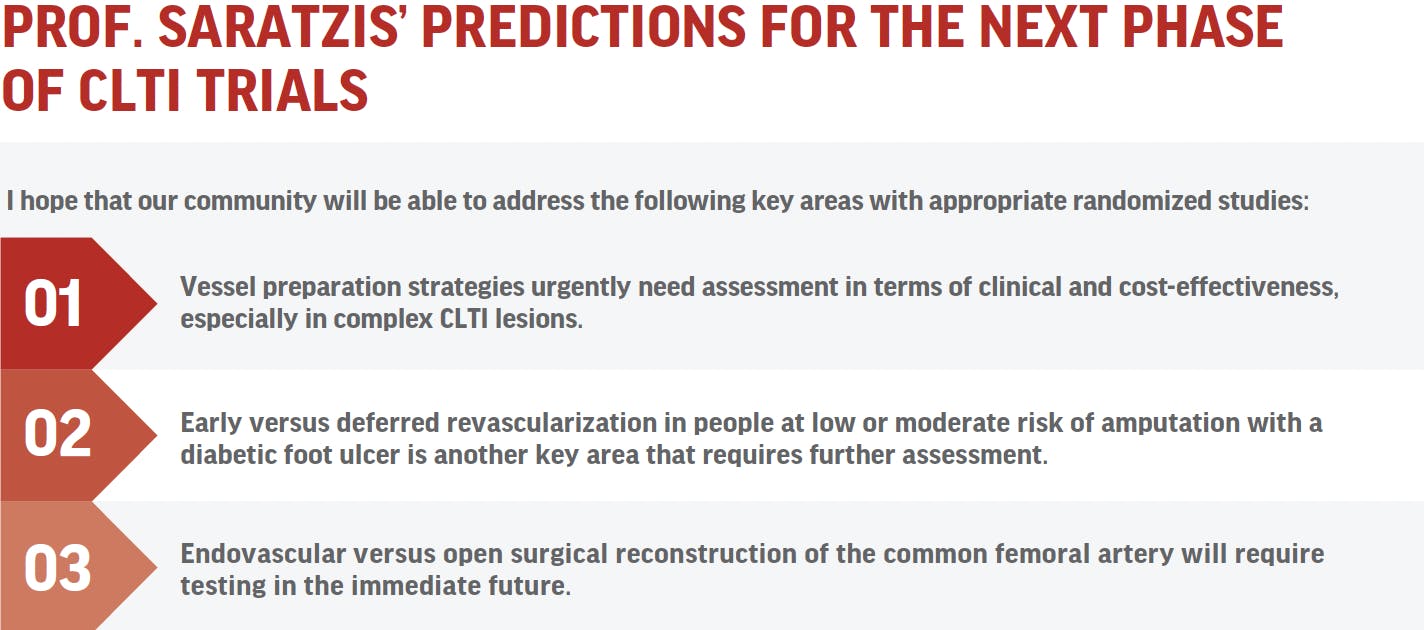
Last year you shared with us about PAEDIS, a trial development project aiming to identify the optimal design of a large-scale platform trial on PAD.4 What is the current status of this project? What insights have you gained regarding trial design and gaps in the current evidence base?
An international group of surgeons, radiologists, and other health care professionals set out to design a complex RCT (platform trial) that would enable us to test new PAD technologies in an efficient manner. We have just published what we thought was the best design for such a trial. Unfortunately, the National Institute for Health and Care Research found the proposal too expensive at present, and we will not be able to start this work in the immediate future.
However, we do hope to be able to fund such a complex RCT at some point, as we are seeing dozens of new PAD technologies introduced in clinical care based only on efficacy-driven small studies, without any clinical or cost-effectiveness data to support their use or even test their safety.
What advice would you share with early career physicians on establishing their research practice?
Persevere. Designing and delivering high-quality clinical research makes a major difference to people’s lives and improves the health of our societies. Unfortunately, the bureaucracy involved at present is very difficult to deal with, and funding does not come easy, especially for randomized trials. At the same time, with patience and perseverance, one can achieve their aims. For the sake of patients, health care systems, and society, we really need to safeguard applied medical research. Please do not give up!
1. Endovascular Today. COSTLY-TLR study evaluates costs of TLR after femoropopliteal PAD intervention. May 6, 2024. Accessed May 17, 2024. https://evtoday.com/news/costly-tlr-study-evaluates-costs-of-tlr-after-femoropopliteal-pad-intervention
2. Saratzis A, Musto L, Kumar S, et al. Outcomes and use of healthcare resources after an intervention for chronic limb-threatening ischaemia. BJS Open. 2023 ;7:zrad112. doi: 10.1093/bjsopen/zrad112
3. Withers TM, Greaves CJ, Bown MJ, Saratzis A. Improving cardiovascular health in patients with an abdominal aortic aneurysm: development of the cardiovascular risk reduction in patients with aneurysms (CRISP) behaviour change intervention. Pilot Feasibility Stud. 2024;10:17. doi: 10.1186/s40814-024-01445-z
4. Saratzis A. Designing a platform/adaptive trial for PAD: the PAEDIS international platform trial development project. Endovasc Today. 2024;7:83-85.
Advertisement
Advertisement
Interested in reading more interviews?
To read more interviews with thought leaders in the vascular field, check out our Profiles & Perspectives hub.
Read More