Advertisement
Advertisement
July 2024
Sponsored by Medtronic
Nontraditional Venous Stent Patient Pathways


A pelvic vein obstruction can cause unexplained leg pain or swelling, pelvic pain, and various other discomforts, including dyspareunia. The most common cause of pelvic vein obstruction is compression of the iliac vein in the pelvis. Patient presentation for the diagnosis of iliac vein compression may not be straightforward. It is important to thoroughly evaluate patient symptoms, medical history, and impact on quality of life (QOL) to identify individuals who would benefit from treatment. In appropriately selected patients, stent placement results in reduced leg swelling, improved pelvic/leg pain, and overall QOL.1 The Abre™ venous self-expanding stent system (Medtronic, https://manuals.medtronic.com/manuals/) is indicated for use in iliofemoral veins for treatment of symptomatic venous outflow obstruction. One cause of outflow obstruction is compression of the left common iliac vein (CIV) by the right common iliac artery, referred to as nonthrombotic iliac vein lesions (NIVLs). Abre stent patency has been shown to be well preserved in NIVL patients, as demonstrated recently by the 97.1% patency rate through 3 years in the ABRE study.2
CASE EXAMPLE 1
By Kush Desai, MD
Patient Presentation
A woman in her mid 30s with two prior pregnancies had a long-standing history of chronic pelvic pain that began several years after her first delivery and worsened after her second pregnancy. She underwent a hysterectomy, which did not alleviate any symptoms. The pain was exacerbated when standing for long periods of time, which she described as severe heaviness in her pelvis, localized on the left more than the right. Other associated symptoms included severe lingering pain after intercourse, as well as a sensation of incomplete and uncomfortable urination.
She was found to have ovarian vein reflux, which was treated with pelvic reservoir and ovarian vein embolization approximately 4 years prior to presentation. This procedure did initially alleviate some of the pelvic pain symptoms; however, they had since returned and became as severe as before. In addition, the patient had developed symptoms of significant left lower extremity heaviness and fatigue with extended periods of standing and activity. These symptoms improved with rest and lying supine. She described subjective edema, although no overt edema was clearly present on examination. Overall, this constellation of symptoms made it impossible for her to work.
Procedural Overview
Available CT abdominal imaging was reviewed, which demonstrated compression of the left CIV by the right common iliac artery (Figure 1A). It was discussed that the compression lesion likely reflected a significant pelvic pain generator, as well as the cause of her left lower extremity venous claudication symptoms. She was scheduled for left iliac venography, intravascular ultrasound (IVUS), and potential stent placement.
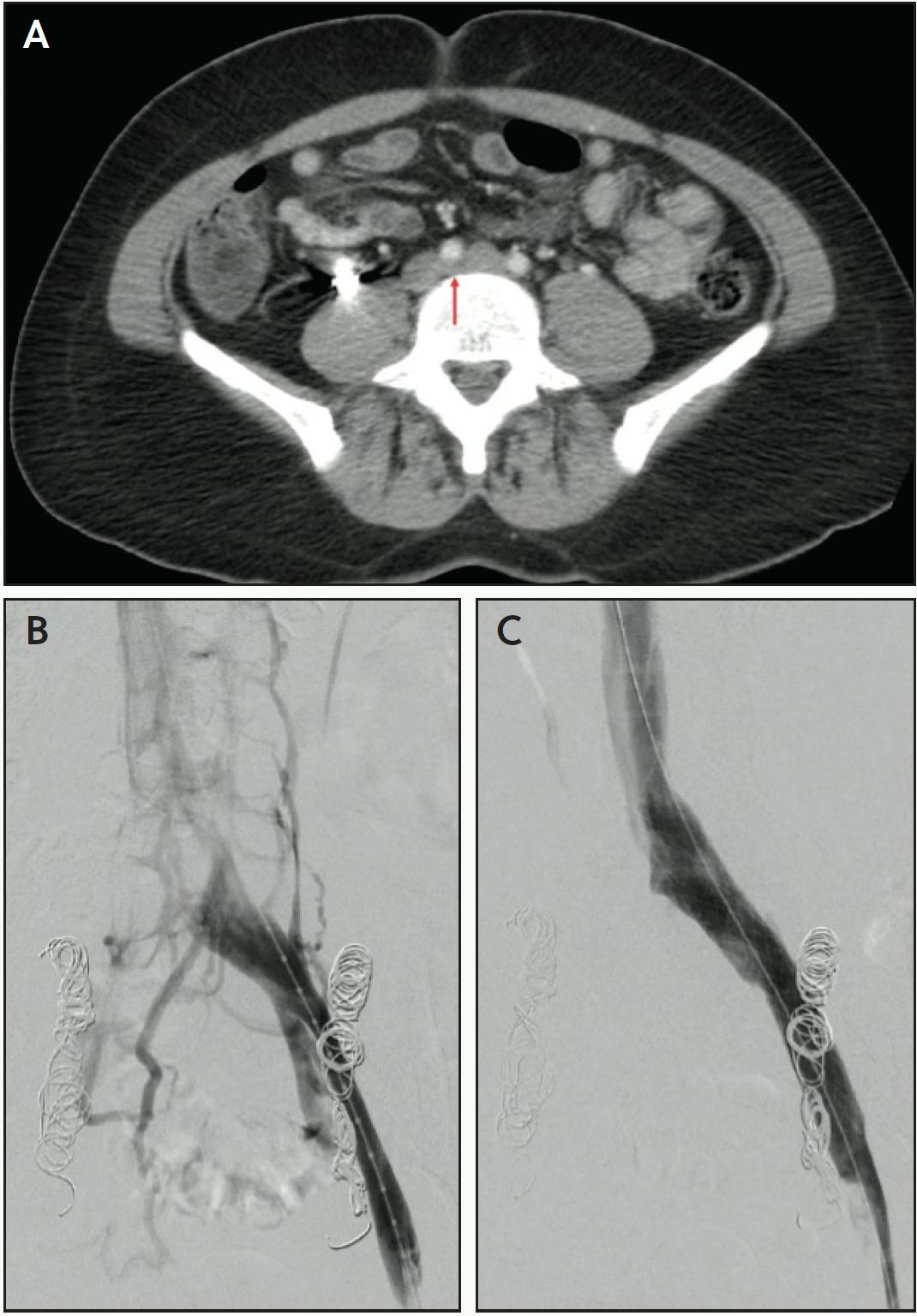
Figure 1. Postcontrast axial CT of the pelvis demonstrated compression of the left CIV by the right common iliac artery (red arrow) (A). Digital subtraction venography demonstrated severe obstruction of the left CIV with associated presence of pelvic and lumbar collaterals (B). After stent placement, the obstruction was relieved, and collaterals were no longer present (C).
Venography demonstrated significant obstruction, with associated lumbar and pelvic collaterals present (Figure 1B). IVUS was performed (not shown), demonstrating > 80% obstruction by average diameter and a reference external iliac vein (EIV) diameter of approximately 12.5 mm. A 14-mm balloon was used to perform predilation, followed by placement of a 14- X 120-mm Abre stent with a 14-mm balloon postdilation. The completion venogram demonstrated brisk flow (Figure 1C), and the pelvic/lumbar collaterals were no longer present.
Postprocedure Follow-Up
At 1-month follow-up, she reported complete resolution of pelvic pain symptoms, including dyspareunia and voiding symptoms. Further, her left lower extremity venous claudication symptoms had resolved as well. She noted marked improvement in her QOL. These results have been maintained through 2 years of follow-up.
Discussion
This case highlights the complexity of female pelvic venous disease, where multiple pain/symptom generators can be present. It is important to elicit the dominant symptoms and then perform relevant interventions in a stepwise approach. Further, it is important to counsel patients on expected outcomes, which can be variable in magnitude and rate of improvement.
CASE EXAMPLE 2
By Aravinda Nanjundappa, MD
Patient Presentation
A woman in her mid 40s presented to our outpatient clinic with left leg swelling. Her medical history included five uncomplicated pregnancies without pregnancy-induced hypertension or diabetes and no prior history of malignancy, prolonged immobilization, hypercoagulability, or previous venous intervention. Her risk factors for deep vein thrombosis (DVT) included body mass index of 28 kg/m2, maternal family history of DVT, and history of hypercoagulability unclear for factor V deficiency.
Her recent medical history revealed a diagnosis of extensive DVT in the left leg extending from the iliofemoral veins to the popliteal and calf veins. This diagnosis was made after the patient underwent ligament repair surgery in her left ankle following an ankle injury. Her DVT treatment included therapeutic doses of apixaban, support stockings, and early ambulation. Her mild dyspnea on exertion prompted a CT, which was negative for pulmonary embolism.
She presented to the emergency department 7 months after the DVT diagnosis for severe throbbing pain (most notably in the left groin) and swelling, indicating she was unable to walk or bear weight on her left leg. Initial physical examination was not consistent with phlegmasia. A repeat scan showed chronic DVT changes in the left iliac veins. At that time, she was advised leg elevation and use of compression stockings.
She presented to our clinic with continuation of symptoms, including left leg swelling, edema, fatigue after walking, and leg heaviness. Physical examination revealed a left leg diameter greater than the right leg from the hip to calf; telangiectasia; varicose veins; and intact palpable femoral, popliteal, and pedal pulses. She noted mild discomfort on calf squeeze, and faint purple discoloration of the left shin and ankle was seen. An MR venogram of the abdomen and pelvis revealed compression of the left CIV between the right common iliac artery and the vertebral body, consistent with May-Thurner syndrome (MTS). Venous duplex ultrasound (DUS) showed extensive occlusive thrombus from the EIV to the calf veins. She was evaluated for postthrombotic syndrome (PTS) and noted to have a Villalta score of 10.
In view of persistent leg swelling and symptoms despite optimal guideline-derived therapy, as well as findings consistent with MTS, the decision was made to pursue femoral venography and plan for possible balloon angioplasty and iliocaval stent placement to recanalize the occluded iliocaval veins.
Procedural Overview
The patient was brought to the cardiac catheterization laboratory and made to lie prone under conscious sedation. The initial venogram showed an occluded deep femoral vein, common femoral vein (CFV), EIV, and CIV on the left (Figure 2A). The inferior vena cava (IVC) was noted to be filling late via collaterals. Balloon predilation was performed, and IVUS was used to confirm the left CIV compression and vein sizing for appropriate stent sizing. Two Abre stents (14 X 150 mm and 14 X 80 mm) were deployed with two to three struts into the distal IVC. The distal end of the stent terminated just above the profunda femoral vein, and the stent overlap was proximal to the inguinal ligament. The stents were postdilated with a 14-mm balloon.
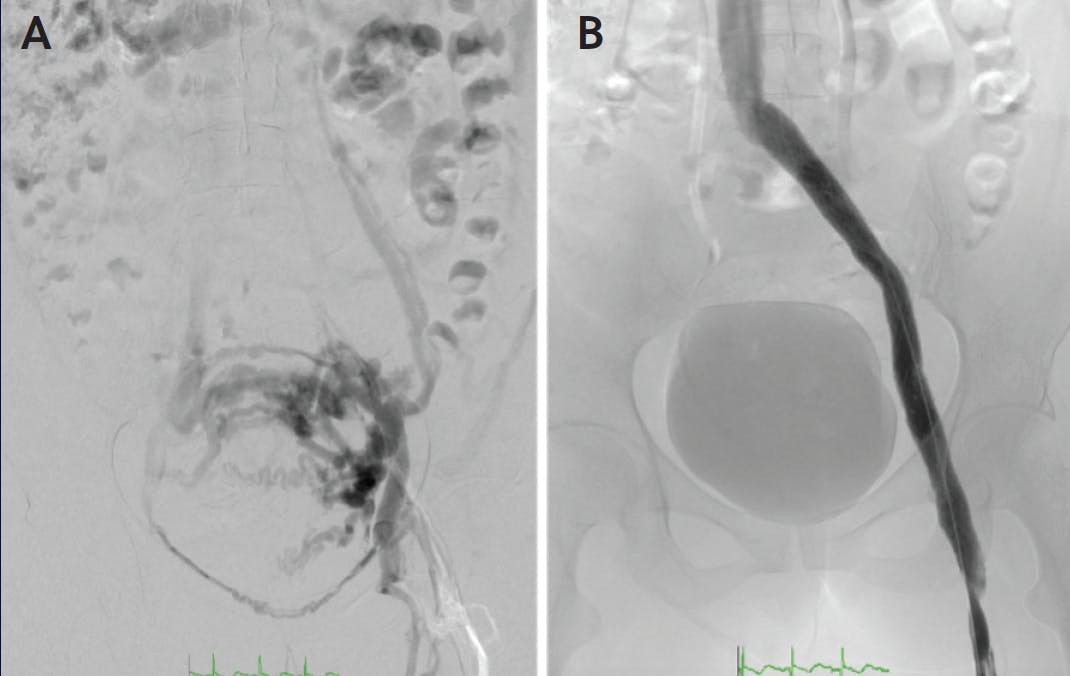
Figure 2. Initial venogram demonstrated occluded CIV, EIV, and femoral vein with robust pelvic collaterals (A). After stent placement, widely patent stents were seen in the CIV, EIV, and CFV just proximal to the profunda femoral vein (B).
The final venogram showed widely patent stents in the CIV, EIV, and CFV just proximal to the profunda femoral vein (Figure 2B). IVUS after stent placement confirmed adequate stent expansion and appropriate coverage of the compression area by the stent, as well as a patent contralateral iliac vein.
Postprocedure anticoagulation was continued with subcutaneous enoxaparin sodium 1 mg/kg twice daily for 5 days to reduce inflammation, then transitioned to apixaban 5 mg by mouth twice daily. The patient was instructed to continue wearing her support stockings and to ambulate.
Postprocedure Follow-Up
At her 30-day follow-up visit, DUS showed patent stents with reduced left leg swelling and no further pain on ambulation. The repeat Villalta score decreased to 4, and no limitations of fatigue or tiredness of leg on walking persisted.
Discussion
This case illustrates appropriate diagnosis of MTS in a young female with provoked DVT. Unfortunately, the prolonged DVT resulted in this patient’s progression to PTS. It is important to evaluate these patients for possible catheter-based balloon angioplasty and IVUS-guided stent placement to prevent PTS sequelae and relieve leg pain swelling and venous claudication symptoms.
Disclosures
Dr. Desai: Consultant to Asahi Intecc, Becton Dickinson, Boston Scientific, Cook Medical, Cordis, Medtronic, Penumbra, Tactile Medical, Varian, Veryan, and W.L. Gore.
Dr. Nanjundappa: Consultant to Abbott, Medtronic, Penumbra, Philips, Recor Medical, Shockwave, and ZOLL.
1. Joh M, Desai KR. Treatment of nonthrombotic iliac vein lesions. Semin Intervent Radiol. 2021;38:155-159. doi: 10.1055/s-0041-1727101
2. Black S, Sapoval M, Dexter DJ, et al; ABRE Study Investigators. Three-year outcomes of the Abre venous self-expanding stent system in patients with symptomatic iliofemoral venous outflow obstruction. J Vasc Interv Radiol. 2024;35:664-675.e5. doi: 10.1016/j.jvir.2024.01.030
Abre™ venous self-expanding stent system
Brief Statement
Intended Use/Indications: The Abre™ venous self-expanding stent system (Abre™ stent system) is indicated for use in the iliofemoral veins for the treatment of symptomatic venous outflow obstruction.
Contraindications: Do not use the Abre™ stent system with patients with known hypersensitivity to nickel titanium (nitinol), with patients who are judged to have a lesion that prevents complete inflation of a balloon dilatation catheter or proper placement of the stent or the stent delivery system, and with patients in whom anticoagulant or antiplatelet therapy is contraindicated.
Potential Adverse Effects of the Device on Health: The potential adverse effects (e.g., complications) associated with the use of the Abre™ stent system include, but are not limited to, access failure, access site infection, allergic reaction to contrast medium or procedure medications; aneurysm; AV fistula; bleeding; bruising; death; device breakage; device maldeployment; edema; embolization; fever; hematoma; hypertension; hypotension, nausea, or other vasovagal response; infection; myocardial infarction, arrhythmia, or other cardiovascular insufficiency; open surgical repair; pain; pseudoaneurysm; renal insufficiency or renal failure (new or worsening); respiratory distress or pulmonary embolism; sepsis; stent fracture; stent malapposition; stent malposition; stent migration; stroke, paradoxical embolism, transient ischemic attack, or intracerebral hemorrhage; tissue necrosis; venous occlusion, restenosis, or thrombosis, within or outside of stented segment; and vessel damage, including intimal injury, dissection, perforation, or rupture.
Warnings, precautions, and instructions for use can be found in the product labeling at http://manuals.medtronic.com.
CAUTION: Federal (USA) law restricts this device to sale by or on the order of a physician.
MR501524 ©2024 Medtronic. Medtronic, Medtronic logo are trademarks of Medtronic. All other brands are trademarks of Medtronic. For global distribution. 07/2024
Advertisement
Advertisement