Advertisement
Advertisement
March 2024
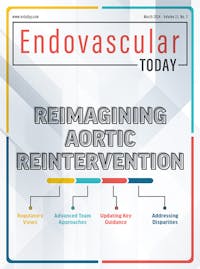
Evolving Views on Reintervention After Aortic Repair
Drs. Javairiah Fatima and Marc Schermerhorn share perspectives on whether reintervention necessarily constitutes failure.
With Javairiah Fatima, MD, FACS, RPVI, DFSVS, and Marc Schermerhorn, MD

Endovascular repair is being performed with increasing frequency for not just the infrarenal abdominal aortic aneurysms (AAAs) or thoracic aortic aneurysms amenable to endovascular aneurysm repair (EVAR) and thoracic endovascular aortic repair (TEVAR), but also, with technologic evolution, we have seen an increase in use of fenestrated/branched technology (F/BEVAR) for the more complex juxtarenal, pararenal, and thoracoabdominal aortic aneurysms (TAAAs). The premise for this is reduced physiologic stress and perioperative morbidity, as well as improved survival compared to open repair, even in the high-risk population, given the minimally invasive nature of F/BEVAR. Despite these benefits, the endovascular intervention remains fraught with increased need for reintervention or secondary intervention, noted to be in the range of 10% to 40%. This stems from complexity of the multimodular nature of the devices as well as due to underlying aortic pathology, and subsequently, there is a need for close surveillance to identify and treat them in a timely fashion to avoid downstream complications.
REINTERVENTIONS AFTER EVAR VERSUS F/BEVAR ARE NOT EQUAL
As the F/BEVAR technology gained momentum, reinterventions in this cohort were initially seen through the lens of reinterventions after EVAR. EVAR reinterventions have been shown to carry significant morbidity, including explant and open conversion with their inherent high morbidity and mortality. Additionally, an alarming 5.4% rate of rupture has been shown in patients treated with EVAR, and reinterventions account for approximately 10% of all EVAR-related deaths.1 However, as we have gained more experience and longer-term follow-up in F/BEVAR patients, we have developed more in-depth understanding of the failure modes of F/BEVAR, which are distinctly different from those of EVAR. We have learned that reintervention in F/BEVAR is usually benign and largely preventive in nature. This is a paradigm shift over the last few years. The need for reintervention in F/BEVAR can broadly be categorized as device/procedure-related, including component separation, limb or branch vessel occlusion, stent migration, device kinks, or fracture, or secondary to progressive degenerative aortic pathology such as proximal and distal aortic degeneration and subsequent endoleaks. Although once considered to be device failure, the need for reintervention is now considered an anticipated part of the process for such complex repairs.
Reintervention rates after F/BEVAR are frequent; however, approximately > 80% are remediated via minor, percutaneous, elective procedures that can be performed on an outpatient basis with excellent outcomes. Most commonly, reinterventions are performed to remediate target vessel instability secondary to type Ic and type III endoleaks, merely requiring stent relining or extensions. As one would expect, these are noted more frequently with increasing extent and complexity of the aortic pathology being addressed. Another frequent need for reintervention is type II endoleaks in patients with > 5-mm sac expansion on follow-up imaging; these can be addressed with percutaneous embolization procedures to halt sac expansion and prevent loss of proximal seal, therefore enhancing the durability of repair and impact on survival associated with sac shrinkage. As the role of F/BEVAR has expanded to treatment of postdissection TAAA with known multiple sets of large lumbar arteries, the reintervention rates are higher yet, including planned reinterventions to treat/embolize these lumbar arteries in a delayed fashion as a strategic, staged plan to prevent spinal cord ischemia. Another less common cause of reintervention is related to access site procedures, or proximal (TEVAR) or distal (EVAR or iliac extensions, including iliac branch devices) extension due to aortic degenerative disease. Major complications such as open conversions, bowel ischemia requiring bypasses, infections requiring explantation, or other major reinterventions performed as life-saving measures are indeed harbingers of lower survival, but their occurrence is very low.
DO REINTERVENTIONS IMPACT SURVIVAL?
Although the primary goal for AAA repair is prevention of aneurysm-related mortality, it is important to evaluate whether these reinterventions impact survival. This has been looked at by various individual centers with well-established aortic practices and shown to have no impact on long-term survival.2-4 A recent publication from the United States Fenestrated and Branched Aortic Research Consortium demonstrated excellent outcomes from secondary reinterventions and 94% technical success with < 1% associated mortality; in fact, it showed evidence that reinterventions were associated with improved long-term survival.5 This can be explained by the minimal physiologic impact of the secondary interventions performed as a preventive measure done a timely fashion, which can avert dire consequences such as loss of target vessels with end-organ ischemia and fatality due to AAA rupture in the long term. This highlights the significance of scheduled interval surveillance imaging in the short and long term for early detection of device or anatomic factors that can avoid catastrophic complications by prompt attention with simple reinterventions.
REINTERVENTIONS AFTER COMPLEX EVAR MAY BE THE RESULT OF STRICT SURVEILLANCE MANDATES
A vast majority of these complex endovascular aortic repairs are performed as part of investigational device exemptions with adherence to strict surveillance mandates. The higher rate of secondary interventions is a testament to the need for close follow-up with various imaging modalities, early detection, and preventive remediation for superior long-term outcomes. This also emphasizes the need for thoughtful selection of patients who are amenable to being compliant with the short- and long-term follow-up and surveillance imaging required for F/BEVAR. This calls for investment of the surgical team in patient education to help them understand the importance of compliance with postoperative follow-up for optimization of long-term outcomes.
CONCLUSION
It is important to understand that all reinterventions should not be equated to adverse events or failure of F/BEVAR. The reinterventions performed as a preventive measure to address surveillance imaging findings that can avoid potentially devastating complications if left undetected or untreated must be distinguished from those performed as a response to treat adverse events that have already occurred. Fortunately, with growing experience and follow-up, we have learned that most aortic reinterventions in the F/BEVAR patients are performed to prevent “failure” and are necessary adjuncts to prolong durability of repair and ultimately improve patient survival.
1. Schermerhorn ML, Buck DB, O’Malley AJ, et al. Long-term outcomes of abdominal aortic aneurysm in the Medicare population. N Engl J Med. 2015;373:328-338. doi: 10.1056/NEJMoa1405778
2. Mastracci TM, Eagleton MJ, Kuramochi Y, et al. Twelve-year results of fenestrated endografts for juxtarenal and group IV thoracoabdominal aneurysms. J Vasc Surg. 2015;61:355-364. doi: 10.1016/j.jvs.2014.09.068
3. Oderich GS, Ribeiro M, Hofer J, et al. Prospective, nonrandomized study to evaluate endovascular repair of pararenal and thoracoabdominal aortic aneurysms using fenestrated-branched endografts based on supraceliac sealing zones. J Vasc Surg. 2017;65:1249-1259.e10. doi: 10.1016/j.jvs.2016.09.038
4. Giles KA, Scali ST, Pearce BJ, et al. Impact of secondary interventions on mortality after fenestrated branched endovascular aortic aneurysm repair. J Vasc Surg. 2019;70:1737-1746.e1. doi: 10.1016/j.jvs.2019.02.029
5. Zettervall SL, Tenorio ER, Schanzer A, et al; US Fenestrated and Branched Aortic Research Consortium. Secondary interventions after fenestrated/branched aneurysm repairs are common and nondetrimental to long-term survival. J Vasc Surg. 2022;75:1530-1538.e4. doi: 10.1016/j.jvs.2021.11.074

EVAR has gained wide acceptance and popularity compared with open repair of AAAs owing to the superior perioperative outcomes reported in randomized trials.1,2 Further developments led to the expansion of EVAR to the visceral and thoracic aortic segments with F/BEVAR and TEVAR. These procedures also offered better perioperative feasibility and safety than their open repair counterparts.3,4 However, the advantages of endovascular repair compared with open repair have been found to attenuate in the long term.3-5 In addition to the loss of survival benefit in the long term, studies have demonstrated higher late reintervention for AAA-related indications following endovascular repair as compared with open repair (EVAR vs open repair: 18% vs 3.7%; FEVAR vs open repair: 11% vs 6.1%; and TEVAR vs open repair: 23% vs 14%).6-8 Of note, higher aortic-related reintervention following endovascular repair was balanced by a higher rate of laparotomy/thoracotomy-related reinterventions and hospitalizations after open repair.6,9 Nevertheless, reinterventions after endovascular aortic repair may have implications on survival and quality of life, alongside durability and cost-effectiveness of the repair.
REINTERVENTIONS AFTER EVAR
Long-term data from the DREAM and EVAR 1 trials demonstrated 30% and 35% reintervention rates following EVAR at 6 years and 15 years.10,11 Similar results were reproduced using real-world data by Schermerhorn et al and Columbo et al.6,12 Using Medicare population, Schermerhorn et al reported a reintervention rate of 25% at 8 years.6 Columbo et al found 5-year reintervention rates of 20% in elective EVAR patients, 25% in symptomatic patients, and 27% in ruptured aneurysms.12 There was a rapid rise in reintervention rate to 5% by 3 months postprocedure, which then continued to increase yearly by 3% or 4%.12 In the Medicare analysis, 18.8% of reinterventions were found to be aneurysm-related, with 2.3% major, 18% minor, and 8.2% laparotomy-related.6 In another Medicare study, Giles et al reported that among patients with reinterventions after EVAR, 54% had only a single reintervention or readmission, 26% had two, and 20% had three or more reinterventions.13 Furthermore, they also confirmed that most reinterventions after EVAR are minor endovascular and found that reintervention-related mortality could only partially explain the loss of survival advantage of EVAR over open repair in the long term. Giles et al also showed that any reintervention after EVAR was associated with lower 5-year survival.13 Similarly, Chang et al found higher all-cause and aortic-related mortality in patients with any reintervention after EVAR.14 A 20% reduction in 5-year survival in patients who underwent any reintervention was noted by Giles et al, while Chang et al found that the long-term mortality hazard increased by 50% in patients with reintervention.13,14
REINTERVENTIONS AFTER FEVAR
In patients undergoing F/BEVAR, freedom from reintervention at 1 and 5 years has been reported to be 80% to 86% and 59% to 63%, respectively. There is consensus that most secondary interventions after F/BEVAR are endovascular and minor.15-19 Zettervall et al categorized reinterventions based on their physiological impact and found that low-magnitude reinterventions were more prevalent (81%).16 In contrast to the EVAR literature, in patients undergoing F/BEVAR, some studies have shown improved survival in those with reinterventions,15,16 some have demonstrated no difference,17,18 and one study found lower 3-year survival in those with reinterventions.19 Giles et al and Zettervall et al found that reintervention was associated with higher long-term survival after F/BEVAR.15,16 In patients who received the Zenith fenestrated device (Cook Medical), Dossabhoy et al found no association between reintervention and 5-year survival.17 Tachida et al showed that reintervention within 1 week of physician-modified endograft placement was associated with lower survival, but late-reintervention (beyond 1 week) patients had similar survival compared with no-reintervention patients.18 In the study by Gallitto et al, reintervention was found to be associated with higher 3-year mortality.19
REINTERVENTIONS AFTER TEVAR
In patients undergoing TEVAR, a Vascular Quality Initiative (VQI)–based analysis studied reintervention based on indication, and the 5-year freedom from reintervention was 89.5% following thoracic aneurysm repair, 73.6% after TEVAR for type B aortic dissection, and > 90% for all other indications.20 Similar to endovascular repair in other aortic regions, most reinterventions after TEVAR were endovascular, with type I endoleak being the most common indication in a majority of thoracic pathologies.20 The authors found no difference in survival in reintervention patients compared with those who did not undergo reintervention. However, a trend toward decreased survival in patients who underwent in-hospital reintervention was noted.
REINTERVENTION IS NOT A FIXED COVARIATE
An important limitation in all prior literature evaluating the impact of reinterventions on long-term survival after endovascular repair is the lack of accounting for the time-varying nature of reintervention when using it as a predictor variable. Using reintervention as a fixed covariate in a regression model generates bias by classifying patients as the “reintervention” group before the event has occurred. For a patient to undergo a reintervention at time point X, survival until point X is a prerequisite. If a patient dies before this time point is reached, then reintervention is not possible, and this patient defaults to the no-reintervention group. This creates responder bias, leading to misinterpretation of better survival in the reintervention group.
IMPACT OF REINTERVENTION ON SURVIVAL WHEN STUDIED AS A TIME-VARYING COVARIATE
Our group conducted a retrospective analysis using VQI registry data linked to Medicare claims and found that reintervention after discharge following EVAR was associated with higher hazards of 5-year mortality when compared with no reintervention. After EVAR, mortality hazards remained higher for the reintervention group irrespective of timing, with increasingly higher hazards as the number of reinterventions increased. Using reintervention as a time-dependent variable in the Cox proportional hazards model, we found 5-year mortality in the reintervention group to be almost twice that of the no-reintervention group—a substantial increase in hazards compared to the 20% to 50% reported previously.13,14
After FEVAR, reintervention was found to be associated with higher 5-year mortality, except for reintervention within 30 days of the index procedure, which was associated with lower 5-year mortality hazard (albeit not statistically significant). We believe the differences in findings in the F/BEVAR could be explained by responder bias.15,16 In studies by Giles et al and Zettervall et al, > 75% of the secondary reinterventions occurred beyond 30 days postprocedure.15,16 In contrast, 62% of reinterventions occurred within 30 days of index repair in the institutional analysis by Gallitto et al.19 Although there could be many reasons for the observed differences in time to intervention and their impact on mortality—including disease heterogeneity, indication for reintervention, surgeon and/or patient preferences, and institutional protocols—reinterventions occurring later are more likely to introduce responder bias in a straightforward time-to-event Cox regression model. Use of reintervention as a time-varying predictor provides a more robust approach to studying its impact on long-term mortality. It is to be acknowledged that reinterventions are necessary to treat complications following the index procedure. Therefore, undergoing timely reintervention could improve survival when compared with developing complications but not receiving necessary intervention. However, comparing patients who undergo reinterventions to those who did not require a reintervention (and for the reintervention to improve survival) seems counterintuitive and needs careful reconsideration. Future studies may employ reintervention as a time-varying covariate when evaluating its impact on survival to accurately evaluate this association.
CONCLUSION
Worse prognosis is to be anticipated in patients undergoing reinterventions, and careful monitoring is needed following secondary interventions after EVAR. Future efforts should identify patients at increased risk of reintervention and ways to reduce the need for reintervention, thereby improving the long-term durability of the repair and survival of the patient.
1. Prinssen M, Verhoeven ELG, Buth J, et al. A randomized trial comparing conventional and endovascular repair of abdominal aortic aneurysms. N Engl J Med. 2004;351:1607-1618. doi: 10.1056/NEJMoa042002
2. Greenhalgh RM, Brown LC, Kwong GPS, et al. Comparison of endovascular aneurysm repair with open repair in patients with abdominal aortic aneurysm (EVAR trial 1), 30-day operative mortality results: randomised controlled trial. Lancet. 2004;364:843-848. doi: 10.1016/S0140-6736(04)16979-1
3. O’Donnell TFX, Boitano LT, Deery SE, et al. Open versus fenestrated endovascular repair of complex abdominal aortic aneurysms. Ann Surg. 2020;271:969-977. doi: 10.1097/SLA.0000000000003094
4. Conrad MF, Ergul EA, Patel VI,et al. Management of diseases of the descending thoracic aorta in the endovascular era: a Medicare population study. Ann Surg. 2010;252:603-610. doi: 10.1097/SLA.0b013e3181f4eaef
5. Schermerhorn ML, O’Malley AJ, Jhaveri A, et al. Endovascular vs. open repair of abdominal aortic aneurysms in the Medicare population. N Engl J Med. 2008;358:464-474. doi: 10.1056/NEJMoa0707348
6. Schermerhorn ML, Buck DB, O’Malley AJ, et al. Long-term outcomes of abdominal aortic aneurysm in the Medicare population. N Engl J Med. 2015;373:328-338. doi: 10.1056/NEJMoa1405778
7. Deery SE, Lancaster RT, Gubala AM, et al. Early experience with fenestrated endovascular compared to open repair of complex abdominal aortic aneurysms in a high-volume open aortic center. Ann Vasc Surg. 2018;48:151-158. doi: 10.1016/j.avsg.2017.10.017
8. von Allmen RS, Anjum A, Powell JT. Outcomes after endovascular or open repair for degenerative descending thoracic aortic aneurysm using linked hospital data. Br J Surg. 2014;101:1244-1251. doi: 10.1002/bjs.9568
9. Ferrer C, Cao P, De Rango P, et al. A propensity-matched comparison for endovascular and open repair of thoracoabdominal aortic aneurysms. J Vasc Surg. 2016;63:1201-1207. doi: 10.1016/j.jvs.2015.10.099
10. De Bruin JL, Baas AF, Buth J, et al. Long-term outcome of open or endovascular repair of abdominal aortic aneurysm. N Engl J Med. 2010;362:1881-1889. doi: 10.1056/NEJMoa0909499
11. Patel R, Sweeting MJ, Powell JT, et al. Endovascular versus open repair of abdominal aortic aneurysm in 15-years’ follow-up of the UK endovascular aneurysm repair trial 1 (EVAR trial 1): a randomised controlled trial. Lancet. 2016;388:2366-2374. doi: 10.1016/S0140-6736(16)31135-7
12. Columbo JA, Martinez-Camblor P, O’Malley AJ, et al. Long-term reintervention after endovascular abdominal aortic aneurysm repair. Ann Surg. 2021;274:179-185. doi: 10.1097/SLA.0000000000003446
13. Giles KA, Landon BE, Cotterill P, et al. Thirty-day mortality and late survival with reinterventions and readmissions after open and endovascular aortic aneurysm repair in Medicare beneficiaries. J Vasc Surg. 2011;53:6-12,13.e1. doi: 10.1016/j.jvs.2010.08.051
14. Chang RW, Goodney P, Tucker LY, et al. Ten-year results of endovascular abdominal aortic aneurysm repair from a large multicenter registry. J Vasc Surg. 2013;58:324-332. doi: 10.1016/j.jvs.2013.01.051
15. Giles KA, Scali ST, Pearce BJ, et al. Impact of secondary interventions on mortality after fenestrated branched endovascular aortic aneurysm repair. J Vasc Surg. 2019;70:1737-1746.e1. doi: 10.1016/j.jvs.2019.02.029
16. Zettervall SL, Tenorio ER, Schanzer A, et al. Secondary interventions after fenestrated/branched aneurysm repairs are common and nondetrimental to long-term survival. J Vasc Surg. 2022;75:1530-1538.e4. doi: 10.1016/j.jvs.2021.11.074
17. Dossabhoy SS, Sorondo SM, Tran K, et al. Reintervention does not affect long-term survival after fenestrated endovascular aneurysm repair. J Vasc Surg. 2022;76:1180-1188.e8. doi: 10.1016/j.jvs.2022.04.050
18. Tachida A, Stafforini N, Singh N, et al. Reinterventions after physician-modified endovascular grafts for treatment of juxtarenal aortic aneurysms are non-detrimental to long-term survival. J Vasc Surg. 2023;77:1367-1374.e2. doi: 10.1016/j.jvs.2022.12.061
19. Gallitto E, Sobocinski J, Mascoli C, et al. Fenestrated and branched thoraco-abdominal endografting after previous open abdominal aortic repair. Eur J Vasc Endovasc Surg. 2020;60:843-852. doi: 10.1016/j.ejvs.2020.07.071
20. Fairman AS, Beck AW, Malas MB, et al. Reinterventions in the modern era of thoracic endovascular aortic repair. J Vasc Surg. 2020;71:408-422. doi: 10.1016/j.jvs.2019.04.484
Advertisement
Advertisement