Advertisement
Advertisement
March 2024
Reconsidering Aortic Aneurysm Repair and Reintervention


As far as concepts go, aortic reintervention has seen the full spectrum of judgment in the last 30 years.
Back in the “one and done” heyday of open aortic surgery, reintervention constituted either intraoperative misadventure or a hernia repair long after the laparotomy wound had healed. Patients who left the hospital were not routinely reimaged, and only specialized centers would look for trouble via surveillance imaging.
As the endovascular approach took hold, with cross-sectional imaging more readily available, postoperative surveillance became the standard of care, and early graft failure was common. Reintervention became the crucible against which endografts were measured, and the frequent need for it in those early endo years was the Achilles’ heel of the minimally invasive newcomer. In short order, aortic reintervention became vilified. This was largely because it represented a way to quantify the failure of durability in endovascular repair that gave traditionalists the evidence they needed to prove the new technology was flawed. And in the very early days, they were right.
However, as technology progressed and we began to learn what it meant to design a durable repair, aortic reintervention has evolved for many of us to be an indication of success in some cases. Having a patient survive to develop another aortic aneurysm in a noncontiguous territory signals a newfound longevity for aortic patients and is in most cases a marker of high-quality, long-term follow-up. Of course, reintervention for endoleak remains a hallmark of failed repair, but it does not always signal a total failure of the technology, as we have learned new and wonderful ways to rescue failed devices. And especially in the setting of reintervention for a planned staged repair, it can be a tool used purposefully to make the difference between spinal ischemia and a successful outcome.
The challenge of course is that it’s hard to fully understand which of those categories a reintervention falls into when it’s tallied in a single cell in the “postoperative outcomes” table in a journal. Further incompletely understood is the toll that an “endoleak repair” has on our patients’ well-being or the cost-effectiveness of the treatment. Had reintervention not been vilified in those early years, would the lifetime risk of reintervention for complex endovascular aortic surgery be considered only the tax one must pay for a far less traumatic intervention, or does it represent a failed technology? Perhaps it’s time we take a page out of the peripheral interventionalists’ book and recognize some of these aortic reinterventions as “assisted durability” rather than failure.
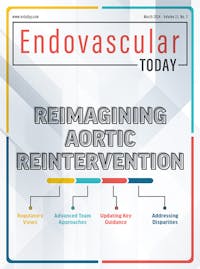
In this edition of Endovascular Today, we’re hoping to unpack the essence of successful endovascular surgery and advance a modern dialogue about when and where devices should be used, using a rubric that includes but is not limited to the discussion of reintervention as a facet of a long-term design. We ask how some colleagues have changed their approaches to reintervention in the debate with Drs. Fatima and Schermerhorn, as well as the lessons shared by Drs. Farber and Motta. We explore the role that multiple disciplines have in the quest for durability by hearing from Dr. Burke. We discuss the FDA’s perspective on postoperative monitoring in the interview with Dr. Fairman and colleagues. We look at training and moving from failure to rescue as a changing paradigm in the article by Dr. Resch and colleagues. Outside the realm of reintervention, we are also fortunate to explore the new European Society for Vascular Surgery guidance with the writing committee and take a closer look at how disparities affect aortic intervention with insights shared by Drs. Witheford and Newhall.
We hope to ignite honest discourse about reintervention—to understand when it is a signal of failure and poor design, when it is rescue of aggressive disease and improved longevity and follow-up in this complex patient population, how we can tell the difference, and to what degree each of these categories should be tolerated. This will open the door to more robust evaluations of long-term outcomes and give patients a better understanding of what consenting to complex endovascular repair actually means. In the past, by casting reintervention in the same light as failure, we closed the door on opportunities for rescue. An interventionalist who fears reporting too many reinterventions may let those patients who could be salvaged go unrepaired—consciously or unconsciously. The concept of “assisted durability” may yet have a place in our practice, but this is only once we can talk about it without shame.
Tara M. Mastracci, MD
Sara L. Zettervall, MD, MPH
Guest Chief Medical Editors
Advertisement
Advertisement