Advertisement
Advertisement
March 2024
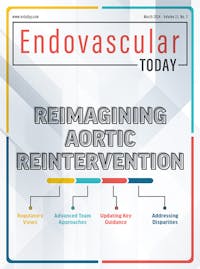
Health Care Disparities and the Impact on Aortic Reintervention
What is known about disparities in aortic reintervention and what impacts care, barriers to diagnosis and surveillance, steps toward solutions, and key unanswered questions.

What are the best sources of data for understanding the disparities that affect longitudinal care and outcomes for abdominal aortic aneurysms (AAAs)?
Large-scale data regarding longitudinal outcomes after aneurysm repair in the United States are most commonly from administrative claims, specifically Medicare. Studies focused on sex and racial disparities have largely utilized data from the Vascular Quality Initiative (VQI) linked with long-term Medicare data.
Findings from these data sets should be interpreted with caution, due to their selection bias. Hospital participation in the VQI is voluntary and requires significant investments of time and money to collect, audit, and then review the data. In the few comparisons that exist of aortic VQI and non-VQI outcomes, VQI data are more likely to be from urban, larger, and academic centers.1,2
Medicare claims data are likewise subject to selection bias and limited to patients aged > 65 years who subscribe to fee-for-service Medicare. Apart from the age-related bias, > 40% of Medicare enrollees are within a Medicare Advantage plan, which is not included in long-term follow-up data.3
How would you summarize what is currently known about these disparities and their potential impact on care?
The underlying question when studying racial, socioeconomic, or sex disparities in aneurysmal disease for me is whether the disparity in aortic reinterventions simply reflects disparity in disease burden. It is well-established that AAAs in women are less prevalent but more malignant than those in men.4,5 Most AAAs are discovered in older women, grow at nearly twice the rate of aneurysms in men, and rupture at smaller sizes. AAAs in women are also more likely to be anatomically unfavorable—including shorter, more angulated necks; small access vessels; associated occlusive disease; and tortuosity of the iliac vessels.6,7
In many studies of reintervention after endovascular aneurysm repair (EVAR), female sex is associated with a higher incidence of both early and late reinterventions.8,9 However, in a newer meta-analysis of 36 cohort studies, female sex was associated with worse outcomes after EVAR, including increased 30-day and long-term mortality, limb ischemia, renal complications, and cardiac complications.10 However, there was no difference in outcomes by sex for 30-day reinterventions or late reinterventions.
In a longitudinal study of Medicare-linked VQI patients who underwent EVAR, there was no difference between men and women for reintervention 5 years after elective endovascular repair.11 Reintervention was highest in patients who underwent EVAR for rupture, those with aneurysms > 6 cm, and patients who were of Black race. When examining the question using both open and endovascular repair, male and female patients who underwent AAA repair had similar rates of reintervention and late aneurysm rupture in the 10 years after their procedure, but women were more likely to undergo reintervention after repair for large or ruptured aneurysms.12 These studies suggest disparities lie almost entirely within the disease burden—that is, reinterventions in women are more likely due to their presentation of rupture.
When examining the impact of racial and socioeconomic disparities on aortic reinterventions, again it is established that AAAs are less prevalent but more morbid among Black and Hispanic patients.13 Black and Hispanic patients undergo elective EVAR less often and receive emergency surgery more often than White patients.14 In a study of patients within the VQI, Black patients were less likely to undergo reintervention after elective EVAR compared to White patients in the first postoperative year, but all-cause mortality did not significantly differ between groups.15 However, when a similar study was performed with Medicare-linked VQI data, Black race was an independent risk factor for reintervention after EVAR.11 Similarly, a study of disparities in long-term outcomes after EVAR again noted that Black and Hispanic race was associated with higher rates of both reintervention and loss to follow-up imaging.16
Long-term postoperative aneurysm surveillance is lower among Black men than White men, although this interestingly is not associated with a higher rupture or mortality risk. However, in women, surveillance is similarly lower than men after AAA repair but is associated with a higher rupture risk.
The data to date would suggest that sex and racial disparities in aortic reintervention are not driven by the same mechanisms—that is, sex disparities appear to be related to disease burden while racial disparities appear to be driven by a loss to surveillance.
What are some of the obstacles that create these disparities?
The disparities in diagnosis or detection of aneurysmal disease clearly inform the differences in long-term outcomes such as reintervention. When compared with White men, Black and Hispanic men and women of all races are more likely to present with a rupture. This presentation seems to inform their subsequent reinterventions and perhaps their follow-up.
Apart from disease presentation, women are usually older and with more comorbidities at the time of repair, likely creating barriers to interval surveillance imaging. From the data, it appears that the increased reintervention in Black and Hispanic men may be driven by a loss to follow-up or surveillance imaging. Few studies have investigated barriers to surveillance imaging among these groups. Education, provider availability, travel distance, provider trust, and patient illness have all been suggested as explanations for the worse long-term surveillance, but further studies are certainly needed.
Are there known differences between health care systems and structures (ie, in one country vs another)?
It would serve to reason that the presence of a robust social health network would reduce the loss to surveillance imaging in countries with a public health system. Unfortunately, limited data exist about this question. With respect to reintervention disparities by sex or socioeconomics internationally, little literature exists. In both Swedish and Japanese data, while women experience higher mortality from elective EVAR, no differences exist for ruptured aneurysms.17,18 Limited data exist that focus on disparities in reintervention rates internationally, but this is certainly an area for future study.
What are some first steps toward solutions, either on the global or local scale? How can individual operators and their practices ensure optimal follow-up and reintervention are carried out for all patients?
I think loss to surveillance imaging after EVAR is an area for quality improvement among all surgical practices. It is now a quality metric tracked by the VQI. I don’t think any surgeons intentionally lose patients to follow-up, so it is important to understand why a patient may not return yearly for surveillance. The few studies on the topic have identified advanced age, ruptured aneurysm, socioeconomic factors, and long travel distance.
From a provider standpoint, improving follow-up imaging could be as simple as combining surveillance examinations (evaluating aneurysm size on cancer surveillance imaging), telehealth visits with remote imaging, or ensuring good communication with primary care providers. More large-scale steps would involve identifying patient-reported barriers to follow-up, especially in populations already identified as higher risk.
Because it appears that the differences in reintervention may be attributable to rupture or emergent repair as well as a lack of surveillance imaging, establishing early and accessible postoperative follow-up for rupture patients should be an important focus as well.
In terms of future study, what are the key unanswered questions, and how might these be explored?
I think the key question I asked earlier remains: Are disparities in outcomes of aneurysm disease reflective of the underlying disparity in disease burden, or do they reflect something else? I think future studies need to move beyond identifying that disparities exist and into what is driving them to exist.
For example, are aneurysms more aggressive in female patients because we do not screen female patients?
Why do patients stop surveillance or follow-up after aneurysm repair, and how can we do better? This question will be increasingly important as patients live longer with endovascular repairs that require surveillance.
1. Aiello FA, Shue B, Kini N, et al. Outcomes reported by the Vascular Quality Initiative and the National Surgical Quality Improvement Program are not comparable. J Vasc Surg. 2014;60:152-159, 159.e1-3. doi: 10.1016/j.jvs.2014.01.046
2. Brooke BS, Beck AW, Kraiss LW, et al. Association of quality improvement registry participation with appropriate follow-up after vascular procedures. JAMA Surg. 2018;153:216-223. doi: 10.1001/jamasurg.2017.3942
3. Agarwal R, Connolly J, Gupta S, Navathe AS. Comparing Medicare Advantage and traditional Medicare: a systematic review. Health Aff (Millwood). 2021;40:937-944. doi: 10.1377/hlthaff.2020.02149
4. Kent KC, Zwolak RM, Egorova NN, et al. Analysis of risk factors for abdominal aortic aneurysm in a cohort of more than 3 million individuals. J Vasc Surg. 2010;52:539-548. doi: 10.1016/j.jvs.2010.05.090
5. Lo RC, Schermerhorn ML. Abdominal aortic aneurysms in women. J Vasc Surg. 2016;63:839-844. doi: 10.1016/j.jvs.2015.10.087
6. Sweet MP, Fillinger MF, Morrison TM, Abel D. The influence of gender and aortic aneurysm size on eligibility for endovascular abdominal aortic aneurysm repair. J Vasc Surg. 2011;54:931-937. doi: 10.1016/j.jvs.2011.02.054
7. Velazquez OC, Larson RA, Baum RA, et al. Gender-related differences in infrarenal aortic aneurysm morphologic features: issues relevant to Ancure and Talent endografts. J Vasc Surg. 2001;33(suppl):S77-84. doi: 10.1067/mva.2001.111921
8. Timaran DE, Knowles M, Soto-Gonzalez M, et al. Gender and perioperative outcomes after fenestrated endovascular repair using custom-made and off-the-shelf devices J Vasc Surg. 2016;64:267-272. doi: 10.1016/j.jvs.2016.02.062
9. Truong C, Kugler NW, Rossi PJ, et al. Sex-dependent outcomes following elective endovascular aortic repair. J Surg Res. 2018;229:177-185. doi: 10.1016/j.jss.2018.03.015
10. Liu Y, Yang Y, Zhao J, et al. Systematic review and meta-analysis of sex differences in outcomes after endovascular aneurysm repair for infrarenal abdominal aortic aneurysm. J Vasc Surg. 2020;71:283-296.e4. doi: 10.1016/j.jvs.2019.06.105
11. Columbo JA, Ramkumar N, Martinez-Camblor P, et al. Five-year reintervention after endovascular abdominal aortic aneurysm repair in the Vascular Quality Initiative. J Vasc Surg. 2020;71:799-805.e1. doi: 10.1016/j.jvs.2019.05.057
12. Ramkumar N, Suckow BD, Arya S, et al. Association of sex with repair type and long-term mortality in adults with abdominal aortic aneurysm. JAMA Netw Open. 2020;3:e1921240-e1921240. doi: 10.1001/jamanetworkopen.2019.21240
13. Deery SE, O’Donnell TFX, Shean KE, et al. Racial disparities in outcomes after intact abdominal aortic aneurysm repair. J Vasc Surg. 2018;67:1059-1067. doi: 10.1016/j.jvs.2017.07.138
14. Osborne NH, Mathur AK, Upchurch GRJ, Dimick JB. Understanding the racial disparity in the receipt of endovascular abdominal aortic aneurysm repair. Arch Surg. 2010;145:1105-1108. doi: 10.1001/archsurg.2010.213
15. Vervoort D, Canner JK, Haut ER, et al. Racial disparities associated with reinterventions after elective endovascular aortic aneurysm repair. J Surg Res. 2021;268:381-388. doi: 10.1016/j.jss.2021.07.010
16. Marcaccio CL, Patel PB, de Guerre LEVM, et al. Disparities in 5-year outcomes and imaging surveillance following elective endovascular repair of abdominal aortic aneurysm by sex, race, and ethnicity. J Vasc Surg. 2022;76:1205-1215.e4. doi: 10.1016/j.jvs.2022.03.886
17. Wanhainen A, Bylund N, Björck M. Outcome after abdominal aortic aneurysm repair in Sweden 1994-2005. Br J Surg. 2008;95:564-570. doi: 10.1002/bjs.6109
18. Yamaguchi T, Nakai M, Sumita Y, et al. Sex differences in Japanese patients with ruptured aortic aneurysms. J Vasc Surg. 2020;71:1907-1912.e3. doi: 10.1016/j.jvs.2019.07.098
Advertisement
Advertisement