Advertisement
Advertisement
May 2024
An Interview With Iris Quasar Grunwald, MD
Professor Grunwald reflects on the early days of stroke thrombectomy, the barriers to implementation, the need for cross-speciality training in stroke intervention, and her involvement with breakthrough technologies.

You performed the first thrombectomy in Europe with a novel aspiration device. What were your initial thoughts, and did you have any idea what impact this intervention would have on the field?
Performing the first stroke thrombectomy with the original Penumbra system in 2006 at Saarland University Hospital in Germany was a pivotal moment, not just in my career but also in the evolution of stroke treatment. The call from Professor Klaus Fassbender about a man in his early 40s with a severe stroke marked the beginning of an extraordinary journey. Despite the patient’s critical condition and failure of recombinant tissue plasminogen activator to alleviate his symptoms, the situation presented an unprecedented opportunity to employ a novel device, colloquially termed then as a “vacuum cleaner” for the brain. It was scary; catheters of such large size had not yet been placed into the tiny brain vessels, and the device did not even have regulatory approval at the time. But, my colleague Professor Tobias Struffert and I knew this was the only remaining, promising option for the patient.
The procedure entailed navigating a catheter through the patient’s arteries to the site of the blockage and using the suction device to remove the clot. The success of the procedure was life-changing. The patient who went from being completely incapacitated to asking if we were done yet. This rapid transformation from acute stroke victim to recovery was nothing short of miraculous. Discharging himself 2 days postprocedure, the patient’s determination saw him completing a marathon just days later—a testament to the efficacy of thrombectomy.
I believe the profound success of this first Penumbra aspiration thrombectomy, the 100% recanalization rate in this first Penumbra trial (which led to CE Mark), and the success of the subsequent FDA pivotal trial, for which I was the European lead, contributed to revolutionizing stroke care.
At the time, I was convinced that mechanical thrombectomy would swiftly become the frontline treatment for acute ischemic stroke. I’m heartened by the strides made since. Nevertheless, it’s dismaying to observe that nearly 2 decades later, countless patients worldwide still lack access to this critical level 1A–evidenced treatment, indicating a need to change how endovascular stroke care is currently being delivered.
What are the current barriers to broader implementation of endovascular stroke therapy?
The barriers to endovascular stroke treatment revolve around attitudes, education, and resources.1 Turf wars between different medical specialties, the few established neuroradiology centers, and hospitals able to deliver stroke interventions locally on who can and will perform interventional stroke treatment have certainly not helped.2
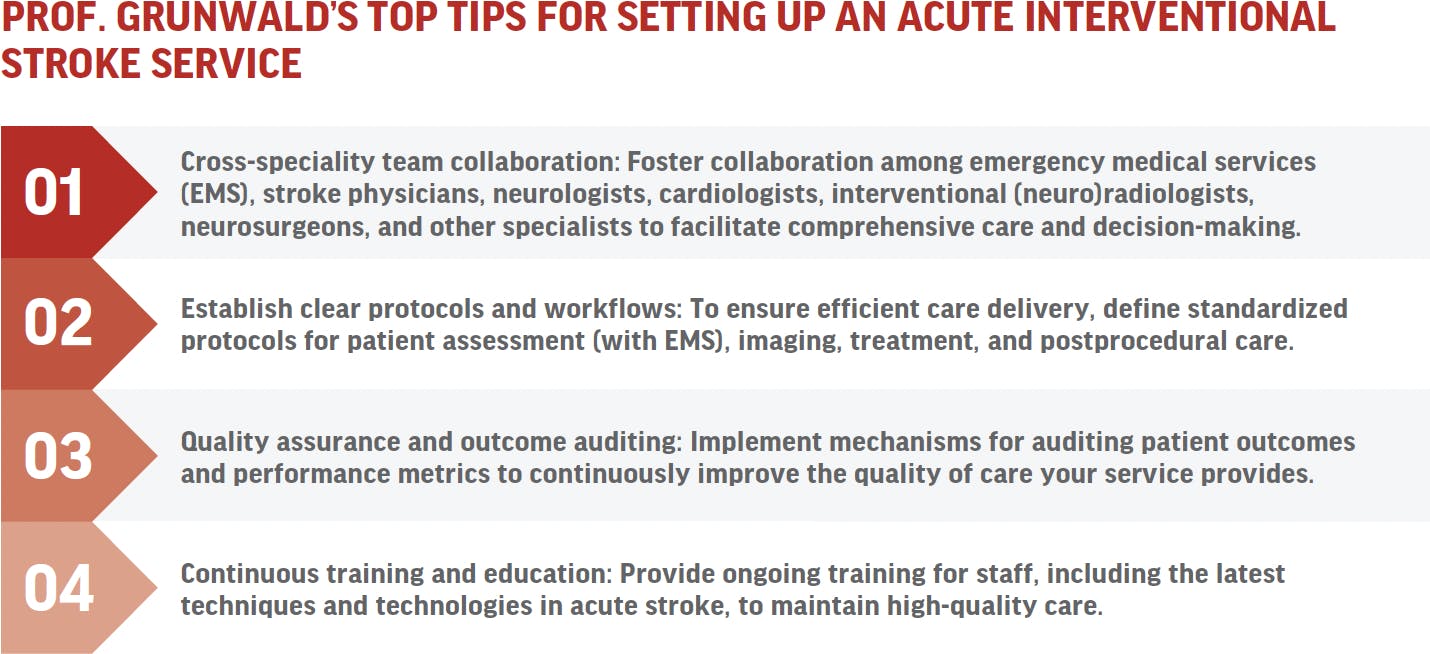
Thrombectomy is brain resuscitation. Hospital transfers lose precious brain time and result in a lower number of functional independence and, for many patients, a lost treatment opportunity. Extended time windows in some specific scenarios cannot serve as an excuse for long transportation times to scarce interventional neuroradiology centers. Getting a maximum number of patients fast access to this life- and brain-saving treatment must be the main goal, and we should work toward getting more highly able and skilled operators from different specialties trained to deliver competent stroke care. Cross-training should be promoted, and any excessive requirements aimed at protecting turf are not acceptable.
What have you learned from pioneering the training of cardiologists, neurologists, and other vascular specialists in endovascular stroke therapy?
There are not enough neuroradiologists to cover the interventional demand for stroke. The borders between the different specialties that can contribute to stroke care are decremental when it comes to endovascular stroke treatment. This procedure requires a combination of different skill sets. Stroke is a vascular disease of the brain. A large part of my neurovascular learning involved understanding underlying cardiovascular disease and cardiac blood-thinning regimens. While training numerous operators and teams from varying backgrounds to perform endovascular stroke therapy, I learned a great deal from the other specialties. Thankfully, since the first cardiologist I trained > 15 years ago, it has now long been confirmed that interventional cardiologists and other stroke specialists trained in stroke intervention can effectively treat acute large vessel occlusion strokes without having undergone extensive, focused neurointerventional training for extended time periods and can replicate the results of randomized clinical trials.3-5 I am pleased that government agencies overseeing health care delivery are now recognizing this and advocating for the inclusion of stroke interventionalists from specialties other than neuroradiology. This should be done without imposing unreasonable barriers, considering the significant unmet clinical needs in delivering endovascular stroke therapy.
The World Federation for Interventional Stroke Treatment (WIST), for which you are Vice President, published the 2023 guidelines on multispecialty training in endovascular stroke intervention.6 What did you see in current training approaches that necessitated these guidelines? What is unique about these guidelines’ approach to training, and what is the impact on endovascular stroke services globally?
Twenty years after introducing brain-saving stroke intervention, conservative training approaches remain fundamentally insufficient. The development of WIST’s 2023 guidelines on multispecialty training for endovascular stroke intervention was driven by recognition of the need for a more tailored, competency-based approach to training, as opposed to traditional time-based models. The guidelines uniquely incorporate an individualized training approach, acknowledging operators’ diverse skills, such as experience in carotid stenting. This enables a more efficient and focused development path.
The introduction of high-fidelity simulation with haptic feedback and lifelike, soft-embalmed, perfused human cadavers as integral components of the training pathway is another groundbreaking aspect. These tools offer realistic, risk-free environments for practitioners to refine their skills, make critical decisions, and practice complex procedures, thus bridging the gap between theoretical knowledge and clinical practice.
Moreover, the guidelines distinguish between accreditation for individual operators and the centers in which they operate, underlining the importance of team dynamics and the infrastructural support necessary for delivering high-quality stroke care.
The impact from these guidelines on a global scale is already significant.7,8 They have helped save brains and lives in different health care systems in the world. By standardizing training to a competency-based model that accounts for individual experience and promotes the use of advanced simulation techniques, the aim is to not only improve patient outcomes by ensuring highly skilled practitioners are available across diverse health care settings but also to foster collaboration in stroke centers worldwide.
Are there any innovations on the horizon today with the potential to again shift stroke care decades down the road, as we’ve seen with thrombectomy?
Innovations such as mobile photon-counting detectors (PCDs) are poised to significantly transform stroke care in the future. Photon-counting technology holds the potential to revolutionize radiology and patient care by providing higher-quality images, enabling precise tissue characterization and material decomposition, and reducing radiation exposure. With our mobile OmniTom Elite PCD scanner (NeuroLogica), we demonstrated clot composition and differentiated between intracranial blood and contrast, which are integral for guiding patient management. Integrating PCDs into mobile stroke units (MSUs) could also facilitate better triage decisions. As Cofounder of Brainomix Limited, the first developer of an artificial intelligence (AI) solution for interpreting CT scans using ASPECTS (Alberta Stroke Program Early CT Score), I’ve witnessed the transition from initial skepticism to widespread acceptance of AI in stroke diagnosis. I believe this will soon lead to more personalized AI health care solutions.
Recently, we implemented a dedicated communication app (Pulsara) in our stroke service that is integrated with our AI imaging software. This led to significant time savings and minimized communication errors. I believe these AI tools will soon be an integral part of any stroke service of excellence.
One hallmark of your career has been your involvement with building and running the first MSU and subsequently implementing the program in the United Kingdom since 2018. Can you tell us about this experience?
The integration of MSUs into stroke care, an idea conceived and initiated in Germany by Prof. Klaus Fassbender, has been transformative. MSUs are equipped with advanced diagnostic tools, including CT scanners and telemedicine capabilities. They allow for rapid assessment and treatment of stroke patients in prehospital settings, resulting in faster treatment and ultimately better outcomes. Our recent study demonstrated the feasibility and utility of the Hybrid-MSU. Equipped with additional tools like x-ray, AI, ultrasonography, and extensive laboratory testing, the Hybrid-MSU extends its service beyond just stroke to seizures, falls with head trauma, infections, and acute coronary syndromes.9 A staggering 86% of patients avoided emergency department admission, with management either at home (46.4%) or by direct transfer to specialized wards (39.6%).
What are your primary research goals at the University of Dundee?
As Director of the Tayside Innovation Medtec Ecosystem, my mission is to help innovators and companies develop, test, and implement new medical technology, from bench to bedside. Specifically, we develop unique, lifelike, perfused human cadaveric models for training and device testing in endovascular procedures, facilitating regulatory approval and clinical implementation. For instance, we recently hosted a company that developed a new heart implant and came to train their principal investigators before performing the first live cases. However, it became evident during implementation that the device, which had previously been tested in a pig model, didn’t suit certain human anatomies and necessitated a return to the drawing board. If initial testing had been done on our perfused human cadaveric model, these issues could have been detected earlier. With the Center for Anatomy and Human Identification at University of Dundee housing around 200 cadavers at any given time, this presents a substantial resource that not only minimizes reliance on animal testing and reduces animal suffering but also enhances realism, potentially leading to improved clinical outcomes.
How does your clinical practice inform your technologic innovation, and vice versa?
The day-to-day experiences and challenges I encountered in clinical stroke settings have been the driving force behind the majority of my innovations. For example, my research work often clashed with the need to respond to stroke cases that didn’t ultimately require intervention. This led to the development of automated detection tools for vessel occlusions and infarct volume measurement, both on plain CT and CTA, within the Brainomix software, providing physicians with a second opinion.
Recognizing the significant training needs in endovascular stroke therapy, I developed modules for high-fidelity simulators with hepatic feedback and initiated training programs for interventionalists using lifelike perfused human cadavers to bridge this gap.
Addressing the risk posed during carotid stenting, my latest venture focused on developing a new device for endovascular procedures. This solution received recognition via a Woman in Innovation award and a Purple Plaque and will support clinical practice by the end of the year.
Along with a busy work schedule, you’re also a pilot and compete in aerobatics. What do you enjoy about this, and what advice would you share with physicians regarding the importance of maintaining a hobby?
Engaging in hobbies and interests outside of one’s professional life offers a counterbalance, particularly in high-stress fields like medicine. For me, aerobatics provides not just an adrenaline rush but also a unique way to develop precision, control, and decision-making under pressure—skills that are remarkably complementary to clinical practice. The intense focus required in piloting helps me clear the mind and step into a completely different world, offering a sense of freedom.
Acknowledgments: I would like to thank, among others, the two neurointerventional key opinion leaders who immediately understood the need to transform the field of training in stroke intervention and who have been by my side throughout the process: Professors Leo Nelson Hopkins and Klaus Mathias.
1. Hopkins LN, Holmes DR. Public health urgency created by the success of mechanical thrombectomy studies in stroke. Circulation. 2017;135:1188-1190. doi: 10.1161/CIRCULATIONAHA.116.025652
2. Niżankowski RT. Mechanical thrombectomy for ischemic stroke: deceptive access promoted by leading neurologists harms patients. Kardiol Pol. 2020;78:803-804. doi: 10.33963/KP.15569
3. Hornung M, Bertog SC, Grunwald I, et al. Acute stroke interventions performed by cardiologists: initial experience in a single center. JACC Cardiovasc Interv. 2019;12:1703-1710. doi: 10.1016/j.jcin.2019.05.052
4. Skrypnik DV, Anisimov KV, Botsina AY, et al. Endovascular treatment results in patients with large cerebral artery occlusions in a metropolis. Moscow Stroke Registry data over 2019. Neurol Neuropsych Psychosom. 2020;12:9-17. doi: 10.14412/2074-2711-2020-5-9-17
5. Pawłowski K, Dziadkiewicz A, Podlasek A, , et al. Thrombectomy-capable stroke centre—a key to acute stroke care system improvement? Retrospective analysis of safety and efficacy of endovascular treatment in cardiac cathlab. Int J Environ Res Public Health. 2023;20:2232. doi: 10.3390/ijerph20032232
6. Grunwald IQ, Mathias K, Bertog S, et al. World Federation for Interventional Stroke Treatment (WIST) multispecialty training guidelines for endovascular stroke intervention. Cardiovasc Revasc Med. 2023;53:67-72. doi: 10.1016/j.carrev.2023.03.004
7. Cameron A. WIST guidelines: a global solution to increase interventional stroke treatment. Postepy Kardiol Interwencyjnej. 2023;19:4-5. doi: 10.5114/aic.2023.126403
8. Musiałek P, Niżankowski R, Witkowski A. WIST Guidelines: a chance to make a breakthrough in crisis of the treatment of stroke in Poland. Nauka. 2023;4:145-149. doi: 10.24425/nauka.2023.147316
9. Fassbender K, Phillips DJ, Grunwald IQ, et al. Hybrid‐mobile stroke unit: opening the indication spectrum for stroke mimics and beyond. Stroke Vasc Interv Neurol. 2023;3:e000482.
Advertisement
Advertisement
Interested in reading more interviews?
To read more interviews with thought leaders in the vascular field, check out our Profiles & Perspectives hub.
Read More