Advertisement
Advertisement
November 2024
An Interview With Narayan Karunanithy, MRCS, FRCR, FCIRSE
Dr. Karunanithy discusses his multidisciplinary approach to vascular anomalies, trends in acute pulmonary embolism, what adult and pediatric interventional radiologists can learn from each other, and more.

With an expansive clinical practice that includes both adult and pediatric patients and a range of clinical interests, can you tell us about your path to interventional radiology (IR)?
I completed 3 years of surgical residency in the early 2000s, covering emergency department, general surgery, urology, trauma and orthopedics, and vascular surgery. I saw firsthand the increasing influence that radiology was playing in everyday clinical practice. Hence, I made the decision to change career paths and undertook my radiology training first in Portsmouth and then at Imperial College London. The hands-on practical nature and close clinical care naturally attracted me to IR. I was lucky to be mentored by some incredible teachers in my formative years, including Drs. Julian Atchley, James Jackson, Paul Tait, Adam Mitchell, and Alison Graham.
You’ve been involved in several notable research efforts over the course of your career and are currently a coinvestigator of the PAVE-2 trial evaluating paclitaxel- and sirolimus-coated balloons for arteriovenous fistula. What are the evidence gaps that this trial aims to fill, and how do you envision it impacting clinical practice and patient outcomes?
Maintaining and salvaging hemodialysis access has become increasingly important as the number of patients and the duration they are on renal replacement therapy steadily increases. A number of industry-supported randomized controlled trials (RCTs) studying both paclitaxel- and sirolimus-coated balloons in maintaining hemodialysis access have reported favorable outcomes.
PAVE-2 is a National Institute for Health and Care Research–funded, three-arm RCT looking at whether treatment with paclitaxel (In.Pact, Medtronic) or sirolimus (MagicTouch, Concept Medical) offers better, clinically relevant outcomes in patients with dysfunctional hemodialysis access. Trial recruitment commenced in July 2024 and is expected to last about 24 months.
Along with dialysis access research, you’re also interested in venous disease, with a 2023 publication reviewing trends in interventional therapies for acute pulmonary embolism (PE).1 What trends do you predict for acute PE in the next decade?
Acute PE care has seen rapid evolution in recent years. Previously, the mainstay of treatment was anticoagulation, with select few patients receiving systemic thrombolysis or surgical pulmonary embolectomy. Recently, there has been great interest in catheter-directed therapies as well as right ventricular mechanical support (eg, extracorporeal membrane oxygenation). These therapies have broadened the scope of treatment for an increasingly diverse patient population. However, there currently is a paucity of high-quality data to support their use routinely, and there is wide variability in the availability and utilization of these techniques. Hence, to standardize and support decision-making at an institutional level, PE response teams have been established.
Looking ahead, I envisage acute PE care for severe (high- and intermediate-high–risk) PE evolving akin to acute myocardial infarction and stroke, where primary reperfusion has been established as the mainstay of treatment. I also think there will be a greater focus on the medium- to long-term consequences of acute PE, where the main current consideration is immediate risk to life.
As one of many leadership roles, you’re the vascular anomalies multidisciplinary team (MDT) lead at your institution. What specialties make up the essential members of this MDT, and do you have a basic algorithm for how you approach these cases?
Vascular anomalies are a diverse group of conditions that range from isolated and small to extensive, complex lesions that can sometimes be associated with generalized syndromes. They can present in childhood or become symptomatic in adulthood. We are starting to better understand the genetic basis of these conditions.
A common challenge faced by vascular anomalies services is the diverse range of specialties to whom patients can present. Therefore, the investigations and treatments patient receive are also hugely variable. My primary role as the MDT lead is to facilitate a regular forum where we can discuss cases but also consolidate and streamline the referral, diagnostic, and therapeutic phases of care. The MDT also provides a single portal for clinicians who do not regularly treat vascular anomalies to reference in cases.
The core team members making up a vascular anomalies MDT can vary regionally. We are lucky to have strong representation alongside IR, including dermatology, genetics, hematology, adult and pediatric plastic surgery, adult and pediatric otolaryngology, oral and maxillofacial surgery, and vascular surgery. Between all of these specialties, we are able to provide a comprehensive service that covers all aspects of best medical, surgical, and interventional care.
You spend part of your clinical time at the Evelina London Children’s Hospital with its pediatric IR program. What can all interventional radiologists learn from pediatric IR?
I think this is a two-way process. There are nuances about pediatric IR that adult interventional radiologists need to learn, and the same is true for adult interventional radiologists, who may have greater experience in certain adult procedures that could be translated to pediatric practice (eg, trauma embolization). Some aspects where pediatric practice slightly differ include preprocedure consultations and obtaining consent, periprocedure hemodynamic changes and blood loss, thermoregulation (especially for complex long procedures), and the more frequent need for anesthetic support and lower-profile/smaller devices.
What are your plans and goals as Secretary and Incoming Chair of the British Society of Interventional Radiology (BSIR) Paediatric IR United Kingdom (PIRUK) Special Interest Committee? Are there any field-wide concerns that are top of mind?
The PIRUK Special Interest Committee, under the astute leadership of my predecessors Drs. Alex Barnacle, Premal Patel, and Nasir Imran, has been cognizant that a large proportion of “pediatric IR” work nationally is performed by adult interventional radiologists. Alongside this, the scope and complexity of pediatric IR procedures is progressing rapidly. The focus for the 2 years ahead will be supporting adult IR with their scope of pediatric IR work, creating closer national European and international networks to share good practice and gather high-quality scientific data to consolidate our clinical practices.
As Editor of the BSIR newsletter, you put out a special 2024 edition that highlighted physical, mental, and emotional well-being for interventional radiologists.2 Why was this an important approach to take?
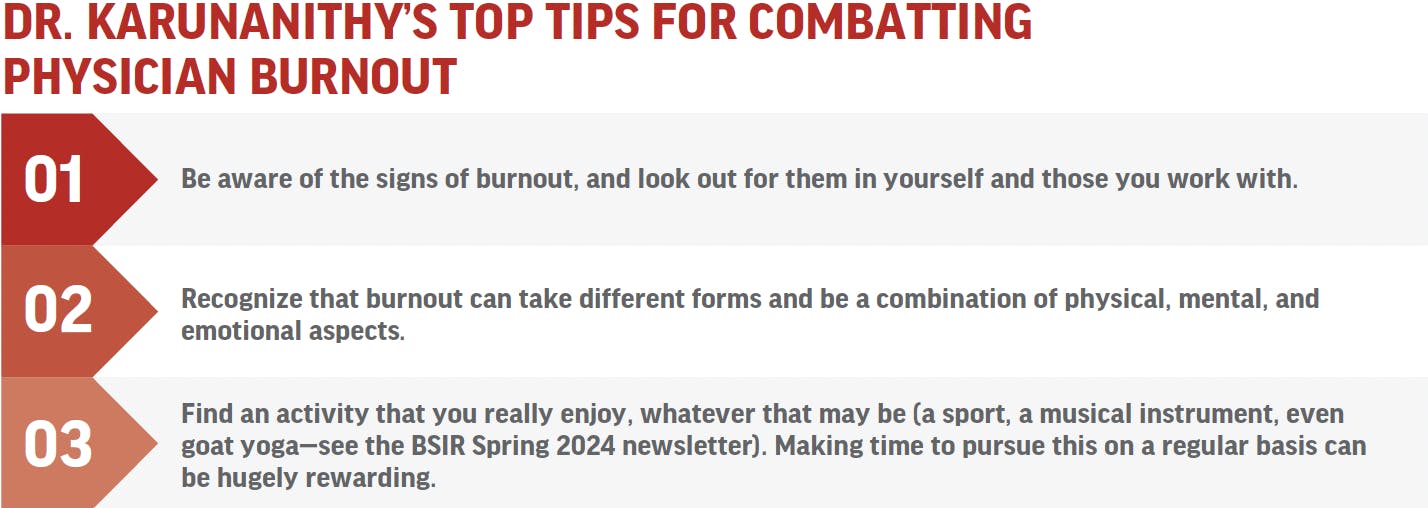
Physicians and health care professionals overall tend to focus on their professional lives, often working in less-than-ideal health care delivery systems. This can result in neglecting their own well-being. The high prevalence of burnout in health care professionals and interventional radiologists in particular has been highlighted recently. Burnout can manifest in different forms and can be physical, mental, or emotional in nature. All too often, the early signs of burnout (eg, exhaustion, insomnia, not feeling in control of your work environment) are not recognized by the individual or those around them. Even when recognized, practical and simple remedial actions to help may not be easily accessible. A solution could be something as simple as arranging a regular chat over coffee with a colleague or friend, physical exercise, or meditation. The purpose of the BSIR Spring 2024 newsletter theme was to cast a focus on this important topic and have a varied group of IRs discuss their own experiences.
From presenting to hosting and organizing, you are a big proponent of medical education and live symposia. How would you describe the value this type of collaboration and education adds to a physician’s career?
IR is a rapidly evolving clinical specialty where practice has changed from primarily a field of “proceduralists” to that of providing comprehensive clinical care; we have seen innovations in procedure type, expanding treatments for a wide spectrum of clinical conditions. As a result, there is a need to continuously maintain and update clinical knowledge. In modern clinical practice, care is often provided by an MDT, with expertise drawn from several specialists. Understanding and respecting the value of the whole team will foster a stronger working bond. The Cardiovascular and Interventional Radiological Society of Europe and BSIR both have comprehensive educational programs, but there remains a need for complementary targeted educational events that support the physician’s career.
1. Patel S, Thulasidasan N, Thomson B, et al. Interventional therapies in acute pulmonary embolus-current trends and future directions. Br J Radiol. 2023;96:20221151. doi: 10.1259/bjr.20221151
2. British Society of Interventional Radiology. Spring newsletter 2024. Accessed October 24, 2024. https://www.bsir.org/mediacentre/news/spring-newsletter-2024/
Advertisement
Advertisement
Interested in reading more interviews?
To read more interviews with thought leaders in the vascular field, check out our Profiles & Perspectives hub.
Read More