Advertisement
Advertisement
November 2024
Multidisciplinary Aortic Dissection Teams
An organized approach to improving outcomes for a lethal disease.
The concept of having dedicated teams for specific cardiovascular diseases is not new. In fact, for the past 2 decades, cardiac care has been transformed from a single cardiologist to complete “heart teams” that feature a multidisciplinary approach as the preferred way of managing complex cardiac diseases.1 We believe caring for patients with aortic dissection (AD) should be no different, as AD remains one of the most catastrophic aortic emergencies, often necessitating rapid intervention from multiple specialists with expertise germane to the disease process.
This approach for AD means that multiple medical and allied health disciplines will be involved in these patients’ immediate and long-term care. Given the numerous stakeholders in AD care, the presence of a designated “aortic team” allows for smooth and facile interaction, information dissemination, and treatment planning, which provides improved care.
RATIONALE AND ESSENTIAL MEMBERS OF THE AORTIC TEAM
The initial management of AD is as expansive as it is variable. Often a clinical masquerader, this disease classically presents with abrupt-onset ripping or tearing chest and back pain but can also manifest as headache, visual changes, abdominal pain, shortness of breath, and central or peripheral motor, sensory, or other neurologic deficits. It can also be completely asymptomatic. Herein lies the difficulty in the initial management of AD. Its diagnosis requires a high degree of clinical suspicion from initial health care providers, such as emergency physicians.
Once suspected, one potential is activation of a protocolized care pathway, analogous to ST-segment elevation myocardial infarction or stroke. For example, a “Code Aorta” prompts an immediate CT scan with the necessary technical specifications to evaluate all relevant anatomy for AD, including presence of stroke, the cerebral vessels and status of the circle of Willis, and upper extremity as well as thoracic, visceral, and inguinal vasculature. Ideally, this would be interpreted in an expeditious fashion by a radiologist adept in aortic pathology. This system has already been developed in certain institutions in the United States, permitting immediate access to relevant specialists in the emergency care of AD.2
Once these frontline providers initiate the care pathway for AD, there should be immediate communication with the next tier of providers for expert management of AD—namely, cardiac and vascular surgeons. In some centers, due to a shortage of vascular surgeons, interventional radiologists or cardiologists may also provide endovascular care for AD when needed. Given the intrinsic mortality rate associated with acute AD—specifically for dissections involving the ascending aorta, classically defined as type A ADs (TAADs)—it is salient that surgeons with the capability of expeditiously intervening on this disease be made aware at the time of diagnosis to triage the care of these patients. Radiologists or vascular surgeons also provide the initial diagnosis and interpretation of radiographic studies and perform emergent endovascular interventions of AD.
One of the more morbid presentations of AD is organ malperfusion, which carries poor clinical outcomes. In most patients with TAAD, the malperfusion resolves after central aortic repair. However, in a subset of patients presenting with signs of organ failure due to malperfusion, deferring central aortic repair for an endovascular intervention to treat malperfusion followed by a second, operative central aortic repair at a later time has been suggested as an alternative approach.3 Given those complex presentations, it is crucial to have both the cardiac and vascular surgery teams immediately available for discussion and management of those patients.
Other immediate sequelae of TAAD include central thoracic and cardiac complications (eg, intrapericardial rupture with tamponade) and aortic valvulopathy (eg, acute aortic insufficiency). Additionally, coronary artery involvement can lead to myocardial ischemia, affecting cardiac function. All of these can be immediately assessed by transthoracic and/or transesophageal echocardiography, which can be performed in the intensive care unit by a cardiologist or in the operative room by cardiovascular anesthesiologist. As such, both represent crucial members of the multidisciplinary AD team. Central to the safe provision of aortic surgery, cardiovascular anesthesiologists also provide valuable intraoperative support in the form of echocardiographic assistance in true lumen aortic cannulation, monitoring of cerebral oxygenation as a surrogate for end-organ protection, and advanced hemodynamic monitoring and resuscitation.
Surgical intervention for AD can be broadly categorized into open and endovascular strategies. These are offered by aortic specialists with training in cardiac and/or vascular surgery. While a discussion of the repair techniques is beyond the scope of this editorial, it is sine qua non that surgeons represent a keystone member of the multidisciplinary aortic team, providing expertise in both the formulation of operative strategy as well as the safe execution of all aspects of aortic surgery. Further, surgeons are well suited to provide longitudinal patient management and follow-up, regarding both postoperative recovery and lifelong aortic surveillance. There are numerous institutions today in both Canada and the United States where surgeons manage aortic collaborations and clinics. One example is the recently developed Canadian Thoracic Aortic Collaborative (CTAC), which emphasizes interdisciplinary collaboration to reduce the traditional fragmentation of care from which aortic patients traditionally have suffered.4 The CTAC serves as a model to continue strengthening cross-disciplinary ties with the goal of improving aortic outcomes.
The utility of multidisciplinary AD teams is critical in not only the immediate management of acute AD but also in the posthospitalization, long-term, longitudinal management thereafter. In addition, creation of these teams can empower allied health professionals to further enhance the immediate management of acute AD. Dedicated nursing and perfusion teams specified to the treatment of AD can reduce potential delays and enhance the rapid delivery of precise care.
Perhaps a foremost example of where multidisciplinary collaboration can improve AD outcomes is longitudinal patient follow-up. Although the immediate care of AD is predominantly tackled by perioperative aortic teams, posthospital care has not been historically uniform under one specialty. This has led to the development of aortic clinics in certain centers, serving as outpatient hubs in which all aortic patients can be seen and assessed by all relevant practitioners. While dependent on the specific center, the typical stakeholders include cardiac and vascular surgeons, cardiologists, and medical genetics—a valuable discipline in the long-term management of AD given that the interventional or surveillance strategy for AD can frequently hinge on the specific genetic or heritable disease, leading to its phenotypic manifestation. The importance of medical genetics in the long-term management of AD is evident in both the individualized care of patients tailored to their specific genetic profile and risk stratification, as well as the construction of genetic aortic databases that serve to identify and further drive areas of research.5 In female patients of childbearing age, the maternal-fetal medicine specialist is also a significant team member, giving preconception and family planning counseling as well as helping with prenatal care and delivery plans in case of a pregnancy.
BENEFITS OF CENTRALIZING AORTIC CARE
Interdisciplinary collaboration with AD also permits the development of common language, reporting standards, and guidelines. Given that numerous medical and paramedical specialties are involved in managing acute and chronic AD (Figure 1), it is important that all relevant parties communicate in a standardized way to facilitate expeditious patient care. In addition, it has been suggested that centralization of aortic care can lead to improved immediate and long-term patient outcomes. The development of multidisciplinary aortic teams is a nascent step in the direction of implementing regional centralization of AD care as it serves to break down interprofessional barriers and unify aortic care under a common umbrella. Data from the International Registry of Aortic Dissection support improving patient outcomes for acute AD when managed at high-volume, centralized institutions.6 However, to facilitate this, there must be buy-in from all relevant stakeholders in the multidisciplinary AD team; this type of centralization will inevitably lead to an increased clinical burden on all involved, as the volume of patient care increases due to the creation of the teams. Those in administrative positions and hospital management must facilitate the provision of the necessary resources to allow for the increase in clinical activity.7
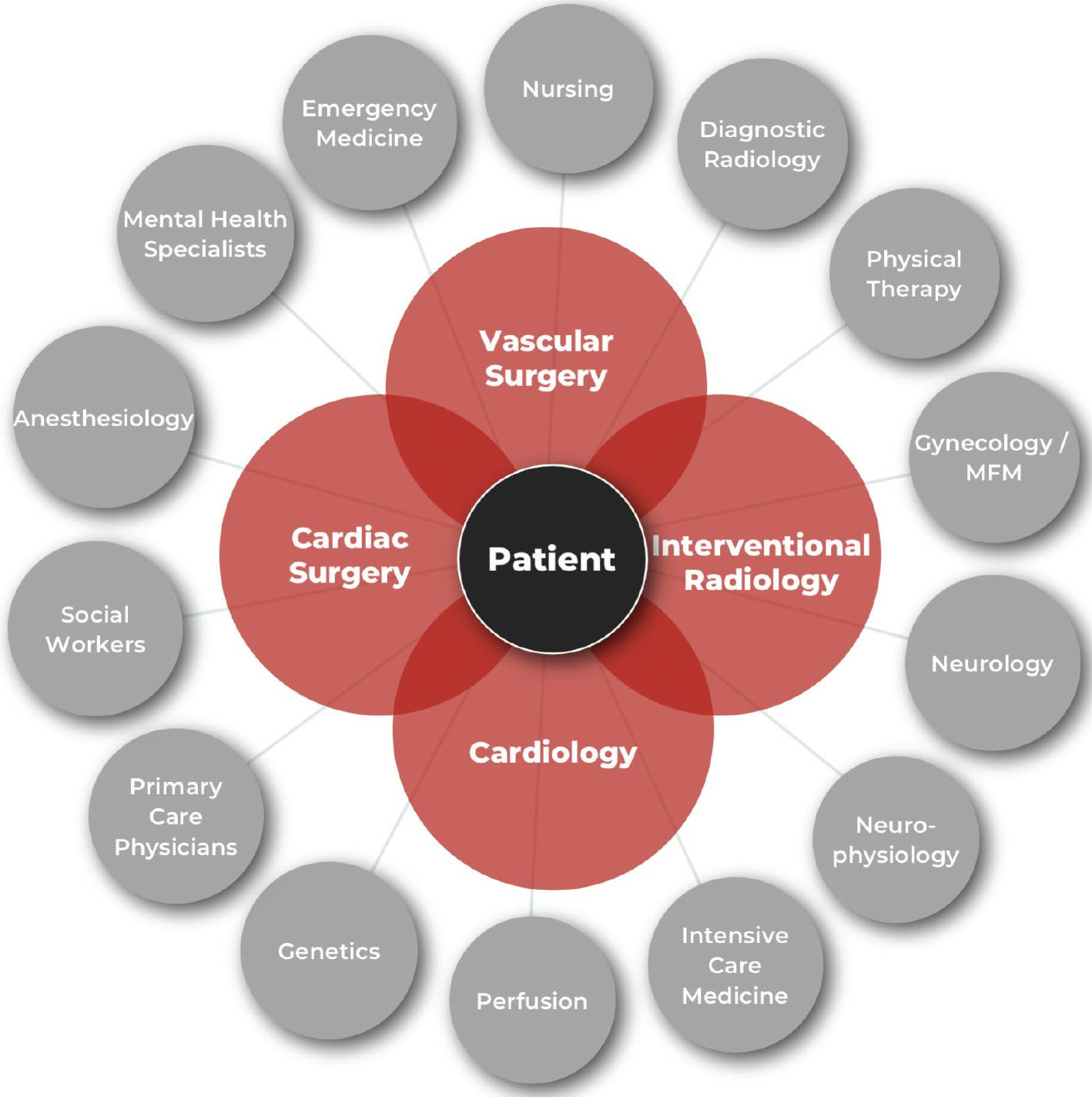
Figure 1. Schematic representation of the multidisciplinary aortic team model and shared decision-making for managing AD. MFM, maternal-fetal medicine.
CONCLUSION
The overall benefit of multidisciplinary teams in the management of AD is increasingly supported by a growing body of literature and is also endorsed by numerous societal guidelines. The 2022 American Heart Association (AHA) aortic guidelines give a class 1A recommendation for development of a multidisciplinary aortic team for managing acute aortic pathology, such as AD.8 They liken the creation of an aortic team to the previously developed and endorsed heart team models, resulting in a recommendation that has led multiple centers in North America to adopt this concept. Echoing this strong recommendation given by the 2022 AHA guidelines, a recently published article in Journal of the American College of Cardiology9 has suggested that the creation of multidisciplinary aortic teams should be considered standard practice.
In conclusion, we believe that the development of standardized multidisciplinary AD teams—with specified team members and roles—should be the standard of care and widely implemented in regional institutions that serve as dedicated aortic centers. This is congruent with both the current tide of evidence in the literature and the major societal guideline recommendations.
1. Archbold A, Akowuah E, Banning AP, et al. Getting the best from the heart team: guidance for cardiac multidisciplinary meetings. Heart. 2022;108:e2. doi: 10.1136/heartjnl-2021-320510
2. Northwestern Medicine. Center for aortic care. Accessed October 21, 2024. https://www.nm.org/conditions-and-care-areas/cardiovascular-care/center-for-aortic-care
3. Yang B, Rosati CM, Norton EL, et al. Endovascular fenestration/stenting first followed by delayed open aortic repair for acute type A aortic dissection with malperfusion syndrome. Circulation. 2018;138:19:2091-2103. doi: 10.1161/CIRCULATIONAHA.118.036328
4. McClure RS, Lindsay TF, Keir M, et al. The aortic team model and collaborative decision pathways for the management of complex aortic disease: clinical practice update from the Canadian Cardiovascular Society/Canadian Society of Cardiac Surgeons/Canadian Society for Vascular Surgery/Canadian Association for Interventional Radiology. Can J Cardiol. 2023;39:1484-1498. doi: 10.1016/j.cjca.2023.07.031
5. Cecchi AC, Drake M, Campos C, et al. Current state and future directions of genomic medicine in aortic dissection: a path to prevention and personalized care. Semin Vasc Surg. 2022;35:51-59. doi: 10.1053/j.semvascsurg.2022.02.003
6. Pape LA, Awais M, Woznicki EM, et al. Presentation, diagnosis, and outcomes of acute aortic dissection: 17-year trends from the International Registry of Acute Aortic Dissection. J Am Coll Cardiol. 2015;66:350-358. doi: 10.1016/j.jacc.2015.05.029
7. Andersen ND, Benrashid E, Ross AK, et al. The utility of the aortic dissection team: outcomes and insights after a decade of experience. Ann Cardiothorac Surg. 2016;5:194-201. doi: 10.21037/acs.2016.05.12
8. Isselbacher EM, Preventza O, Black JH 3rd, et al. 2022 ACC/AHA guideline for the diagnosis and management of aortic disease: a report of the American Heart Association/American College of Cardiology joint committee on clinical practice guidelines. Circulation. 2022;146:e334-e482. doi: 10.1161/CIR.0000000000001106
9. Siddique A, Castleberry A, Thompson J, Yetman A. Should a multidisciplinary aortic team be considered standard in cardiovascular medicine? JACC Adv. 2023;2:100321.
Advertisement
Advertisement