Advertisement
Advertisement
October 2024
An Interview With Marie Josee van Rijn, MD, PhD
Dr. van Rijn discusses her epidemiology background, the multidisciplinary nature of DVT treatment, tips for postthrombectomy acute iliofemoral venous thrombosis stenting, and more.

Along with your training in vascular surgery, you also have a PhD and master’s degree in epidemiology. How did you land on these two interests, and how does your epidemiology background come into play in your venous disease practice and research?
When I studied medicine, the top 10% of students in our first year were offered the opportunity to simultaneously start a master’s degree program in epidemiology. It took place during the summers, with some courses during spring and fall breaks. The best part was the final course at Harvard! Of course I accepted. Part of the program was participation in research, and mine was in the field of genetic epidemiology, which led me into starting my PhD in that area. After obtaining my master’s degree and PhD, I was officially an epidemiologist.
This has helped me enormously in not only understanding scientific papers but also in reviewing them, as I do in my role as Assistant Editor for European Journal of Vascular and Endovascular Surgery. Of course, it has also helped in conducting my own research. I think this experience would be a solid foundation for every scientist or physician.
Although deep venous pathology is your main focus, your expertise is wide-ranging. What do you enjoy most about your clinical work?
The fact that my work is indeed so wide-ranged. I still treat patients with arterial disease, from peripheral artery disease to complex aneurysms. This leads to having an outpatient clinic with patients from all ages and treating blood vessels in almost all parts of the body, both open and endovascularly. I never get bored!
You’ve shared that you enjoy the multidisciplinary nature of vascular care and the collaboration it allows with other specialties. Do you have a specific algorithm when it comes to involving other specialties in deep venous care at Erasmus Medical Center? What do your multidisciplinary conversations before deep vein thrombosis (DVT) treatment involve?
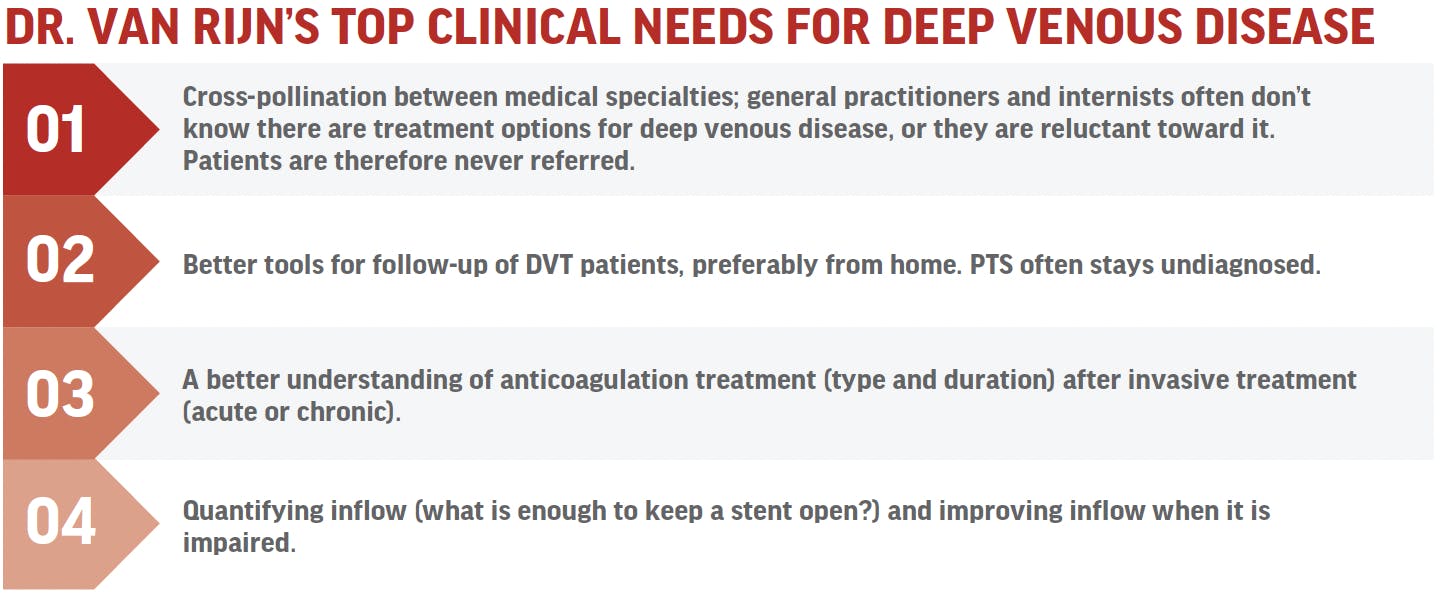
Yes, I enjoy collaborating with other specialties a lot. It improves patient care, and you learn so much from one another. My outpatient (deep) venous practice is part of the Department of Dermatology at Erasmus. Along with four dermatologists, we see all of the venous patients. Thus, for venous care, it is a 100% dermatology and vascular surgery collaboration. Before DVT and postthrombotic syndrome (PTS) treatment, patients are additionally discussed multidisciplinary with interventional radiologists and a hematologist. We discuss whether patients are eligible for invasive treatment with respect to symptom severity and failure of conservative measures, and we also aim to predict whether invasive treatment will be successful (good enough inflow, compliant patient, etc). After treatment, the hematologist is closely involved in the anticoagulant treatment.
In recent years, you’ve been focusing on acute iliofemoral DVT. What are you currently researching in this arena?
I am researching the time frame in which mechanical thrombectomy is possible, because after a certain point, the clot cannot be extracted anymore. We are also researching clot characteristics and looking into ways to follow up patients from home after a DVT to see if they develop PTS.
You and colleagues recently explored stenting in acute iliofemoral venous thrombosis after thrombolysis or thrombectomy.1 How would you summarize the key considerations when stenting in this situation? What are some tips for ensuring good patient outcomes?
To increase patency, treatment is advised in cases of significant stenosis; > 50% area reduction, frequently corresponding to > 70 diameter stenosis. The best way to identify and quantify these lesions is with intravascular ultrasound. The common iliac vein should typically be stented with a 16-mm stent and the external iliac/common femoral vein with a 14/12-mm stent, with pre- and postballooning. The length of the iliac stent should be > 8 cm to prevent migration and an acute angulated landing at the iliosacral curvature.
Care should be taken to prevent jailing of the contralateral common iliac vein proximally and jailing of the deep femoral vein distally. It is mandatory to stent into the common femoral vein in case of residual stenosis/thrombus at that level. Short overlapping (2-3 cm) is typically enough, and this segment should ideally be proximal to the superior ramus of the pubis.
Start (intermittent pneumatic) compression and anticoagulation immediately after the procedure, and perform close surveillance with duplex ultrasound.
You’ve also explored the postintervention stages of deep venous disease and specifically quality of life (QOL), with one recent paper demonstrating a negative impact on mental QOL in certain patients who underwent early clot removal for acute iliofemoral DVT.2 How does this knowledge affect how your approach in these patients?
We have found that mental functioning specifically is often impaired after early clot removal. Patients tell us they are very anxious to get another DVT, and many are disappointed in their own body, especially when they were previously active and ate a healthy diet. They don’t understand why they developed a DVT. We involve a psychologist early on and always ask about these feelings at the outpatient clinic. This way, you provide a safe environment for them to open up. With regard to physical impairments, we try to manage their expectations, saying, “We do this procedure hoping to prevent PTS, but you might still experience symptoms and signs of it.”
What is your favorite place you’ve traveled, and what’s on your bucket list?
I have traveled all over the world, and every country has its own charms. My fondest memory is that of Australia and New Zealand, which I traveled through for a year when I was 18—my first time away from home. On my bucket list are Japan, Peru, Alaska, and Vancouver Island.
1. Avgerinos ED, Black S, van Rijn MJ, Jalaie H. The role and principles of stenting in acute iliofemoral venous thrombosis. J Vasc Surg Venous Lymphat Disord. 2024;12:101868. doi: 10.1016/j.jvsv.2024.101868
2. Bakas JM, van Montfrans C, Moelker A, et al. Quality of life after early clot removal for acute iliofemoral deep vein thrombosis. EJVES Vasc Forum. 2024;61:44-49. doi: 10.1016/j.ejvsvf.2023.12.004
Advertisement
Advertisement
Interested in reading more interviews?
To read more interviews with thought leaders in the vascular field, check out our Profiles & Perspectives hub.
Read More