Advertisement
Advertisement
October 2024
Liver Ablation: Can We Push the Treatment Boundaries?
Current methods and cutting-edge technologies in liver ablation.
By Omid Shafaat, MD; Junaid Y. Raja, MD, MSPH, MS; Noreen Siddiqi, MD; Abin M. Sajan, MD; and Venkatesh P. Krishnasamy, MD, FCIRSE
Liver ablation has become an essential part of treating patients with primary and metastatic liver tumors. The technology has advanced significantly over the past decades, optimizing minimally invasive treatment options provided by interventional radiologists. This allows for precise targeting and effective ablation of malignant tissue with curative intent. However, as with all medical innovations, the current standard practices are evolving, and we are exploring future treatment possibilities. The aim of this article is to explore the current methods and cutting-edge technologies in liver ablation while also examining these potential advancements that could expand treatment guidelines and improve outcomes for patients with liver tumors.
STANDARD PRACTICE: CURRENT METHODS AND TECHNIQUES
Microwave ablation (MWA) is one of the most used locoregional treatment options today for treating liver tumors, but radiofrequency ablation still has relevance and utility domestically and internationally due to cost and accessibility. These techniques are usually used for smaller tumors, typically those < 3 cm in diameter, and in patients not eligible for surgery due to comorbidities or tumor location.1 However, the outcome gap between surgery and ablation has changed, as seen in recent literature.2,3 For lesions between 3 and 5 cm, ablation may be combined with transarterial chemoembolization or other additional treatments to improve outcomes.4,5 Although liver ablation has mainly been focused on treating early stage and oligometastatic disease, with careful planning, larger tumors can also be treated with ablative therapies, especially when complete surgical removal is not feasible.
The challenge for interventional radiologists lies in expanding this range—treating larger lesions or those in more challenging locations while minimizing damage to surrounding healthy tissue. Additionally, the importance of accomplishing an ablation with clear margins (A0) continues to be a focus of optimizing outcomes. However, manual assessment of the ablation zone and margin is subjective and prone to error. Additionally, mismatches between expected and observed ablation zones can easily lead to over- or undertreatment, resulting in untoward outcomes. As a result, we will discuss cutting-edge technologies that are now being integrated into the practice.
PUSHING THE TREATMENT BOUNDARIES: CUTTING-EDGE TECHNOLOGIES
Advances in ablation technology are continuously pushing the boundaries of what can be achieved in the treatment of liver tumors. The integration of imaging, real-time guidance, and enhanced precision tools have allowed for more aggressive ablation strategies.
IntelliBlate MWA System
The IntelliBlate 2.45 GHz MWA system (Varian Medical Systems) recently received FDA 510(k) clearance and seeks to improve thermal energy delivery and ablation zone predictability. It features a uniform fiberglass probe shaft to minimize mechanical joint weakness along the probe and keep it fully saline cooled. This saline cooling desensitizes performance changes to the evolving surrounding tissue. Bundling of the lead cable and cooling lines facilitates straightforward probe management and limits the risk of cable-related skin burn. The system also has strategically placed thermocouples on the probe to monitor ablation zone growth in real time and allow estimation of lesion coverage and ablation zone margin. This is aided by accurate delivery of power reported from the probe’s tip by calibrating for the loss from the system to the antenna through the cable. The user-friendly, intuitive interface has a cassette-designed setup and LED indicators on the probes, and the system offers dual-probe capability. These features allow for reproducible, controlled creation of ablation zones from small to large, with a high level of sphericity to spare normal tissue and minimize the need for multiple probe insertion.
There are plans for a dedicated ablation confirmation software platform in the future. Although device-agnostic software platforms do have their appeal given the multiplicity of devices in the space, this planned ablation guide software platform will seek to predict ablation zones based on the nuances and engineering of the IntelliBlate probes and generator. Future integration with CT from Siemens Healthineers will allow an optimized, seamless workflow, from ablation probe placement to CT visualization and overlay of the ablation zone on the lesion (Figure 1).6
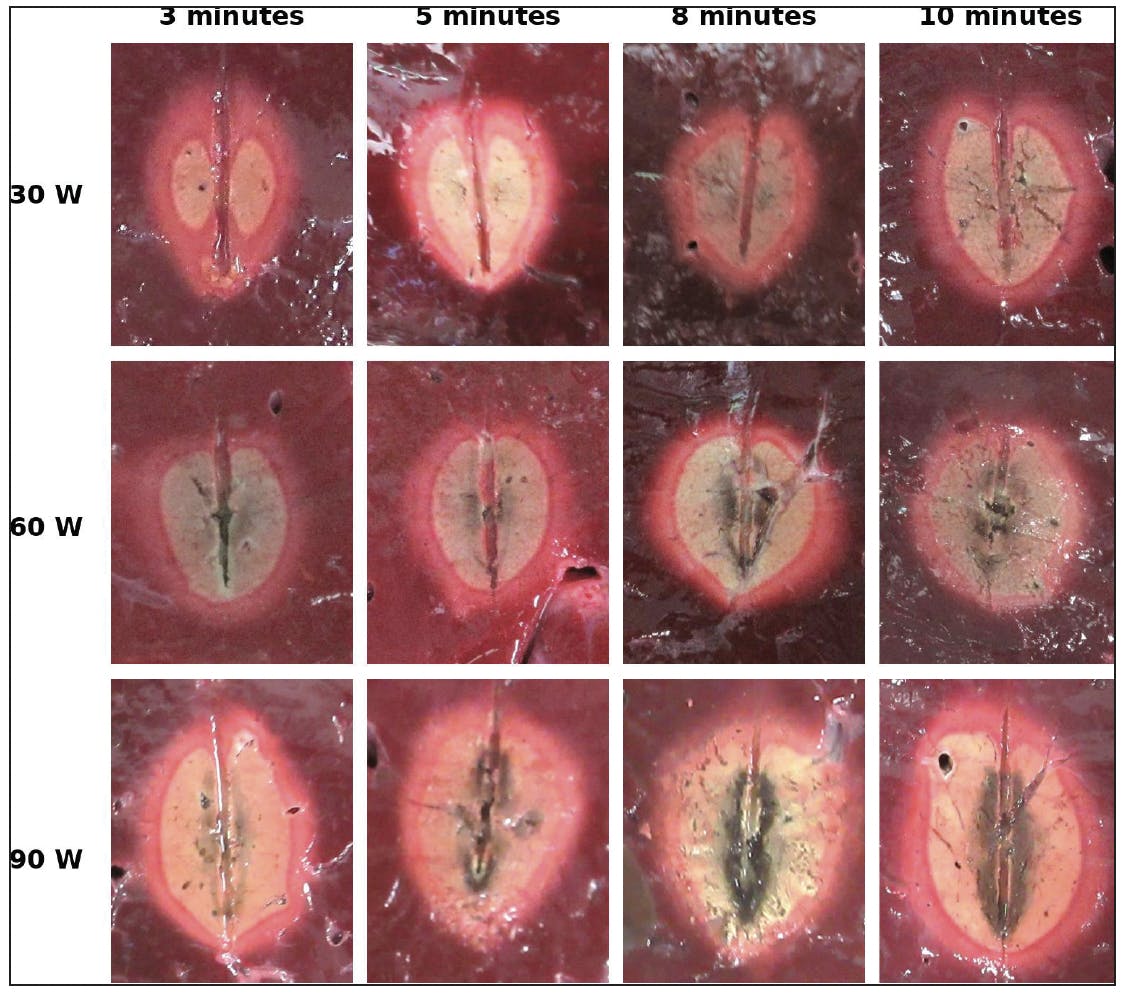
Figure 1. MWA examples using the IntelliBlate Ximitry probe at three power settings (30, 60, and 90 W) over four time intervals (3, 5, 8, and 10 minutes) in an ex vivo, bovine liver tissue model. Adapted with permission from Varian Medical Systems.
BioTrace Platform
Another development comes from TechsoMed. Based on Techsomed’s collaboration with the Mayo Clinic, Alzubaidi et al provided new insights into the dynamic nature of postablation tissue response, showcasing a consistent increase in ablation zone volume from immediately postprocedure to 24 hours after liver tumor ablation.7 This work highlights a critical challenge in ablation: poor visibility and control of the tissue destruction zone, which continues to expand for 24 hours after the procedure.
The BioTrace platform (TechsoMed) is designed to provide real-time visualization of the full extent of the ablation zone, along with personalized treatment planning and assessment tools. At the heart of the platform, BioTrace’s algorithm and artificial intelligence (AI)–powered software solutions leverage standard imaging modalities. BioTraceIO Precision, which has FDA de novo classification, is an ultrasound-based software for postablation tissue response prediction in liver tumor ablation. Based on ultrasound imaging during liver tissue ablation, the reference ablation zone is coregistered with the live image, which enables probe localization and monitoring. The BioTrace map correlates with findings from the contrast-enhanced CT obtained 24 hours posttreatment, which is displayed in a two-dimensional (2D) ultrasound plane. Ultimately, BioTraceIO Precision offers unique insights into planned ablation versus the predicted 24-hour postoperative ablation zone, empowering physicians with early detection of potential complications and ensuring comprehensive coverage of the target tissue (Note: The BioTraceIO 3D solution is not yet approved and is currently limited to investigational use under United States law) (Figure 2).
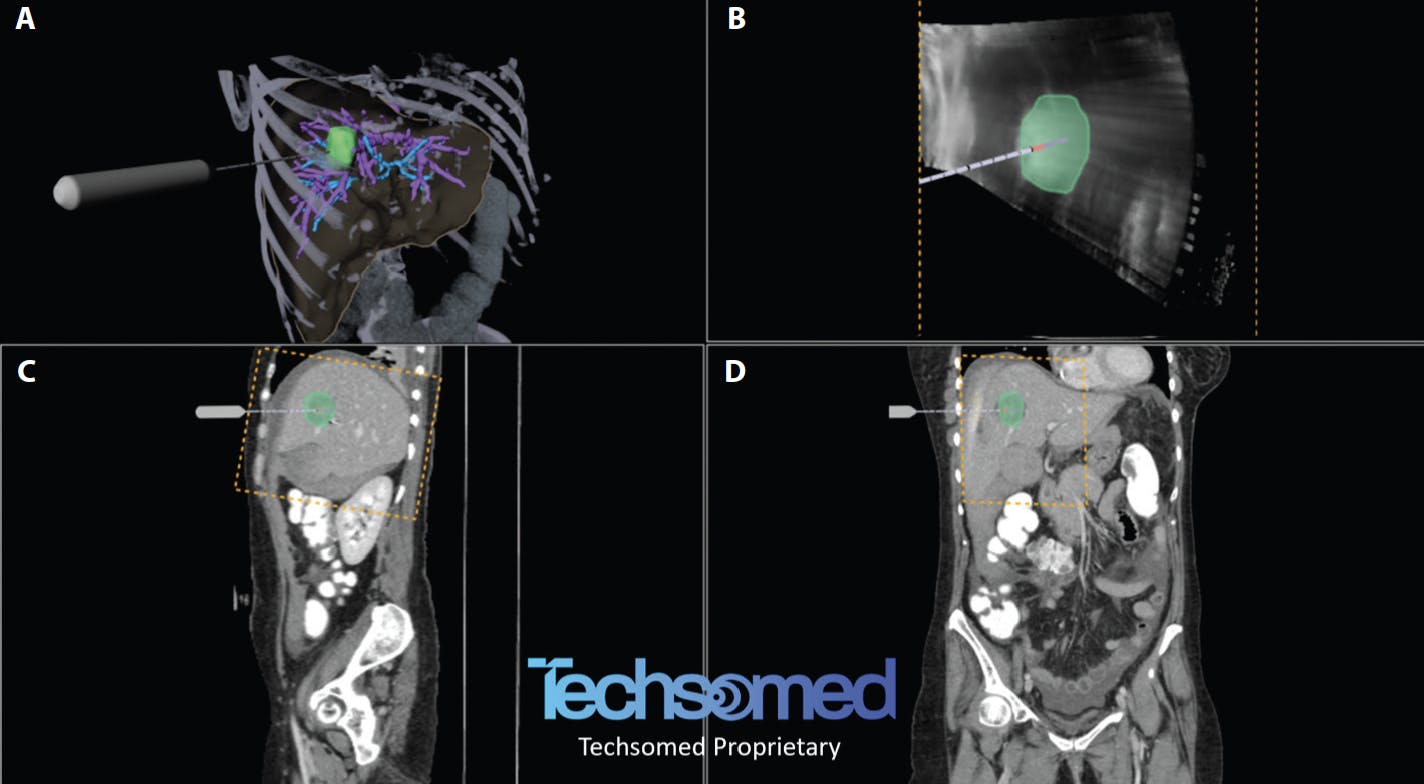
Figure 2. Capabilities of the BioTraceIO 3D monitoring solution: This AI-driven software uses real-time ultrasound in a swiping mode to reconstruct a predictive 3D view of the ablation zone during liver tumor ablation (A, B). The green map illustrates a predictive 3D ablation area, which is typically only visible on 24-hour postprocedure contrast-enhanced CT, providing real-time insights into ablation margins and target tissue coverage (C, D). Adapted with permission from TechsoMed Inc.
On the horizon is the BiotraceIO 360 platform. With AI-powered advanced monitoring and critical information from live ultrasound data, the software will provide a three-dimensional (3D) volumetric map with real-time feedback to allow real-time decision-making. This could lead to development of a closed-loop, self-regulating ablation system based on such data, which may in turn democratize liver tumor ablation and further optimize outcomes.8
XR90 Augmented Reality Platform
MediView is another company on the frontier of innovation. Its augmented reality (AR) platform, particularly the XR90 (MediView), has shown promising results in early clinical evaluations for percutaneous tumor ablation procedures.9 Work by Gadodia et al demonstrated the feasibility of this platform for real-time navigation and guidance, potentially enhancing procedural accuracy and patient outcomes.10 The XR90 system is designed to improve spatial and depth perception compared to traditional 2D displays, allowing for better visualization of critical structures and precise targeting during tumor ablation. This technology not only improves the effectiveness of procedures but also addresses ergonomic challenges faced by clinicians during complex interventions.
Further studies and presentations have highlighted the broader impact of AR technologies in interventional radiology. AR-enhanced sonography improves procedural accuracy, workflow efficiency, and collaboration.11 It allows for customizable monitor placement, improving hand-eye coordination and reducing physical strain on clinicians. MediView’s platform also enables remote collaboration and telemedicine opportunities, which could improve access in underserved areas. The integration of AR into interventional radiology represents a significant step forward in overcoming the limitations of traditional imaging and advancing the standard of care in tumor ablation procedures (Figure 3).
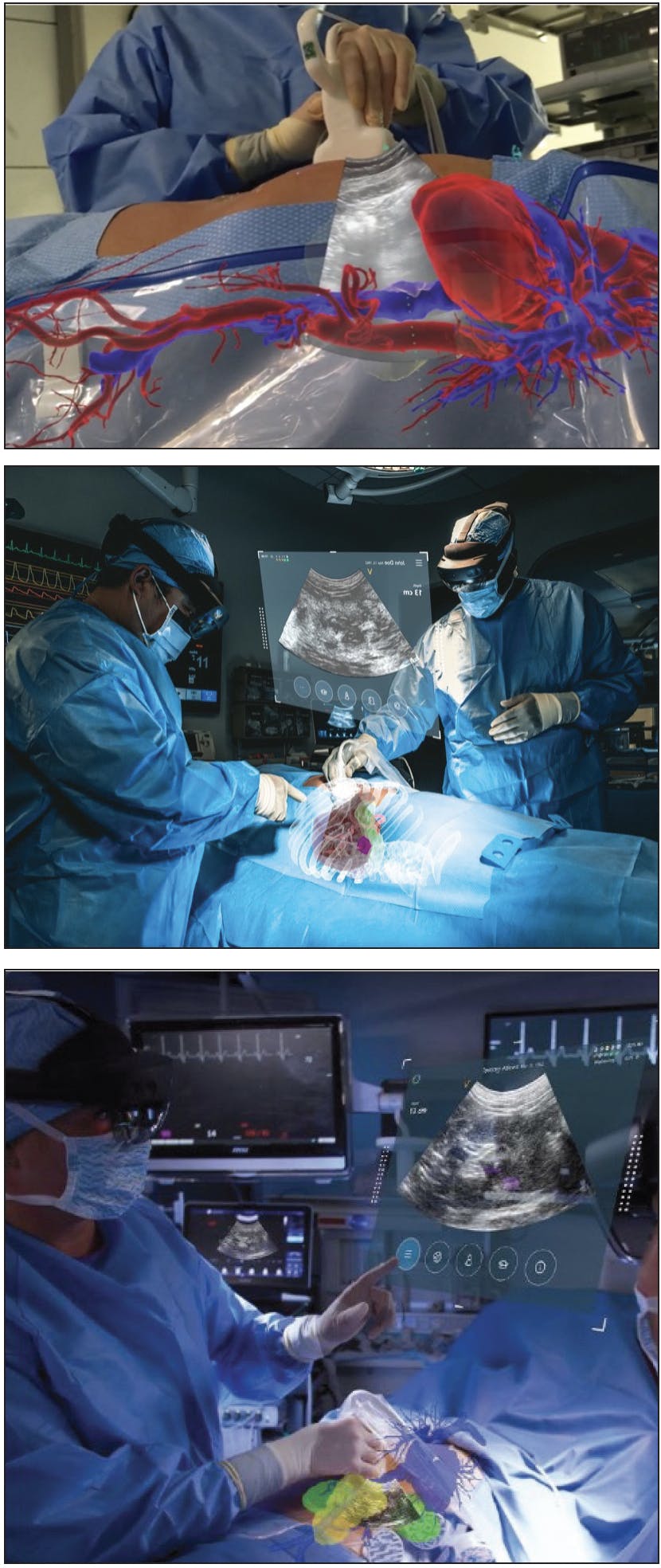
Figure 3. Interventional radiologists using MediView’s AR platform during a percutaneous image-guided procedure. The AR system enhances real-time imaging by providing a 3D holographic view of the patient’s anatomy, allowing for precise targeting of tumors and improved procedural outcomes. Adapted with permission from MediView.
Ablate-IQ Software
The NeuWave Ablate-IQ software (Johnson & Johnson MedTech) is a liver tumor ablation confirmation technology that offers planning and guidance capabilities for treatment precision.12 A key feature of the FDA 510(k)–cleared Ablate-IQ is a probe insertion planning tool that allows interventional radiologists to define and adjust probe pathways relative to the target tumor using various views, including needle and periscope perspectives. This system integrates time and power inputs for the probes, enabling visualization of proposed ablation zones on CT images and ensuring that the ablation zone is as accurate as possible. With multiple view options (axial, coronal, sagittal, 3D) and real-time feedback, interventional radiologists can better evaluate probe placement relative to the target tumor, thus minimizing errors and optimizing the ablation process.
In addition to planning tools, Ablate-IQ can support procedure efficiency with its streamlined workflow and user-friendly interface. The software also includes a margin analysis tool for assessing adequate tumor coverage, a tissue contraction feature, and a new optional reporting feature to capture detailed procedural data. These data can be stored in the PACS (picture archiving and communication system) for postprocedure follow-up and simplifying data collection for research purposes. The NeuWave MWA system not only aids in liver ablation precision but also supports good overall patient outcomes and efficient clinical workflow (Figure 4).
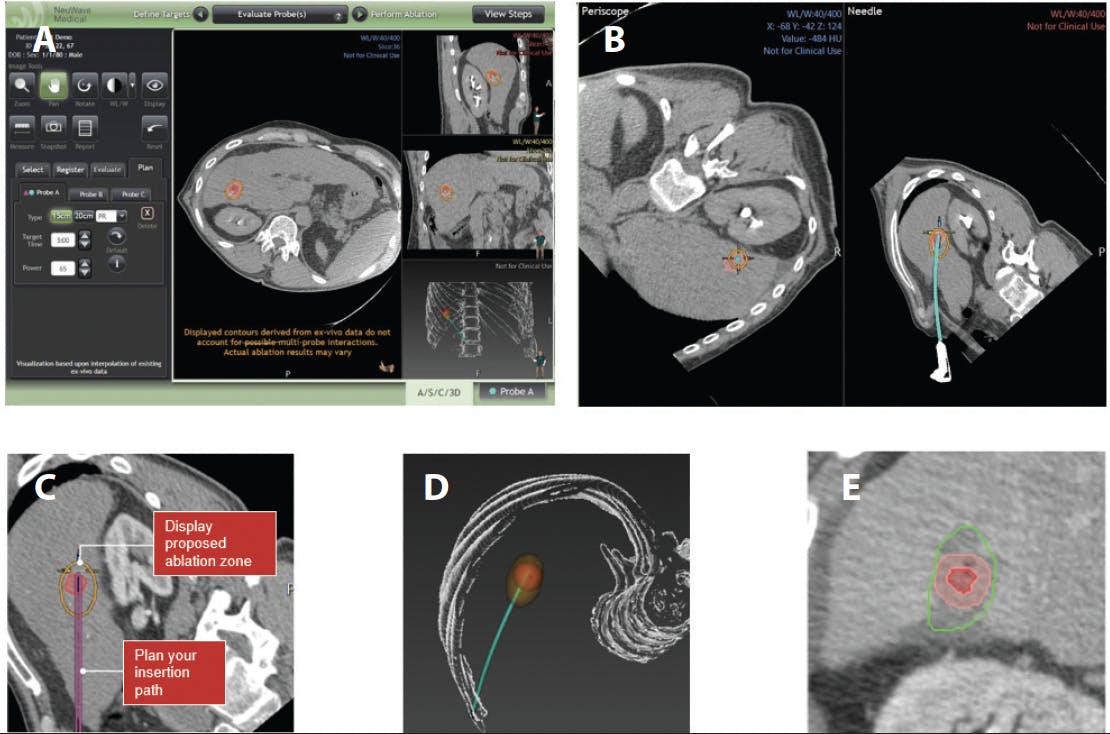
Figure 4. Features of the NeuWave Ablate-IR demonstrated in a demo patient: User interface with multiple view options (A); needle and periscope views (B); probe insertion planning (C); evaluate probes in 3D (D); margin analysis tool (E). Adapted with permission from Johnson & Johnson MedTech.
BEYOND THE CUTTING EDGE: THE FUTURE OF LIVER ABLATION
Looking beyond current innovations, the future of liver ablation seems promising with the potential integration of even more sophisticated technologies. One area of exploration is the use of robotics to assist in the placement of ablation probes. Robotic systems, potentially guided by AI, could enable highly accurate probe placement, particularly in tumors in difficult-to-reach areas of the liver where manual placement would be challenging. Such systems could also offer standardized treatment protocols, improving consistency across centers and reducing operator-dependent variability.13,14
Moreover, future development in nanotechnology could allow for targeted delivery of ablative energy at the cellular level. This would enable the destruction of microscopic diseases that current imaging techniques cannot detect, pushing the boundaries of what is possible in treating liver cancer.15
TECHNOLOGIES ON THE HORIZON: EXPANDING CAPABILITIES
The field of liver ablation is at a pivotal moment, with innovative technologies poised to redefine the possibilities of treatment. Current advances in imaging, real-time monitoring, and energy delivery are already expanding the range of treatable tumors, improving precision, and reducing complications. Companies like Varian, TechsoMed, MediView, and Johnson & Johnson MedTech are leading the charge by integrating cutting-edge technology into liver ablation, pushing the boundaries of what can be achieved. As these technologies continue to evolve, the potential for more effective, personalized, and less invasive treatments grows, offering hope to patients with complex or previously untreatable tumors.
CONCLUSION
Future advancements will likely involve the integration of generative AI to enhance real-time decision-making with advanced thermal and nonthermal modalities, such as microwave, radiofrequency, irreversible electroporation, and cryoablation. These technologies, tailored to specific tumor characteristics and patient profiles, will allow for optimized treatment strategies that reduce damage to surrounding tissues while ensuring complete tumor destruction. The potential for combining these and other treatment modalities potentially further increases the efficacy of ablation treatments, particularly in more complex cases.
The liver ablation landscape holds immense promise, driven by ongoing innovations in AI, imaging, and energy delivery systems. As these technologies continue to integrate into clinical practice, the field will expand the boundaries of what is possible, offering more effective, personalized, and less invasive treatment options for liver cancer patients. The future of liver ablation is bright, with transformative technologies on the horizon that will undoubtedly improve patient care and outcomes.
1. Izzo F, Granata V, Grassi R, et al. Radiofrequency ablation and microwave ablation in liver tumors: an update. Oncologist. 2019;24:e990. doi: 10.1634/THEONCOLOGIST.2018-0337
2. Takayama T, Hasegawa K, Izumi N, et al. Surgery versus radiofrequency ablation for small hepatocellular carcinoma: a randomized controlled trial (SURF Trial). Liver Cancer. 2021;11:209-218. doi: 10.1159/000521665
3. Meijerink MR, van der Lei S, Dijkstra M, et al. Surgery versus thermal ablation for small-size colorectal liver metastases (COLLISION): an international, multicenter, phase III randomized controlled trial. J Clin Oncol. 2024;42(17 suppl). https://doi.org/10.1200/JCO.2024.42.17_suppl.LBA3501
4. Hammett JT, Patel MN, Odisio BC, Shah K. Imaging guidelines during percutaneous liver ablation to optimize outcomes and patient safety. Semin Intervent Radiol. 2024;41:258-262. doi: 10.1055/S-0044-1788058
5. Campbell WA 4th, Makary MS. Advances in image-guided ablation therapies for solid tumors. Cancers (Basel). 2024;16:2560. doi: 10.3390/CANCERS16142560
6. Varian. Microwave ablation solutions. Accessed September 15, 2024. https://www.varian.com/products/interventional-solutions/microwave-ablation-solutions
7. Alzubaidi S, Wallace A, Naidu S, et al. Single-arm prospective study comparing ablation zone volume between time zero and 24 h after microwave ablation of liver tumors. Abdom Radiol (New York). 2024;49:3136-3142. doi: 10.1007/S00261-024-04185-Z
8. TechsoMed. Accessed September 5, 2024. https://www.techsomed.com/
9. MediView. Accessed September 15, 2024. https://mediview.com/
10. Gadodia G, Yanof J, Hanlon A, et al. Early clinical feasibility evaluation of an augmented reality platform for guidance and navigation during percutaneous tumor ablation. J Vasc Interv Radiol. 2022;33:333-338. doi: 10.1016/J.JVIR.2021.11.014
11. Gadodia G, Evans M, Weunski C, et al. Evaluation of an augmented reality navigational guidance platform for percutaneous procedures in a cadaver model. J Med Imaging (Bellingham, Wash). 2024;11:062602. doi: 10.1117/1.JMI.11.6.062602
12. Johnson & Johnson MedTech. NeuWave™ microwave ablation systems. Accessed September 15, 2024. https://www.jnjmedtech.com/en-US/product-family/neuwave-microwave-ablation-systems
13. Elsayed M, Solomon SB. Interventional oncology: 2043 and beyond. Radiology. 2023;308:e230139. doi: 10.1148/radiol.230139
14. Rivera AKU, Seeliger B, Goffin L, et al. Robotic assistance in percutaneous liver ablation therapies: a systematic review and meta-analysis. Ann Surg Open. 2024;5:e406. doi: 10.1097/AS9.0000000000000406
15. Xu M, Yang L, Lin Y, et al. Emerging nanobiotechnology for precise theranostics of hepatocellular carcinoma. J Nanobiotechnology 2022;20:427. doi: 10.1186/S12951-022-01615-2
Advertisement
Advertisement