Advertisement
Advertisement
September 2024 Supplement
Sponsored by Cagent Vascular
Serranator® PTA Serration Balloon Catheter as Vessel Prep Prior to Bioresorbable Scaffold Use for Below-the-Knee Disease
With Jessica Katsiroubas, MD, and Rajesh K. Malik, MD, FACS, RPVI


CASE STUDY 1
Patient Presentation
A woman in her mid-50s with multiple comorbidities presented with bilateral leg cramping and significant rest pain. Ankle-brachial indices (ABIs) were obtained, showing an ABI of 0.70 on the right and 0.65 on the left. Left lower extremity angiography was performed, which demonstrated a stenosed popliteal and an occluded posterior tibial (PT) artery (Figure 1A and 1B).
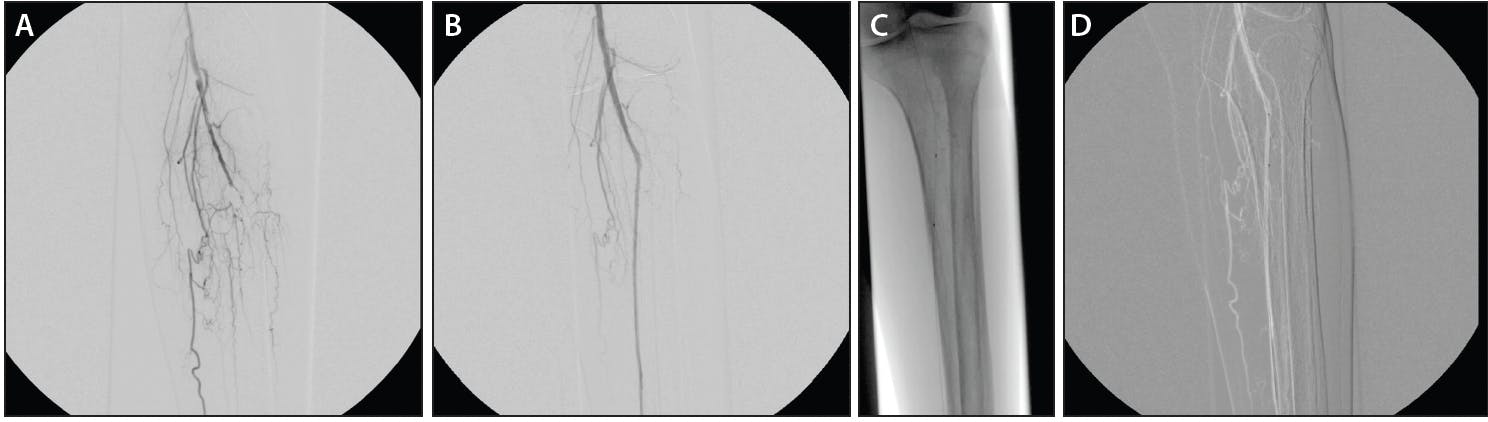
Figure 1. Initial angiograms (A, B). A 2.5- X 80-mm Serranator PTA Serration Balloon for vessel preparation of the occluded PT artery prior to use of a bioresorbable scaffold (BRS) (C). Completion angiogram (D).
Procedural Overview
After unsuccessful attempts at crossing antegrade, it was deemed necessary to obtain access distally via the PT artery. Working from below, using a 6-F sheath and crossing wire (0.014-inch Hi-Torque Command [Abbott] and 0.46-mm [0.58-mm outer diameter], 150-mm TrailBlazer [Medtronic]), we were able to cross the popliteal artery and snare the wire to externalize the wire. The TurboHawk directional atherectomy device (Medtronic) was utilized throughout the popliteal artery, extending into the PT artery and then followed by a 5- X 150-mm (80- and 130-cm catheter effective length) In.Pact Admiral drug-coated balloon (DCB) in the popliteal artery. We then turned our attention to the occluded PT artery and utilized a 2.5- X 80-mm Serranator® PTA Serration Balloon (Cagent Vascular) (Figure 1C). The Serranator provided the vessel preparation needed to follow with an Esprit BTK everolimus-eluting resorbable scaffold (Abbott).
Conclusion
A completion angiogram showed good inline flow through the popliteal and PT arteries (Figure 1D). There was likely an arteriovenous fistula in the distal portion of the popliteal artery, but it slowed down by the end of the case and we were satisfied with the result.
CASE STUDY 2
Patient Presentation
A man in his mid-70s with a past medical history of chronic kidney disease, coronary artery disease treated with coronary artery bypass grafting, hypertension, hyperlipidemia, peripheral vascular disease, and diabetes mellitus presented with rest pain and a nonhealing right foot wound. His arterial duplex ultrasound showed multilevel bilateral disease; therefore, angiography was performed. This patient was lining up to be a perfect candidate for use of a BRS.
Procedural Overview
Angiography revealed severe disease proximally in the popliteal artery, single-vessel runoff via the PT artery, and a high-grade stenosis going into the foot (Figure 2A). Antegrade access and crossing using a 6-F Destination sheath (Terumo Interventional Systems) and 0.014-inch Hi-Torque Command wire was successful. Atherectomy using the TurboHawk device was performed, followed by a 5- X 80-mm In.Pact DCB in the popliteal artery. After revascularization of the popliteal artery, we began treatment of the PT artery with a 2.5- X 120-mm Serranator PTA Serration Balloon to effectively prep the vessel prior to delivery of the BRS (Figure 2B). Three Esprit BTK everolimus-eluting resorbable scaffolds (one 3 X 38 mm and two 3.5 X 38 mm) were utilized throughout the PT artery. We did not have a 3.0-mm Serranator at the time, but the serration technology still provided the stable lumen gain for the slightly larger BRS.
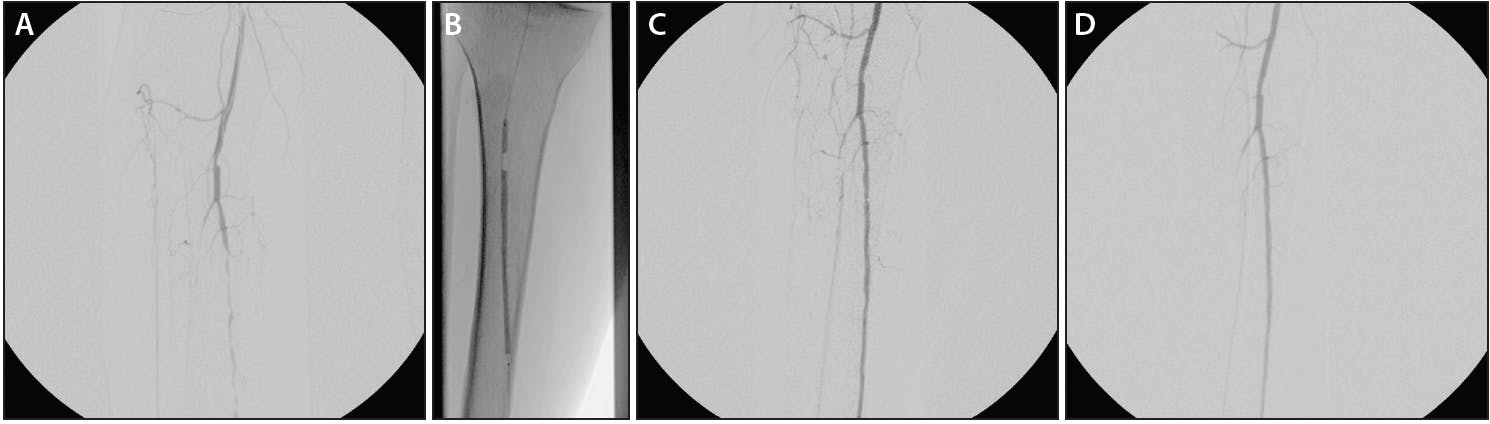
Figure 2. Initial angiogram (A). Vessel prep with a 2.5- X 120-mm Serranator PTA Serration Balloon prior to use of a BRS (B). Final angiograms showing inline flow throughout the PT artery and no dissection (C, D).
Conclusion
Final angiography demonstrated wonderful inline flow throughout the PT artery and excellent blood flow without any dissection (Figure 2C and 2D).
What is your typical treatment algorithm and when do you choose Serranator?
Drs. Katsiroubas and Malik: We are seeing patients with complex calcified tibial disease in Brooklyn, so we would like to maximize the outcomes of our index procedures. We are using Serranator and Esprit in our primary treatment algorithm when treating below-the-knee (BTK) tibial disease.
How important is excellent lumen gain prior to using drug therapy?
Drs. Katsiroubas and Malik: Good vessel preparation for drug therapy is critical for successful drug uptake, as is proven in many other endovascular modalities. Achieving maximum lumen gain, eliminating recoil, and avoiding dissection are key aspects in vessel preparation. We are maximizing lumen gain and effectively preparing the vessel with Serranator compared to standard angioplasty.
Is there something about the Serranator’s mechanism of action that you believe makes it different than other specialty balloons?
Drs. Katsiroubas and Malik: The Serranator’s mechanism is unique because the serration points give the balloon some rigidity, and the semicompliant properties help in these difficult BTK lesions. The three serration strips allow the balloon to open at an equalized force without needing to increase the pressure and aid in minimizing recoil.
Do you utilize Serranator without drug therapy and what are your typical results?
Drs. Katsiroubas and Malik: Yes, we also utilize the Serranator without drug therapy and have appreciated its properties and ability to gain lumen size in challenging lesions. In distal lesions, we have seen remarkable angiographic results as compared to plain old balloon angioplasty. As we continue to utilize the device more, we hope this translates into longer patency, better wound healing rates, and freedom from reintervention.
Advertisement
Advertisement
