Advertisement
Advertisement
September 2024 Supplement
Sponsored by Cagent Vascular
Vessel Preparation With the Serranator® PTA Serration Balloon Catheter in Two Patients With Severely Calcified SFA Occlusions

CASE STUDY 1
Patient Presentation
A man in his late 60s, a smoker with a history of coronary artery disease, diabetes, hypertension, chronic kidney disease, and lifestyle-inhibiting claudication, presented with right leg pain. The right superficial femoral artery (SFA) had mild to diffuse disease with a severely calcific, subtotally occluded distal segment into the popliteal artery (Figure 1A). The posterior tibial (PT) artery was occluded and filled distally by the communicating branch from the peroneal artery, while the anterior tibial (AT) artery was patent. Based on the results of angiography, the decision was made to perform an intervention and to treat the lesion in the distal SFA and popliteal artery.
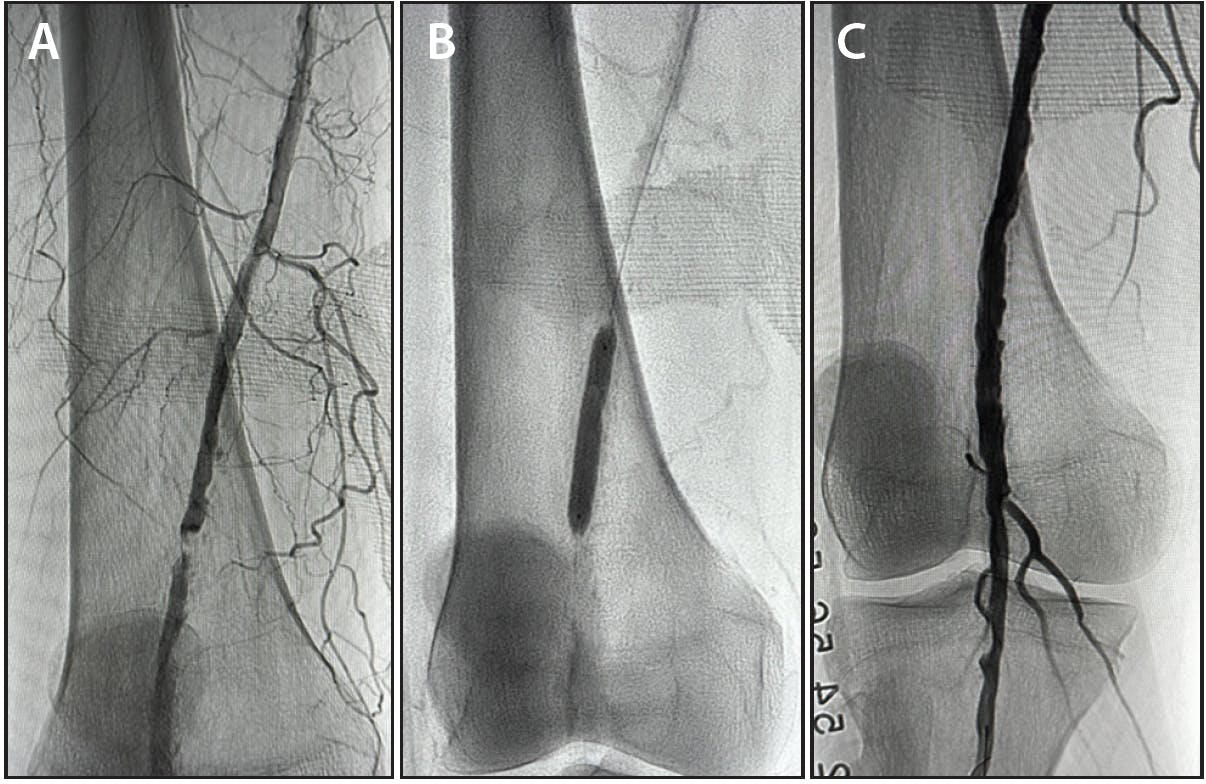
Figure 1. Preprocedure angiogram (A). A 6- X 40-mm Serranator balloon inflated to 6 atm for 2 minutes (B). Post-Serranator angiogram demonstrating lumen gain and no dissection (post-DCB image not shown) (C).
Procedural Overview
Contralateral femoral access was obtained, and a 6-F, 45-cm Destination sheath (Terumo Interventional Systems) was advanced to the common femoral artery. A 0.035-inch Glidewire Advantage (Terumo Interventional Systems) with a 0.035-inch, 135-cm Quick-Cross microcatheter (Philips) were advanced to the distal SFA lesion where it could not be crossed. The wire was exchanged for an 0.035-inch straight, stiff Glidewire and advanced through the lesion and into the peroneal artery. The 0.035-inch Quick-Cross was advanced into the peroneal artery, where the straight, stiff Glidewire was removed and exchanged for 0.014-inch Viperwire (Abbott). Following placement of the Viperwire, the Quick-Cross was removed and a 2.0-mm Diamondback 360 (Abbott) was advanced to the lesion. Orbital atherectomy was performed for multiple passes utilizing low, medium, and high speeds. A 6- X 40-mm Serranator® PTA Balloon (Cagent Vascular) was then advanced and inflated for 2 minutes at 6 atm and provided excellent luminal gain without dissection (Figure 1B and 1C). Lastly, a 6- X 60-mm Ranger drug-coated balloon (DCB; Boston Scientific Corporation) was used to treat the same SFA segment.
Final angiography showed excellent results with brisk flow to the popliteal segment and brisk filling of the tibial vessels.
CASE STUDY 2
Patient Presentation
A woman in her early 70s, a smoker with hypertension and high cholesterol, presented with lifestyle-inhibiting claudication and resting pain in her left foot. Initial imaging demonstrated a highly calcified chronic total occlusion (CTO) of the left common iliac artery to the external iliac artery as well as a CTO of the left SFA (Figure 2A and 2B). A decision was made to stage the intervention and first treat the iliac lesion. She was treated with serration balloon angioplasty using a 5- X 40-mm Serranator balloon to provide optimal vessel preparation for placement of a 7- X 59-mm Omnilink stent (Abbott).
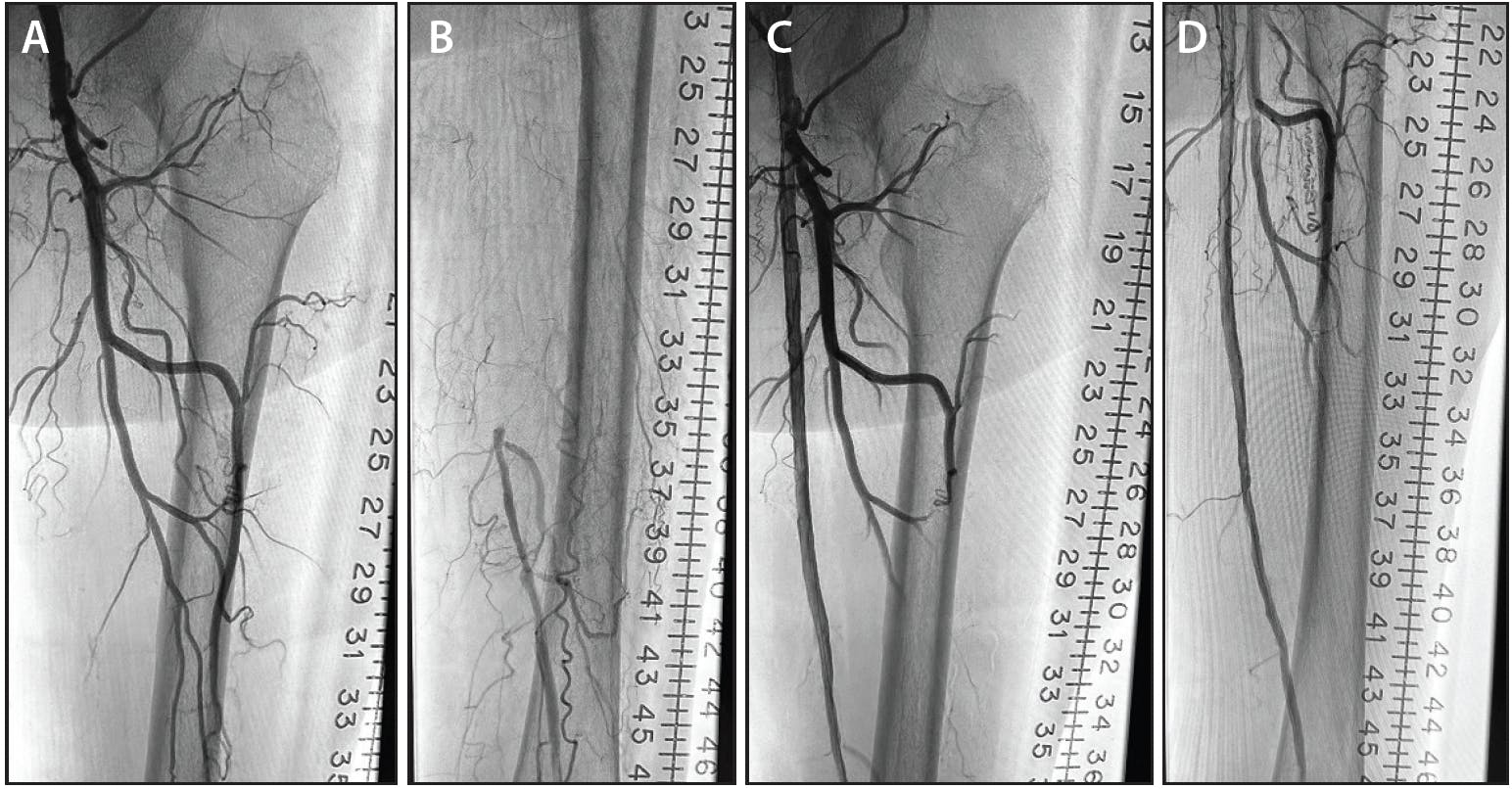
Figure 2. Preprocedure angiograms of the proximal (A) and distal (B) SFA CTO. Postprocedure angiograms showing a patent proximal (C) and distal (D) SFA.
Procedural Overview
A few months later, the patient returned for the treatment left SFA CTO, and initial angiography showed that the previously placed stent in the left common iliac artery was patent. Due to the complexities of the CTO, contralateral and retrograde popliteal access were necessary to cross the CTO. The CTO was crossed using a 0.035-inch Glidewire Advantage with a 0.035-inch, 90-cm Quick-Cross microcatheter from the retrograde approach. Following successful crossing, a 0.018-inch Visions PV intravascular ultrasound (IVUS) catheter (Philips) was advanced and pullback imaging was performed, showing diffuse, multiple segments of fibrotic disease with minimal calcification throughout. The vessel measured at 5.1 to 5.3 mm. A 5- X 120-mm Serranator balloon was utilized to treat the entire SFA with prolonged inflations. After serration angioplasty, angiography showed excellent results. The IVUS catheter was advanced again, showing effective luminal gain without dissection; therefore, a 5- X 150-mm Ranger DCB was used.
Final angiography showed excellent results with brisk flow through the SFA (Figure 2C and 2D).
What has been your overall experience with Serranator?
Dr. Kalisetti: I’ve had an overall good experience utilizing the Serranator. It is consistent at reducing recoil in the tibial vessels as well as minimizing flow-limiting dissection above the knee.
Has the Serranator replaced any devices on your shelf? If yes, what and why?
Dr. Kalisetti: Following multiple uses of the Serranator, we chose to replace both Chocolate balloon (Medtronic) and AngioSculpt scoring balloon (Philips) with the Serranator balloon. The results I’ve seen have been dramatically improved, both postangiography as well as normal ankle-brachial indices during clinical follow-up.
What types of cases do you typically treat with Serranator?
Dr. Kalisetti: I utilize the Serranator above the knee, below the knee, the iliacs, subclavian artery, renal arteries, the superior mesenteric artery, and inferior mesenteric artery. The Serranator is also great for vessel preparation for pre-DCB due to the potential for increased drug absorption. As a user of intravascular lithotripsy, I’ve found that the mechanism of action of the Serranator can potentially increase the effectiveness of IVL therapy.
Advertisement
Advertisement
