Advertisement
Advertisement
September 2024
CHAMPIONS: Providing Access to Vascular Care for the Underserved
Highlights and opportunities from CHAMPIONS, a program aimed at addressing disparities in vascular care in vascular deserts.
By Maria Denalene Tiu, BS, MS; Guistinna Tun, BS; Clara Gomez-Sanchez, MD; and Leigh Ann O’Banion, MD
Comprehensive management of vascular disease is best accomplished through early recognition and support from a multidisciplinary team. However, access to specialized care can be scarce, especially in rural locations or areas where social factors affect health care access. These are defined as vascular deserts (ie, regions with decreased access to vascular specialized care).1 CHAMPIONS, the Comprehensive Heart and Multidisciplinary Limb Preservation Outreach Network, aims to offer on-site screening, consultation, and education to rural and at-risk populations.
The CHAMPIONS program was founded in 2022 by vascular surgeon Dr. Leigh Ann O’Banion and cardiologist Dr. Teresa Daniele of University of California San Francisco (UCSF) Fresno in the San Joaquin Valley (SJV) of California through partnership and financial support from Abbott. The SJV is a vascular desert and one of the most disadvantaged health care populations in the nation, with the lowest ratio of physicians per 100,000 people in California.2 CHAMPIONS targets social events (eg, fairs, festivals, food drives) and partners with hosting organizations to offer health screenings for communities particularly vulnerable to cardiovascular disease (Figure 1).
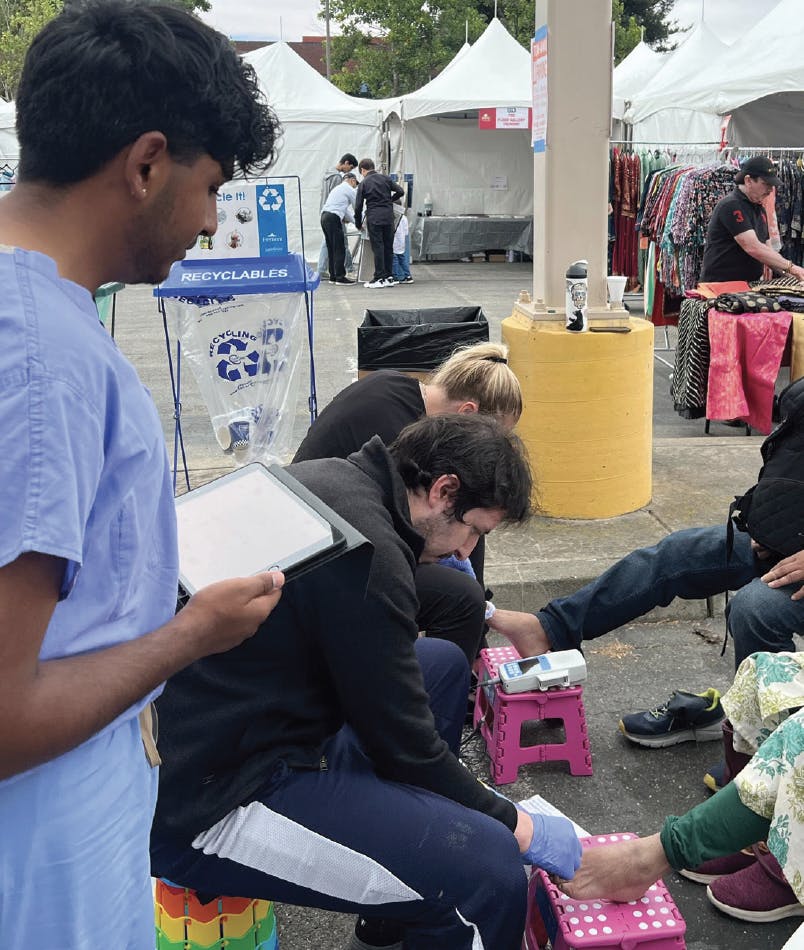
Figure 1. Toe-brachial index screening at the 32nd Festival of India by UCSF medical students and vascular sonographer.
During screening events, medical providers, medical students, and pre-med volunteers set up five stations: check-in, point-of-care testing, vitals, peripheral vascular screening, and education. Participants share demographic information at check-in and then are screened for obesity, hypertension, hyperlipidemia, diabetes, and peripheral vascular disease, if indicated. Based on the screening results, patients receive individualized education about relevant disease processes in their native language and are given results to share with their primary care provider (PCP). Individuals without insurance or a PCP are connected with on-site social services and a local primary care clinic. Patients at risk may be referred to cardiology and vascular services to establish care.
Data from the first two events at the Raisin Harvest Festival in Dinuba, California, and a food bank drive in Poplar, California, showed the following: 86% of participants were Hispanic, 81% had an annual income < $30,000, 28% had no health insurance, and 27% had no PCP. Moreover, 30% had diabetes (10% newly diagnosed on site), 38% had hypertension (40% newly diagnosed on site), and 21% described intermittent claudication.3 Using Healthy Places Index data, we demonstrated that these participants are significantly disadvantaged and at risk for vascular disease, making this the ideal group for targeted outreach. The urgency to provide screening, early diagnosis, and early intervention cannot be understated in these populations given the rise of chronic limb-threatening ischemia (CLTI) and amputation rates we are facing in the United States.
PROGRESS
The long-term goal of CHAMPIONS is to expand outreach to vascular deserts across the United States. In 2023, CHAMPIONS launched its collaboration with vascular surgeons Dr. Clara Gomez-Sanchez (UCSF) and Dr. Camille Jackson (UCSF East Bay). The vision was to expand to communities in the East Bay, including Alameda and Contra Costa counties. Simultaneously, CHAMPIONS began a partnership with the Foundation to Advance Vascular Cures (FAVC), a nonprofit organization led by CEO Isabel Bjork. These additional partnerships have broadened the capacity of CHAMPIONS to not only serve more communities but also improve the quality of the screening clinics.
Working with the FAVC, CHAMPIONS then implemented a quality improvement initiative with the goal of automating screening flow. Initially, collected information was manually documented on paper. This required physicians to interpret the handwritten results from each station and for all participants to be literate. Although effective, this process was inherently time intensive and created room for inconsistencies. The new initiative created a secure, shareable electronic template across all stations. An individual’s screening results automatically generate results for physicians to review with patients. This automation also allows us to select patients based on the European Society for Vascular Surgery guidelines for meeting peripheral artery disease (PAD) screening criteria, rather than universally screening all participants.4 Overall, we are still in the early stages of envisioning internet access across various settings (an unmet need for austere environments), but standardization of the screening flow has drastically improved the efficiency and quality of the services that CHAMPIONS provides.
Given the linguistic diversity found across the SJV and East Bay communities,5,6 CHAMPIONS has been working to ensure language access in the educational material we provide. Our team created an approachable education pamphlet highlighting the relevant disease processes, with a brief overview of their disease, symptoms, risk factors, and management using evidence-based medicine widely available. Thus far, we have translated the material to Spanish, Hindi, Telugu, Tamil, and Punjabi. We expect to expand our repertoire as we continue to serve different patient populations across the nation. Future efforts will also include establishing a website with access to educational material and expanding these CHAMPIONS programs nationwide.
CHALLENGES
A common challenge encountered by the SJV and East Bay CHAMPIONS teams is equipment restrictions, particularly the HbA1c point-of-care device that is only operable within a narrow temperature range (64.4-82 °F). This limits the type of events that CHAMPIONS is able to participate in—especially in the SJV area, which faces a harsh summer climate. Thus, the SJV CHAMPIONS team has only been able to participate in indoor events during summer months. Clearly, this will need to be addressed for future CHAMPIONS clinics across the nation with similar or even harsher climates and especially in areas with limited indoor space.
Additionally, finding community partners to form the vital link between CHAMPIONS and at-risk populations can be challenging. Although it is imperative to address the health disparities within underserved communities, acknowledging the legacy of exploitation endured by vulnerable populations, particularly the Black and Latinx communities, is equally significant and should not be overlooked. This history of unethical research practices and bias in health care has understandably fostered medical mistrust, making these communities hesitant to partner with large academic institutions. Several community partners have expressed excitement to work with CHAMPIONS, and we strive to ensure our approach to building relationships is consistent across all organizations we engage with—guided by the reminder that establishing trust requires transparency, respect, and engagement even beyond the screening event. To further this point, we have analyzed our screening populations and results, and no participants meeting criteria for PAD screening required initial invasive interventions for lower extremity PAD or met the diagnosis of CLTI. This is a crucial finding given the overuse and misuse of peripheral interventions highlighted in the media recently, particularly in vulnerable populations. The goal in this patient population is not intervention but rather prevention and education to halt the progression of limb-threatening vascular disease.
CONCLUSION
CHAMPIONS represents a crucial step forward in addressing the disparities in vascular and cardiovascular care that are experienced by underserved populations in vascular deserts. Although advancements have been made in automating the screening process and creating language-accessible educational materials, challenges persist—particularly in overcoming equipment limitations and building trust with historically marginalized populations. The success of CHAMPIONS thus far exemplifies how collaboration and innovation can improve health outcomes and make a lasting impact on the lives of individuals who lack access to health care.
1. DiLosa KL, Nguyen RK, Brown C, et al. Defining vascular deserts to describe access to care and identify sites for targeted limb preservation outreach. Ann Vasc Surg. 2023;89:104-105. doi: 10.1016/j.avsg.2022.12.038
2. Association of American Medical Colleges. State physician workforce data report: 2021 state profiles. Accessed August 19, 2024. https://www.aamc.org/data-reports/workforce/data/2021-state-profiles
3. DiLosa KL, Humphries M, Mora V, et al. Using vascular deserts as a guide for limb preservation outreach programs successfully targets underserved populations. Ann Vasc Surg. 2024;100:P274-275. doi: 10.1016/j.avsg.2023.12.055
4. Nordanstig J, Behrendt CA, Baumgartner I, et al. Editor’s choice—European Society for Vascular Surgery (ESVS) 2024 clinical practice guidelines on the management of asymptomatic lower limb peripheral arterial disease and intermittent claudication. Eur J Vasc Endovasc Surg. 2024;67:9-96. doi: 10.1016/j.ejvs.2023.08.067
5. East Bay Works. Analytical overview of the region. Accessed August 19, 2024. https://www.eastbayworks.com/wp-content/uploads/2023/02/Analytic-Overview-EBW-Regional-Plan-Mod-PY21-24.pdf
6. San Joaquin Council of Governments California. Demographics. Accessed August 19, 2024. https://www.sjcog.org/236/Demographics
Advertisement
Advertisement
