Advertisement
Advertisement
April 2025
Sponsored by Siemens Healthineers
At the Nexus of Image Quality and Dose
Leading interventional radiologists from Mount Sinai Hospital share first-hand case experiences using the ARTIS icono ceiling from Siemens Healthineers.
With Dan Shilo, MD, and Aaron Fischman, MD, FSIR, FCIRSE, FSVM
In vascular and interventional radiology, where success depends on precision and speed, the ARTIS icono ceiling (Siemens Healthineers) continues to make its mark. The ceiling-mounted angiography system is built to master a wide range of routine and advanced image-guided procedures, with new mechanical flexibility that makes it suitable for many complex image-guided interventions.
We asked two leading interventional radiologists from Mount Sinai Hospital in New York City to offer a review of how the system is performing for them at a facility known for high volumes of outpatient embolizations.
Dan Shilo, MD, is the Director of Vascular and Interventional Radiology at Mount Sinai West. His clinical interests include portal hypertension, uterine fibroid embolization (UFE), genicular artery embolization (GAE), and venous thromboembolic disease including advanced inferior vena cava (IVC) filter retrieval, venous reconstruction, as well as pulmonary embolism management.
Aaron Fischman, MD, FSIR, FCIRSE, FSVM, is Professor of Diagnostic, Molecular and Interventional Radiology, Urology and Surgery at the Icahn School of Medicine at Mount Sinai. He pioneered the transradial technique for access to the arterial system from the wrist during oncologic liver interventions, UFE, and prostate artery embolization (PAE) in men with benign prostatic hyperplasia.
What procedures do you perform at Mount Sinai West?
Dr. Shilo: Most of the procedural volume at our practice at Mount Sinai West is composed of outpatient embolizations, the vast majority in healthy, ambulatory patients. The procedures are primarily established service lines like UFE and PAE, but also emerging service lines like musculoskeletal embolization and hemorrhoid embolization. From a procedural volume perspective, most of our cases are what I’ve mentioned, although not exclusively; some other service lines (eg, venous thromboembolism) occur at this campus as well, inclusive of deep vein thrombosis thrombectomy and complex IVC retrieval.
Dr. Fischman: This is basically a complete outpatient practice with a very small inpatient footprint. Most of our work is with outpatient procedures.
Can you share with us how the ARTIS icono ceiling has impacted your practice?
Dr. Fischman: We’ve seen our radiation dose be dramatically less with our ARTIS icono ceiling system in comparison with other technology. I have some patients and cases that I know are going to be more complex. The ARTIS icono ceiling is now our go-to system for these cases, because it gives us more time with the patient without being exposed to radiation dose that is too high.
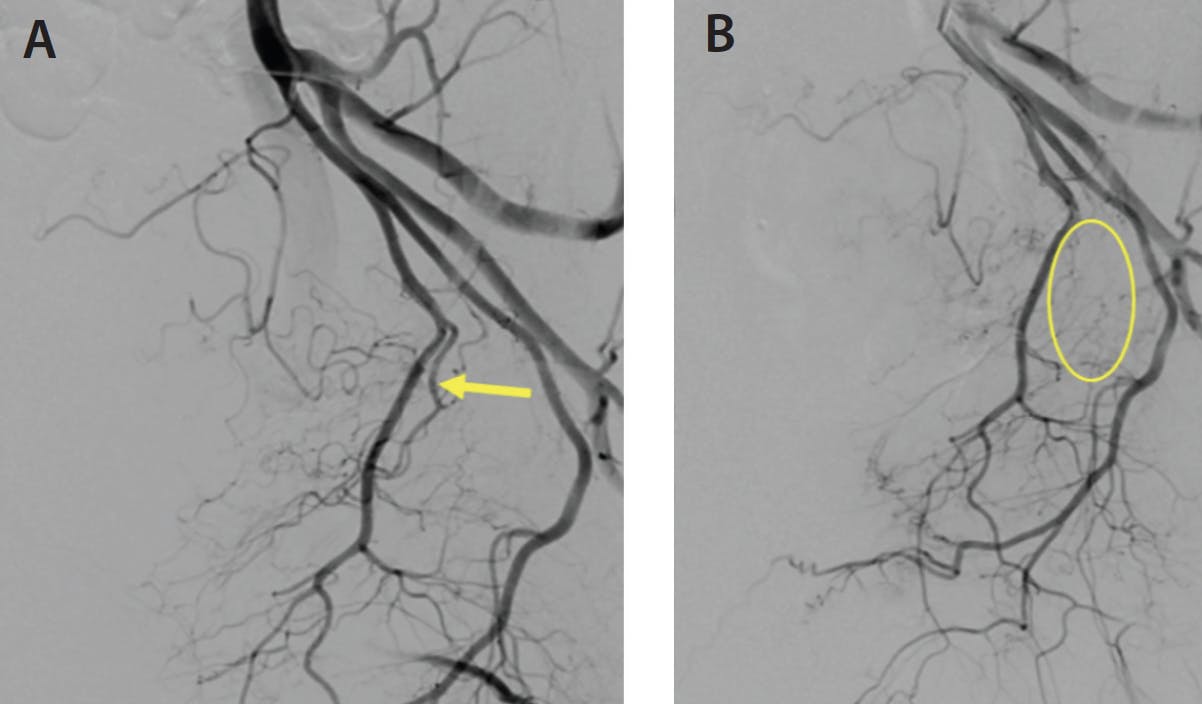
Before and after left PAE. Type III origin of the left prostate artery from the left obturator artery (A). Postembolization of the left prostate artery (B).
Larger patients typically require a higher dose. A case in point is PAE where we frequently oblique the x-ray tube. In those cases, fluoroscopy time can be up to 50 minutes. Now, with the ARTIS icono ceiling, the dose is considerably lower—sometimes by up to a half or more than it would have been previously. This is particularly true for cases that we know are going to be more complicated or for larger patients. We can plan a lot better for these patient factors and for the complexity of the case.
Dr. Shilo: Soon after the ARTIS icono ceiling was installed, we did a complex venous construction that involved through-and-through access from the left posterior tibial vein to the right internal jugular vein. That’s not a typo—we had access all the way through the body, what we call “body floss.” It was a procedure that involved over 40 minutes of fluoroscopy over the pelvis in a patient with a large body habitus and a multitude of steep oblique angles. It stands out in my mind because it was very early on after our ARTIS icono install. As you can imagine, with both neck and ankle access, we were really pushing the system to its limits, both in terms of the ergonomics of the case and the different angulations we were doing. A case of this length and complexity would be pushing what’s possible from any imaging system, and the ARTIS icono ceiling performed admirably in that setting. We had high image quality at a low dose even with significant fluoroscopy times. That procedure stands out to me, because the system passed with flying colors early on after the installation.
As you think about the system’s advanced features, can you elaborate on how intraprocedural cone-beam CT (CBCT) and cross-sectional imaging are utilized in your procedure mix?
Dr. Shilo: In our outpatient embolization practice, we use CBCT primarily as a problem-solving tool. It’s used sparingly; however, it’s a powerful tool for those who may need it for complex anatomy. I’ve used it in PAE to confirm location to avoid nontarget embolization. I’ve also used it for GAE to confirm abnormal anatomy.
Dr. Fischman: There are three ways you can use CBCT for PAE. First, to identify blood vessels that are going to the prostate. This is where we can use the vessel guidance software. Second, to identify nontarget branches. In those scenarios it confirms that the branch is prostate or nontarget. Third, I have used it to confirm complete coverage of the prostate. Using this in combination with vessel guidance software allows you to confirm that you have complete coverage of the entire gland. That’s nice to do at the end of a case (Figure 1).
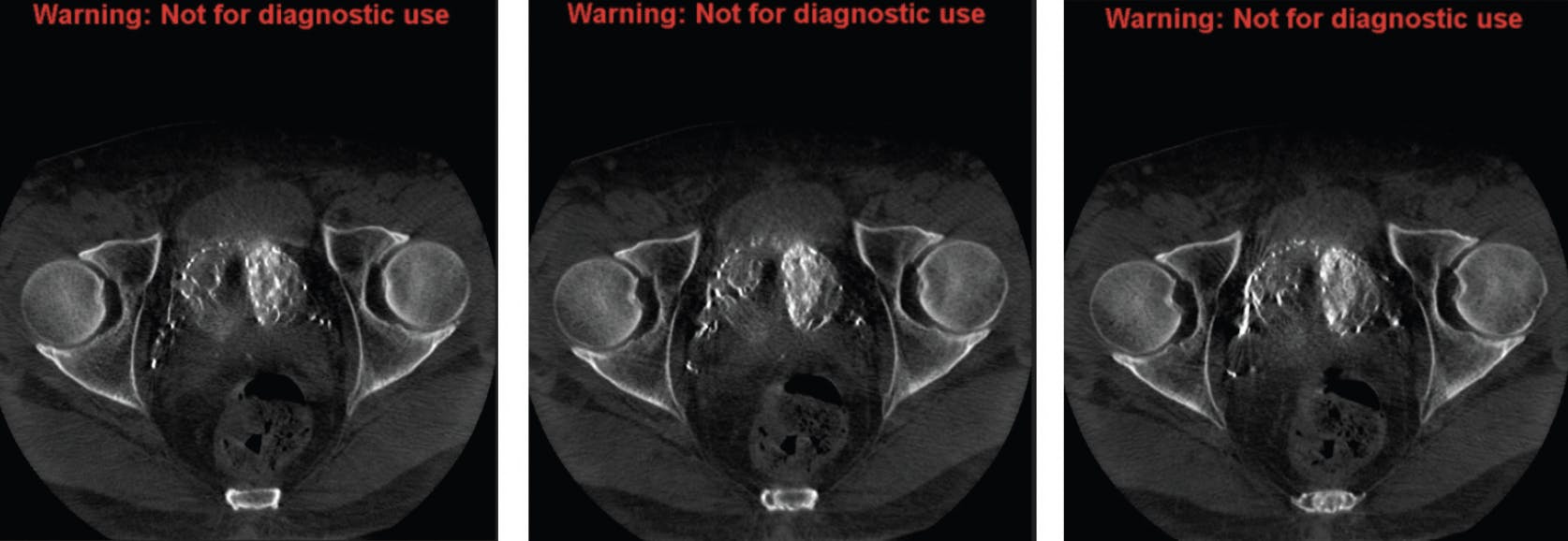
Figure 1. Use of CBCT and vessel guidance software during PAE.
How would you assess your overall experience with the ARTIS icono ceiling?
Dr. Shilo: What stands out to me is the ability to generate high image quality while maintaining low radiation dose. If you can’t see what you’re doing, nothing else matters. My overall experience with the system has been impressive in terms of balancing those two factors.
I think PAE is the most challenging procedure for an imaging system: you’re trying to image the abdomen of an American-sized man in his 50s, 60s, or 70s at steep oblique angles, often over 30° to 40°, while trying to access extremely small vessels with microcatheters that are less than a millimeter in diameter. The procedures can take a long time, and you may need CBCT as well. The ARTIS unit checks off all those boxes, so that on days when we’re doing six or more prostates, we can get to the end of the day without the patient or the operator glowing.
Dr. Fischman: The biggest improvement I’ve noticed from the system we were previously using is the quality of the two-dimensional fluoroscopic and digital subtraction angiographic (DSA) images. For PAE, one the most important things is the roadmapping—I use it in every case. I think the quality and the ease of use of the roadmapping allows us to get a lot of patients through the lab quicker because we’re not repeating DSA runs. I find the feature to be seamless, and they’re very easy to produce and manage throughout the entire case.
The DSA roadmap saves dose, as you can use a reference image from a previous run and create a roadmap from that image. Because we can now use a previously acquired acquisition, we reduce dose by not having to shoot another roadmap.
What’s nice is the Automap feature is integrated into the DSA roadmap. You can choose from any previous DSA for a new DSA roadmap. It doesn’t have to match your current system position. Automap is activated and automatically drives the system to the position where that reference image was created, so you don’t have to inject more contrast media. Because Automap is integrated in DSA roadmap, you have all your system geometry at the ready, so your C-arm position and arm size is recalled.
I’m also impressed with how the C-arm moves around the room. It doesn’t get in the way of the operators, and it doesn’t get in the way of the equipment in the room. It moves around freely.
What has your experience been like with Siemens Healthineers support?
Dr. Fischman: One thing that we worked on early on with Siemens was optimizing our imaging protocols for our pelvic embolizations. The Siemens team helped us create a protocol that allowed us to visualize anatomy while keeping doses extremely low. We now use that protocol as our default for pelvic embolizations, allowing us to keep the dose very low. We only increase it if it is necessary. I can count on one hand the times we had to increase dose last year. The system is already very low dose. With Siemens Healthineers support, we’ve taken it down to the lowest possible amount.
LEVERAGING THE CAPABILITIES OF ARTIS ICONO CEILING
Mount Sinai Hospital has leveraged the advanced capabilities of ARTIS icono ceiling from Siemens Healthineers. Its technology supports complex minimally invasive procedures in interventional radiology. The flagship product of the ARTIS icono family offers new flexibility that lets clinicians adjust its position to achieve optimal views for procedures like embolizations, where precise visualization of blood vessels and surrounding tissue is critical. The ceiling-mounted design enables greater space efficiency in the procedure room.
Users continue to laud the advanced fluoroscopic and angiographic imaging technologies that deliver high-resolution, real-time imaging with low radiation dose exposure. This is a critical advantage during long interventional procedures like embolization. The cutting-edge software suite includes tools like dynamic imaging enhancement, DSA roadmap, and 3D imaging.
Click here to learn more about ARTIS icono ceiling.
Dr. Shilo: That was a good example. We were able to optimize the roadmap technology in what is a challenging procedure for any imaging system. In addition, when we do cases that are more outside the box—for example, a biliary endoscopy using multiple modalities and ancillary equipment inside the room—we can easily get support. We had a Siemens representative on site to support this case, and we were able to seamlessly troubleshoot the issues that inevitably arose. When you are using a new room, there are growing pains and challenges. As we did more complex procedures that pushed the technology further, we always had somebody available to assist us on site.
Statements by Siemens Healthineers customers described herein are based on results that were achieved in the customer’s unique setting. Since there is no “typical” hospital and many variables exist (eg, hospital size, case mix, level of IT adoption), there can be no guarantee that other customers will achieve the same results.


Advertisement
Advertisement