Advertisement
Advertisement
April 2025
Sponsored by Inari Medical
Peripheral Thrombectomy Simplified: Integrating Aspiration and Mechanical Techniques
Interventionalists share their experiences managing peripheral thrombus with Triever aspiration catheters from the FlowTriever® System and their preferences regarding thrombectomy techniques.
With Udit Bhatnagar, MD, FACC, FSCAI, RPVI; Jeffrey Saavedra, MD; and Edward Assi, DO
This is an article sponsored and authored by Inari Medical. The health care providers (HCPs) sharing their views and opinions here express their experience with Inari Medical devices. The HCPs’ opinions of these devices were formed independent of Inari Medical and may not represent every experience or outcome.
Peripheral thrombosis, including deep vein thrombosis (DVT), is a common and complex condition. In the United States alone, research indicates that > 500,000 patients might be diagnosed with DVT each year.1,2 Patients with DVT frequently present with pain, swelling, and skin changes in the affected limb.3 Without intervention, these signs and symptoms can persist, eventually leading to a morbid condition known as post-thrombotic syndrome (PTS).4 Up to 50% of patients who receive conservative medical managements for acute iliofemoral DVT will develop PTS within 2 years.5,6
In randomized controlled trials, catheter-directed thrombolysis (CDT) has been shown to improve the severity of PTS after acute iliofemoral DVT when compared with anticoagulation alone.5-7 However, mixed efficacy was observed regarding the overall rate of PTS in these studies, and major bleeding with CDT was as high as 5%.8 Current guidelines do not recommend fibrinolytic-based therapies as a first-line treatment for most patients with DVT.9,10
Combined with the lack of clear benefit from CDT, recent technologic advances have led to an increased use of mechanical and aspiration thrombectomy for DVT. Of these next-generation techniques, mechanical thrombectomy (MT) with the ClotTriever System (Inari Medical) remains the most studied DVT treatment. In the 500-patient CLOUT registry, MT demonstrated a favorable safety profile, excellent removal of acute through chronic thrombus, and a low rate of PTS through 2 years of follow-up.11-13 However, randomized data from studies like the DEFIANCE trial are not yet available, and some physicians prefer an aspiration-based approach to DVT while awaiting such results.
Multiple thrombectomy platforms for aspiration are available, each with distinct features. Unlike continuous aspiration devices, Triever catheters from Inari Medical’s FlowTriever System offer controlled, over-the-wire aspirations and the capacity to return blood to the patient after filtration using the FlowSaver Blood Return System (Inari Medical). The Triever catheters are available in 16-, 20-, and 24-F sizes, allowing physicians to select the most appropriate catheter size based on the specific requirements of the procedure. Inari Medical’s comprehensive portfolio provides flexible solutions for physicians who favor an aspiration approach to removing peripheral thrombus.
In this article, Drs. Udit Bhatnagar, Jeffrey Saavedra, and Edward Assi present their experiences managing peripheral thrombus with user-friendly Triever aspiration catheters, sharing varied preferences regarding MT techniques. These case studies illustrate the ability of Triever catheters to deliver successful outcomes across a range of peripheral thrombus presentations.
Case 1: Efficient Restoration of Anterograde Flow in an Elderly Patient After Recurrent Lower Extremity DVT

PATIENT PRESENTATION
A female patient in her early 70s with a history of dyslipidemia and DVT of the left lower extremity presented with new onset of severe swelling and pain in the left leg. These worsening symptoms raised concern for a recurrent thrombotic event.
On physical examination, there was noticeable swelling of the left lower extremity, and the patient complained of heaviness and continued pain in the affected leg. There were no signs of pulselessness, cyanosis, or skin discoloration, and pulses were palpable in both lower extremities. Doppler ultrasound showed thrombus in the left common femoral (CFV), external iliac (EIV), and common iliac veins (CIV). The findings raised suspicion for chronic venous compression, potentially due to May-Thurner syndrome.
Given the medical history, symptoms, and presence of significant thrombus burden, the decision was made to proceed with further evaluation and venous intervention.
“When I start a case, I don’t set out with a specific device in mind. I begin with IVUS to diagnose the thrombus and then choose the appropriate tools from my available options. Aspiration thrombectomy isn’t a new approach for DVT, but I’ve found that Triever catheters perform very well overall. They strike a great balance between strong initial suction forces because of the large-caliber catheter, great deliverability and trackability, and reduced blood loss compared to other devices. The reason why I like Inari is it gives me the tools for both acute and chronic thrombus.” – Dr. Bhatnagar
PROCEDURAL OVERVIEW
The patient was positioned prone for the procedure. Bilateral popliteal vein (PV) access was achieved, and a venogram was performed through the left PV. Confirming the Doppler ultrasound results, venography revealed occlusion of the left CFV (Figure 1A) through the CIV (Figure 1B). There were also signs of chronic venous disease and compression of the left CIV (Figure 1B).
A 0.035-inch guidewire was placed from the left side. Intravascular ultrasound (IVUS) showed no thrombus in the PV or distal superficial femoral veins (SFV) (Figure 1C). On further IVUS imaging, acute thrombus was seen in the left EIV and extending into the CFV (Figure 1D), and severe compression and fibrotic changes were observed in the left CIV and EIV (Figure 1E), including large webs and synechiae.
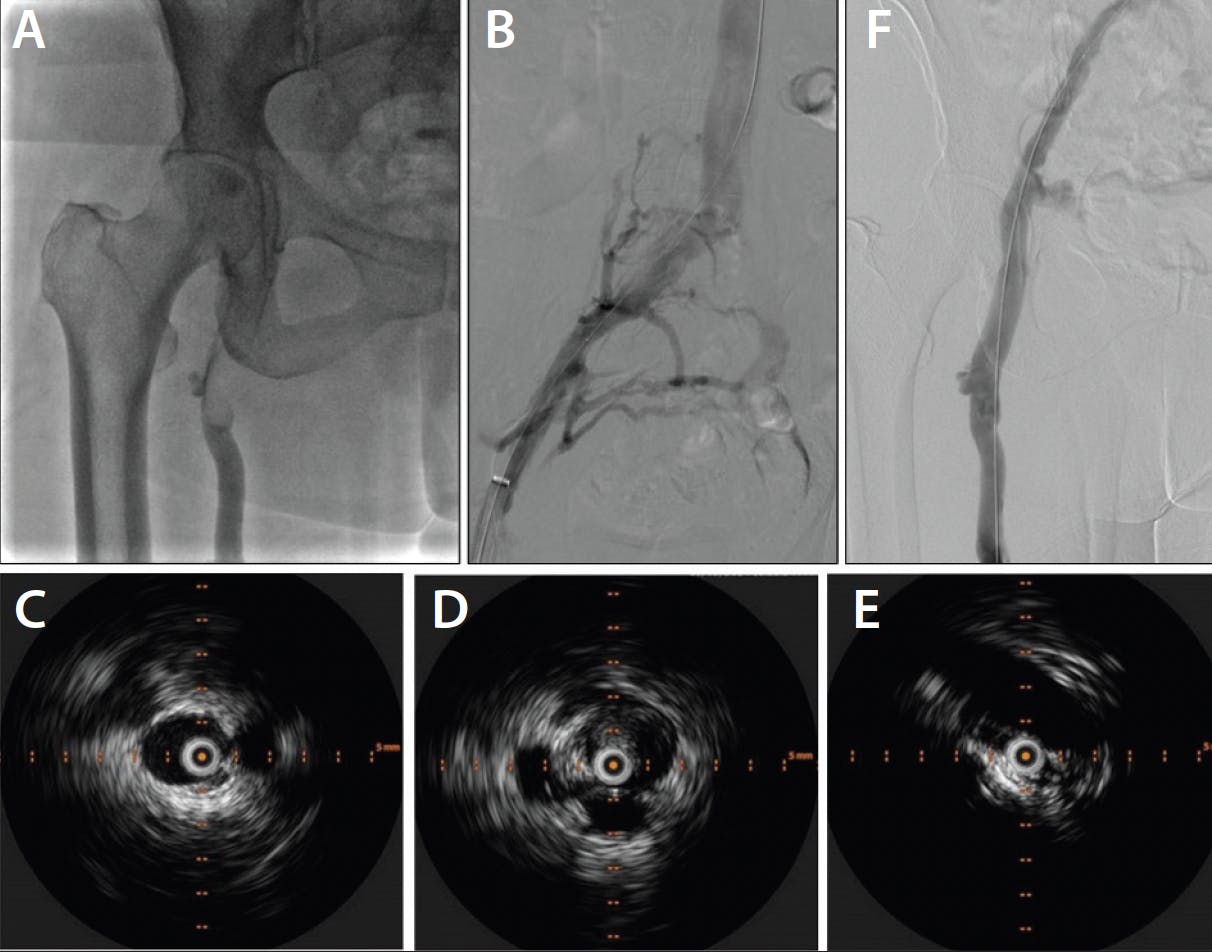
Figure 1. Pre-thrombectomy venograms showing thrombosis of the left CFV (A) through the left EIV and CIV (B). Pre-thrombectomy IVUS showing no thrombus in the left PV or distal SFV (C), acute thrombosis of the left CFV (D), and severe compression of the left CIV (E). Post-thrombectomy venogram demonstrating significant improvement of cephalad flow in the left CFV and iliac veins (F).
Given the thrombus burden and findings, a Triever20 aspiration thrombectomy catheter was used. After upsizing the sheath to 20 F, multiple aspirations were performed. A large amount of thrombus was aspirated from the left iliac veins and CFV. Post-procedural venography demonstrated significant improvement in anterograde flow throughout the left CFV and iliac veins (Figure 1F). However, severe compression and fibrotic changes remained in the left CIV, consistent with May-Thurner syndrome. As a result, balloon venoplasty was performed to address the webs and synechiae in the left iliac veins. In total, the estimated blood loss was 50 mL.
The patient tolerated the procedure well, with heparinization maintained throughout. Hemostasis was achieved with a figure-of-eight suture and manual compression for the left and right lower extremity access sites, respectively. The patient was scheduled for a follow-up venogram during which the potential need for venous stent placement to address the iliac venous compression will be evaluated.
Case 2: Lytic-Free Removal of Acute Lower Extremity Thrombosis in a Pregnant Patient

PATIENT PRESENTATION
A female patient in her late teens with no significant past medical history presented to the emergency department with left leg pain and swelling. The patient reported cramping and pain in the left upper thigh, which gradually extended down to her lower leg the morning before the procedure. The swelling also progressively worsened, leading her to seek evaluation. There were no other symptoms reported, including no fever or chest pain.
In addition, the patient was noted to be 8 weeks pregnant, which required careful consideration of potential radiation exposure during the procedure.
“The benefits of Triever catheters for aspiration thrombectomy are the speed and efficiency, the low rate of complications, and the aesthetically pleasing results.” – Dr. Saavedra
PROCEDURAL OVERVIEW
The patient was initially placed in the supine position for placement of an inferior vena cava (IVC) filter. Subsequently, the patient placed prone for improved access to the left PV, and the procedure continued with the patient under mild sedation.
A diagnostic venogram confirmed significant thrombus burden in the left lower extremity, including the PV, SFV, CFV, EIV, and CIV (Figure 2A). A Triever16 catheter was introduced through the left PV access for thrombectomy. Aspirations were performed in successively proximal venous segments. To minimize blood loss, a FlowSaver device was employed for autologous blood return to the patient after the blood was filtered of thrombi.
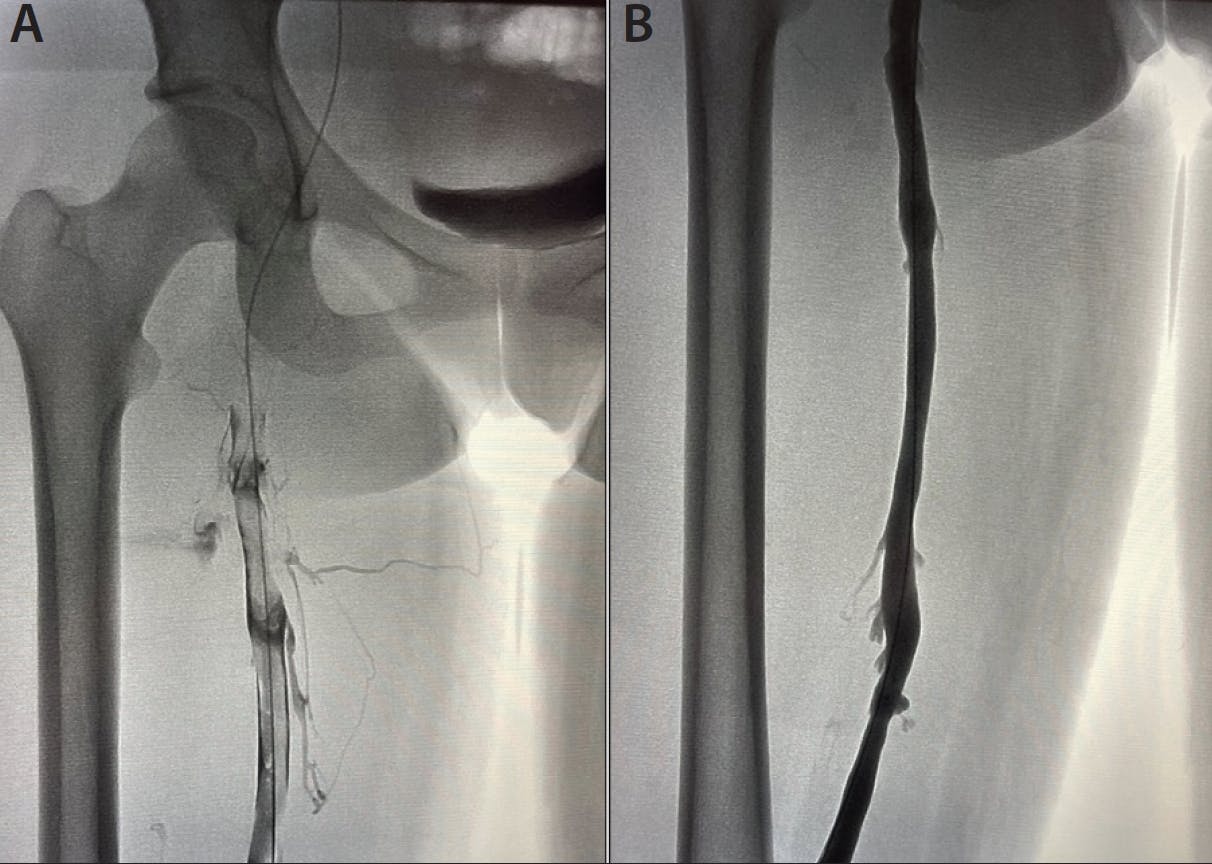
Figure 2. Pre-thrombectomy venogram demonstrating thrombosis of the left PV, SFV, CFV, EIV, and CIV (A). Post-thrombectomy venogram of the left lower extremity showing restored patency and anterograde flow (B).
Post-thrombectomy venography demonstrated patent flow (Figure 2B). Following thrombectomy, balloon angioplasty was performed in the left CIV, which was suspected to be compressed due to May-Thurner syndrome. The procedure was completed in 10 minutes, with a favorable outcome and improved flow observed in the treated veins.
Case 3: Resolution of Extensive Bilateral DVT With Minimal Blood Loss in a Post-Surgical Patient With Acute Renal Failure

PATIENT PRESENTATION
A male patient in his mid-60s with obstructive sleep apnea presented with a recent history of right total knee replacement 8 weeks prior. Routine laboratory testing revealed acute renal failure secondary to obstructive uropathy; serum creatinine was 9 mg/dL. The patient had developed bilateral lower extremity swelling post-operatively after his total knee replacement surgery. Upon hospital admission, gross hematuria was noted, likely due to heparin administration and Foley catheter insertion.
Bilateral lower extremity ultrasound revealed extensive bilateral DVT involving the CFV, proximal deep femoral, posterior tibial, and peroneal veins. Significant thrombus burden was noted in the left PV and femoral vein as well as the right femoral vein.
“Patients who present early with fresh thrombus are great candidates for aspiration. I approach these cases with a PV access. I do one or two aspirations, advance the catheter, perform one or two more aspirations, and continue moving up to open the entire vein without any difficulty. The ability to give blood back is a game changer, especially with patients who start with very little.” – Dr. Assi
PROCEDURAL OVERVIEW
Diagnostic venography confirmed significant bilateral thrombosis (Figure 3A). Given the extensive thrombus burden in both legs, a contralateral access approach was utilized. To trap any thrombus embolized during the procedure, FlowTriever disks were introduced into the IVC through a 12-F sheath in the left PV access site. Next, a Triever20 aspiration catheter was advanced into the right PV, and multiple aspirations were performed to remove the thrombus.
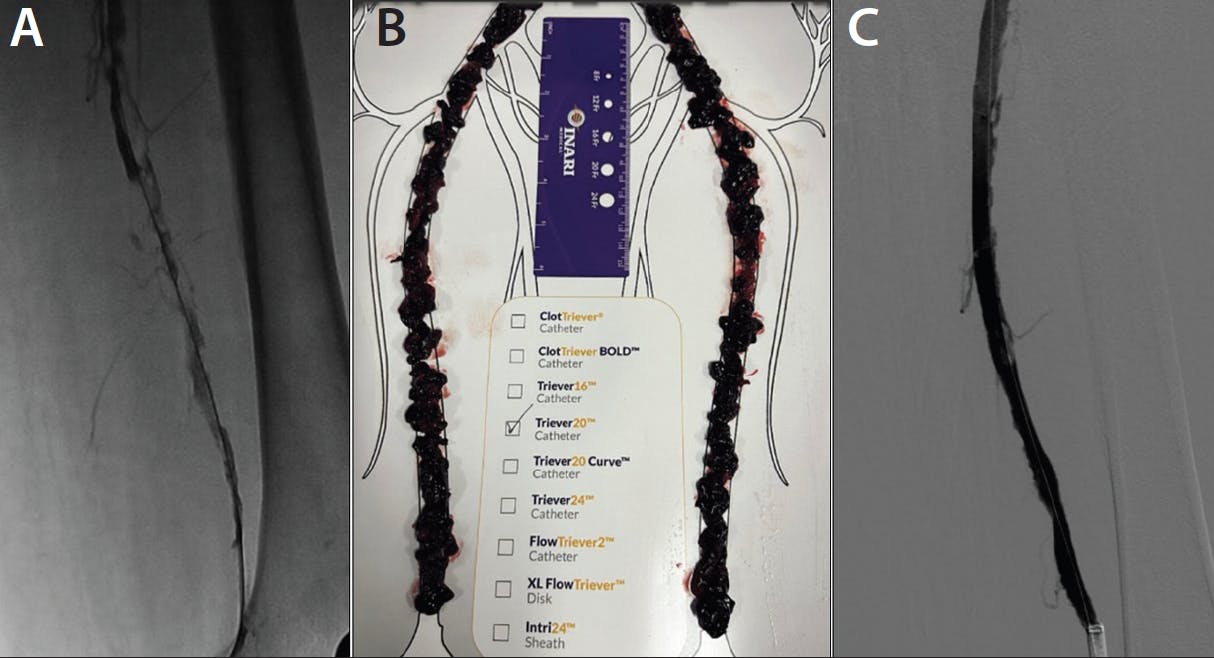
Figure 3. Pre-thrombectomy venogram demonstrating thrombosis of the left femoral veins (A). Image showing the thrombus burden removed from the bilateral lower extremity venous anatomy (B). Post-thrombectomy venogram demonstrating restoration of inflow to and outflow from the left femoral veins (C).
After successful thrombectomy in the right lower extremity was completed, FlowTriever disks were reintroduced to the IVC through the access site in the right leg. Through the access site in the left leg, aspirations were performed using the 20-F Triever catheters, removing thrombus from the left femoral veins, then from the left EIV, and finally from the left CIV (Figure 3B). Imaging demonstrated successful thrombus removal from the left side, with excellent outflow and inflow restoration in the treated veins (Figure 3C).
The procedure was completed with an estimated blood loss of 100 mL and 15 minutes of fluoroscopy time, demonstrating the efficiency of Triever catheters for aspirating DVT. The patient tolerated the procedure well and showed immediate improvements in blood flow after thrombectomy.
CONCLUSION
Patients with peripheral thrombosis represent a frequently underserved population, but new technologies aim to improve the standard of care for this challenging condition. The ClotTriever System is the leading device for intervening in DVT, with prospective research demonstrating the excellent safety and effectiveness of MT for acute to chronic DVT. However, when aspiration thrombectomy is required or preferred, Triever catheters allow for straightforward thrombus removal without the need for lytic agents. Unlike other available catheters, Triever catheters offer the option to perform aspirations over the wire for enhanced safety, with the flexibility to choose from 16-, 20-, or 24-F sizes based on procedural needs. Another benefit of the Triever catheters is that blood can be filtered and returned to the patient, particularly in the presence of extensive thrombus. This helps avoid significant blood loss, which can be a concern with other aspiration thrombectomy systems.
The cases presented here highlight the versatility of Triever aspirations catheters and their role in achieving successful outcomes for patients with peripheral thrombosis.
1. Wendelboe AM, Campbell J, Ding K, et al. Incidence of venous thromboembolism in a racially diverse population of Oklahoma County, Oklahoma. Thromb Haemost. 2021;121:816-825. doi: 10.1055/s-0040-1722189
2. Raskob G, Angchaisuksiri P, Blanco A, Buller H. Thrombosis: a major contributor to global disease burden. Thromb Res. 2014;134:931-938. doi: 10.1016/j.thromres.2014.08.014
3. Stubbs MJ, Mouyis M, Thomas M. Deep vein thrombosis. BMJ. 2018;360:k351. doi: 10.1136/bmj.k351
4. Kahn SR. The post-thrombotic syndrome. Hematology Am Soc Hematol Educ Program. 2016;2016:413-418. doi: 10.1182/asheducation-2016.1.413
5. Enden T, Haig Y, Klow NE, et al. Long-term outcome after additional catheter-directed thrombolysis versus standard treatment for acute iliofemoral deep vein thrombosis (the CaVenT study): a randomised controlled trial. Lancet. 2012;379:31-38. doi: 10.1016/S0140-6736(11)61753-4
6. Comerota AJ, Kearon C, Gu CS, et al. Endovascular thrombus removal for acute iliofemoral deep vein thrombosis. Circulation. 2019;139:1162-1173. doi: 10.1161/CIRCULATIONAHA.118.037425
7. Notten P, de Smet A, Tick LW, et al. CAVA (Ultrasound-Accelerated Catheter-Directed Thrombolysis on Preventing Post-Thrombotic Syndrome) trial: long-term follow-up results. J Am Heart Assoc. 2021;10:e018973. doi: 10.1161/JAHA.120.018973
8. Notten P, Ten Cate-Hoek AJ, Arnoldussen C, et al. Ultrasound-accelerated catheter-directed thrombolysis versus anticoagulation for the prevention of post-thrombotic syndrome (CAVA): a single-blind, multicentre, randomised trial. Lancet Haematol. 2020;7:e40-e49. doi: 10.1016/S2352-3026(19)30209-1
9. Stevens SM, Woller SC, Baumann Kreuziger L, et al. Executive summary: antithrombotic therapy for VTE disease: second update of the CHEST guideline and expert panel report. Chest. 2021;160:2247-2259. doi: 10.1016/j.chest.2021.07.056
10. Vedantham S, Desai KR, Weinberg I, et al. Society of Interventional Radiology Position Statement on the endovascular management of acute iliofemoral deep vein thrombosis. J Vasc Interv Radiol. 2023;34:284-299.e7. doi: 10.1016/j.jvir.2022.10.038
11. Abramowitz SD, Kado H, Schor J, et al. Six-month deep vein thrombosis outcomes by chronicity: analysis of the real-world ClotTriever outcomes registry. J Vasc Interv Radiol. 2023;34:879-887.e4. doi: 10.1016/j.jvir.2022.12.480
12. Bisharat MB, Ichinose EJ, Veerina KK, et al. One-year clinical outcomes following mechanical thrombectomy for deep vein thrombosis: a CLOUT registry analysis. J Soc Cardiovasc Angiogr Interv. 2024;3:101307. doi: 10.1016/j.jscai.2024.101307
13. Dexter DJ; for the CLOUT investigators. Complete two-year outcomes in patients receiving mechanical thrombectomy for deep vein thrombosis in the CLOUT registry. Presented at: The 22nd annual Vascular Interventional Advances (VIVA) meeting; November 4, 2024; Las Vegas, Nevada.
Indications for Use:
The FlowTriever Retrieval/Aspiration System is indicated for (1) the non-surgical removal of emboli and thrombi from blood vessels; and (2) injection, infusion, and/or aspiration of contrast media and other fluids into or from a blood vessel. The FlowTriever Retrieval/Aspiration System is intended for use in the peripheral vasculature and for the treatment of pulmonary embolism. Triever Catheters are indicated for: (1) The non-surgical removal of emboli and thrombi from blood vessels. (2) Injection, infusion, and/or aspiration of contrast media and other fluids into or from a blood vessel. Triever Catheters are intended for use in the peripheral vasculature and for the treatment of pulmonary embolism. Triever Catheters are also intended for use in treating clot in transit in the right atrium, but not in conjunction with FlowTriever Catheters.
The FlowSaver Blood Return System is used with Inari Medical catheters and sheaths for autologous blood transfusion.
Review complete Instructions for Use, Indications for Use, Warnings, Precautions, Possible Adverse Effects and Contraindications prior to use of these product.
The ClotTriever thrombectomy system is indicated for (1) the non-surgical removal of thrombi and emboli from blood vessels and (2) injection, infusion and/or aspiration of contrast media and other fluids into or from a blood vessel. The ClotTriever thrombectomy system is intended for use in the peripheral vasculature, including deep vein thrombosis (DVT).
Review complete Instructions for Use, Indications for Use, Warnings, Precautions, Possible Adverse Effects and Contraindications prior to use of these product.
Caution: Federal (USA) law restricts these devices to sale by or on the order of a physician.
For all non-Inari products, please refer to manufacturer Instructions for Use/Intended Purpose for complete indications for use, contraindications, warnings, and precautions.
All trademarks are property of their respective owners.
Drs. Saavedra and Assi are paid consultants of Inari Medical. Drs. Bhatnagar, Saavedra, and Assi are sharing their views and opinions and are expressing their experience with Inari Medical devices. Their opinions and experiences using these devices were created independent of Inari Medical and may not represent every experience or outcome with the devices.
PRO-2232-USA-EN-v1
Advertisement
Advertisement