Advertisement
Advertisement

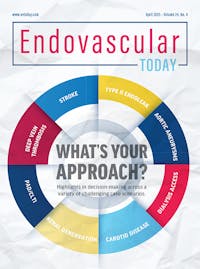
Few disciplines in medicine have evolved as rapidly as endovascular therapy for arterial and venous disease. In this issue of Endovascular Today, an array of thought leaders and expert operators share their respective approaches to tackling some of the most challenging clinical and technical scenarios they’ve encountered in their practices.
Our series of challenging cases begins with a discussion by Sundeep Kumar, MD; Mehdi Shishehbor, DO; and Jun Li, MD, around “no-option” chronic limb-threatening ischemia in a patient with poor bypass targets and failed endovascular arterial interventions.
Subhash Banerjee, MD; Zachary Rosol, MD; and Sameh Sayfo, MD, take us through a tough case of superficial femoral artery revascularization, showcasing the role of intravascular ultrasound in the evolving landscape of complex endovascular interventions.
Then, Kathleen Gibson, MD, and Sooyeon Kim, MD, share a case involving a patient with severe, symptomatic iliofemoral deep vein thrombosis complicated by a large pelvic mass requiring abdominal surgery—highlighting the complexities of clinical decision-making for venous thromboembolism.
Next, Andi Peshkepija, MD, reviews how physician-modified endografts are increasingly used in the management of complex aortic aneurysms in high-risk patients.
Meghan Clark, MD; Alexandra Banathy, MD; and Nicole Keefe, MD, provide an overview of current strategies for managing type II endoleaks, illustrated by a case of persistent endoleak and sac enlargement after fenestrated endovascular aneurysm repair.
Peter A. Soukas, MD, and Pieter Storm de Klerk, MBChB, provide a case study on intravascular lithotripsy for the treatment of calcified carotid artery stenosis demonstrating its technical feasibility and highlighting areas in need of further study.
Alex B. Chebl, MD, discusses a case that outlines a plan for endovascular management of acute ischemic stroke due to tandem occlusion.
Kevin Onofrey, MD, and Xhorlina Marko, MD, share a case involving chronic venous occlusion in a patient with a recently constructed arteriovenous loop graft and shed light on contemporary challenges with dialysis access—a landscape characterized by increasingly scarce providers and increasingly complicated patients.
Our final challenging case is led by Brian Fulton, MD; Taisei (‘Tai’) Kobayashi, MD; and Jay Giri, MD, who present a case of renal sympathetic denervation for a patient with resistant hypertension.
Wrapping up this issue is our featured interview with Vivian L. Bishay, MD, who discusses keys to a successful interventional radiology program, her role as National Co-Principal Investigator of SYMPHONY-PE, the broader clinical trial landscape for pulmonary embolism, and priorities for research in women’s health.
To our team of master clinicians, thank you for sharing your insight and guidance. And to our readers, we are certain that your review of these cases, performed from head to toe and spanning the arterial and venous vasculature, will leave you better equipped to evaluate and manage the most complex patient scenarios and the most challenging patient anatomy you’ll encounter.
Herb Aronow, MD, MPH, FACC, MSCAI, MSVM
Guest Chief Medical Editor
Advertisement
Advertisement