Advertisement
Advertisement
August 2025 Supplement
Sponsored by Merit Medical Systems, Inc.
The Early Days of the WRAPSODY® Cell-Impermeable Endoprosthesis (CIE)
A case highlighting the efficacy and durability of the WRAPSODY CIE and an overview of how my practice utilizes it.
The majority of our hemodialysis patient cohort consists of patients with native arteriovenous fistulas (AVFs) and arteriovenous grafts (AVGs). Access circuit stenoses are a common problem and have a significant impact on the speed and efficiency of dialysis sessions and patient quality of life. Pathophysiology is a multifactorial process, involving turbulent flow, inflammation, neointimal hyperplasia, and thrombus formation. The aims of fistula intervention should be to optimize fistula function, prevent circuit thrombosis, and minimize the number of reinterventions. We are fortunate to have an excellent surveillance program combining clinical and transonic assessment to enable early identification and intervention of access circuit stenosis, thus preventing complications.
The WRAPSODY CIE (Merit Medical Systems, Inc.) has been designed from its inception to meet the challenges of access circuit stenotic disease. It features optimized radial force and crush resistance, reduced radial force at each end of the CIE to minimize stent edge neointimal hyperplasia, a cell-impermeable middle layer to reduce cellular in-growth, and a novel-spun, inner polytetrafluoroethylene microstructure to reduce thrombosis without the addition of drugs or coatings.
We were honored to be selected as one of the centers for the WRAPSODY first-in-human (FIH) study1 and placed the first device in the study—a proud moment for us, a momentous day for the Merit WRAPSODY team, and the culmination of many years of hard work. The FIH results were exceptional and are paving the way for significant disruption of the status quo of access circuit stenosis treatment.
The FIH study was performed across three centers in Europe. Forty-six patients met the eligibility criteria and were enrolled. The study cohort consisted of patients with both native AVFs and AVGs and included stenotic lesions in the cephalic arch, graft-vein anastomosis, and central veins.1*
All procedures were technically successful, and all but one patient were free from safety events at 30 days (97.8% [45/46]). Target lesion primary patency (TLPP) rates at 6 and 12 months were 97.7% (42/43) and 84.6% (33/39), respectively, and 6- and 12-month access circuit primary patency (ACPP) rates were 84.4% (38/45) and 65.9% (29/44), respectively (Figure 1 and Figure 2).1
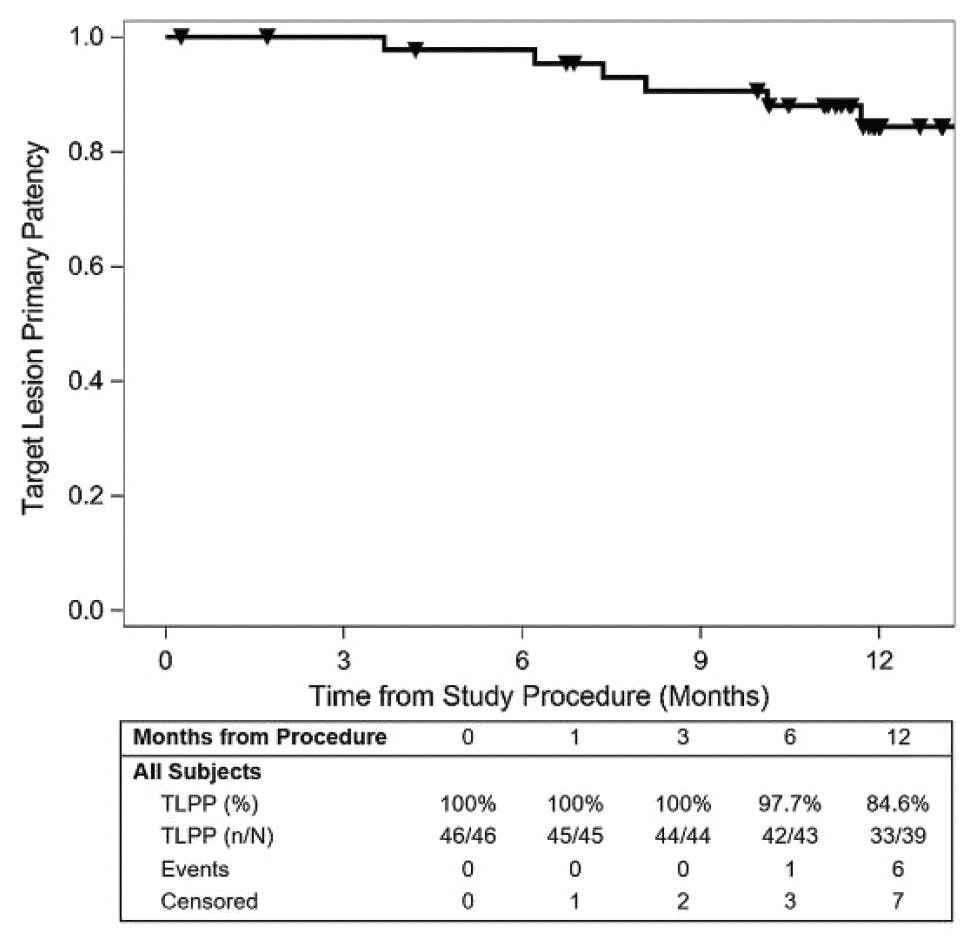
Figure 1. Kaplan-Meier curve of TLPP for all patients through 12 months. Reprinted from Gilbert J, Rai J, Kingsmore D, et al. First clinical results of the Merit WRAPSODY™ cell-impermeable endoprosthesis for treatment of access circuit stenosis in haemodialysis patients. Cardiovasc Intervent Radiol. 2021;44:1903-1913. doi: 10.1007/s00270-021-02953-8
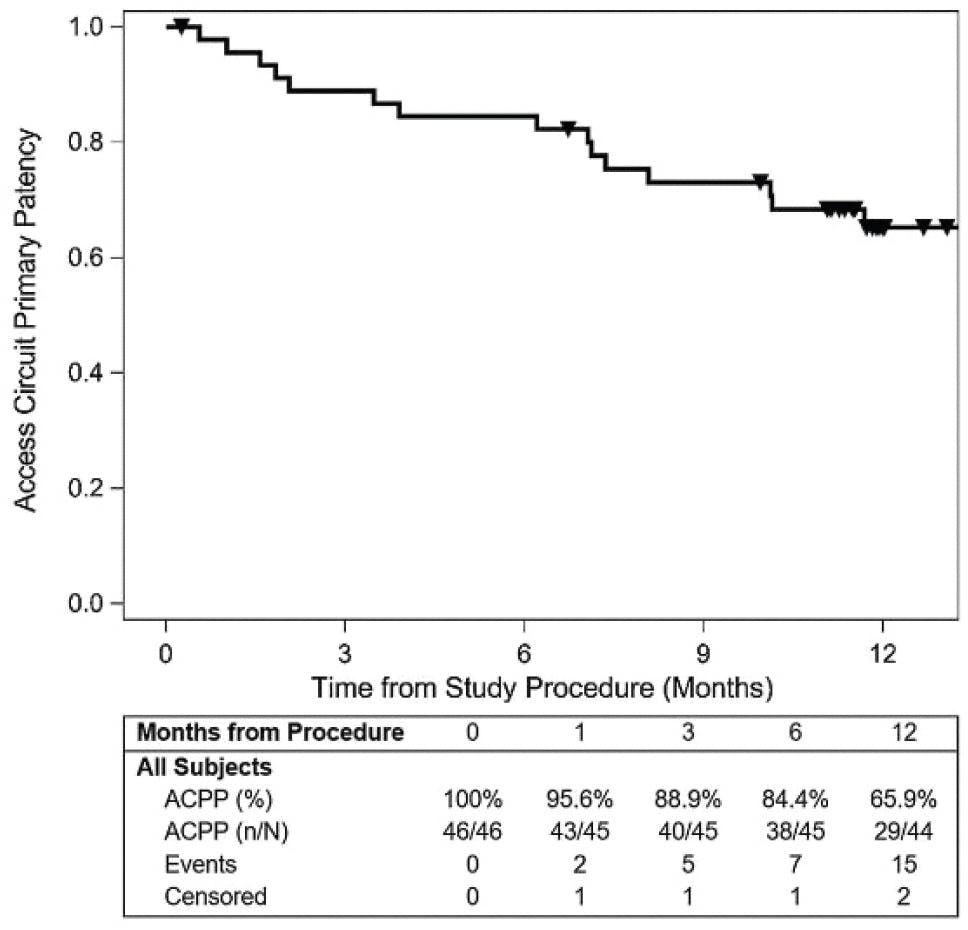
Figure 2. Kaplan-Meier curve of ACPP for all patients through 12 months. Reprinted from Gilbert J, Rai J, Kingsmore D, et al. First clinical results of the Merit WRAPSODY™ cell-impermeable endoprosthesis for treatment of access circuit stenosis in haemodialysis patients. Cardiovasc Intervent Radiol. 2021;44:1903-1913. doi: 10.1007/s00270-021-02953-8
This article highlights the efficacy and durability of the WRAPSODY CIE in one of our earliest cases and describes how we incorporate it into our treatment algorithm.
CASE STUDY
The patient presented with a brachiocephalic fistula created 1 year prior and increasing venous pressures and aneurysmal fistula dilatation. A significant stenosis was identified in the cephalic arch, and the patient underwent angioplasty, which provided no benefit.
The patient was subsequently referred for repeat fistulography, which showed severe residual cephalic arch stenosis (Figure 3). This was treated with angioplasty and stenting with 8-, 10-, and 12-mm WRAPSODY CIE devices, which were deployed in a telescoped fashion to overcome inflow/outflow vessel-size discrepancy (Figure 4).
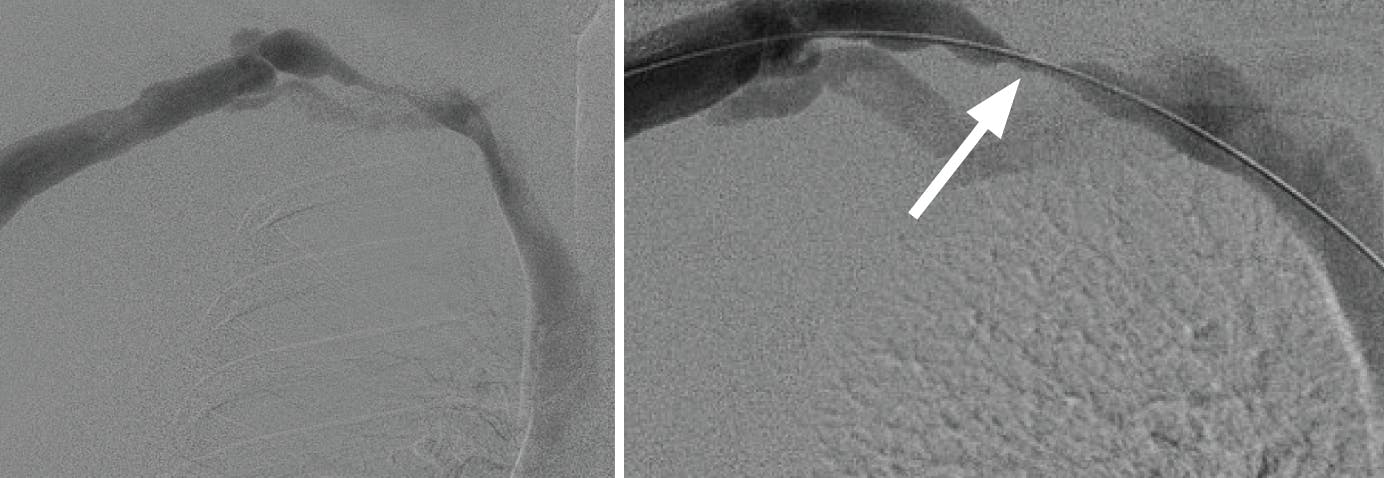
Figure 3. Repeat fistulograms showing severe residual cephalic arch stenosis (white arrow).
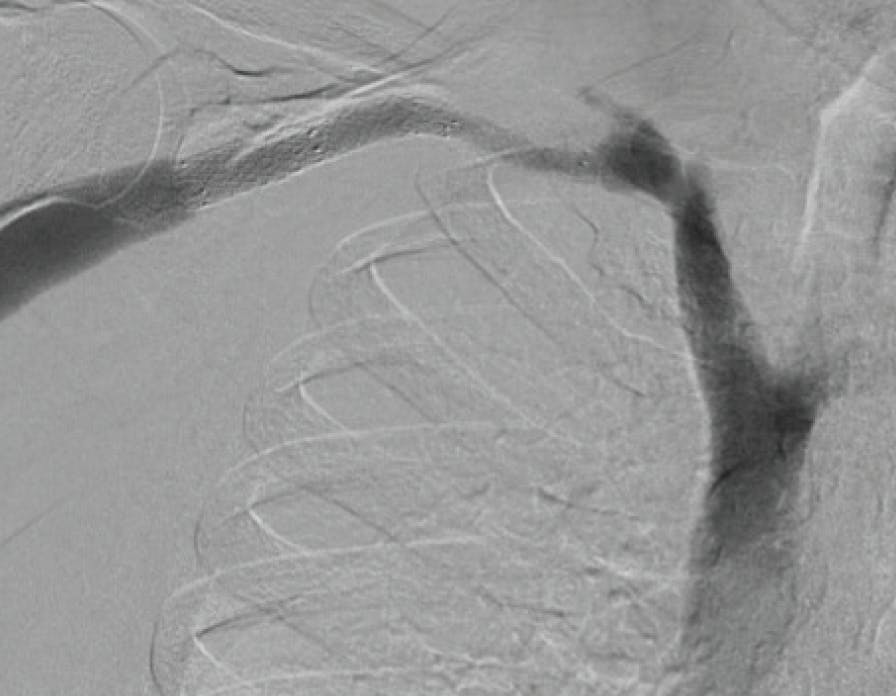
Figure 4. WRAPSODY CIE deployed.
The patient has since undergone a renal transplant, which unfortunately failed, followed by replacement of native vein segments in the arm with graft material due to vein degradation. Throughout this time (6 years after initial placement), the cephalic arch venous stents have remained widely patent with no target lesion reintervention required (Figure 5).
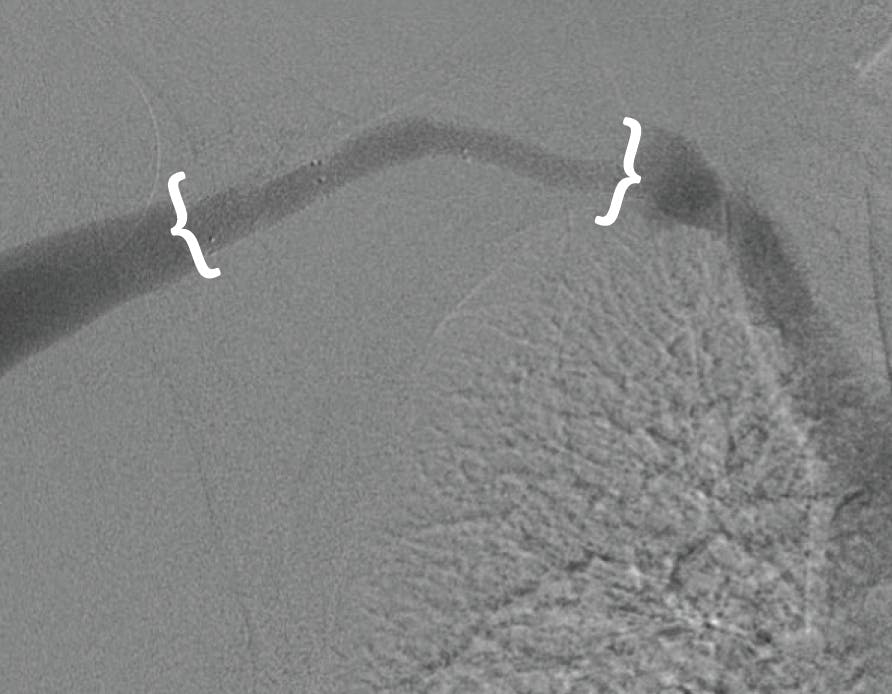
Figure 5. Fistulogram showing widely patent cephalic arch WRAPSODY CIEs 6 years after initial placement (bracket arrows).
DISCUSSION
The positive results of the WRAPSODY FIH study have been further reinforced with the recently published data from the WRAPSODY Arteriovenous Access Efficacy (WAVE) trial.2 In the AVF cohort, patients were randomized 1:1 to treatment with the WRAPSODY CIE or percutaneous transluminal angioplasty (PTA). The 12-month TLPP and ACPP rates reported from WRAPSODY CIE were 70.1% and 58.1%, respectively, as compared with 41.6% and 34.4%, respectively, in the PTA arm.3 These results appear to further confirm that the novel design features of the WRAPSODY CIE are translating into improved clinical performance.
In my practice, stenting with the WRAPSODY CIE has been successfully used across a range of lesion types. All AVF intervention begins with adequate lesion preparation, often in the form of high-pressure or cutting balloons to ensure the waist of the stenosis is overcome prior to stenting. AVG venous anastomoses are treated with venoplasty and primary stenting. There is good level 1 evidence that stenting in this location is appropriate.4 In the cephalic arch, we would certainly use a stent if a suboptimal result is obtained after venoplasty or in the case of early recurrence after treatment, and we are increasingly performing primary stenting in this region.
CONCLUSION
The evidence supporting the use of the WRAPSODY CIE to treat access circuit dysfunction continues to grow, based on the early highly promising FIH study and results of the WAVE trial. Moreover, the unique features of the device appear to be translating into improved TLPP and ACPP. Real-world evidence from the WRAP Global Registry (NCT05062291) and WRAP North America Registry (NCT06807099) will continue to address the need for ongoing evidence related to the performance of the WRAPSODY CIE.
1. Gilbert J, Rai J, Kingsmore D, et al. First clinical results of the Merit WRAPSODY™ cell-impermeable endoprosthesis for treatment of access circuit stenosis in haemodialysis patients. Cardiovasc Intervent Radiol. 2021;44:1903-1913. doi: 10.1007/s00270-021-02953-8
2. Razavi MK, Balamuthusamy S, Makris AN, et al. Six-month safety and efficacy outcomes from the randomized-controlled arm of the WRAPSODY arteriovenous access efficacy (WAVE) trial. Kidney Int. 2025;107:740-750. doi: 10.1016/j.kint.2025.01.006
3. Rajan D. 12-month outcomes from the randomized arm of the Merit WRAPSODY AV Access Efficacy (WAVE) trial. Presented at: the Society of Interventional Radiology (SIR) 2025 annual scientific meeting; March 30, 2025; Nashville, Tennessee.
4. Lok CE, Huber TS, Lee T, et al. KDOQI clinical practice guideline for vascular access: 2019 update. Am J Kidney Dis. 2020;75(4 suppl 2):S1-S164. doi: 10.1053/j.ajkd.2019.12.001
*The WRAPSODY CIE is not approved for use in central veins in the United States.

Advertisement
Advertisement