Advertisement
Advertisement
December 2025 Supplement
Sponsored by Surmodics
The 10 Fr Pounce™ Venous Thrombectomy System: Designed for Power and Operator Control
With Stephen A. Black, MD, FRCS(Ed), FEBVS; Pradeep K. Nair, MD, FACC, FSCAI; and Nachiket J. Patel, MD, FACC, FACP, FSCAI
Venous thromboembolism (VTE) affects >1 million Americans per year and is a major cause of disability and death.1 As an adjunct to anticoagulation, mechanical thrombectomy in peripheral veins serves to alleviate patient symptoms and interrupt the acute damage caused by thrombus to the vein wall and valves, an early event in the pathophysiology of post-thrombotic syndrome (PTS).2 Although venous thrombi are often categorized as acute, subacute, or chronic based on duration of patient symptoms, most are a combination of fresh, soft material and organized components.3
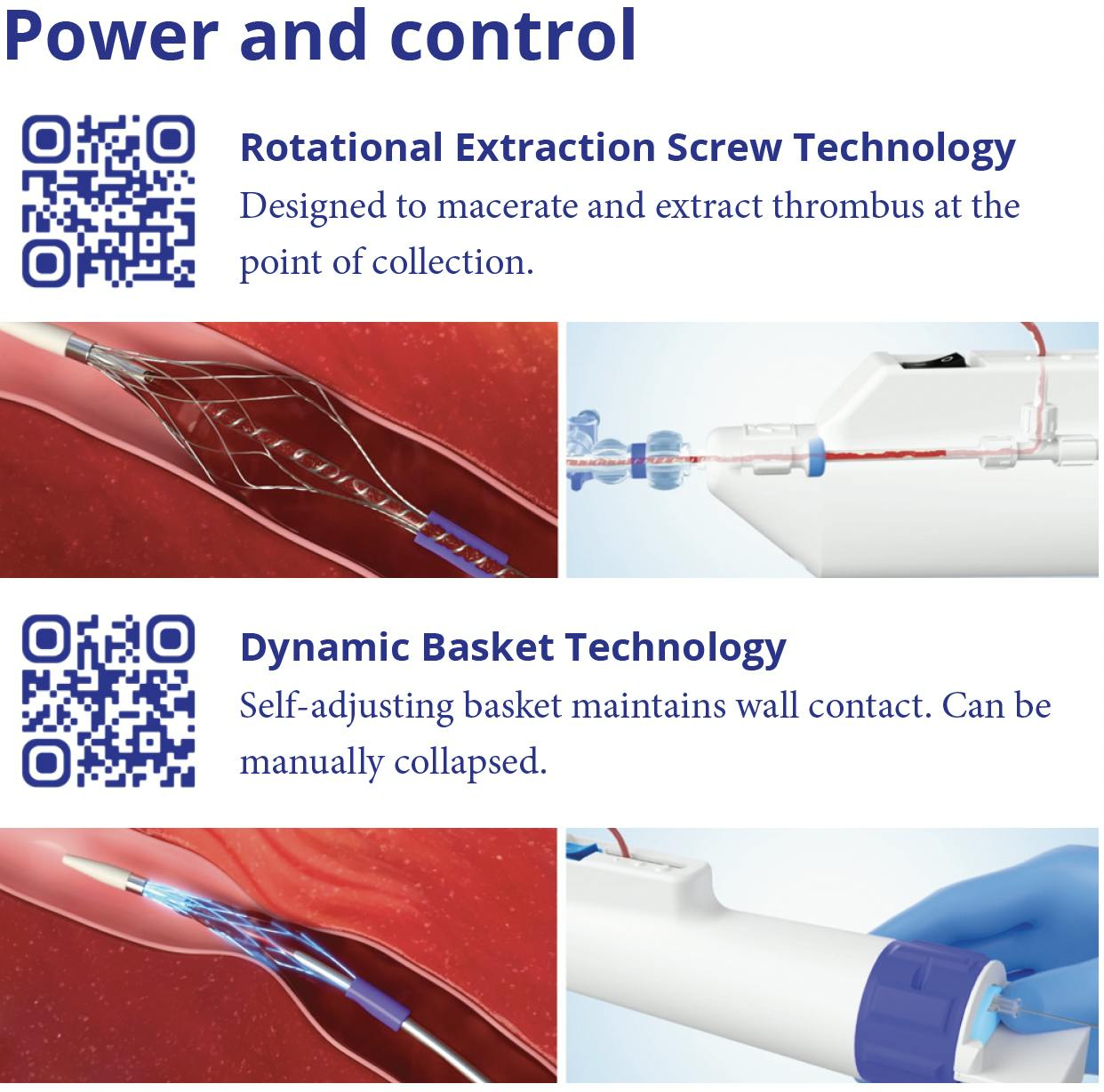
The Pounce™ Venous Thrombectomy System (Surmodics, Inc.), indicated for mechanical clot removal in the peripheral vasculature, rapidly removes fresh or organized, wall-adherent thrombus without the need for thrombolytics. The dual-action system features a wall-apposable basket for clot disruption and a powered rotational extraction screw within the basket for clot maceration and active extraction. This efficient combination enables effective thrombus removal with a low (10 Fr) profile and a short (3-4 cm) spring-tensioned basket, which self-adjusts to vessel diameter to maintain wall contact (Figure). Operators may also manually collapse the basket to minimize wall apposition where desired and re-expand it for focal treatment. The system requires no capital equipment.
Design Considerations
Professor Stephen Black, surgical lead at St Thomas’ Hospital and professor of venous surgery at King’s College London, consulted on the design of the Pounce™ Venous System. A co-principal investigator for multiple clinical trials in the venous space, Professor Black was also a lead investigator in the system’s first-in-human (FIH) study.4
“I support the concept of a basket that can pass through tightly stenosed or fibrotic areas with relative gentleness on the vessel,” he said. “This way, you’re not trying to make the vein accommodate the device, you’re using a device that accommodates the vessel.”
Professor Black is among the growing number of venous specialists who use intravascular ultrasound (IVUS) imaging prior to intervention. “I think it’s important to work out what parts of the vein are full of thrombus and what parts are already chronically scarred,” he said. “I want to see where the thrombus is and clean out those areas with a thrombectomy device. With the Pounce Venous device, you can manually narrow the basket in scarred vessels to target the acute-on-chronic disease. It doesn’t make sense to me to try to remove the scar tissue itself, which essentially means you’re removing remnants of the vessel. I’m going to balloon and stent those areas.”
In the prospective, nonrandomized, multicenter FIH study, the primary endpoint of complete or near-complete thrombus removal* was obtained in all 19 subjects, with complete thrombus removal in most. These results were obtained with ≤3 device passes per patient. Although the study was limited to patients with ≤14-day symptoms, chronic components were found in 63% of thrombi removed. PTS (Villalta scale ≥5) was identified in 17 of 19 patients at baseline, with 11 patients scored as severe (≥15). Among 11 of 15 subjects† that completed their 12-month follow-up visit, the median Villalta score was 2 (range, 0.5–3.0).
“The excellent patient outcomes in this study reinforce why I’ve always been a big fan of this device,” he said. “Because it works.”
Read Case Report: qrco.de/DrBlackCaseReport
A Happy Medium
For peripheral venous thrombectomy, most US physicians now use aspiration systems from Penumbra, Inc., or wall-apposed systems from Inari Medical. Interventional cardiologist Pradeep Nair, MD, with Cardiovascular Institute of the South in Houma, Louisiana, sees the Pounce™ Venous System as a “happy medium” between these options, adept at removing mixed-morphology thrombus with added versatility afforded by the system’s size and operator control of powered extraction.
“The dual-action mechanism is an important benefit, especially in the current generation of thrombectomy tools available to us,” he said. With the Pounce™ Venous System, “you’re able to get active, effective extraction of fresh thrombus,” he said. “In this respect, the system acts similarly to aspiration devices. That’s a strong plus. But I don’t think you can rely solely on aspiration, because you also have to deal with nidus of thrombus on the vein wall.”
He finds the Pounce™ Venous System basket effective for disrupting this more organized, wall-adherent material. After an initial device pass, he may intermittently deactivate powered extraction to minimize blood loss.
In addition to having a low profile, the powered extraction mechanism within the system’s 3–4 cm length basket removes clot at the point of collection, eliminating the need for additional clot collection with a trailing bag. In contrast, the ClotTriever™ catheter (Inari Medical) uses a 19 cm long collection bag with its 4.5 cm coring element. For Dr. Nair, the system’s 10 Fr sheath compatibility and short basket make it well-suited for upper extremity cases. “In the upper extremities, we’re looking for the smallest device possible to remove the maximum amount of thrombus,” he said. “Here, the value of the Pounce™ Venous System’s low profile is self-evident. If you’re using a 16 Fr sheath versus a 10 Fr sheath, it could mean you’re completely occluding the vein.”
Read Case Report: qrco.de/DrNairCaseReport
Efficiency and Effectiveness
Interventional cardiologist Nachiket Patel, MD, with HonorHealth Heart Care in Mesa, Arizona, values the procedural efficiency he sees in the Pounce™ Venous System.
“As a private practice guy, I want safe, effective results that allow for the most efficient use of my time,” he said. “The Pounce™ Venous System is a slam dunk for the vast majority of my venous cases,” which he describes as uncomplicated superficial femoral and popliteal vein, mixed-morphology thrombosis.
“Even if a patient’s symptoms started 2 days ago, there may be a lot of organized material in the vein. This system can take care of it. I don’t want to have to open two devices.”
For Dr. Patel, the ability to infuse contrast through the side ports on the Pounce™ Venous System catheter lends added efficiency.
“After making a pass that doesn’t remove much thrombus, my thought is that I might be done, but let’s take a picture,” he said. “If there’s a small amount of clot remaining, I can go back and just treat that area. Or, if I feel a little resistance, I can take a picture to see what’s causing that.”
Dr. Patel finds the short Pounce™ Venous basket easy to clean between passes. The basket’s short landing zone also allows him to visualize the entire Pounce™ Venous System and guidewire in the patient’s body in one view.
“When you’re doing a large volume of cases, you want a go-to device you and your team can become very familiar with,” he said. “I think this enhances procedural safety and proficiency with the device. For me, that device is the Pounce™ Venous System. There are a lot of advantages with this system I haven’t found in other devices.”
Watch Case Video: qrco.de/DrPatelCaseVideo
Caution: Federal (US) law restricts the Pounce™ Venous Thrombectomy System to sale by or on the order of a physician. Please refer to the product’s Instructions for Use for indications, contraindications, warnings, and precautions. SURMODICS, POUNCE, and SURMODICS and POUNCE logos are trademarks of Surmodics, Inc. and/or its affiliates. Third-party trademarks are the property of their respective owners.
1. Virani SS, Alonso A, Benjamin EJ, et al. Circulation. 2020;141:e139-e596. doi: 10.1161/CIR.0000000000000757
2. Kahn SR, Comerota AJ, Cushman M, et al. Circulation. 2014;130:1636-1661. doi: 10.1161/CIR.0000000000000130
3. Czaplicki C, Albadawi H, Partovi S, et al. Cardiovasc Diagn Ther. 2017;7(suppl 3):S186. doi: 10.21037/cdt.2017.11.05
4. Black SA, Thulasidasan N, Benton L, et al. J Vasc Surg Venous Lymphat Disord. 2024;12:101866. doi: 10.1016/j.jvsv.2024.101866
*Achievement of Society of Interventional Radiology (SIR) grade II lysis (50%-95% thrombus removal) or grade III lysis (>95%) in treated vessels with freedom from procedural adverse events.
†COVID limited the ability to collect Villalta scores for 4 subjects.
This article first appeared as a digital featured technology article in the July 2025 issue of Endovascular Today.
Advertisement
Advertisement