Advertisement
Advertisement
February 2025
Lymphatic Embolization: Current State and Future Directions
A look at the role of lymphatic interventions in oncology and pediatrics, as well as expanding indications.
By Amgad M. Moussa, MD; Majid Maybody, MD; and Ernesto Santos, MD
Lymphatic interventions have expanded tremendously over the past 30 years. What started off as a solitary intervention—thoracic duct embolization to address chylothorax after thoracic surgery1—has become a variety of procedures that address several indications in different patient populations. This expansion in the field of lymphatic interventions can be attributed to several factors. First, and perhaps most importantly, is the development of intranodal lymphangiography as a less cumbersome alternative to pedal lymphangiography.2 The feasibility of intranodal lymphangiography allowed its wide adoption by removing one of the barriers that was holding back lymphatic interventions, the technical difficulty and time-consuming nature of pedal lymphangiography, and encouraged interventional radiologists to take interest in lymphatic interventions. The second factor is the ongoing advancement in imaging of the lymphatic system. The continuous improvement in our ability to image the lymphatic system through MR lymphangiography3 and CT lymphangiography4 has allowed a better understanding of the pathogenesis behind different lymphatic disorders, which is an important first step in understanding these disorders to appropriately address them. The third factor is that improvements in the procedural tools available to interventional radiologists, such as more developed microcatheters and microwires, as well as intraprocedural imaging techniques such as cone-beam CT and ultrasonography, have allowed technical endpoints that were previously not possible, such as retrograde thoracic duct cannulation. The final factor, and perhaps a combination of all the prior points, is the increased focus on the lymphatic system and its role in different disease processes, such as in patients with cirrhosis and ascites5 or those receiving specific immunotherapies.6 This article briefly reviews the current state and future directions of lymphatic interventions.
ONCOLOGY
Lymphatic interventions in cancer patients can be broadly divided according to the site of accumulation of lymphatic fluid (chylothorax when in the hemithorax, chylous ascites when in the peritoneal space, or lymphoceles when in a lymphadenectomy bed elsewhere) or according to the underlying cause of the accumulation of lymphatic fluid (traumatic vs nontraumatic lymphatic leaks). Management of traumatic lymphatic leaks relies mainly on lymphangiography to identify the site of leakage, followed by lymphatic embolization, with overall good results. In cancer patients with traumatic chylothorax, most often after mediastinal lymph node dissection or esophagectomy, lymphangiography often shows a lymphatic leak off the main thoracic duct or one of its tributaries. After nodal lymphangiography and accessing the cisterna chyli percutaneously, confirmatory lymphangiography of the thoracic duct is performed through a microcatheter followed by embolization of the entire thoracic duct using a combination of microcoils and a liquid embolic such as N-butyl cyanoacrylate (NBCA) or ethylene vinyl alcohol (Onyx, Medtronic), with excellent results (Figure 1).7 In cancer patients with traumatic chylous ascites, which occurs most often after retroperitoneal lymph node dissection, lymphangiography often shows a lymphatic leak off the lumbar lymphatic vessels into the peritoneal space. These lymphatic leaks are often addressed by percutaneous, direct NBCA injection under fluoroscopy into the site (or sites) of lymphatic leak or upstream lymph node feeding the leak, with good results.8 In cancer patients with traumatic lymphocele, which often occurs following lymph node dissection in the pelvis or the neck, the approach is similar, with a low threshold to undergo lymphangiography followed by lymphatic embolization depending on the site of the leak.9,10
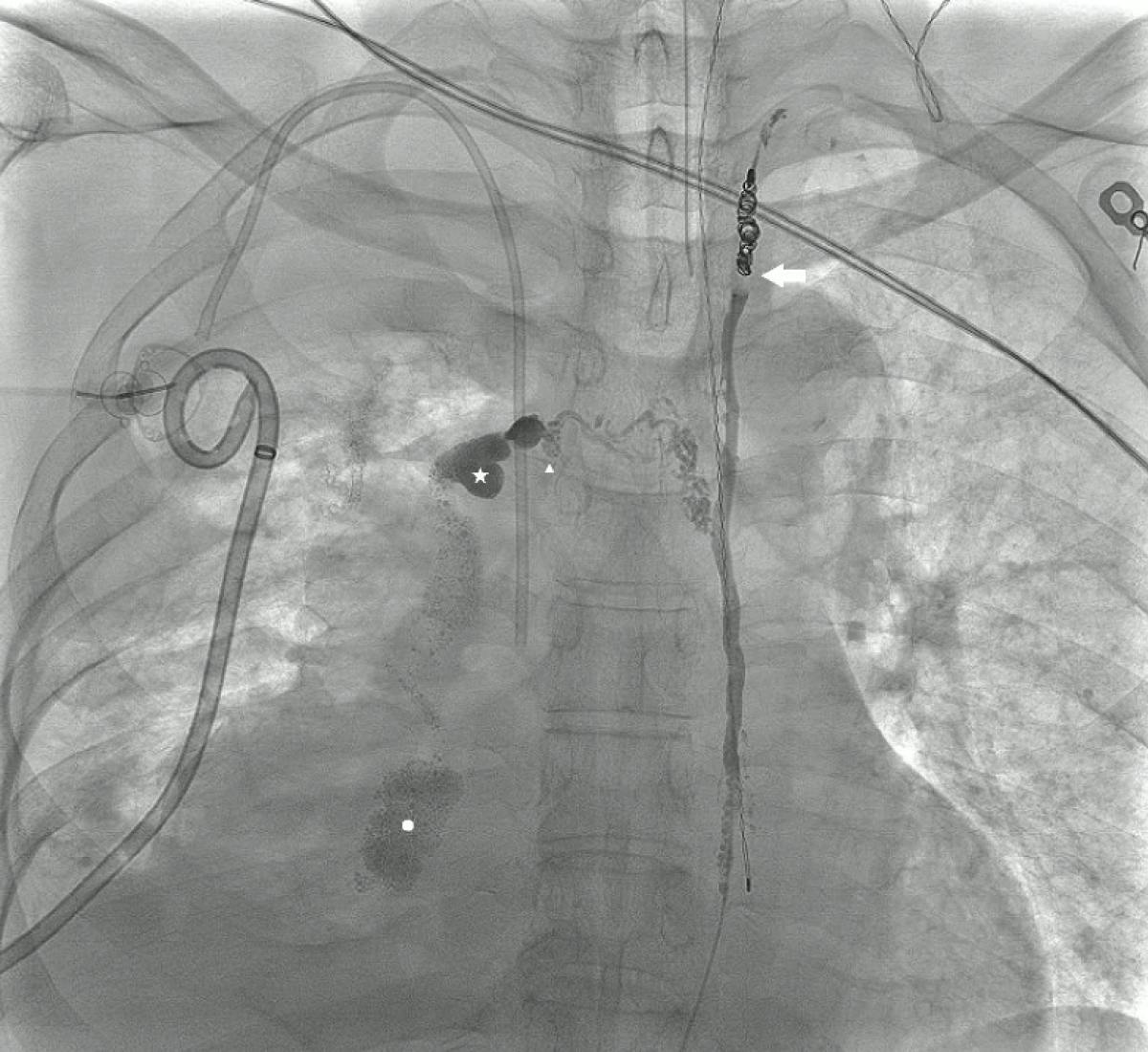
Figure 1. Fluoroscopic image of a male patient in his mid-50s with metastatic colon cancer who underwent robotic-assisted wedge resection of right lung nodules and mediastinal lymph node sampling that was complicated by right chylothorax. The image shows the thoracic duct embolized by coils and glue (white arrow) after a leak was identified (star) off a tributary of the main thoracic duct (arrowhead). The Lipiodol is nicely seen pooling in the mediastinum (star) before it empties into the right pleural space (solid dot).
Nontraumatic lymphatic leaks in cancer patients are less understood and therefore more challenging to manage. Interventional radiologists should have a higher threshold to proceed with lymphangiography and lymphatic embolization in these patients, and there should be a role for lymphatic imaging, such as CT or MR lymphangiography, to identify the site of abnormality. In cancer patients with nontraumatic chylothorax, MR lymphangiography is useful to help identify the source of the lymphatic leak. If the source is the thoracic duct, it should be embolized. In case of other sources such as lymphatic masses or retrograde lymphatic flow, these sources should be directly embolized, and embolization of the thoracic duct should not be performed, as it may lead to worsening of symptoms.11 Similarly, in cancer patients with nontraumatic chylous ascites, CT lymphangiography with water-soluble contrast should be performed as it will dictate management. If a site of lymphatic leak is identified, then Lipiodol (Guerbet LLC) lymphangiography should be performed, followed by lymphatic embolization similar to patients with traumatic chylous ascites. However, if a site of leak is not identified, then Lipiodol lymphangiography and lymphatic embolization should not be performed, and Denver shunt placement should be considered.
More recently and owing to the increased role of novel anticancer medications, more patients are seen with nontraumatic lymphatic leaks following use of some of these anticancer medications.6 The pathophysiology behind this is poorly understood, and lymphangiography has so far failed to show sites of lymphatic leak in these patients. There may be a role for noninvasive imaging, such as MR or CT lymphangiography, to get a better understanding of this process.
Although minimally invasive and with rare complications, lymphatic embolization has been associated with complications related to obstruction of the normal lymphatic pathway, such as diarrhea after thoracic duct embolization or lower limb edema after lymphatic embolization in the pelvis. This has led to the consideration of superselective embolization of the leaking tributary12 or the use of covered stents in patients with leaks off the thoracic duct to maintain the patency of the thoracic duct13 and theoretically decrease the risk of lymphatic obstruction. Also, in select patients, retrograde cannulation of the thoracic duct through a transvenous or direct percutaneous approach has been described. This is an area where future improvements may be seen as the tools at the disposal of interventional radiologists continue to improve.14
PEDIATRICS
In the pediatric population, there is a growing role for advanced imaging, specifically MR lymphangiography owing to its lack of ionizing radiation, in assessment of lymphatic disorders prior to any intervention. This can be attributed to the delicate nature of this patient population, along with the small maximum dose of Lipiodol that can be used in this patient population (0.25 mL/kg) for conventional lymphangiography.
Pediatric lymphatic disorders can be broadly divided into those affecting neonates and those affecting older pediatric patients. Those affecting neonates include chylothorax, chylous ascites, or central lymphatic flow disorders, and those affecting older pediatric patients include complex lymphatic malformations and plastic bronchitis.15 In neonatal chylothorax, MR lymphangiography has shown abnormal lymphatic flow through branches of the thoracic duct toward the lung parenchyma, which has responded to conventional lymphangiography with Lipiodol, likely due to its viscous nature.16 Management of neonatal chylous ascites is more challenging and similarly relies on the findings of MR lymphangiography. If retroperitoneal lymphatic masses are seen as the source of the leak, they are subsequently directly percutaneously embolized with NBCA.15 Overall, neonatal lymphatic disorders are rare entities with no standardized treatment and are best addressed in specialized centers.
Similarly, pediatric lymphatic disorders such as plastic bronchitis are rare entities. Plastic bronchitis is seen in pediatric patients with congenital heart disease who have undergone a Fontan procedure and is characterized by patients coughing up lymphatic rich fluid that forms casts in the shape of the bronchial tree and leads to airway plugging. MR lymphangiography in this patient population has shown abnormal lymphatic flow from the thoracic duct into the bronchial tree to be the underlying pathogenesis, similar to neonatal chylothorax, which has responded well to lymphatic embolization.15,17 As an improvement to the technique of lymphatic embolization in these patients, and owing to improvement in the armamentarium of tools available for minimally invasive procedures, selective embolization of the sites of lymphatic leakage has been described with promising results.18
EXPANDING INDICATIONS
Recently, lymphatic dysfunction has been implicated in other disease processes that were previously deemed to be unrelated. The two main examples mentioned herein are protein-losing enteropathy and portal hypertension ascites.
Protein-losing enteropathy, which is characterized by loss of proteins through the gastrointestinal tract leading to hypoalbuminemia, is often seen in patients with a history of congenital heart disease. The lymphatic system of the liver has been identified in the pathogenesis of this disease process, with liver lymphangiography showing lymphatic leaks of albumin-rich fluid into the duodenum. Liver lymphangiography, a recently described technique used to visualize the liver lymphatic tree, is performed by injecting contrast through a 25-gauge needle placed under ultrasound guidance in proximity to the wall of a main portal vein branch, where liver lymphatics reside.19 Embolization of these lymphatic leaks through interstitial embolization or addressing them through a combined endoscopic procedure has shown promising results in managing this challenging disease process.20,21
Management of portal hypertension ascites in patients with advanced cirrhosis has been significantly improved through the increased adoption of the transjugular intrahepatic portosystemic shunt (TIPS) procedure. However, there remain patients who are not candidates for TIPS placement and therefore are dependent on recurrent large-volume paracentesis or Denver shunt placement for managing refractory ascites, with consequent poor quality of life. It is known that there is increased flow through the lymphatic system in patients with advanced cirrhosis and portal hypertension, and it is believed that ascites develops when the lymphatic system is overwhelmed by the increased volume of lymphatic fluid.22 Recently, thoracic duct stenting, specifically at the site of the lymphatic venous junction, has been explored in patients with a high-pressure gradient between the thoracic duct and venous system to relieve this pressure gradient and help decompress the lymphatic system, with promising results.23 This has been done through a combination of antegrade and retrograde thoracic duct cannulation, which is now feasible with the improved tools available to interventional radiologists, as well as the evolving understanding of the anatomy of the lymphatic system.
CONCLUSION
The field of lymphatic interventions is rapidly expanding. This is due to a combination of improved noninvasive imaging of the lymphatic system and increased feasibility of lymphatic procedures, which have sparked interest in the role of the lymphatic system in many different disease processes. As the imaging and procedural technology continues to improve, a deeper understanding of the role of the lymphatic system in many disease processes is anticipated. This will likely be followed by an expanding role for lymphatic interventions in addressing these findings.
1. Cope C. Diagnosis and treatment of postoperative chyle leakage via percutaneous transabdominal catheterization of the cisterna chyli: a preliminary study. J Vasc Interv Radiol. 1998;9:727-734. doi: 10.1016/S1051-0443(98)70382-3
2. Rajebi MR, Chaudry G, Padua HM, et al. Intranodal lymphangiography: feasibility and preliminary experience in children. J Vasc Interv Radiol. 2011;22:1300-1305. doi: 10.1016/j.jvir.2011.05.003
3. Negm AS, Collins JD, Bendel EC, et al. MR lymphangiography in lymphatic disorders: clinical applications, institutional experience, and practice development. Radiographics. 2024;44:e230075. doi: 10.1148/rg.230075
4. Patel S, Hur S, Khaddash T, et al. Intranodal CT lymphangiography with water-soluble iodinated contrast medium for imaging of the central lymphatic system. Radiology. 2021;302:228-233. doi: 10.1148/radiol.2021210294
5. Ghelfi J, Frandon J, Itkin M, et al. Acute central lymphatic obstruction associated with decompensated cirrhotic ascites and hydrothorax. J Vasc Interv Radiol. 2023;34:1626-1629. doi: 10.1016/j.jvir.2023.05.034
6. Kalchiem-Dekel O, Falcon CJ, Bestvina CM, et al. Brief report: chylothorax and chylous ascites during RET tyrosine kinase inhibitor therapy. J Thorac Oncol. 2022;17:1130-1136. doi: 10.1016/j.jtho.2022.06.008
7. Itkin M, Kucharczuk JC, Kwak A, et al. Nonoperative thoracic duct embolization for traumatic thoracic duct leak: experience in 109 patients. J Thorac Cardiovasc Surg. 2010;139:584-589. doi: 10.1016/j.jtcvs.2009.11.025
8. Aly AK, Santos E, Fung J, et al. Intranodal lymphangiography and embolization for management of iatrogenic chylous ascites after oncological surgery. J Vasc Interv Radiol. 2024;35:883-889. doi: 10.1016/j.jvir.2024.02.015
9. Moussa AM, Aly AK, Maybody M, et al. A comparison of lymphatic embolization and sclerotherapy in the management of iatrogenic abdominopelvic lymphoceles following oncological surgery. Diagn Interv Radiol. 2023;29:542-547. doi: 10.4274/dir.2023.232135
10. Moussa AM, Maybody M, Gonzalez-Aguirre AJ, et al. Thoracic duct embolization in post-neck dissection chylous leakage: a case series of six patients and review of the literature. Cardiovasc Intervent Radiol. 2020;43:931-937. doi: 10.1007/s00270-020-02475-9
11. Nadolski G. Nontraumatic chylothorax: diagnostic algorithm and treatment options. Tech Vasc Interv Radiol. 2016;19:286-290. doi: 10.1053/j.tvir.2016.10.008
12. Itkin M, Chen EH. Thoracic duct embolization. Semin Interv Radiol. 2011;28:261-266. doi: 10.1055/s-0031-1280676
13. Srinivasa RN, Chick JFB, Hage AN, et al. Endolymphatic thoracic duct stent-graft reconstruction for chylothorax: approach, technical success, safety, and short-term outcomes. Ann Vasc Surg. 2018;48:97-103. doi: 10.1016/j.avsg.2017.11.031
14. Morikawa K, Takenaga S, Hasumi J, et al. Retrograde transvenous lymphatic embolization for postoperative chylous ascites: a report of three cases and literature review. Radiol Case Rep. 2020;15:1623-1628. doi: 10.1016/j.radcr.2020.06.052
15. Rabinowitz D, Maxim I. Pediatric lymphatics review: current state and future directions. Semin Interv Radiol. 2020;37:414-419. doi: 10.1055/s-0040-1715876
16. Gray M, Kovatis KZ, Stuart T, et al. Treatment of congenital pulmonary lymphangiectasia using ethiodized oil lymphangiography. J Perinatol. 2014;34:720-722. doi: 10.1038/jp.2014.71
17. Dori Y, Keller MS, Rome JJ, et al. Percutaneous lymphatic embolization of abnormal pulmonary lymphatic flow as treatment of plastic bronchitis in patients with congenital heart disease. Circulation. 2016;133:1160-1170. doi: 10.1161/CIRCULATIONAHA.115.019710
18. Srinivasan A, Smith CL, Krishnamurthy G, et al. Selective lymphatic duct embolization for treatment of thoracic lymphatic flow disorders in children: technical aspects and comparison with thoracic duct embolization. J Vasc Interv Radiol. Published online September 16, 2024. doi: 10.1016/j.jvir.2024.09.004
19. Itkin M, Rabinowitz D, Hur S. Liver lymphatic imaging and interventions: resurrection of the forgotten knowledge. Semin Intervent Radiol. 2020;37:318-323. doi: 10.1055/s-0040-1713638
20. Maleux G, Storme E, Cools B, et al. Percutaneous embolization of lymphatic fistulae as treatment for protein-losing enteropathy and plastic bronchitis in patients with failing Fontan circulation. Catheter Cardiovasc Interv. 2019;94:996-1002. doi: 10.1002/ccd.28501
21. Husnain A, Aadam AA, Reiland A, et al. Combined percutaneous transhepatic lymphatic embolization and peroral duodenal mucosal radiofrequency ablation to manage protein-losing enteropathy. J Vasc Interv Radiol. 2024;35:1351-1356.e1. doi: 10.1016/j.jvir.2024.06.011
22. Iwakiri Y. The lymphatic system: a new frontier in hepatology. Hepatology. 2016;64:706-707. doi: 10.1002/hep.28650
23. Ghelfi J, Brusset B, Teyssier Y, et al. Endovascular lymphatic decompression via thoracic duct stent placement for refractory ascites in patients with cirrhosis: a pilot study. J Vasc Interv Radiol. 2023;34:212-217. doi: 10.1016/j.jvir.2022.10.030
Advertisement
Advertisement