Advertisement
Advertisement
February 2025
Genicular Artery Embolization: A Practical Guide for Interventional Radiologists
Patient selection, imaging techniques, procedural insights, strategies for optimizing patient outcomes, and more.
By Bedros Taslakian, MD, MA, EBIR-EV, FCIRSE, FAHA; Christiana Salami, MS; and Yan Epelboym, MD, MPH
Genicular artery embolization (GAE) is emerging as a treatment for osteoarthritis (OA)-related knee pain.1,2 Originally developed to treat recurrent hemarthrosis following total knee arthroplasty (TKA), GAE aims to reduce pain and inflammation by embolizing the abnormal neovasculature in the inflamed synovium. GAE is a promising treatment, but it is important to recognize that the evidence supporting its widespread adoption is still maturing. A cautious approach is recommended until further evidence from randomized controlled trials is available, focusing on patient selection, long-term outcomes, and comparative effectiveness.3
This practical guide provides interventional radiologists with an overview of GAE, addressing patient selection, imaging techniques, procedural insights, and strategies for optimizing patient outcomes.
NAVIGATING PATIENT SELECTION FOR GAE: CURRENT STATUS AND FUTURE DIRECTIONS
Although identifying the ideal candidate for GAE is an ongoing area of research, the patient should have moderate-to-severe OA-related knee pain refractory to conservative treatment options and either not be a suitable candidate for or has declined TKA. A correlation has been observed between the severity of preprocedure synovitis and the degree of pain reduction experienced after GAE.4 To optimize patient selection for GAE, further research is needed to define which phenotypes of OA respond best to a treatment that durably reduces synovitis and identify reliable imaging techniques or biomarkers that can predict outcome.5 This will allow clinicians to personalize treatment plans and improve outcomes by selecting the most appropriate candidates for GAE.
For patients who have undergone TKA, GAE may be considered for recurrent hemarthrosis refractory to conservative management, including rest, ice pack application, compression, and limb elevation. This occurs in < 1% of patients and typically presents as acute episodes of knee pain and swelling, often without a history of trauma.6 Various etiologies have been identified, including intraoperative vascular injuries, entrapment of synovial tissue, and bleeding disorders.7 Data show that clinical success was achieved in 56%, 79%, and 85% of patients after the first, second, and third GAE, respectively.8 Although evidence supports the use of GAE for this indication, its efficacy in managing refractory knee pain after TKA (a prevalent condition affecting approximately 20%-30% of patients postoperatively9) remains under investigation and requires further study.10
In addition to standard contraindications for angiography, GAE is contraindicated in patients with significant peripheral artery disease because genicular arteries are an essential collateral pathway for arterial supply of the lower extremity.11 However, this contraindication may evolve as use of shorter-acting, temporary embolic agents grows.12
IMAGING AND PREPROCEDURAL PLANNING
Prior to GAE, imaging is crucial to confirm the diagnosis of OA and assess a patient’s suitability for the procedure. The imaging modalities used include a knee radiograph and, in select cases, MRI. Weight-bearing knee radiographs are used to confirm the presence of OA and grade its severity using the Kellgren-Lawrence classification system. MRI can help exclude other potential causes of knee pain not likely to respond to GAE, such as subchondral insufficiency fractures or malignancy. Contrast-enhanced MRI can be used to detect the presence or absence of knee synovitis with a higher sensitivity than non–contrast-enhanced MRI.13,14
Imaging plays a crucial role in the diagnosis of complications following TKA, particularly in cases of knee hemarthrosis and pain. Postsurgical complications can arise from various factors, including infection, loosening of implants, fractures, and other soft tissue issues. Understanding these complications is essential for effective management. For patients with refractory hemarthrosis or post-TKA pain where imaging studies have not identified specific complications or structural etiology, GAE may be an option.
It is essential to obtain baseline patient-reported outcome measures, such as the Western Ontario and McMaster Universities Osteoarthritis Index, Knee Injury and Osteoarthritis Outcome Score, visual analog scale pain scores, and 30-second sit-to-stand test to assess and monitor patient response to intervention during follow-up visits.
Before the procedure, areas of focal knee pain and tenderness reported by the patient can be marked with radiopaque markers to help guide selective angiography of genicular arteries supplying these areas.
It is essential to have a detailed discussion with the patient about the procedure, including its risks, benefits, and alternatives, while setting realistic outcome expectations based on currently available data.
SETTING UP FOR GAE SUCCESS: ANATOMY AND ERGONOMICS
A thorough understanding of genicular artery anatomy and variant branching patterns is essential for technical and clinical success of GAE. The genicular arteries provide blood supply to the articular joint but also to surrounding muscles, skin, tendons, ligaments, and osseous structures. Therefore, familiarity with the anatomic course, ramifications, variants, and anastomoses of the genicular arteries is critical to accurately identify articular branches and avoid nontarget embolization.15 Correct identification of target vessels minimizes the risk of common adverse events, such as periarticular skin ischemia, as well as rare adverse events, such as bone infarcts and temporary paresthesia.
Beyond anatomic knowledge, a thoughtfully arranged procedural environment contributes significantly to patient safety and positive GAE outcomes. The patient is placed supine on the fluoroscopy table with the target knee positioned at the isocenter of the imaging field. The contralateral knee is positioned to minimize overlap and artifact generation during fluoroscopy. After initial access, an adjustable-height (and ideally, length-adjustable) equipment table is positioned perpendicular to the fluoroscopy table at the level of the groin (Figure 1A). This allows for unobstructed access to catheters and guidewires, facilitating efficient catheter manipulation.
Optimal ergonomic configuration is achieved when the height of the equipment table is aligned with the arterial access site, providing a stable working surface for the operator and ensuring adequate catheter length for endovascular navigation (Figure 1B). The proceduralist is positioned on either the cranial or caudal aspect of the fluoroscopy table, dictated by the laterality of the target knee (Figure 1C). To maintain sterility and prevent inadvertent contamination, a separate, dedicated table can be used for the preparation and storage of embolic materials. Adherence to ergonomic principles contributes to procedural efficiency and minimizes the risk of complications.
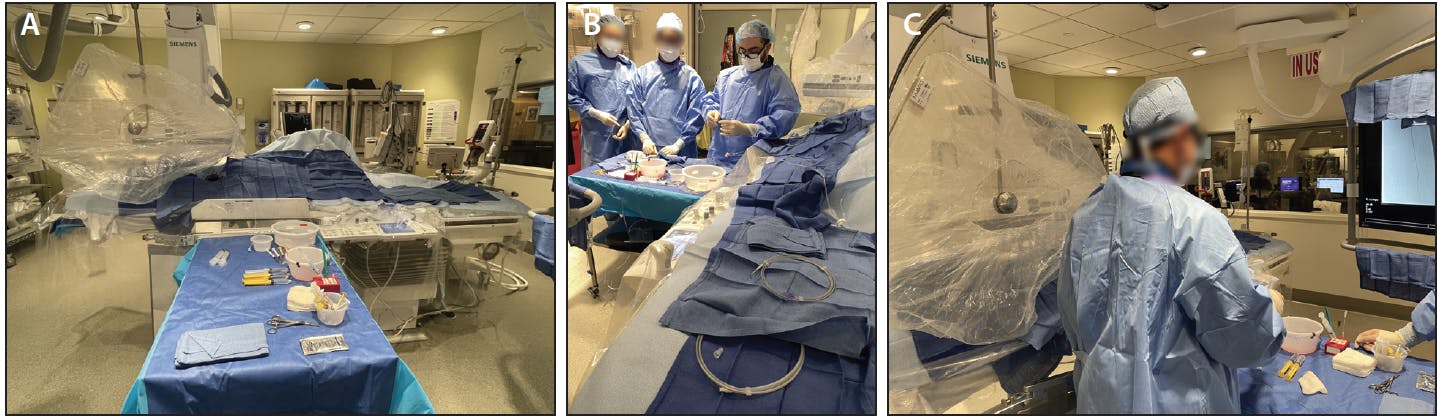
Figure 1. Room setup illustrating placement (A) and height (B) of the equipment table to ensure a stable working surface and adequate catheter length for endovascular navigation, as well as operator positioning (C).
PROCEDURAL STEPS
Vascular access is typically achieved via an ipsilateral antegrade approach through the common femoral artery or superficial femoral artery (SFA) approach.16 However, contralateral access may be preferred in patients with elevated body mass index or contraindications to ipsilateral access. Alternative access sites, including transpedal or transradial approaches, can be used in select cases, particularly in patients with “hostile groins” or morbid obesity.17,18 When using a base catheter for GAE, vascular access can be maintained with a 4- to 5-F vascular sheath. In cases where a microcatheter is used without a base catheter, a smaller sheath such as a micropuncture set sheath may be employed.
After vascular access, nonselective digital subtraction angiography (DSA) of the SFA is performed to identify the genicular arteries and any anatomic variants. A contrast injection rate of 3 to 4 mL/sec for a total volume of 9 to 12 mL is typically employed, preferably through a base catheter. Rotational cone-beam CT (CBCT) of the SFA may be performed as an adjunct or alternative to DSA. CBCT generates a rotating scout image, facilitating identification of the optimal angulation for visualizing the origin of each genicular artery without repeated DSA acquisitions. This is particularly valuable in patients with prior TKA, where metallic hardware may obscure the origins of the genicular arteries (Figure 2). Furthermore, CBCT provides enhanced three-dimensional anatomic information and multiplanar cross-sectional imaging, enabling clear differentiation between articular, cutaneous, and muscular branches of the genicular arteries. This aids in the precise selection of the optimal embolization site, minimizing the risk of nontarget embolization.
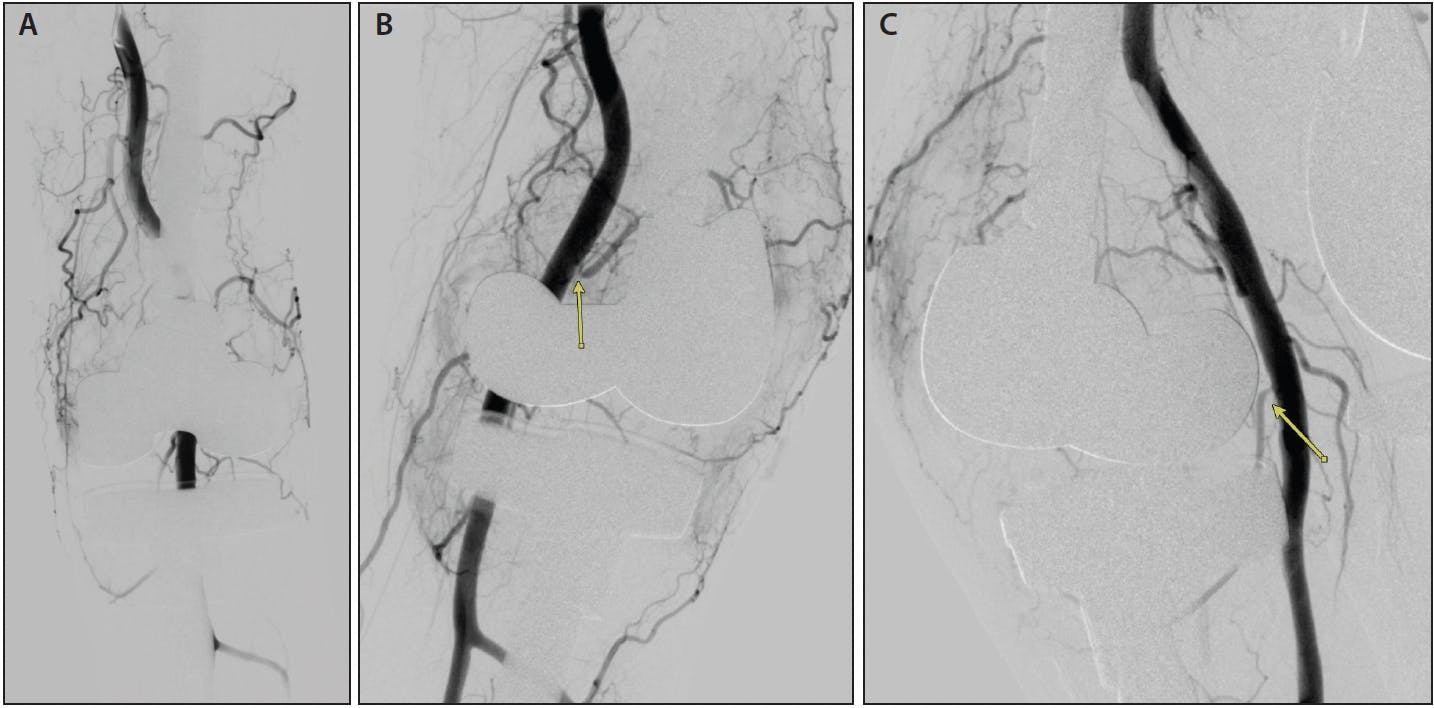
Figure 2. A patient with post–left TKA hemarthrosis. To optimize vessel visualization, CBCT was utilized. Initial anteroposterior SFA angiography revealed significant vascular hypertrophy, tortuosity, and hyperemia within the medial and lateral compartments of the left knee, without clearly demonstrating the origin of the genicular arteries (A). On CBCT scout DSA, a 36° right anterior oblique projection was determined to be ideal for visualizing the origin of the superior lateral genicular artery (yellow arrow, B), while a 32° left anterior oblique projection was selected to optimally visualize the origin of the inferior medial genicular artery (yellow arrow, C).
Successful catheterization of the genicular arteries for embolization requires a thorough understanding of their circumferential origins in the axial plane and branching angle.15 Although most genicular arteries arise from the anterior aspect of the popliteal artery, the descending genicular artery (DGA) is an exception, originating medially at a 90° angle. This necessitates specific fluoroscopic views for optimal visualization: anteroposterior for the DGA, 30° to 60° contralateral oblique for the superior and inferior lateral genicular arteries (Figure 2B), and 30° to 60° ipsilateral oblique for the superior and inferior medial genicular arteries (Figure 2C). The middle genicular artery is often best visualized on a near-lateral projection, which can be challenging. Genicular artery origins can exhibit considerable variability, especially in cases of shared origins or previous knee surgery, reinforcing the need for meticulous angiographic assessment to guide safe and effective catheterization.
An angled base catheter allows for efficient selection of nearly all genicular artery origins, often eliminating the need for a guidewire, microcatheter, or microwire. Once the origin is selected, a microcatheter (1.7-2 F) and microwire are advanced distally into the target vessel. Due to their small diameter and susceptibility to spasm, careful wire and catheter manipulation of the genicular arteries is necessary.
After selecting the genicular artery corresponding to areas of pain, selective DSA is performed to evaluate anatomy and presence of arterial blush and detect any anatomic variants or excessive collateralization. The choice of embolic agent for GAE remains a subject of ongoing debate. Although no consensus exists on the ideal material, available options can be broadly classified as temporary or permanent based on their resorbability.19 Temporary embolics, such as imipenem/cilastatin (IPM/CS), offer the advantage of transient vascular occlusion, reducing the risk of permanent nontarget embolization. However, IPM/CS has limitations, including its off-label use, potential for antibiotic resistance, and risk of allergic reactions.
Emerging temporary embolics like quick-soluble gelatin sponge particles and ethiodized oil-based emulsions are being investigated as potentially safer alternatives.12 Permanent embolics, including polyvinyl alcohol particles and various microspheres (Embozene [Varian Medical Systems], Embosphere [Merit Medical Systems, Inc.], and OptiSphere [Medtronic]), provide durable occlusion. However, their permanence raises concerns about the potential consequences of nontarget embolization, although no significant differences in complication rates were demonstrated when comparing permanent to temporary embolic agents.20,21 Ultimately, the selection of an embolic agent should be guided by a thorough risk-benefit assessment, considering factors such as the patient’s clinical presentation, anatomic considerations, and operator’s experience. Further research is needed to establish guidelines on embolic selection for GAE.
Musculoskeletal embolization for OA-related knee pain has a distinct endpoint compared to conventional embolization, although this might become subject of debate with the advent of temporary embolic material. Traditional embolization often aims to occlude a vessel completely, but GAE aims to selectively target hypervascular synovium while preserving the normal arterial supply and patency within the genicular arteries. This technique, often referred to as “vascular pruning,” involves embolizing the abnormal vessels until distal hypervascularity is resolved, while maintaining main vessel patency. However, for recurrent hemarthrosis after TKA, the embolization endpoint is often stasis in the target artery, with trimming or elimination of the hyperemic blush.8 Upon completion of the procedure, hemostasis is achieved with manual compression or a closure device. Patients are monitored in recovery for 2 to 4 hours and then discharged home.
POSTPROCEDURE CARE
Most patients are discharged on the same day with detailed postprocedure care instructions. They are advised to avoid strenuous activities for 1 week to allow for proper healing. Mild soreness or bruising at the catheter insertion site is common and typically resolves after a few days. Increase in pain and stiffness during the first week is expected, likely due to initial increase in inflammation from the ischemic effects on the synovium.
Follow-up appointments are scheduled to assess the patient’s progress, evaluate the effectiveness of the procedure, and address any concerns or complications the patient may have experienced. Responders are often advised to undergo physical therapy in an effort to maximize strength and function while pain improves.
CONCLUSION
Although the use of GAE is widely accepted for refractory post-TKA hemarthrosis, its use as a treatment for refractory and painful knee OA is emerging. Current evidence supports the potential short-term benefits of GAE, but further research is necessary to establish long-term outcomes. In addition, the role of GAE as a potential disease-modifying treatment option for knee OA is still under investigation.22 Rigorous randomized trials are still needed to further uncover its mechanism of action and determine its potential clinical benefit. Success relies on precise imaging, a skilled proceduralist, preprocedure preparation, and effective postprocedure care.
1. Taslakian B, Miller LE, Mabud TS, et al. Genicular artery embolization for treatment of knee osteoarthritis pain: systematic review and meta-analysis. Osteoarthr Cartil Open. 2023;5:100342. doi: 10.1016/j.ocarto.2023.100342
2. Casadaban LC, Mandell JC, Epelboym Y. Genicular artery embolization for osteoarthritis related knee pain: a systematic review and qualitative analysis of clinical outcomes. Cardiovasc Intervent Radiol. 2021;44:1-9. doi: 10.1007/s00270-020-02687-z
3. Taslakian B. Editorial comment: a road map for implementing transarterial embolization in the management of chronic joint pain. AJR Am J Roentgenol. Published online November 6, 2024. doi: 10.2214/AJR.24.32251
4. Dablan A, Erdim Ç, Güzelbey T, et al. Effectiveness of genicular artery embolization for reducing synovitis as assessed by contrast-enhanced mr imaging in knee osteoarthritis: a pilot study. J Vasc Interv Radiol. 2024;35:1313-1322.e6. doi: 10.1016/j.jvir.2024.06.003
5. Little MW, O’Grady A, Briggs J, et al. Genicular artery embolisation in patients with osteoarthritis of the knee (GENESIS) using permanent microspheres: long-term results. Cardiovasc Intervent Radiol. 2024;47:1750-1762. Published correction appears in Cardiovasc Intervent Radiol. 2024;47:1432. doi: 10.1007/s00270-024-03752-7
6. Worland RL, Jessup DE. Recurrent hemarthrosis after total knee arthroplasty. J Arthroplasty. 1996;11:977-978. doi: 10.1016/s0883-5403(96)80144-6
7. Walsh JM, Campbell KJ, Jacobs JJ, Rosenberg AG. Recurrent hemarthrosis following total knee arthroplasty: etiology, diagnosis, and treatment. Semin Arthroplasty. 2018;29:223-228.
8. Cornman-Homonoff J, Kishore SA, Waddell BS, et al. Genicular artery embolization for refractory hemarthrosis following total knee arthroplasty: technique, safety, efficacy, and patient-reported outcomes. J Vasc Interv Radiol. 2021;32:1128-1135. doi: 10.1016/j.jvir.2021.04.020
9. Beswick AD, Wylde V, Gooberman-Hill R, et al. What proportion of patients report long-term pain after total hip or knee replacement for osteoarthritis? A systematic review of prospective studies in unselected patients. BMJ Open. 2012;2:e000435. doi: 10.1136/bmjopen-2011-000435
10. Chau Y, Roux C, Gonzalez JF, et al. Effectiveness of geniculate artery embolization for chronic pain after total knee replacement—a pilot study. J Vasc Interv Radiol. 2023;34:1725-1733. doi: 10.1016/j.jvir.2023.06.026
11. Dua A, Desai SS, Johnston S, et al. The impact of geniculate artery collateral circulation on lower limb salvage rates in injured patients. Ann Vasc Surg. 2015;30:258-262. doi: 10.1016/j.avsg.2015.07.041
12. Sapoval M, Querub C, Pereira H, et al. Genicular artery embolization for knee osteoarthritis: results of the LipioJoint-1 trial. Diagn Interv Imaging. 2024;105:144-150. doi: 10.1016/j.diii.2023.12.003
13. Loeuille D, Sauliere N, Champigneulle J, et al. Comparing non-enhanced and enhanced sequences in the assessment of effusion and synovitis in knee OA: associations with clinical, macroscopic and microscopic features. Osteoarthritis Cartilage. 2011;19:1433-1439. doi: 10.1016/j.joca.2011.08.010
14. Shakoor D, Demehri S, Roemer FW, et al. Are contrast-enhanced and non-contrast MRI findings reflecting synovial inflammation in knee osteoarthritis: a meta-analysis of observational studies. Osteoarthritis Cartilage. 2019;28:126-136. doi: 10.1016/j.joca.2019.10.008
15. Liu S, Swilling D, Morris EM, et al. Genicular artery embolization: a review of essential anatomic considerations J Vasc Interv Radiol. 2024;35:487-496.e6. doi: 10.1016/j.jvir.2023.12.010
16. Padia SA, Genshaft SJ. Genicular artery embolization: tried-and-true femoral access still works best. Cardiovasc Intervent Radiol. 2024;47:1346-1347. doi: 10.1007/s00270-024-03806-w
17. Kılıçkesmez Ö, Dablan A, Güzelbey T, et al. Comparative analysis of transpedal and transfemoral access during genicular artery embolization for knee osteoarthritis. Cardiovasc Intervent Radiol. 2024;47:1335-1345. doi: 10.1007/s00270-024-03757-2
18. Sajan A, Lerner J, Kasimcan MO, et al. Feasibility and technique of retrograde pedal access for genicular artery embolization. J Vasc Interv Radiol. 2023;34:2030-2033. doi: 10.1016/j.jvir.2023.07.012
19. Rouzbahani M, Husnain A, Badar W, Ahmed O. Genicular artery embolization: embolic material and imaging review. Semin Intervent Radiol. 2024;41:246-251. doi: 10.1055/s-0044-1788029
20. Correa MP, Motta-Leal-Filho JM, Lugokeski R, et al. GAUCHO - trial genicular artery embolization using imipenem/cilastatin vs. microsphere for knee osteoarthritis: a randomized controlled trial. Cardiovasc Intervent Radiol. 2022;45:903-910. doi: 10.1007/s00270-022-03089-z
21. Abstract 466.3 CIRSE 2024 Book of Abstracts. Cardiovasc Intervent Radiol. 2024;47(suppl 7):441-1880. doi: 10.1007/s00270-024-03850-6
22. Taslakian B, Swilling D, Attur M, et al. Genicular artery embolization for treatment of knee osteoarthritis: interim analysis of a prospective pilot trial including effect on serum osteoarthritis-associated biomarkers. J Vasc Interv Radiol. 2023;34:2180-2189.e3. doi: 10.1016/j.jvir.2023.08.029
Advertisement
Advertisement