Advertisement
Advertisement
February 2025
Prostatic Artery Embolization: Technical Tips, Tricks, and Pitfalls
Advances in technology, imaging, embolic agents, and technique for PAE and areas for future study.
By Tiago Bilhim, MD, PhD, EBIR-ES, FCIRSE, FSIR, and Joaquim Maurício da Motta-Leal-Filho, MD, PhD, SOBRICE
Techniques for prostatic artery embolization inception and now involve dedicated tools and advanced imaging. This article provides an update focused on PAE and specifically techniques for preprocedural vascular planning and intraprocedural imaging, including two-dimensional (2D), three-dimensional (3D), and software guidance. We also outline the most frequently used catheters and wires and how the evolution of medical devices has impacted PAE outcomes over the last 16 years. Finally, we consider the best embolic agent/size and whether N-butyl cyanoacrylate (NBCA) will replace particles.
PREPROCEDURAL VASCULAR IMAGING
Currently two techniques are proven to be efficient for preprocedural vascular mapping: CTA and MRA. CTA was introduced in 2011, the early days of PAE, to guide a complex procedure in the context of 2D angiography PAE.1 At that time, intraprocedural 3D imaging with cone-beam CT (CBCT) was not available, and therefore some form of preprocedural mapping was deemed essential to ensure correct identification of the prostatic arteries. In 2019, MRA with 3T scanners was proven to be accurate for identifying the pelvic vascular anatomy and prostatic arteries.2 This 2019 study also proved that use of preprocedural vascular imaging can save on procedural and fluoroscopy times, thus reducing radiation exposure and contrast medium usage during PAE.2 Preprocedural MRA has an advantage over CTA in that it is radiation free and provides dedicated prostate imaging, allowing the operator to rule out clinically significant prostate cancer (ie, a “one-stop shop”). CTA has been shown to be more accurate at identifying the prostatic arteries, less prone to artifacts, easier to access, and cheaper.
These two landmark studies paved the way for pre-procedural vascular mapping; however, many centers still prefer not to use it, instead relying on extensive anatomic knowledge of the pelvic vasculature, operator expertise, and use of intraprocedural 3D imaging with CBCT—unless the patient has a severe atherosclerotic condition (eg, previous arterial procedures on the aorta and lower limbs or pulse changes on physical examination). In fact, although preprocedural CTA can be useful for less experienced operators, it does have limited impact for expert interventional radiologists and increases radiation exposure to the patient.3
The use of preprocedural vascular mapping increases overall costs with PAE, and the decision to use it or not should be based on operator experience, patient condition, and availability of 3D imaging angiography units. The use of 3D-printed models based on preprocedural CTA to train for PAE procedures is another area of potential future interest.4
INTRAPROCEDURAL IMAGING AND SOFTWARE GUIDANCE
With 2D imaging angiography units, extensive knowledge of pelvic and prostatic artery anatomy is required,5 and preprocedural vascular imaging with CTA or MRA becomes more relevant. However, we developed the following simplified technique that successfully locates the prostatic artery with 2D imaging angiography 90% of the time.
- Use the oblique ipsilateral view (30°-50°).
- Locate the obturator foramen and obturator artery (a bifurcation or trifurcation with a fork or trident shape) (Figure 1A).
- Look at the territory above (Figure 1B). If you have a Foley balloon filled with contrast, this will be your limit. If not, the pubic symphysis will serve as your limit.
- Locate the intraprostatic arteries (corkscrew aspect) (Figure 1C).
- Make your way back and find the two main branches (anteromedial and posterolateral); keep coming back until you locate the origin of the prostatic artery, which may have a C shape (Figure 1D). Catheterize the prostatic artery.
- Perform PAE.
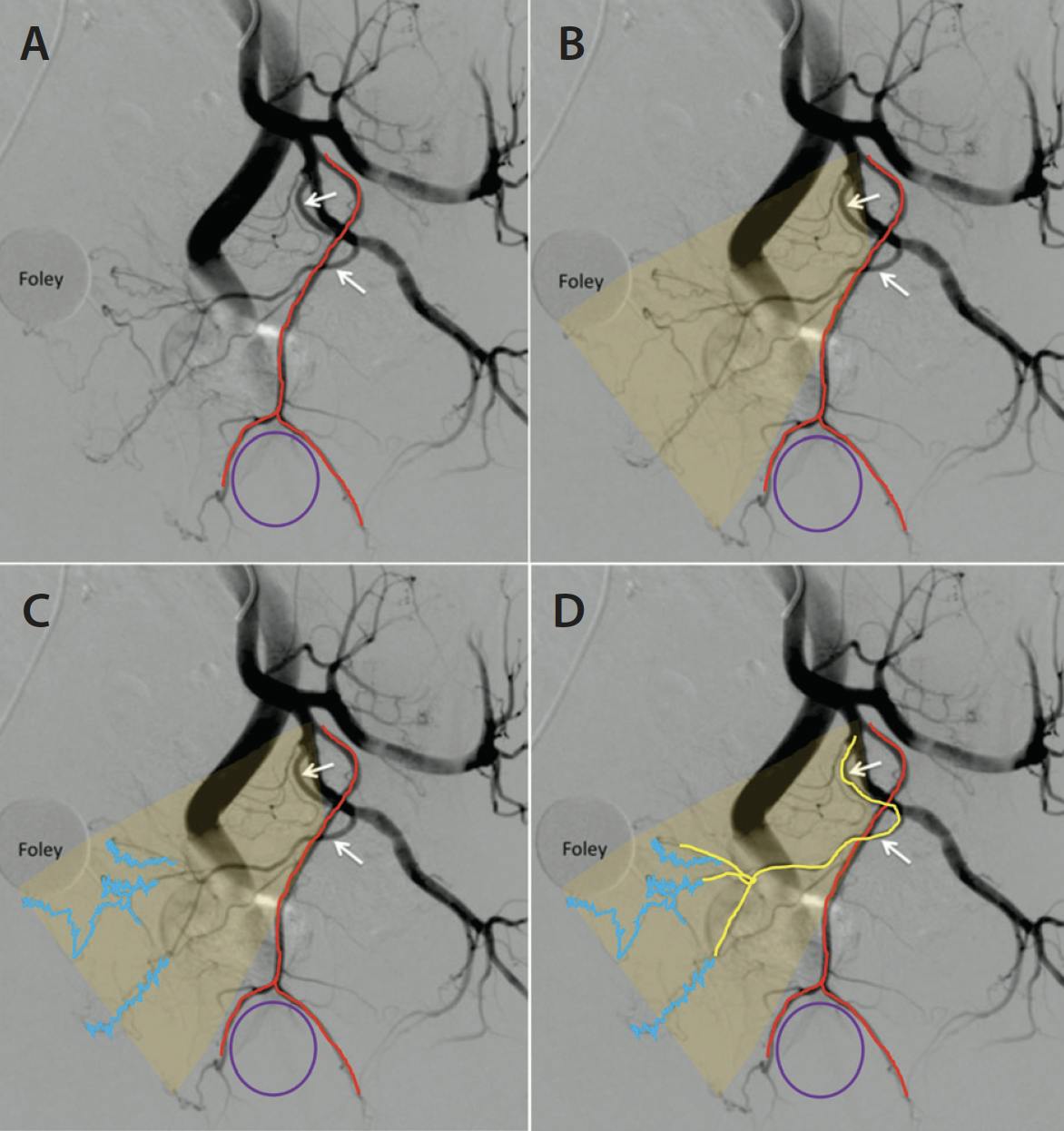
Figure 1. Step-by-step guide used by Grupo de Estudo em Embolização Prostática (GEEPROSTATA) for PAE with 2D fluoroscopy. In the oblique ipsilateral view (30°-50°), find the obturator foramen and obturator artery (A), look at the territory above (B). Find the intraprostatic arteries (C). Make your way back and find the two main branches (anteromedial and posterolateral); keep coming back until you find the origin of the prostatic artery (D); Catheterize the prostatic artery and perform PAE.
Three-dimensional imaging with CBCT for PAE was introduced in 2013,6 highlighting the potential for identifying the prostatic arteries and confirming correct microcatheter placement before embolization. CBCT can also help identify anastomoses that may lead to untargeted embolization,6 although this is also detected with 2D imaging. Use of CBCT with dedicated software can be a powerful tool to identify the prostatic arteries, define the best C-arm angulation for selective catheterization, and guide microcatheter trajectory into the central gland of the prostate,7 reducing radiation exposure and procedural times. Dedicated angiography software is accurate and reliable for identifying the prostatic arteries,8 assisting during embolization,9,10 and reducing radiation exposure and procedural/fluoroscopic times (Figure 2). Along with making the procedure easier, this can also obviate the need for extensive pelvic vascular anatomy knowledge.
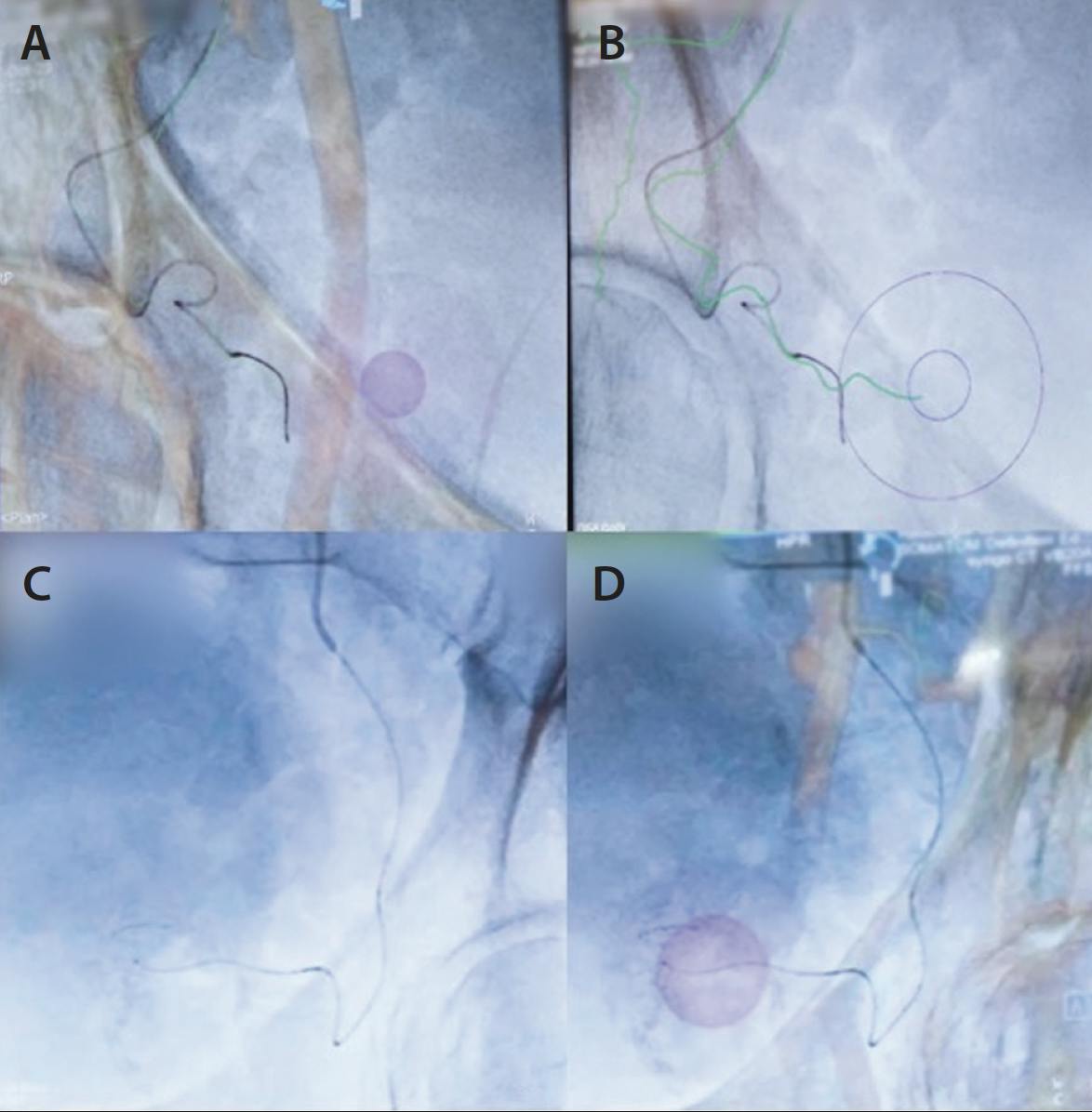
Figure 2. Superselective microcatheter catheterization of the central gland of the prostate on the right (A, B) and left (C, D) sides, using vessel tracking software guidance (green lines), with overlay of the 3D image data sets with 2D fluoroscopy images.
CBCT information can also be used to help identify the endpoint for embolization, whether prostate coverage is complete, and when more embolization is needed.11 Nonenhanced CBCT performed after bilateral PAE showed that 25% of patients required more embolization of the previously embolized prostatic arteries and/or additional prostatic arteries that were missed.11
Although there are numerous reasons and advantages to using CBCT during PAE, some question its added value for operators with extensive PAE experience.12 In fact, level of operator expertise significantly impacts procedural times and radiation exposure during PAE, with an estimated learning curve of 75 procedures.13 Although the combination of CBCT and 2D angiography acquisitions can increase radiation exposure, procedural time, and contrast usage,12 the goal is to use CBCT alone instead of in addition to 2D angiography.
The addition of dedicated software based on CBCT data to assist during PAE is another argument in favor of CBCT.7-10 One area being explored recently is digital variance angiography,14 which has shown potential in reducing radiation exposure and contrast use while also improving image quality.
THE EVOLUTION OF MEDICAL DEVICES FOR PAE OVER THE LAST 16 YEARS: IMPACT ON TECHNICAL OUTCOMES
Early reports of PAE for patients with benign prostatic hyperplasia (BPH) date back to 2010 and 2011, with a unilateral PAE rate of 16% using 2.7-F Progreat microcatheters (Terumo Interventional Systems).15,16 The evolution of dedicated microcatheters and wires for PAE over the last 16 years has been amazing, including the addition of steerable microcatheters and microcatheters with swan-neck, preshaped tips and triple-angle, preshaped tips with 1.9- to 2.4-F profiles. These developments, combined with sophisticated intraprocedural imaging, have allowed us to lower the unilateral PAE rate to < 2% in more recent studies.17
Although PAE was initially performed via a trans-femoral approach,15,16 radial access was proven safe and effective in 2017.18 The choice of radial access for PAE has since been based on operator preference and availability of materials, such as longer microcatheters (> 150 cm) to treat taller patients and occlude a more distal anastomosis between the prostatic artery and another artery and avoid nontarget embolization. In certain centers, radial access is used in more than two-thirds of PAE patients.17
Catheter choices depend on arterial access site, but 5 F is used frequently. For femoral access, long-reversed catheters (eg, uterine artery catheters, Pisco prostate catheter [Merit Medical]) allow for bilateral internal iliac artery catheterization with a single femoral access or can be used in a combination of catheters (vertebral for contralateral catheterization, vertebral in a Waltman loop for ipsilateral catheterization, or Simmons 1). For radial access, longer catheters are needed (125, 135, or 150 cm), and Berenstein, multipurpose, or MG 2 (Terumo Interventional Systems) catheters are preferred. The choice of a hydrophilic wire on a 0.035-inch platform is based on operator preference. Currently, most PAE experts use microcatheters < 2.5 F, often with a preshaped, swan-neck or double- or triple-angled tips. Most vendors offer 150- to 175-cm-long microcatheters for radial access use, and the choice of a microguidewire for 0.014- to 0.016-inch platforms also depends on the operator. Balloon occlusion microcatheters have been shown to reduce nontarget embolization during PAE but have limited added value for clinical outcomes.19,20
EMBOLIC OPTIONS
The first reports of PAE for BPH used Embosphere trisacryl gelatin microspheres (Merit Medical Systems, Inc.) and polyvinyl alcohol (PVA) particles,15,16 and these, along with Embozene microspheres (Varian Medical Systems), are among the most frequently used embolic agents. PVA microspheres such as Bead Block (Boston Scientific Corporation) have also been shown to be safe and effective for PAE but were recently discontinued.21 Both retrospective and prospective comparative studies have failed to show superiority of any of these frequently used embolic agents for PAE.17,21
There is a size paradox for microspheres: 100–300 μm versus 300–500 μm. Although two comparative studies showed a higher risk for complications using 100–300‑μm microspheres and no clinical added value compared to 300–500-μm microspheres, many operators still prefer to use the 100–300-μm range.22,23 The potential benefit of the 100–300-µm microspheres is deeper penetration to the prostate, with more ischemia and thus better and longer-lasting results. This has been proven in vitro, where PVA particles (regardless of the size used) and 300–500-μm Embospheres occluded more proximally with less distal penetration.24 Whether these differences in penetration are clinically relevant remains to be proven. It is well known that PVA particles tend to clump and upsize, and thus particle size for PVA is not as relevant. With PVA particles, most prefer to start with smaller particles (150–250 μm) and then finish embolization with larger (250–355 μm) particles.17 More recently, 400-μm polyethylene glycol microspheres have also been shown to be safe and effective for PAE.25 Radiopaque microspheres have the potential to identify nontarget embolization but have not gained space in the PAE realm.26 Ethylene vinyl alcohol copolymer has been shown to be a feasible option for PAE as well but has not been implemented for PAE.27 More aggressive embolic strategies such as absolute ethanol or bleomycin remain experimental.28,29
As embolic choices are considered, the new kid on the block is NBCA (N-butyl cyanoacrylate) used in a dilution with Lipiodol (Guerbet LLC) of 1/6 to 1/10. PAE with NBCA was proven to be safe and effective in 2021,30 and in the last 3 years, studies have shown that NBCA is equally as safe and effective for PAE as microspheres and PVA particles.31-33 Further, NBCA reduces procedural and fluoroscopy times, thus minimizing radiation exposure.31-33
Because the use of NBCA for PAE has been in high dilutions, there is no information available on recanalization of the prostatic arteries or how this may compromise the long-term result. Future prospective comparative studies looking at longevity of treatment effect will be required to understand if NBCA will replace particles for PAE.
PAE has a 16-year history that granted its place in the urological guidelines.34 This was based on PAE data using PVA particles and microspheres, not NBCA. NBCA can induce more postembolization symptoms and should not be used by operators with limited expertise in PAE and/or NBCA use.30-33 New embolic platforms such as temperature-sensitive liquid embolic agents35 or drug-eluting PAE36 remain experimental but have highly promising features if/when they become more available. Selective prostatic drug delivery of 5α-reductase inhibitors (finasteride, dutasteride) using PAE has an enormous theoretical potential that needs further medical device development to be implemented.
Decision-Making Considerations for Choosing an Embolization Strategy
The evolution and choices of embolic solutions for PAE are based on optimizing clinical efficacy and ensuring longevity of treatment effect, while preserving erectile, ejaculatory functions, and continence status. If one goes for more “aggressive” embolic solutions—for example, using ethanol or very small and compressible microspheres that penetrate more distally—prostate volume reduction and peak urinary flow rate might improve to values comparable with prostate resection surgery. However, this could be at the cost of incontinence and or ejaculatory/erectile dysfunction. These more “aggressive” embolization strategies induce post-PAE changes similar to prostate resection surgery and may lead to prostate tissue sloughing, requiring bailout endoscopic interventions.37,38
If the goal was to replicate surgery, we wouldn’t need PAE. PAE gained space in the BPH arena based on the safety profile and preservation of ejaculatory status. When choosing embolization strategies for PAE, safety profile and ejaculatory preservation must come before longevity of treatment effect, prostate volume reduction, or peak urinary flow rate increase. It is well proven that with use of conventional, “less aggressive” embolic options (300–500-μm microspheres and 100–300-μm PVA particles), ejaculatory and erectile functions are preserved and continence is not affected.17 Patient comfort and satisfaction with PAE rely heavily on recovery postprocedure and should be top priority. It might be preferable to repeat PAE in 5 to 10 years to avoid bailout endoscopic prostate resection in a patient experiencing acute urinary retention at 1 month post-PAE due to urinary tract infection with prostate tissue expulsion. Although prostate volume reduction and peak urinary flow rate increase are excellent after this, the patient will most likely be very dissatisfied with the treatment outcomes.
PAE is not perfect and does not work every time, likely related to patient selection rather than technique. Improvements in technique do not automatically mean improved clinical results. As long as bilateral PAE is performed, results will be consistent regardless of the embolic option used. Clinical failures will always be present in the form of nonresponders or relapsers.
CONCLUSION
PAE techniques have evolved over the last 16 years with the addition of dedicated microcatheters and advanced 3D intraprocedural imaging that enable unilateral PAE rates < 2%. Although some centers prefer not to use it, preprocedural vascular mapping has its advantages; CTA and MRA are both options, and choice is based on operator preference. Selection of the embolic solution is based on many factors, such as optimizing clinical efficacy, ensuring longevity of treatment effect, and preserving erectile, ejaculatory functions, and continence status. Embospheres, PVA particles, and Embozene in the 300–500-μm range are most frequently used. NBCA shows promise for PAE, but more data are needed to assess its potential as first-line option.
1. Bilhim T, Pisco JM, Furtado A, et al. Prostatic arterial supply: demonstration by multirow detector angio CT and catheter angiography. Eur Radiol. 2011;21:1119-1126. doi: 10.1007/s00330-010-2015-0
2. Zhang JL, Wang MQ, Shen YG, et al. Effectiveness of contrast-enhanced MR angiography for visualization of the prostatic artery prior to prostatic arterial embolization. Radiology. 2019;291:370-378. doi: 10.1148/radiol.2019181524
3. Steffen P, Wentz R, Thaler C, et al. Single-center retrospective comparative study evaluating the benefit of computed tomography angiography prior to prostatic artery embolization. Cardiovasc Intervent Radiol. 2022;45:1019-1024. doi: 10.1007/s00270-022-03061-x
4. Dalla S, Richards L, Alli A, et al. 3D printed model to assist endovascular prostate artery embolization for benign prostatic hyperplasia. Radiol Case Rep. 2022;17:4161-4164. doi: 10.1016/j.radcr.2022.08.026
5. Bilhim T, Pisco JM, Rio Tinto H, et al. Prostatic arterial supply: anatomic and imaging findings relevant for selective arterial embolization. J Vasc Interv Radiol 2012;1403-1415. doi: 10.1016/j.jvir.2012.07.028
6. Bagla S, Rholl KS, Sterling KM, et al. Utility of cone-beam CT imaging in prostatic artery embolization. J Vasc Interv Radiol. 2013;24:1603-1607. doi: 10.1016/j.jvir.2013.06.024
7. Schott P, Katoh M, Fischer N, Freyhardt P. Radiation dose in prostatic artery embolization using cone-beam CT and 3D roadmap software. J Vasc Interv Radiol. 2019;30:1452-1458. doi: 10.1016/j.jvir.2019.04.040
8. Schott P, Bilhim T, Fischman A, et al. Evaluation of vessel tracking software for prostatic artery embolization. Cardiovasc Intervent Radiol. 2024;47:1407-1413. doi: 10.1007/s00270-024-03841-7
9. McClure TD, Ortiz AK, Doustaly R, et al. Use of virtual injection technology for planning and guidance of prostate artery embolization. Cardiovasc Intervent Radiol. 2022;45:884-887. doi: 10.1007/s00270-022-03068-4
10. Barral M, Lassalle L, Gardavaud F, et al. virtual injection software reduces radiation exposure and procedural time of prostatic artery embolization performed with cone-beam CT. J Vasc Interv Radiol. 2024;35:409-415. doi: 10.1016/j.jvir.2023.11.012
11. Hakimé A, Tun JK, Haab F, et al. Using prostate contrast retention (PCR) as the procedural endpoint in prostatic artery embolization for benign prostatic hyperplasia. Eur Radiol. 2021;31:9150-9160. doi: 10.1007/s00330-021-08063-w
12. Bürckenmeyer F, Diamantis I, Kriechenbauer T, et al. Prostatic artery embolization: influence of cone-beam computed tomography on radiation exposure, procedure time, and contrast media use. Cardiovasc Intervent Radiol. 2021;44:1089-1094. doi: 10.1007/s00270-021-02787-4
13. Ayyagari R. Operator learning curve for prostatic artery embolization and its impact on outcomes in 296 patients. Cardiovasc Intervent Radiol. 2023;46:229-237. doi: 10.1007/s00270-023-03492-0
14. Alizadeh LS, Gyánó M, Góg I, et al. Initial experience using digital variance angiography in context of prostatic artery embolization in comparison with digital subtraction angiography. Acad Radiol. 2023;30:689-697. doi: 10.1016/j.acra.2022.05.007
15. Carnevale FC, Antunes AA, da Motta Leal Filho JM, et al. Prostatic artery embolization as a primary treatment for benign prostatic hyperplasia: preliminary results in two patients. Cardiovasc Interv Radiol. 2010;33:355-361. doi: 10.1007/s00270-009-9727-z
16. Pisco JM, Pinheiro LC, Bilhim T, et al. Prostatic arterial embolization to treat benign prostatic hyperplasia. J Vasc Interv Radiol. 2011;22:11-19. doi: 10.1016/j.jvir.2010.09.030
17. Bilhim T, Vasco Costa N, Torres D, et al. Comparing embolic particles for prostatic artery embolization to treat lower urinary tract symptoms in patients with benign prostatic hyperplasia. Eur Radiol. Published online August 6, 2024. doi: 10.1007/s00330-024-10998-9
18. Bhatia S, Harward SH, Sinha VK, Narayanan G. Prostate artery embolization via transradial or transulnar versus transfemoral arterial access: technical results. J Vasc Interv Radiol. 2017;28:898-905. doi: 10.1016/j.jvir.2017.02.029
19. Ayyagari R, Powell T, Staib L, et al. Case-control comparison of conventional end-hole versus balloon-occlusion microcatheter prostatic artery embolization for treatment of symptomatic benign prostatic hyperplasia. J Vasc Interv Radiol. 2019;30:1459-1470. doi: 10.1016/j.jvir.2019.05.033
20. Bilhim T, Costa NV, Torres D, et al. Randomized clinical trial of balloon occlusion versus conventional microcatheter prostatic artery embolization for benign prostatic hyperplasia. J Vasc Interv Radiol. 2019;30:1798-1806. doi: 10.1016/j.jvir.2019.06.019
21. Bilhim T, Costa NV, Torres D, et al. Long-term outcome of prostatic artery embolization for patients with benign prostatic hyperplasia: single-centre retrospective study in 1072 patients over a 10-year period. Cardiovasc Intervent Radiol. 2022;45:1324-1336. doi: 10.1007/s00270-022-03199-8
22. Gonçalves OM, Carnevale FC, Moreira AM, et al. Comparative study using 100-300 versus 300-500 μm microspheres for symptomatic patients due to enlarged-BPH prostates. Cardiovasc Intervent Radiol. 2016;39:1372-1378. doi: 10.1007/s00270-016-1443-x
23. Torres D, Costa NV, Pisco J, et al. Prostatic artery embolization for benign prostatic hyperplasia: prospective randomized trial of 100-300 μm versus 300-500 μm versus 100- to 300-μm + 300- to 500-μm embospheres. J Vasc Interv Radiol. 2019;30:638-644. doi: 10.1016/j.jvir.2019.02.014
24. Miller SR, Jernigan SR, Abraham RJ, Buckner GD. Comparing deposition characteristics of various embolic particles using an in vitro prostate microvasculature model. J Vasc Interv Radiol. 2024;35:1534-1543.e4. doi: 10.1016/j.jvir.2024.06.028
25. Insausti I, Galbete A, Lucas-Cava V, et al. Prostatic artery embolization (PAE) using polyethylene glycol microspheres: safety and efficacy in 81 patients. Cardiovasc Intervent Radiol. 2022;45:1339-1348. doi: 10.1007/s00270-022-03165-4
26. Brown B, Yu H, Bagla S, Isaacson A. Nontarget radiopaque embolic deposition during prostatic artery embolization. J Vasc Interv Radiol. 2022;33:558563.e1. doi: 10.1016/j.jvir.2022.01.014
27. Sédat J, Arnoffi P, Poirier F, et al. Non-target embolic events during prostatic embolization with ethylene vinyl alcohol copolymer (EVOH). CVIR Endovasc. 2023;6:54. doi: 10.1186/s42155-023-00402-w
28. Moulin B, Hakime A, Kuoch V. Percutaneous prostatic artery embolization with absolute alcohol: a case report. J Vasc Interv Radiol. 2022;33:1008-1010. doi: 10.1016/j.jvir.2022.03.071
29. Zhang JL, Yuan B, Wang MQ, et al. Prostatic artery embolization for benign prostatic hyperplasia: bleomycin-eluting versus bland microspheres in a canine model. J Vasc Interv Radiol. 2020;31:820-830. doi: 10.1016/j.jvir.2019.11.028
30. Loffroy R, Guillen K, Salet E, et al. Prostate artery embolization using n-butyl cyanoacrylate glue for urinary tract symptoms due to benign prostatic hyperplasia: a valid alternative to microparticles? J Clin Med. 2021;10:3161. doi: 10.3390/jcm10143161
31. Salet E, Crombé A, Grenier N, et al. Prostatic artery embolization for benign prostatic obstruction: single-centre retrospective study comparing microspheres versus n-butyl cyanoacrylate. Cardiovasc Intervent Radiol. 2022;45:814-823. doi: 10.1007/s00270-022-03069-3.
32. Sanghvi J, Bamshad D, Galla N, et al. Fluoroscopy time and radiation dose using liquid embolic (n-butyl-2-cyanoacrylate) versus microspheres for prostatic artery embolization. J Vasc Interv Radiol. 2024;35:147-151.e1. doi: 10.1016/j.jvir.2023.09.019
33. Hijazi BA, Shi HB, Liu S, et al. N-butyl cyanoacrylate glue versus nonspherical polyvinyl alcohol particles for prostatic arterial embolization to treat benign prostatic hyperplasia: safety and efficacy. Urol J. 2023;20:261-268. doi: 10.22037/uj.v20i.7734
34. Bilhim T, McWilliams JP, Bagla S. Updated American Urological Association guidelines for the management of benign prostatic hyperplasia: prostatic artery embolization made it into the guidelines! Cardiovasc Intervent Radiol. 2024;47:150-153. doi: 10.1007/s00270-023-03617-5
35. Lin F, Chen Q, Gao M, et al. Retrospective observation of the early efficacy and safety of temperature-sensitive liquid embolic agent combined with polyvinyl alcohol microspheres for prostatic artery embolization in the treatment of lower urinary tract symptoms caused by benign prostatic hyperplasia. Transl Androl Urol. 2024;13:1847-1858. doi: 10.21037/tau-24-215
36. Li X, Li B, Ullah MW, et al. Water-stable and finasteride-loaded polyvinyl alcohol nanofibrous particles with sustained drug release for improved prostatic artery embolization - In vitro and in vivo evaluation. Mater Sci Eng C Mater Biol Appl. 2020;115:111107. doi: 10.1016/j.msec.2020.111107
37. Hechelhammer L, Müllhaupt G, Mordasini L, et al. Predictability and inducibility of detachment of prostatic central gland tissue after prostatic artery embolization: post hoc analysis of a randomized controlled trial. J Vasc Interv Radiol. 2019;30:217-224. doi: 10.1016/j.jvir.2018.09.029
38. Bilhim T. Endovascular resection of the prostate: how much is enough for prostate artery embolization? J Vasc Interv Radiol. 2019;30:225-227. doi: 10.1016/j.jvir.2018.10.009
Advertisement
Advertisement