Advertisement
Advertisement
January 2025
Beyond Chronicity: Clot Characteristics and How They Drive Decisions in Deep Venous Disease
The knowns and unknowns about venous thrombus biology as it relates to in-stent restenosis and how these results drive patient care.
By Minhaj S. Khaja, MD, MBA, FSIR, FSVM; Oscar Moreno, MD; and Andrea Tara Obi, MD
Endovascular recanalization of a chronically occluded vein or venous stent can be technically challenging. With very few clinical trials evaluating postprocedure medical therapies, identifying the optimal risk-benefit balance of anticoagulant and nonanticoagulant therapies remains elusive. In the absence of high-quality randomized trials to guide evidence-based postprocedural care, we have used the best clinical evidence alongside thrombus and patient-level biology to guide shared decision-making. This article describes what is known and unknown about venous thrombus biology as it relates to in-stent restenosis (ISR) and how these results may be leveraged to drive patient care.
WHAT IS KNOWN ABOUT THROMBUS BIOLOGY AND ISR
The process of thrombus maturation is one that has long been understood to mimic that of wound healing: After formation of the acute thrombus, early infiltration of neutrophils is followed later by monocytes and the conversion from fibrin to collagen-rich matrix, contiguous with the vein wall, resembling scar.1 However, whether ISR pathology is governed by the same process is less clear. For over a decade, preceding the advent of “coring”-type thrombectomy devices, our group obtained intravenous biopsies on patients with bare-metal venous stents using myocardial biopsy forceps. Among this cohort, several distinct pathologic features were found: fresh thrombus, organizing thrombus, old thrombus, diffuse intimal thickening (DIT; analogous to neointimal hyperplasia), calcification, hemosiderin deposition, and neovascularization within the biopsied stent lumen. Time dependence was observed with four of these features: Fresh and organizing thrombus decreased over time, whereas DIT and calcification increased as time lapsed (Figure 1). These data establish two important facts regarding ISR: (1) the process occurs in a predictable, time-dependent fashion, and (2) DIT was the main characteristic of late ISR (Figure 2).2
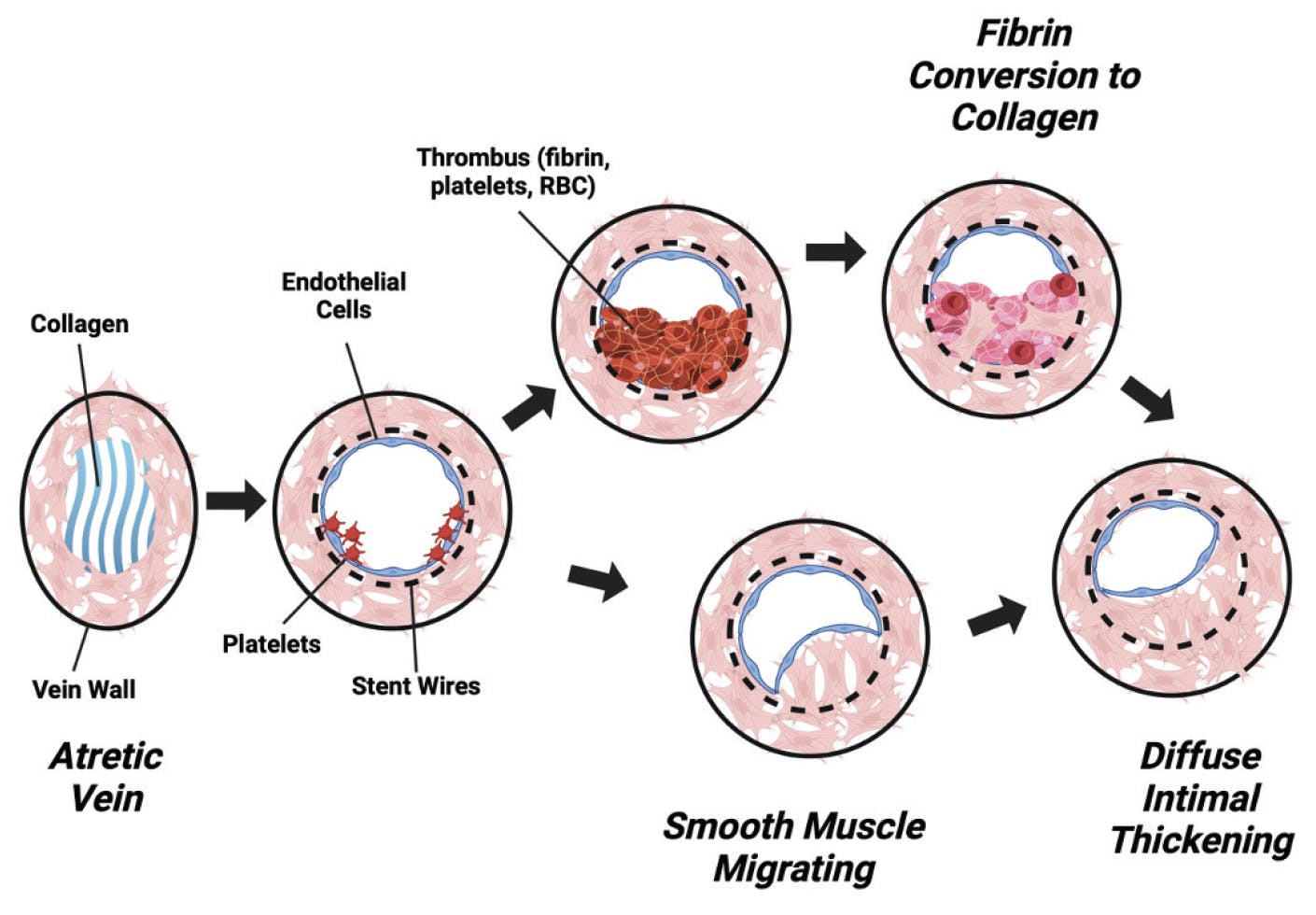
Figure 1. Potential mechanisms of human vein in-stent stenosis. RBC, red blood cell.
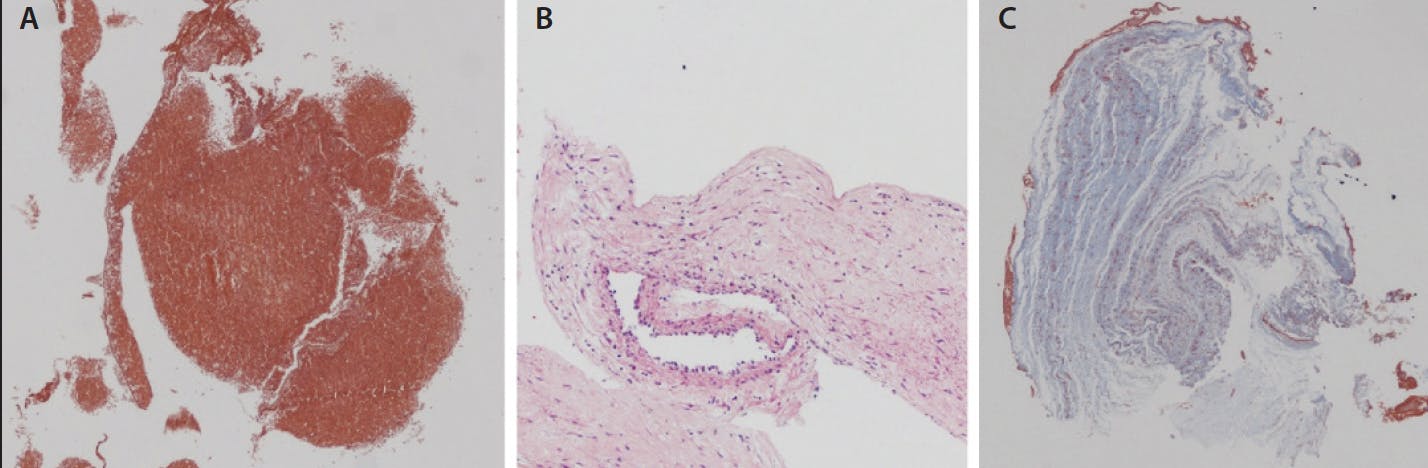
Figure 2. Pathologic characteristics of human venous in-stent stenosis and stent occlusion. Acute thrombi highlighting rich red blood cell content (A). Subacute thrombi characterized by organizing thrombi with fibrin components, ingrowth of mesenchymal cells, and immune cell infiltration (B). Chronic thrombi characterized by DIT (C).
WHAT IS UNKNOWN ABOUT THROMBUS BIOLOGY AND ISR
The most compelling question regarding the evolution of ISR is determining to what degree the organizing thrombus versus the vein wall drives the formation of DIT. In the arterial vasculature, it is well accepted that the migration and proliferation of vascular smooth muscle cells is the dominant mechanism by which neointimal hyperplasia occurs.3 Recent data presented by Gwozdz and colleagues at the American Vein & Lymphatic Society 2024 Annual Congress found that among surgically removed stents and sections of veins removed during Palma procedures, the vein wall was relatively undisturbed by the stents.4 This observation is consistent with our own that sections of organizing thrombus were overlayed by a pannus of DIT in pathologic specimens. When taken together, these observations suggest that persistent, organizing thrombus is the driving force behind DIT development. Fundamentally, the creation of experimental systems such as the goat ISR model published by Dr. Li and colleagues in early 20245 and rodent models presented at American Venous Forum by Nguyen6 and by us7 will be instrumental in identifying the cellular, signaling, and structural elements required for ISR formation.
CURRENT STATE OF CLINICAL DECISION-MAKING
As many endovascular specialists know, there are characteristics that make chronic venous recanalization inherently challenging, including diminutive channels, lack of a clear trajectory, and difficulty crossing an occluded stent, among others. If we can cross a stent occlusion, we face the challenge of thrombus removal (in the acute stage) or compressing/excluding old thrombus or DIT to improve the luminal flow channel. These challenges do not account for underlying issues or unknown technical factors, but to improve patient symptoms and outcomes, operators employ a host of techniques such as debulking with newer thrombectomy devices, venoplasty alone, or stent relining.
At our center, we frequently perform in-stent venous biopsies to attempt to evaluate the contents of the stent so that we can address some of these underlying issues. Venous biopsies are most commonly performed in stented postthrombotic syndrome (PTS) patients with poor inflow, typically at 6 months after their index procedure. These biopsies are routinely performed in patients with poor inflow and in symptomatic patients with adequate inflow. If organizing thrombus is found to represent a large portion of the in-stent contents and the patient has a compromised flow channel resulting in symptoms, we adjust antithrombotic therapy by either reinitiating treatment with an anticoagulant such as a direct oral anticoagulant, increasing therapeutic goals of international normalized ratio or anti-Xa levels, or changing to low-molecular-weight heparin. In those patients with > 70% in-stent restenosis, endovascular intervention with venoplasty and/or stenting may be performed as well. Antithrombotic treatment plans are reassessed in an additional 6-month interval following a successive in-stent venous biopsy. Visual inspection of the removed contents plus pathologic diagnosis and lab values may be helpful in making some decisions, but anecdotal experience remains our basis, as opposed to strong scientific data.
Additionally, lab values such as high-sensitivity C-reactive protein (CRP) and D-dimer levels may assist in assessing the contribution of inflammation and thrombus formation to stent failure, which may be mitigated with the addition of anti-inflammatory drugs or other medications. For example, rosuvastatin has been shown to reduce the risk of venous thromboembolism (VTE) in a multicenter, randomized controlled trial of apparently healthy patients.8 Conversely, a separate pilot randomized controlled trial in patients with new VTE found no reduction in the incidence of PTS or its severity when rosuvastatin therapy was added to anticoagulation.9 Although our patient population is different from both studies (patients with known VTE, PTS, and venous stents), we frequently utilize rosuvastatin 20 mg daily to reduce inflammation as followed by CRP levels and have noted reduced CRP levels consistently.
Our group is evaluating this complex problem of stent thrombosis and recanalization strategy, focusing on better understanding the factors influencing venous stent failure. Recognizing the diverse presentations and challenges posed by acute and chronic in-stent thrombosis, our preliminary study will stratify patients based on disease chronicity, clinical presentation, and histopathologic findings. By analyzing tissue samples collected during revascularization interventions, the study seeks to identify key biological and clinical markers that can guide treatment decisions, such as selecting between thrombectomy, thrombolysis, venoplasty, or restenting, among others. These findings will also provide valuable insights into the underlying processes driving stent failure and inform patient selection and intervention strategies to improve outcomes.
FUTURE STATE
Fundamental understanding of biological processes driving DIT and collagen deposition seen in native vein chronic thrombi may give rise to novel therapeutic targets. Closer to human translation are the ongoing trials evaluating anti-inflammatory perivenous injections (DEXTERITY [NCT04858776]), adoption of antimitogen drug-coated balloons from the arterial to the venous system, and postintervention statin therapy. Fundamentally, the questions of what antithrombotic regimen (anticoagulant, antiplatelet) and for how long, assessment of flow dynamics including inflow, and the role of inflammation and anti-inflammatory therapies are among the looming questions agreed upon by members of Society of Interventional Radiology as the top priority to answer to best serve our patients in an evidence-based fashion.10
IMPLICATIONS FOR FUTURE RESEARCH AND CLINICAL PRACTICE
The extraction and extensive analysis of thrombus samples from ISR provide a better understanding of the sequential histopathologic changes. This is pivotal as this knowledge can direct future research toward novel therapeutic strategies to mitigate ISR. Understanding the time course of thrombus organization, collagen deposition, and neointimal hyperplasia can inform the development of stents and pharmacologic interventions that reduce restenosis rates and improve long-term patient outcomes. Ultimately, further research into the mechanisms of ISR will be crucial, integrating sophisticated thrombus retrieval systems for advanced imaging and histopathologic techniques. This approach enhances our understanding and drives innovations that address the persistent challenge of stent failure due to restenosis, thereby paving the way for more effective and durable vascular interventions.
1. Wakefield TW, Myers DD, Henke PK. Mechanisms of venous thrombosis and resolution. Arterioscler Thromb Vasc Biol. 2008;28:387-391. doi: 10.1161/ATVBAHA.108.162289
2. Williams DM, Nicklas JM, Obi A, Gordon D. Pathologic characteristics of human venous in-stent stenosis and stent occlusion. J Vasc Surg Venous Lymphat Disord. 2023;11:109-118.e2. doi: 10.1016/j.jvsv.2022.07.002
3. Ebert MLA, Schmidt VF, Pfaff L, et al. Animal models of neointimal hyperplasia and restenosis: species-specific differences and implications for translational research. JACC Basic Transl Sci. 2021;6:900-917. doi: 10.1016/j.jacbts.2021.06.006
4. Gwozdz AM, Saha P, Smith A, Black S. Temporal evolution of histopathological changes in venous in-stent stenosis: an in-depth analysis of thrombus organisation and tissue composition Presented at: AVLS; October 11, 2024; Chicago, Illinois.
5. Li G, Hu B, Sun Y, et al. Histological features of in-stent restenosis after iliac vein thrombus removal and stent placement in a goat model. J Vasc Interv Radiol. 2024;35:611-617. doi: 10.1016/j.jvir.2023.12.567
6. Nguyen KP. 2021 JOBST awardee presentation. Presented at: American Venous Forum; March 6, 2024; Tampa, Florida.
7. Moreno OY, Clay A, Luke C, et al. Abstract 2092: Ultrasound and histology protocol for characterization of venous stents effect in deep veins in vivo. Arterioscler Thromb Vasc Biol. 2024;44(suppl 1). https://doi.org/10.1161/atvb.44.suppl_1.2092
8. Glynn RJ, Danielson E, Fonseca FA, et al. A randomized trial of rosuvastatin in the prevention of venous thromboembolism. N Engl J Med. 2009;360:1851-1861. doi: 10.1056/NEJMoa0900241
9. Delluc A, Ghanima W, Kovacs MJ, et al. Prevention of post-thrombotic syndrome with rosuvastatin: a multicenter randomized controlled pilot trial (SAVER). Thromb Res. 2022;213:119-124. doi: 10.1016/j.thromres.2022.03.014
10. Khaja MS, Obi AT, Sharma AM, et al. Optimal medical therapy following deep venous interventions: proceedings from the Society of Interventional Radiology Foundation research consensus panel. J Vasc Interv Radiol. 2022;33:78-85. doi: 10.1016/j.jvir.2021.09.009
Advertisement
Advertisement