Advertisement
Advertisement

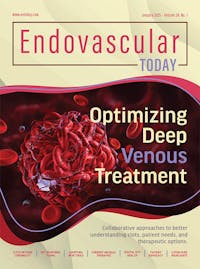
It is a wonderful honor to serve as Guest Editor of this venous disease–focused issue of Endovascular Today and collaborate with its outstanding authors and editorial staff. As we launch into 2025, it is amazing to reflect on how far endovascular venous care has evolved during the past 30 years in terms of innovation, collaboration, and evidence. But, we do so only briefly—this issue is decidedly future-focused, with insightful pieces that address next-level issues in venous care: applying digital technology and knowledge of venous biology to enhance clinical care, conceiving new collaborative models around venous disease care, and increasing the impact of the endovascular community on health care at large via advocacy, education, and mentorship.
The issue kicks off with an article on clot characteristics by Minhaj S. Khaja, MD; Oscar Moreno, MD; and Andrea Tara Obi, MD, who review the knowns and unknowns about venous thrombus biology as it relates to in-stent restenosis and how these results drive patient care.
Next, I moderate a panel discussion on the deep venous thrombosis (DVT) response team concept in which Pavan Kavali, MD, and Kristen Sanfilippo, MD, discuss the possible benefits and barriers, patient selection and medical management considerations, and implications for clinical research.
Pedram Keshavarz, MD; Jonas Kruse, MD; John M. Moriarty, MD; and Mona Ranade, MD, follow with a discussion of the essential considerations for clinicians adopting new DVT tools, focusing on efficacy, safety, and integration into existing protocols.
Then, Dhara Kinariwala, MD; Aditya M. Sharma, MD; and Minhaj S. Khaja, MD, review how to optimize antithrombotic and anti-inflammatory regimens after deep venous disease interventions based on patient presentation, comorbidities, and type of intervention.
Two Literature Highlights articles follow: the first on the recently published consensus statement on nonthrombotic iliac vein lesion management featuring a Q&A with the consensus statement authors Kush R. Desai, MD; Kathleen Gibson, MD; Raghu Kolluri, MD; and Saher Sabri, MD; and the second on the SAFE-IVC study results with a discussion from study investigators Enrico G. Ferro, MD, and Eric A. Secemsky, MD.
Next up, I interview Leslie Lake, Volunteer President and Board Chair of the National Blood Clot Alliance/Stop the Clot, about patient and physician engagement in the organization, educational and outreach initiatives in DVT/pulmonary embolism, and how physicians can get involved in patient advocacy organizations to push governmental agencies and other stakeholders to scale up the resources and collaboration that are needed to succeed in the fight against venous disease and thrombosis.
Rounding out our issue, we ask Christiana Salami, MS; Bedros Taslakian, MD; Osman Ahmed, MD; Ezana Azene, MD; and Dania Daye, MD, to provide their insights about digital health in DVT and what would truly help guide care and research.
Outside our deep venous disease focus is our featured interview with Chelsea Dorsey, MD, who discusses her new role as At-Large Executive Board Member of the Society of Vascular Surgery, her “intentional” style of mentorship, and employing effective diversity, equity, and inclusion strategies.
I greatly enjoyed reading these pieces and I am sure you will too! I urge you to apply the pearls of wisdom presented here into your daily work and reach beyond your clinical practice to advance the impact of the endovascular community upon patient care.
Suresh Vedantham, MD
Guest Chief Medical Editor
Advertisement
Advertisement