Advertisement
Advertisement
July 2025
Sponsored by Medtronic
Venous Stenting Strategies: How to Avoid Migration and Overcome Challenges
Preventing Iliofemoral Venous Stent Migrations With Dr. Windsor Ting

Although stent migration is uncommon and occurs in < 3% of iliofemoral venous stent placements, it is an important complication that can be avoided.1,2 Stent migration is more likely to occur in iliofemoral stenosis due to nonthrombotic iliac venous lesions, which tend to be more focal. The most common is May-Thurner syndrome, where the left common iliac vein (CIV) is compressed between the right common iliac artery and the spine. In contrast, postphlebitic vascular stenosis from a remote deep vein thrombosis (DVT), another cause of iliofemoral stenosis, is more diffuse and less commonly associated with stent migration. It is important to recognize that the steps taken to reduce the risk of stent migration are the same steps for better stent selection and more precise stent placement.
An important tool that can reduce and possibly even eliminate this complication is the use of intravascular ultrasound (IVUS) during venous stent placement. IVUS diagnoses and localizes the iliofemoral stenosis with precision, providing an accurate assessment of the stenosis and assisting in the selection of appropriately sized stents. Some venous stent manufacturers encourage IVUS use within their instructions for use. An iliofemoral stenosis is most commonly located at, or in close proximity to, the orifice of the left CIV. Although venography provides indirect evidence of an underlying stenosis with a pancaked-appearing left CIV, contrast thinning, and collaterals, only IVUS can quantify and localize the stenosis with precision. We frequently use the road mapping feature of angiography and mark the monitor locations of the inferior vena cava confluence and CIV stenosis. With IVUS, the dimensions of a normal segment of the CIV and external iliac vein (EIV) are also obtained. Typically, a stent diameter 2 to 3 mm larger than the normal-segment CIV or EIV is selected, most commonly a 16-mm–diameter stent in women and an 18-mm–diameter stent in men. Our group prefers longer stents (> 80 mm in length), in part based on our published observations,3 which reported that distal to the CIV stenosis, there may be a second stenosis in the EIV that can be camouflaged due to the underlying vessel distention.
There are several additional important considerations. Be cognizant that the dimensions of the iliac veins observed with IVUS may be decreased in a volume-depleted patient. It may be a prudent strategy to use not only the CIV stenosis but also the EIV to anchor the stent, providing two points for securing the stent in place. Finally, studies have shown that shorter (< 60 mm) and smaller (≤ 14 mm) stents are associated with risk of stent migration, while stents > 100 mm in length had little to no migration risk.1,2
A Case Presentation With Dr. Raja Ramaswamy

PATIENT PRESENTATION
A man in his early 50s presented to the emergency department with worsening left lower extremity swelling, heaviness, and fatigue. Symptoms had gradually returned after a previous mechanical thrombectomy and stenting (16 X 80 mm) of the left CIV for iliofemoral DVT a few years prior. Of note, IVUS was not used during the initial procedure. Over several weeks, the patient had developed progressive edema, sensation of tightness, and prominent varicosities. Physical examination revealed pitting edema and skin changes consistent with chronic venous hypertension. Duplex ultrasound ruled out recurrent DVT. CT venography was used to assess the veins and underlying stent (Figure 1A). After the evaluation, the patient was scheduled for an elective venography and possible intervention.
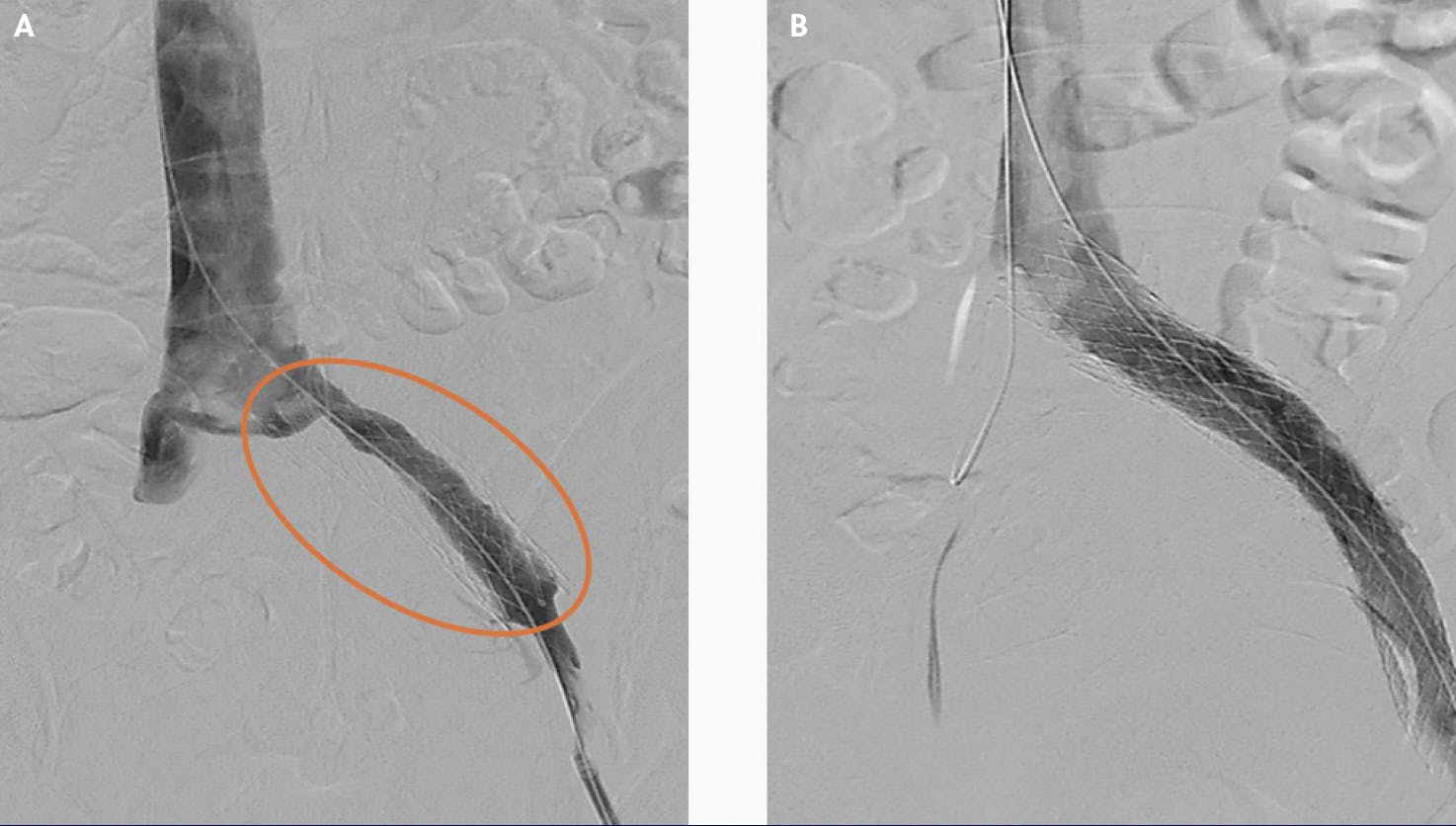
Figure 1. Venography via the left common femoral vein shows delayed contrast clearance, sluggish flow, impaired venous return, and the presence of a stenosis proximal to the stent (A). Postintervention venogram after angioplasty and stent extension both proximally and distally demonstrated restored flow through the iliac veins (B).
PROCEDURAL OVERVIEW
The patient presented to our interventional radiology lab a few months later for further evaluation, intervention, and treatment. Venography demonstrated the presence of a significant stenosis in the CIV, proximal to the previously placed stent, and IVUS revealed significant intimal hyperplasia. The imaging confirmed the presence of a short segment native to the iliac vein and proximal to the prior stent. This was managed by angioplasty of the previous stent and placement of two new stents: proximally (16 X 60 mm) and distally (14 X 60 mm) with 3 cm of overlap at each end, and restoration of brisk flow (Figure 1B).
DISCUSSION
In this case, malpositioning occurred due to inadequate initial imaging and suboptimal landing zone selection. The original procedure did not utilize IVUS, which likely contributed to inaccurate vessel sizing and failure to appreciate the full extent and location of the iliac vein compression. The stent was malpositioned, terminating just below the critical point of external compression in the CIV. As a result, it lacked proximal anchoring. Imaging revealed areas of ISR.
Key Takeaways and Best Practices
- IVUS is essential to placement during venous stenting to assess vein diameter and lesion morphology and to confirm appropriate landing zones.
- Precise stent placement is critical, as most CIV stenoses are located close to or at the orifice of the vein. Where possible, stent from healthy vein to healthy vein.
- Stents must be balloon-expanded postdeployment to the nominal size of the nitinol stent.
- Regular and close follow-up can help detect early stent malpositioning or migration.
CONCLUSION
In retrospect, IVUS would have identified the exact compression point, allowing for accurate stent sizing and landing zone planning. Best practices for venous stenting demand intraprocedural IVUS, postdilation balloon angioplasty, and coverage of the full pathologic segment from healthy vein to healthy vein. This case underscores the need for precision and vigilance to prevent costly complications like migration and restenosis.
1. Sayed MH, Salem M, Desai KR, et al. A review of the incidence, outcome, and management of venous stent migration. J Vasc Surg Venous Lymphat Disord. 2022;10:482-490. doi: 10.1016/j.jvsv.2021.07.015
2. Bai H, Kibrik P, Shaydakov ME, et al. Indications, technical aspects, and outcomes of stent placement in chronic iliofemoral venous obstruction. J Vasc Surg Venous Lymphat Disord. 2024;12:101904. doi: 10.1016/j.jvsv.2024.101904
3. Leong T, Chait J, Chun K, et al. Proximal common iliac vein stenosis may mask a more distal stenosis: a phenomenon unique to veins. J Vasc Surg Venous Lymphat Disord.. 2020;8:334-335. doi: 10.1016/j.jvsv.2019.12.059
Disclosures
Dr. Ting: Consultant to Medtronic.
Dr. Ramaswamy: Consultant to Inari Medical, Cook Medical, and Medtronic.
501761 ©2025 Medtronic. Medtronic, Medtronic logo are trademarks of Medtronic. TM* third party brands are trademarks of their respective owner. All other brands are trademarks of Medtronic. For global distribution. 07/2025
Advertisement
Advertisement