Advertisement
Advertisement
July 2025
An Interview With Lakshmi A. Ratnam, MBChB, MRCP, FRCR, EBIR
Dr. Ratnam discusses the bleomycin electrosclerotherapy (BEST) technique for low-flow vascular malformations and the importance of a dedicated BEST team, hurdles to pediatric IR, guidelines for postpartum hemorrhage, the importance of mentorship, and more.

Among your wide-ranging clinical expertise, you’ve had a specific passion in recent years for bleomycin electrosclerotherapy (BEST) for low-flow vascular malformation. As a relatively new approach, can you walk us through your best practices for treatment? How does this compare to traditional methods?
BEST has significantly advanced the treatment of patients with large, low-flow vascular malformations. The technique involves the traditional injection of bleomycin as a sclerosant into the malformation, followed by the application of electroporation pulses. These pulses temporarily increase the permeability of cell membranes within the malformation, allowing for greater drug uptake and markedly enhancing the efficacy of each treatment session. As a result, we’re seeing very good outcomes with a reduced number of treatment sessions.
The main drawback is the need for general anesthesia, which can lead to longer waiting times and increased resource demands compared to conventional sclerotherapy. However, most procedures are still performed on a day-case basis, except in situations where airway concerns require overnight observation. While the procedure may initially appear more resource-intensive, the reduction in total hospital visits and time off work likely offsets the increased cost per session—although this has not yet been formally evaluated.
As with any novel intervention, establishing a robust clinical pathway and involving a multidisciplinary team is essential, particularly for complex cases. Patients require thorough preoperative evaluation and specific considerations associated with bleomycin usage.
We also collect prospective data on all our procedures to monitor outcomes and maintain an ongoing safety profile. Our unit is currently participating in a United Kingdom (UK)–wide National Institute for Health and Care Research trial assessing the outcomes of patients treated with BEST for vascular malformations.
Research is a core part of your career. Along with involvement in the Lymphatic Research Group at St. George’s, you’re also Chair of the British Society of Interventional Radiology (BSIR) Research Committee and a member of the Royal College of Radiologists Academic Committee. How would you break down the themes of your current research endeavors?
I am part of the Lymphatic Research Group at St. George’s and a co-investigator on a major Medical Research Council–funded project. My specific focus is on imaging the central lymphatic systems in patients with two genetically confirmed primary lymphatic conditions. This is an exciting area of research, as we have a unique patient cohort at St. George’s who have already been genotyped and phenotyped, and yet no data currently exist on the imaging characteristics of their central lymphatics. We hope this work will not only advance our understanding of these rare conditions but also contribute to improved imaging techniques that can support diagnosis and management for a broader group of patients with primary lymphatic abnormalities.
In addition to this, I’m involved in a range of interventional radiology (IR) research projects within our department, including studies in vascular malformations, uterine artery embolization, and dialysis fistulas. I also serve as the Principal Investigator at St. George’s for both the PAVE-2 trial and the BEST trial.
As Chair of the BSIR Research Committee, my goal is to foster the growth of research within the UK IR community. This includes supporting the excellent work of UNITE, the UK IR trainee research network, and helping establish infrastructure that enables members to initiate and conduct research effectively. Current committee initiatives include defining national research priorities for IR and setting up a patient and public involvement group, which BSIR members will be able to access as a resource to support their research efforts.
As member of the Lymphatic and Arteriovenous Anomalies multidisciplinary team at St. George’s, what do you feel are the essential components to a multidisciplinary team, and how would you explain the necessity for such a program?
In our multidisciplinary team at St. George’s, the essential components include a committed group of core specialists who work closely and consistently together: a plastic surgeon, a dermatologist who leads the lymphovascular medicine service, a clinical geneticist, and interventional radiologists. Each brings a distinct area of expertise, and our ability to collaborate effectively is key to delivering the best outcomes for patients. Many of the individuals referred to our service have already seen several doctors elsewhere, without receiving a clear diagnosis or coordinated plan. Our team provides not only targeted interventions but also clarity and reassurance, which is often just as important.
The rarity and complexity of lymphatic and arteriovenous anomalies mean that a single-specialty approach is usually insufficient. The coordinated involvement of multiple disciplines allows us to address the full spectrum of patient needs, from diagnosis to long-term management. As a group, we have developed the experience and mutual understanding necessary to manage these conditions comprehensively and efficiently, which is something that simply is not possible without a dedicated, well-integrated team.
What is on the horizon in the area of lymphovascular malformations? Are there any innovations you hope to see in the next decade?
One developments I hope to see is the ability to offer BEST more routinely, without the need for general anesthesia. This would make the treatment safer, more accessible, and potentially more cost-effective, particularly for patients who are not ideal candidates for general anesthesia or who require repeated interventions.
In parallel, ongoing research into the genetics of lymphovascular malformations is promising and may transform the way we manage these conditions. A better understanding of the underlying genetic mutations—such as PIK3CA abnormalities—has already begun to inform targeted medical therapies.
Another area of interest is pediatric IR, and you played a key role in establishing the pediatric IR service at your institution. What do you think are the primary hurdles to more expansion of IR to all ages?
I think one of the main barriers to expanding pediatric IR is the lack of dedicated training pathways. There are very few formal pediatric IR training numbers, which means that most IRs are trained exclusively in adult IR. Understandably, many adult-trained IRs are hesitant to work with small children, as the anatomy, pathology, and clinical context can be significantly different and often more complex. In addition, there is a shortage of equipment specifically designed for pediatric use, which can make even routine procedures technically challenging.
Another key challenge is maintaining a broad skill set in pediatric IR when case volumes are low, especially in nonspecialist centers. Without a dedicated children’s hospital or sufficient volume, it can be difficult to sustain the experience needed to deliver a safe, high-quality service. Addressing these issues—through expanded training opportunities, development of pediatric-specific equipment, and support for regional centers of expertise—will be essential for growing the field and improving access to care across age groups.
Over the years, you’ve also explored various women’s health concerns, including postpartum hemorrhage (PPH). What is your protocol for managing PPH at your institution? And, what are your guidelines for managing those at risk of PPH?
St. George’s is a referral center for patients with morbidly adherent placentas, and over the past decade, we have built a strong collaborative relationship with our obstetrics and gynecology colleagues to manage this high-risk group. Our standard protocol involves the placement of prophylactic occlusion balloons in the origins of the anterior division of internal iliac arteries prior to delivery. These balloons are inflated immediately after delivery of the baby to allow for controlled removal of the placenta or uterine reconstruction in a relatively bloodless field. The balloons remain inflated for several hours, depending on the clinical scenario, and are subsequently deflated and removed after a completion angiogram. Clear protocols and defined pathways are critical for safe and effective outcomes, particularly as the procedure carries risks—most notably arterial thrombosis. We published our outcomes last year and hope that our experience can support other centers looking to develop similar services.1
As a result of our collaborative working, we have managed to raise awareness among our obstetrics and gynecology colleagues of the broader role IR can play in managing PPH. There is now a well-established understanding within the maternity unit that IR can offer embolization in cases where bleeding is not controlled with medical management.
This interest extends as well to causes related to women in IR. What have you found to be the primary barriers to women entering the field? What role can established IRs play in assisting those new to the space?
There are several hurdles that women face when entering the field of IR, including a lack of visible role models, concerns about the potential impact of radiation on pregnancy, and challenges related to maintaining a work-life balance while pursuing a demanding career and family life. Established IRs can play a crucial role in addressing these barriers by providing mentorship, serving as role models, and helping dispel common myths about the specialty. Organizations such as the Royal College of Radiologists and Cardiovascular and Interventional Radiological Society of Europe have also developed initiatives and resources to support women in IR, which are available on their respective websites.
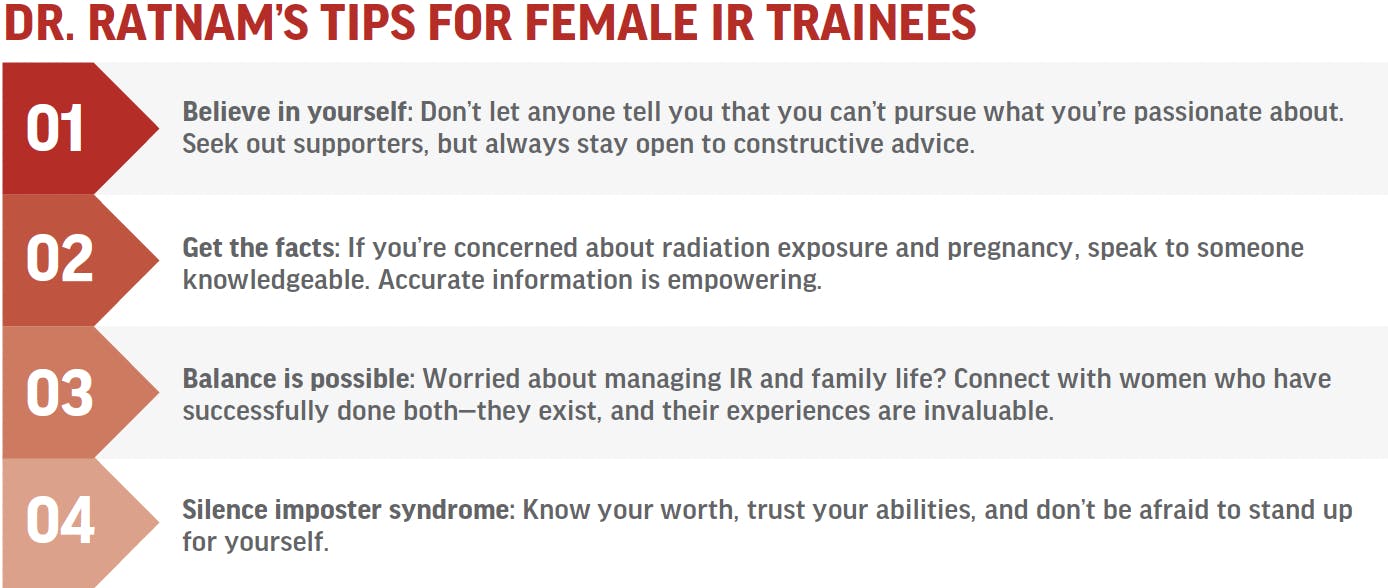
As someone passionate about education, training, and mentorship, what advice would you give regarding finding a strong mentor? What role did mentorship play early in your career?
I have been very fortunate to have had both male and female mentors who were instrumental in my career. I believe it’s important to seek out individuals you admire—those who inspire you through their values, leadership, or career paths. Engaging in conversations with such role models can be both motivating and insightful, offering a framework for shaping your own ambitions and professional journey.
Mentorship played a significant role early in my career. My mentors offered guidance and words of wisdom during moments of uncertainty and at key crossroads. There wasn’t a single defining moment; rather, it was the cumulative impact of support and thoughtful advice over many years—from individuals both within and outside the specialty—that made a lasting difference.
1. Osman A, Das R, Pinas A, et al. Outcome evaluation of prophylactic internal iliac balloon occlusion in the management of patients with placenta accreta spectrum. CVIR Endovasc. 2024;7:57. doi: 10.1186/s42155-024-00466-2
Advertisement
Advertisement
Interested in reading more interviews?
To read more interviews with thought leaders in the vascular field, check out our Profiles & Perspectives hub.
Read More