Advertisement
Advertisement
June 2025 Supplement
Sponsored by Rampart
Confidence in the Data
Redefining radiation safety in the cath lab.
As interventionalists, we constantly make high-stakes decisions about devices, access, strategy, etc., all in the name of improving patient outcomes. These decisions are guided by data, clinical evidence, and experience. Radiation protection should be no different. The same level of clinical scrutiny we apply to patient care must extend to how we protect ourselves and our teams. The future of radiation depends on evidence-based solutions. And as with anything else in our field, the data should lead.
THE DATA
The Rampart system (Rampart) distinguishes itself with rigorous clinical validation. Among six published studies to date, two stand out—“Radiation Exposure Using Rampart vs Standard Lead Aprons and Shields During Invasive Cardiovascular Procedures” and “Real-World Reductions in Lead-Free Radiation Exposure With the Rampart System During Endovascular Procedures.”1,2
The results are not just measurable but also clinically significant. Rampart consistently demonstrates substantial reductions in radiation exposure across both controlled trials and real-world procedures, without compromising workflow or access.
In the randomized controlled trial (RCT) conducted at Emory University School of Medicine, 100 consecutive cases were assigned to either standard lead aprons and shields or Rampart shielding without the use of lead aprons. Using real-time dosimetry across eight anatomical points, the results were striking:
- Rampart provided 99.7% radiation attenuation, resulting in 20 times more total body protection than traditional lead aprons and shields (Figure 1).1
- Fluoroscopy time and procedural access were unaffected, confirming the system’s practical compatibility with coronary and structural heart interventions.1
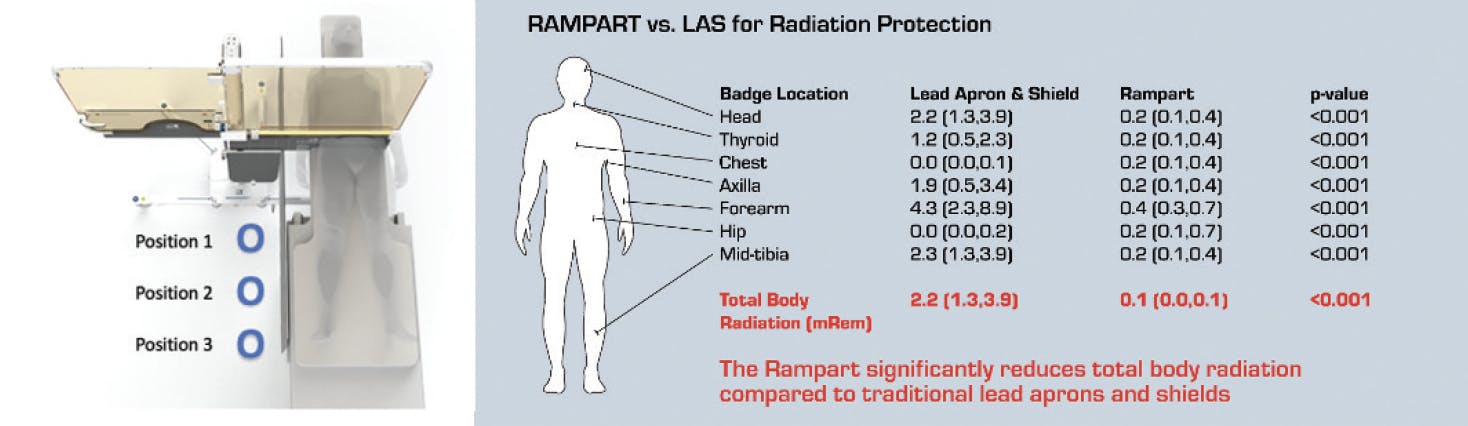
Figure 1. Rampart reduced total body radiation by > 99% compared to traditional lead aprons and shields. Adapted with permission from Lisko JC, Shekiladze N, Chamoun J, et al. Radiation exposure using Rampart vs standard lead aprons and shields during invasive cardiovascular procedures. J Soc Cardiovasc Angiogr Interv. 2023;3:101184.
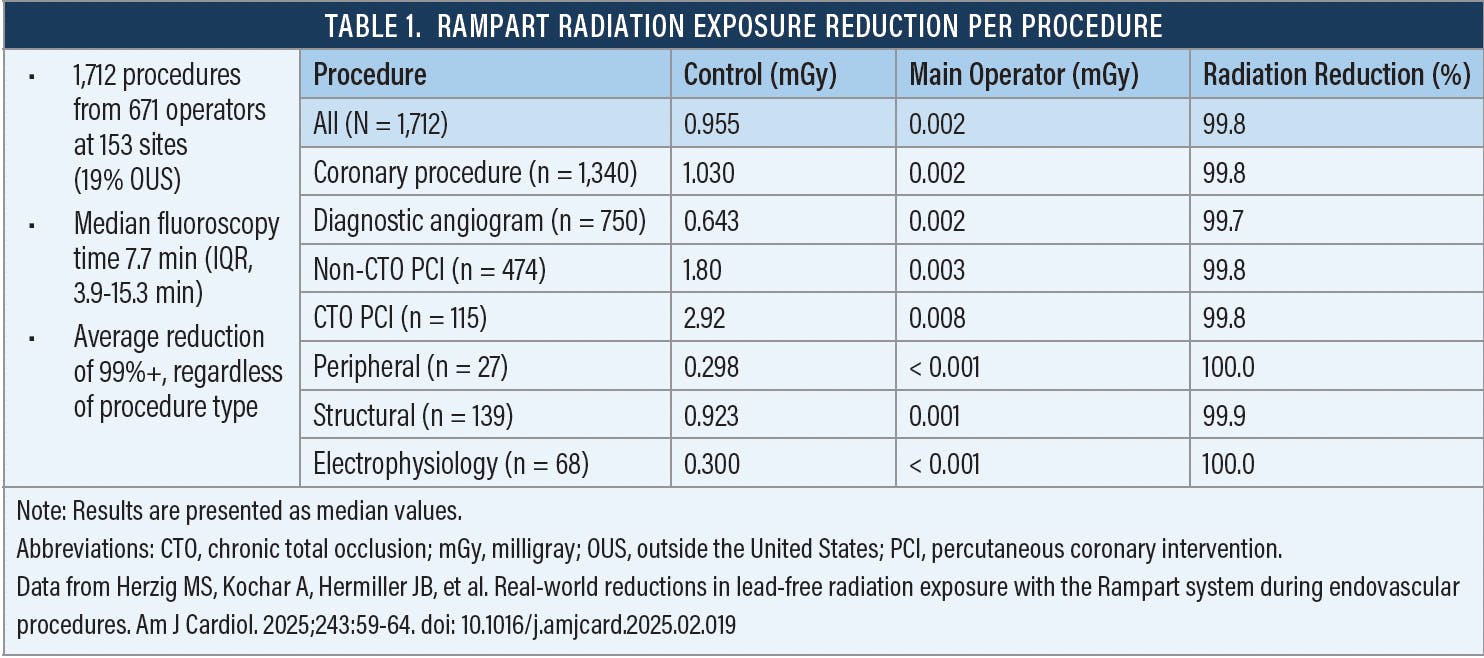
Yet RCTs are just one piece of the puzzle. In practice, variability prevails—case complexity, operator technique, and cath lab layout all impact radiation exposure to staff. That is why the “Real-World Reductions in Lead-Free Radiation Exposure With the Rampart System During Endovascular Procedures” study, recently published in American Journal of Cardiology and including > 1,700 procedures across 153 sites, is so important.2 It demonstrated consistent, lead apron–free radiation protection in coronary, structural, peripheral, and emergency cases. Median operator radiation was just 0.2 mRem, a level comparable to or lower than traditional underlead dosimetry but achieved without the physical burden of wearing lead aprons. This held true across access sites (radial, femoral, combined) and was remarkably stable even with complex chronic total occlusion cases (Table 1).2
Rampart’s strength lies in the balance between these two studies—one strictly controlled, the other completely practical. Regardless of case complexity, geography, or type of procedure, the outcomes are consistent: significant radiation reduction without the weight of lead aprons.
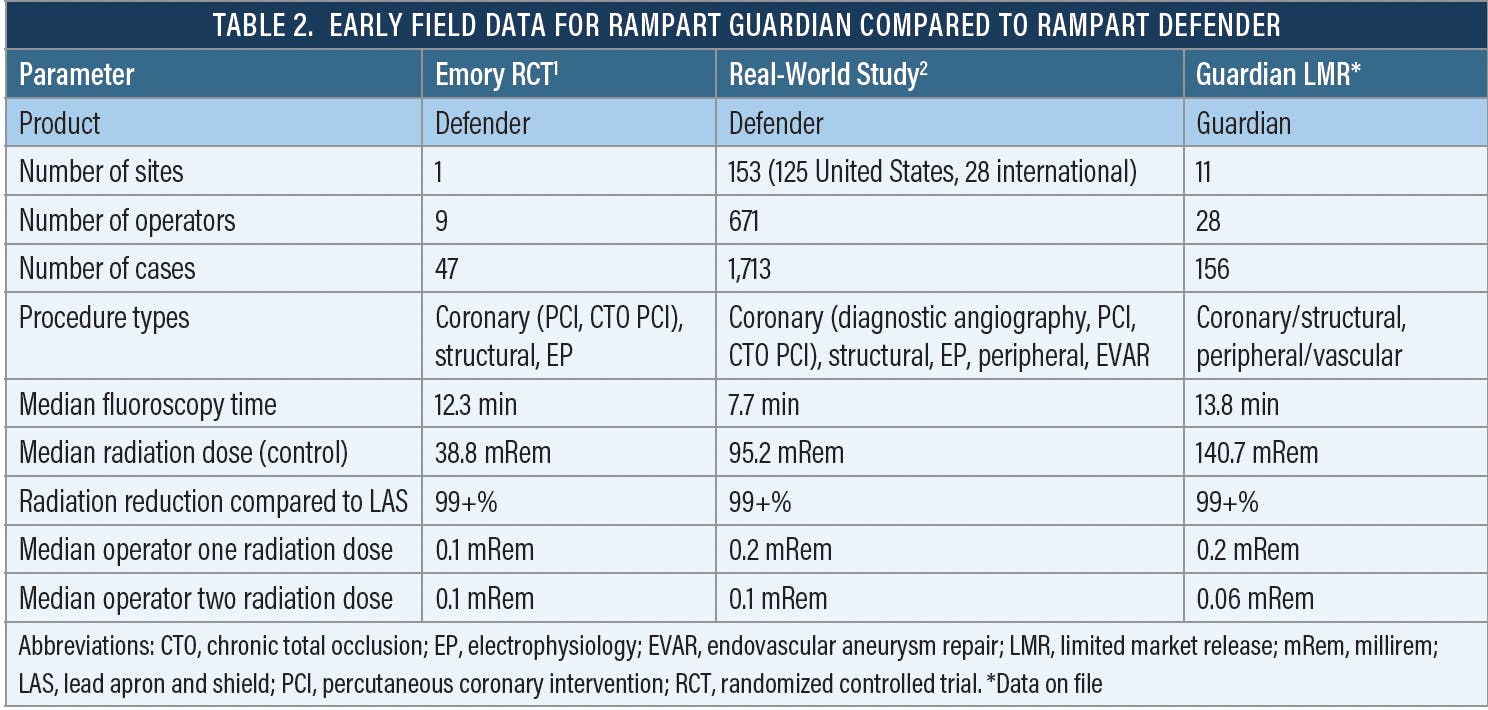
Although the published data have focused primarily on the Defender system (Rampart), early field data for Rampart’s Guardian system are equally promising. Across 11 sites, 28 operators, and 156 procedures, the median exposure for operator one was 0.2 mRem, while operator two’s exposure was 0.06 mRem. These cases spanned coronary, structural, and peripheral interventions, supporting the consistent performance of the Rampart platform across product lines (Table 2).1-3
Overall, the safety of operators and staff is a priority; it is a work hazard that has to be taken very seriously, and systems like Rampart address two main issues: radiation attenuation and alleviating the physical burden of lead.
SUMMARY
Radiation protection is no longer a guessing game. With Rampart, there are data to practice safely and the flexibility to practice freely. In an era when operator wellness, team safety, and procedural efficiency are under increasing pressure, Rampart delivers what few solutions can: evidence-based confidence to practice without lead aprons.
1. Lisko JC, Shekiladze N, Chamoun J, et al. Radiation exposure using Rampart vs standard lead aprons and shields during invasive cardiovascular procedures. J Soc Cardiovasc Angiogr Interv. 2023;3:101184. doi: 10.1016/j.jscai.2023.101184
2. Herzig MS, Kochar A, Hermiller JB, et al. Real-world reductions in lead-free radiation exposure with the Rampart system during endovascular procedures. Am J Cardiol. 2025;243:59-64. doi: 10.1016/j.amjcard.2025.02.019
3. Rampart data on file.

Advertisement
Advertisement