Advertisement
Advertisement
June 2025
An Interview With Eri Fukaya, MD, PhD, FSVM
Dr. Fukaya shares tips for a patient-centered venous disease practice, challenges facing the vascular medicine field, where progress is still needed in terms of awareness of vascular disease, the importance of exercise and compression therapy for swelling, and more.

In 2016, you started the Stanford Vascular and Vein Clinic. Can you tell us how this program came about?
During my interview with Dr. Ron Dalman, I shared my aspiration to become a venous specialist with a focus on outpatient-based vein care. He was incredibly supportive and encouraged me to pursue this vision shortly after I joined Stanford in the summer of 2015. At that time, all venous procedures were performed in the operating room, so creating an outpatient model required several months of careful planning and logistical coordination. In the spring of 2016, we successfully launched an outpatient vein clinic. Having just completed my training, the practical aspects of running a venous practice were entirely new to me, making the journey both a challenge and an exciting learning experience.
Now that you have almost a decade of running the clinic under your belt, what do you think is the cornerstone of a well-run, patient-centered venous disease practice?
At the heart of quality care is delivering the right treatment for each individual patient. This requires not only clinical skill but also a strong foundation of knowledge to discern when to treat—and, equally important, when not to treat. In venous care, patients are often at risk of being either overtreated or undertreated. Overtreatment occurs when interventions are guided solely by ultrasound or imaging findings that do not correlate with the patient’s symptoms. Conversely, undertreatment arises when underlying causes are missed or inadequately addressed. Although many patients do benefit from vein procedures, not all cases are straightforward, especially in the context of functional venous disease or recurrent/residual structural disease. A thoughtful, skilled vein specialist must be able to formulate a comprehensive and individualized treatment plan, whether procedural or conservative. The ability to offer patient-centered education and sound medical management, while ensuring that care is both effective and aligned with the patient’s needs, is a good venous practice in my mind.
From serving as Director of the Stanford Vascular Medicine Fellowship Program to numerous leadership roles with the Society for Vascular Medicine, you’ve demonstrated a commitment to advancing and supporting the vascular medicine field. What do you think are the biggest challenges facing the field right now, and how do you hope to see it grow in the next decade?
The growth and vitality of our field is directly tied to the number of well-trained, well-educated individuals committed to vascular medicine. As more passionate and enthusiastic minds engage with vascular disease, the entire ecosystem flourishes—energizing innovation, advancing knowledge, and pushing the boundaries of what is possible in patient care. Vascular medicine may be a small specialty in terms of numbers, but its impact is profound. Our field plays a crucial role not only in direct patient outcomes but also in driving medical innovation, both independently and in collaboration with other disciplines. Practitioners bring a unique expertise to the comprehensive evaluation and management of vascular disease, grounded in deep understanding and nuanced clinical skill. As medicine moves increasingly toward integrated, team-based care, vascular medicine is well-positioned to play a pivotal role. Collaboration is in our DNA. That’s why I am deeply committed to education, not only for trainees but for all who share in the vision of delivering outstanding vascular care.
One of our greatest challenges remains achieving broader recognition as a distinct and vital specialty. Yet, this only strengthens our resolve to advocate for the field and cultivate the next generation of leaders in vascular medicine.
One foundation of your work is the genetics and pathophysiology of chronic venous disease. Can you give us a snapshot of the nature of your work in this realm? What information are we currently lacking, and how might further research here impact patient care?
In the early stages of my work, I was admittedly naive in believing that the genetic underpinnings of chronic venous disease could be fully unraveled through genetic studies alone. As my understanding has deepened, I’ve come to recognize the intricate interplay between genetic predisposition and environmental influences in shaping this complex condition. It’s a humbling realization—to know that we are only beginning to uncover the surface of a much deeper landscape—but also an exhilarating one. To me, this process is akin to drawing a map. One can sketch a simple outline or delve into finer details, depending on the depth of inquiry. My curiosity lies in uncovering the underlying mechanisms of disease, not only to understand its progression but also to explore how we might delay or even redirect its course. The more precisely we can map the pathophysiology, the better equipped we will be to chart new directions in prevention and care.
You completed parts of your training in Japan and in recent years have partnered with Japanese institutions and the Japanese Society of Phlebology (JSP) on research projects. How did this collaboration come about?
The JSP is deeply committed to its mission, and the dedication of its leadership and members is truly inspiring. Their efforts are impressively thorough and multifaceted. Beyond their annual scientific meetings, they offer a robust compression therapy education program for health care providers, contribute support during natural disasters, translate international guidelines into Japanese, develop their own national practice standards, and conduct high-response surveys to assess evolving clinical patterns. I first began attending JSP meetings prior to the pandemic, and the experience has been consistently enriching. Each visit offers new insights, and over the years, I have become increasingly engaged in supporting their initiatives.
And, what unique needs have you noticed among the vascular disease population in Japan from this work?
There are elements of Japanese daily life that appear inherently beneficial to venous health, and one of the most fascinating aspects of having a multicultural view of medicine is observing how cultural norms can influence clinical presentation. For instance, the cultural custom of removing shoes indoors means that people often spend time barefoot, which promotes subtle but frequent movements of the toes and feet. This helps maintain activation of the intrinsic foot muscles, thereby supporting better function of the foot pump. Walking barefoot naturally engages more muscles than walking in shoes, encouraging better circulation. Additionally, the norm of floor-based living—sitting, kneeling, and transitioning from floor to standing—requires good ankle flexibility and strength. This routine, practiced from a young age, likely supports a healthier range of motion (ROM) and more effective use of the calf muscle pump. Another uniquely beneficial habit is the widespread cultural practice of daily bathing. In Japan, many people soak in a tub as part of their daily routine, which, along with regular showers, contributes to superior skin hygiene, particularly of the lower extremities. Together, these everyday habits may contribute to better leg and vein health, highlighting the subtle but significant ways lifestyle can shape clinical outcomes.
On the societal level, you’ve made efforts to increase awareness of and access to vascular disease. Where have we seen progress in terms of awareness, and where is progress most needed still?
As specialists, we are deeply committed to our work and the mission that drives it. Naturally, we believe that raising awareness about our field is crucial and should reach a broad audience. However, in today’s world—saturated with information and competing messages—it is difficult to capture the attention of the general public, especially when the condition in question is not directly affecting them. This is why our awareness campaigns must go beyond one-off efforts or symbolic gestures that simply make us feel we’ve done our part.
For awareness to be meaningful, it must drive real change. The most effective approach would be to embed systemic changes into health care delivery. Consider how cancer screenings are now an integral part of primary care, routinely recommended and performed. That level of integration is what makes a difference. For example, if our goal is to improve early detection of peripheral artery disease (PAD), then while patient and provider education are important, it is not enough. What we truly need is for the United States Preventive Services Task Force to formally recognize and recommend PAD screening as a necessary health measure. Achieving this level of systemic reform will require unified advocacy, strategic education, and coordinated efforts across multiple societies. Only through such collaboration can we align our voices and push for lasting, impactful change.
On the topics of venous leg ulcers (VLUs) and venous insufficiency, you and your colleagues have authored comprehensive overviews of the disease in The New England Journal of Medicine and Vascular Medicine.1,2 How did the authors approach covering this topic for potentially distinct audiences, one directed more broadly at various medical specialties and the other at vascular and wound care specialists? How do the educational and/or clinical needs differ among the two audiences?
Venous and lymphatic diseases receive surprisingly little emphasis in medical education and training, despite being among the most common conditions encountered in clinical practice. Recognizing the broad readership of The New England Journal of Medicine, we saw a valuable opportunity to offer insights into these often-overlooked conditions, especially for readers who may not regularly consider venous disease in their practice.
There is much that nonvascular specialists can do for patients with venous and lymphatic disorders, provided they have a foundational understanding of the disease and a structured approach to management. Equally important is knowing when to refer these patients to a vascular expert. This ties into the broader issue of venous patients being both overtreated and undertreated, a pattern we hope our article can begin to shift by fostering greater awareness and clinical clarity.
The diagnosis of VLUs is broad and often oversimplified, leading to a tendency to lump a wide range of conditions under the same label. It’s akin to referring to all canines as simply “dogs”—a term that includes animals of vastly different sizes, breeds, and temperaments. And, just as we must distinguish between dogs and similar species such as wolves, coyotes, or foxes, so too must we refine our diagnostic precision when it comes to VLUs. Our article in Vascular Medicine was written with experienced vascular providers in mind, aiming to deepen the dialogue around these distinctions and elevate the standard of care for patients with chronic wounds.
You stress the importance of implementing exercise and compression pumps for swelling reduction in venous disease and VLUs. What are some of your specific recommendations here for your patients, and what impacts have you seen on patients who follow these regimens?
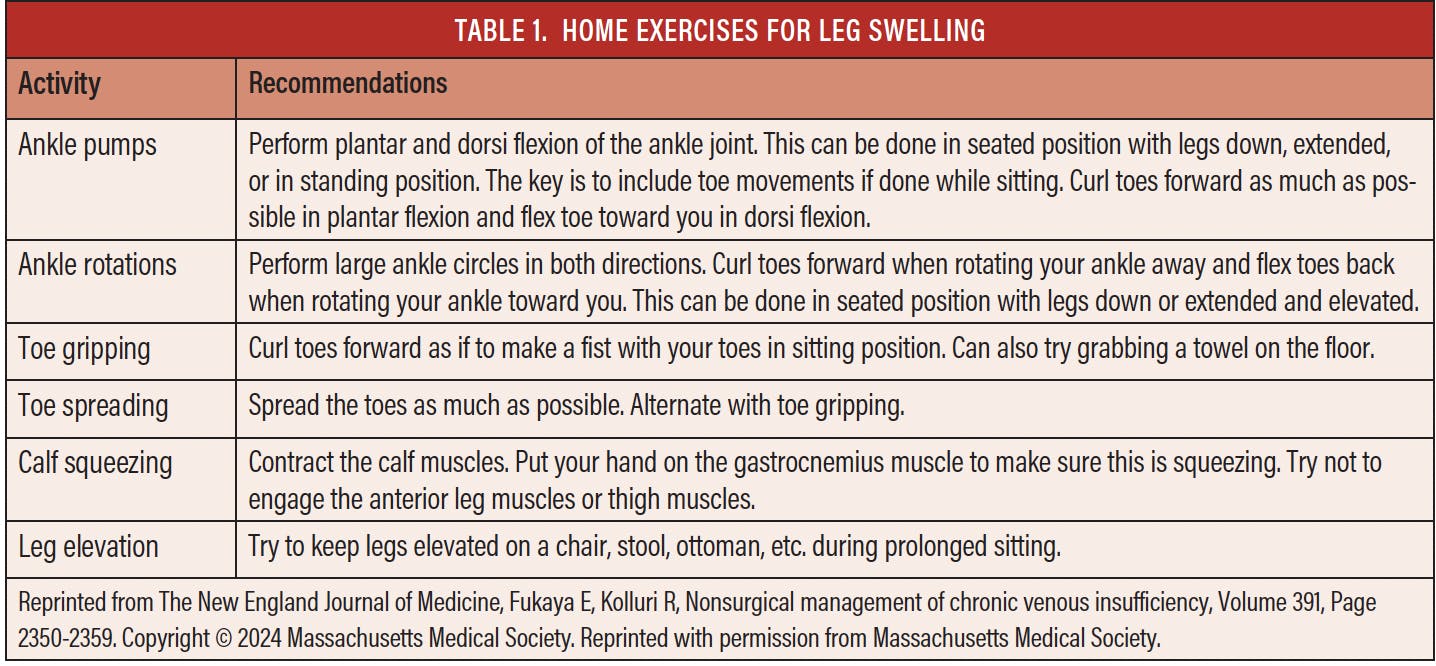
Swelling can be significantly reduced through a combination of exercise and appropriate compression therapy (Table 1). The key is to tailor compression strategies to something the patient can realistically implement and maintain. It doesn’t have to be perfect; something is always better than nothing. Our goal is to offer patients a range of options and work with them to identify a solution that fits naturally into their daily routines. I cannot overstate the value of therapeutic leg exercises. Enhancing the ROM of the ankles and feet activates the foot and calf muscle pumps, which is highly effective in reducing edema. We provide patients with instructional exercise videos and resistance bands to support their efforts. Those who consistently follow these recommendations often experience meaningful symptom improvement. What’s particularly surprising is that this issue isn’t limited to older adults with weakened muscle pump function. We frequently observe suboptimal calf pump activity even in younger individuals, who often need to retrain their bodies to properly engage these muscles. Reeducating patients on the use of their calf muscles is an essential part of improving lower limb circulation and managing swelling effectively.
What is one piece of advice all venous clinicians-in-training should hear?
Do not treat the imaging in isolation. A skilled diagnostician prioritizes the patient’s history, symptoms, and physical examination findings. Imaging should serve as a complementary tool that is used to support, not define, clinical judgment. The most effective treatment plans are those that integrate all aspects of the patient’s presentation in thoughtful correlation with imaging results.
1. Fukaya E, Kolluri R. Nonsurgical Management of Chronic Venous Insufficiency. N Engl J Med. 2024;391:2350-2359. doi: 10.1056/NEJMcp2310224
2. Kolluri R, Fukaya E, Krishna S, Dean S. Venous leg ulcers: a review of clinical variability and differential diagnosis. Vasc Med. Published online March 13, 2025. doi: 10.1177/1358863X251319243.
Advertisement
Advertisement
Interested in reading more interviews?
To read more interviews with thought leaders in the vascular field, check out our Profiles & Perspectives hub.
Read More