Advertisement
Advertisement
June 2025
Sponsored by Imperative Care, Inc.
Embracing New Technologies and Techniques for Mechanical Thrombectomy
My journey from training during the endovascular technology boom to using the Zoom™ Stroke System.

TRAINING IN ENDOVASCULAR SURGERY DURING THE MECHANICAL THROMBECTOMY (MT) INNOVATION BOOM
I was fortunate to have completed my neurosurgery residency and endovascular fellowship at the University at Buffalo. In addition to learning many new skills at a comprehensive, high-volume center, I started at Buffalo on the heels of the SWIFT PRIME and DAWN clinical trials, which meant that my mentors were some of the pioneers in MT. As a fellow, I was in the middle of the debates around the types of tools—stent retrievers versus balloon guide catheters, small- versus large-bore catheters—and witnessed an explosion of new endovascular technologies.
I was immersed in this endovascular ecosystem established by the late Dr. Nick Hopkins that was a hotbed of ideas for neurovascular surgery and treating stroke. One of the most valuable lessons I took from my time in Buffalo was the importance of leaning into possibility when exploring new technologies and techniques. As neuroendovascular specialists, our ultimate goal is to achieve the best possible outcomes for our patients—and that often means pushing beyond the familiarity of what we learned during fellowship. Progress in our field has always been driven by those willing to thoughtfully evaluate and cautiously adopt innovative approaches, even when they initially seem uncertain.
I started my practice in 2018 in Oklahoma. At that point, my understanding of MT tools was based on these stiff, cumbersome types of guide catheters. Unfortunately, the technology at the time had a strong tendency for dissecting vessels if you tried to take them too distal too quickly—making procedures longer with unfavorable patient outcomes. Early in my practice at OU Health, I had the opportunity to utilize different technologies, including balloon guide catheters, stent retrievers, and aspiration catheters. When discussing tool selection with my colleagues who had experience with the Zoom™ Stroke System (Imperative Care, Inc.), they talked about all the benefits of the technology—enhanced tracking, a variety of sizes to fit patient anatomy, secure clot engagement, and strong aspiration (Figure 1)—which initially sounded too good to be true. When I joined as a participating surgeon during the Imperative Trial, I had my initial doubts and thought that these benefits were just marketing talking points, but once the system was in my hands, it was clear how user-friendly the Zoom Stroke System was. I was able to quickly park my catheter intracranially and aspirate clots even in distal M2 occlusions. My first pass aspiration rate improved, and cases were more efficient.
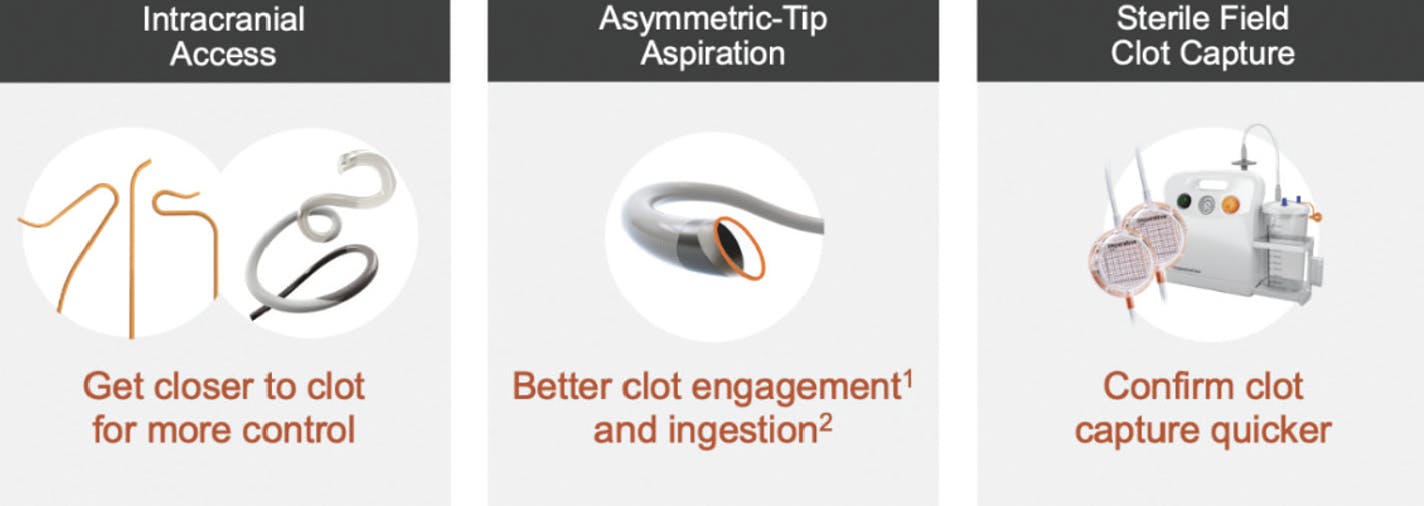
Figure 1. The Zoom Stroke System. Imperative Care provides a complete solution for performing MT. Starting with its unique asymmetric tip, Zoom System catheters allow for enhanced navigation of the brain’s tortuous vasculature and are designed for better clot engagement and ingestion.1,2 The Zoom 6 F insert catheters are designed to provide more torque, support, and reach to allow for faster intracranial access. Zoom System catheters are available in a variety of diameters (0.035-0.088 inches) and lengths to match patients’ specific anatomy. The Zoom System is the first FDA 510(k)-cleared system for clot aspiration throughout its whole portfolio of catheter sizes. Zoom POD provides sterile field clot capture for immediate visual confirmation of emboli retrieval. Zoom DuoPort is designed for CDAT when used with the Zoom System and Zoom aspiration pump. The Zoom System allows clinicians to achieve better reperfusion in patients with faster reperfusion times.4
THE IMPERATIVE CLINICAL TRIAL RESULTS: My EXPERIENCE
In assessing different technologies available in the operating room (OR), it is important to assess both the technical features of the devices as well as clinical evidence proving safety and efficacy for our patients. The Imperative Trial reinforced what I saw in the OR with its multicenter safety and efficacy data, and my belief that the Zoom Stroke System was a game changer for my practice. The study results showed that the system resulted in faster procedures with low rates of complications.3,4,6
Of the data released in the trial, the reperfusion time stood out to me the most (Figure 2). The median time between groin puncture to mTICI (modified treatment in cerebral infarction) 2b+ reperfusion using the Zoom System was only 19 minutes.3 Although clinical trials cannot be directly compared, it is interesting to observe that the time to reperfusion in the Imperative Trial was 15 minutes faster than a meta-analysis of 510(k) data from other major MT trials (19 vs 34.5 minutes).5 As the mantra in the stroke field goes, time is brain.
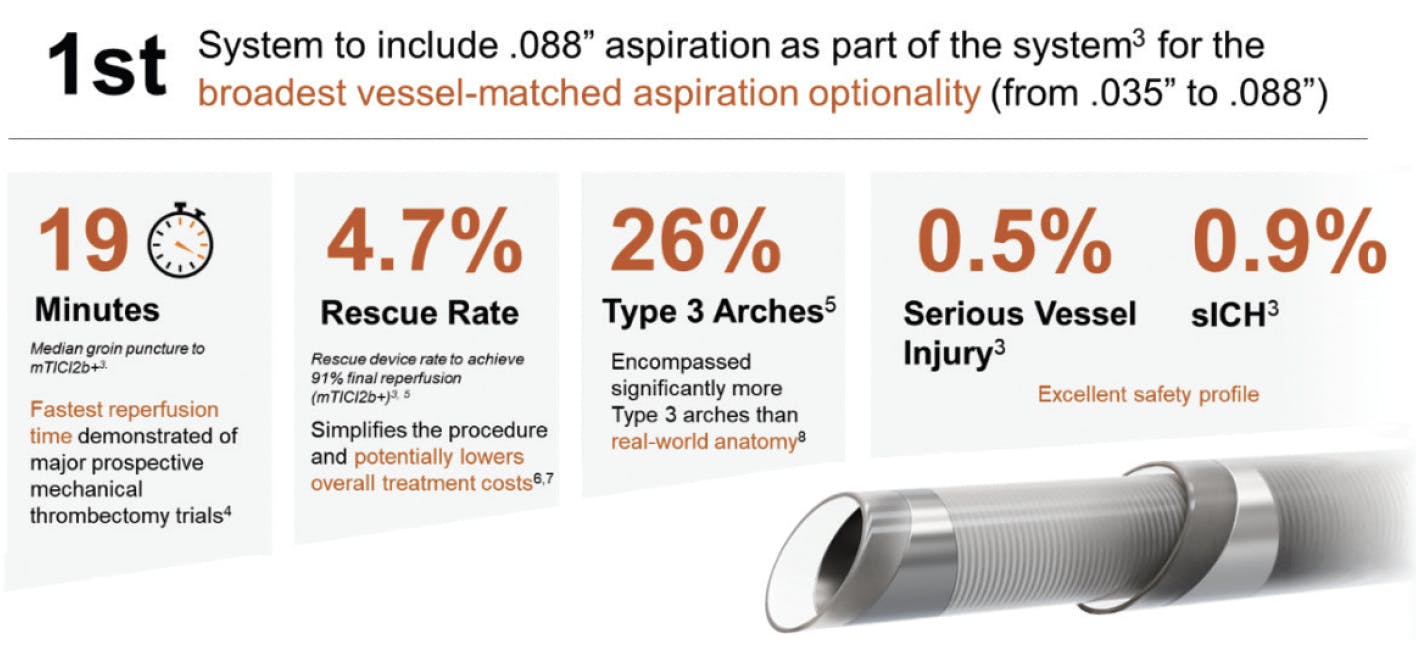
Figure 2. The Imperative Trial demonstrated fast reperfusion times with an exceptional safety profile. This prospective, multicenter clinical trial evaluated the clinical benefits of the Zoom System in patients treated across 26 United States institutions. The analyzed cohort included 211 patients who were treated with concomitant aspiration thrombectomy and showed the fastest time to reperfusion4 and lowest rescue device rate of major prospective MT trials.9
The Imperative Trial also underscored the system’s excellent safety profile. Fewer than 1 in 20 procedures in the study resulted in the use of rescue devices with minimal rates of serious vessel injury (0.5%) and symptomatic intracranial hemorrhage (sICH; 0.9%).3 These data are plenty to dispel the notion that trying to position a large-bore catheter distally (like the Zoom 88) could lead to vascular injury. These results are even more impressive given the anatomy encountered in the trial; 26% of the patients in the study had type 3 arches versus an estimated 15% occurrence in the broader patient population.8
CONTINUOUS DUAL ASPIRATION Technique (CDAT): THE NEXT PHASE OF TECHNOLOGY IMPROVEMENT
Given how well the Zoom 88 catheter navigated intracranially, it was intuitive to leverage it for aspiration. When aspirating from both the Zoom 88 catheter and another Zoom aspiration catheter, it seemed likely this approach would provide more secure clot handling. From my perspective, it was exciting to have the option of using the CDAT technique (Figure 3). Early in my adoption of the Zoom Stroke System, I leveraged a second vacuum pump to pull aspiration from both catheters to free my hands up. During the trial, I noticed that the Zoom POD captured clot debris from the Zoom 88 in about half of my cases, which could have contributed to follow-up procedures for my patients. Without a second active aspiration source, I would have had to fumble with large Luer lock syringes and vacuum pressure would have been quickly lost when withdrawing the smaller catheter (Figure 3B). This drop in vacuum pressure could have resulted in loss of emboli and subsequent complications. Although the second aspiration pump ensured that the larger-bore catheter is always under vacuum, it added a level of complexity to my OR setup.
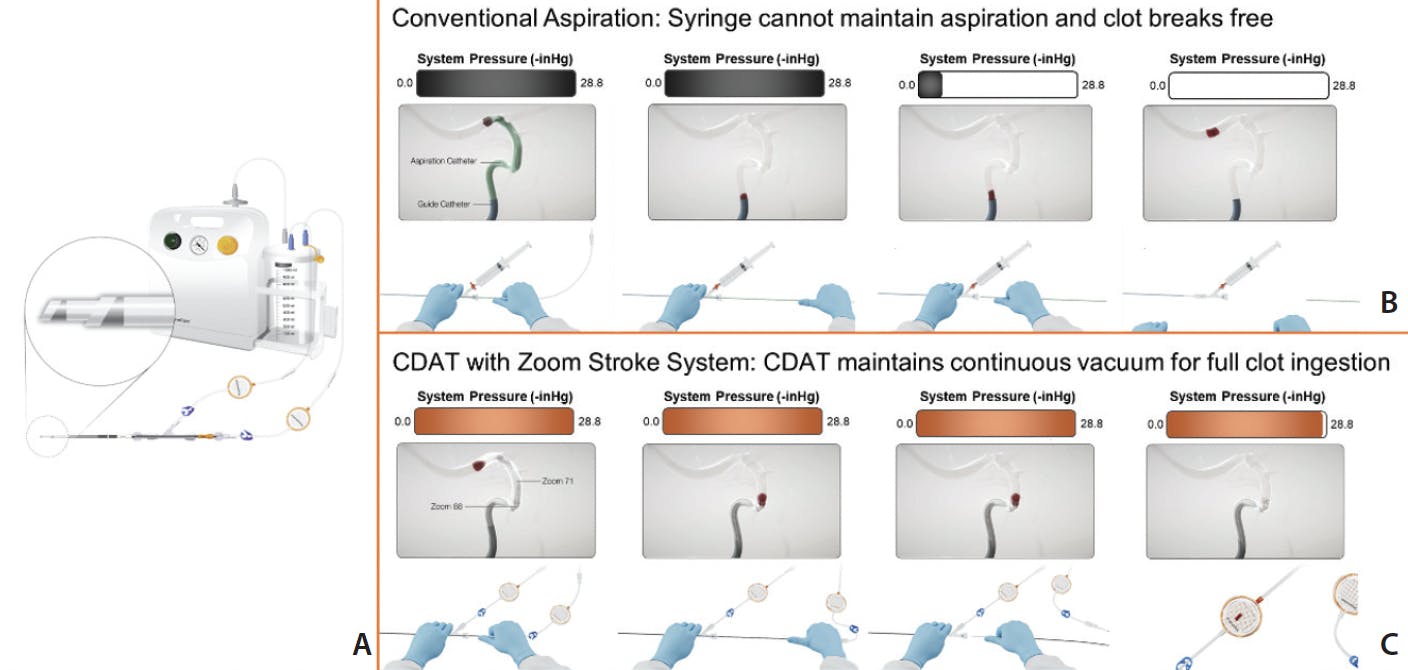
Figure 3. CDAT provides consistent and reliable aspiration for complete clot ingestion (A). Conventional aspiration techniques rely on using a large-volume syringe to maintain vacuum. Withdrawing the aspiration catheter can lead to a rapid (< 0.5 seconds) loss of vacuum and potential loss of the clot.1 Zoom DuoPort allows for the connection of two lines for continuous aspiration. When the aspiration catheter is removed, the system maintains vacuum to allow for full clot ingestion (B, C).
Imperative Care refined my setup by adding a second aspiration port to their Zoom DuoPort, replacing the second pump. The second port allows you to add an additional line set and Zoom POD, thereby having continuous aspiration from both catheters on a single vacuum source, giving me the ability to deploy CDAT quickly and simply.
Some of the testing conducted by Imperative Care1 demonstrated that consistent vacuum is held within the canister, even when using a variety of different catheter sizes. More importantly, only minor changes in vacuum pressure are observed when withdrawing the smaller catheter during a procedure (Figure 3C). As a result, I can maintain a reliable hold on clots and achieve complete ingestion to quickly restore blood flow to the patient’s brain.
CASE STUDY: CDAT POWERED BY ZOOM DUOPORT
Endovascular specialists come from various disciplines and geographic locations, and, of course, each clinician has their own set of habits and preferences. A recent case allowed me to demonstrate the benefits of CDAT and the Zoom Stroke System to a colleague (Figure 4). A patient in their mid-50s was admitted with an internal carotid artery (ICA) terminus occlusion (Figure 4B). Given the location of the occlusion, my partner and I concluded that we were likely dealing with a large clot. My partner made the case to use a stent retriever to make sure we got a good first pass effect. However, I suggested using the Zoom 71 and Zoom 88 catheters with CDAT, to which my colleague agreed.
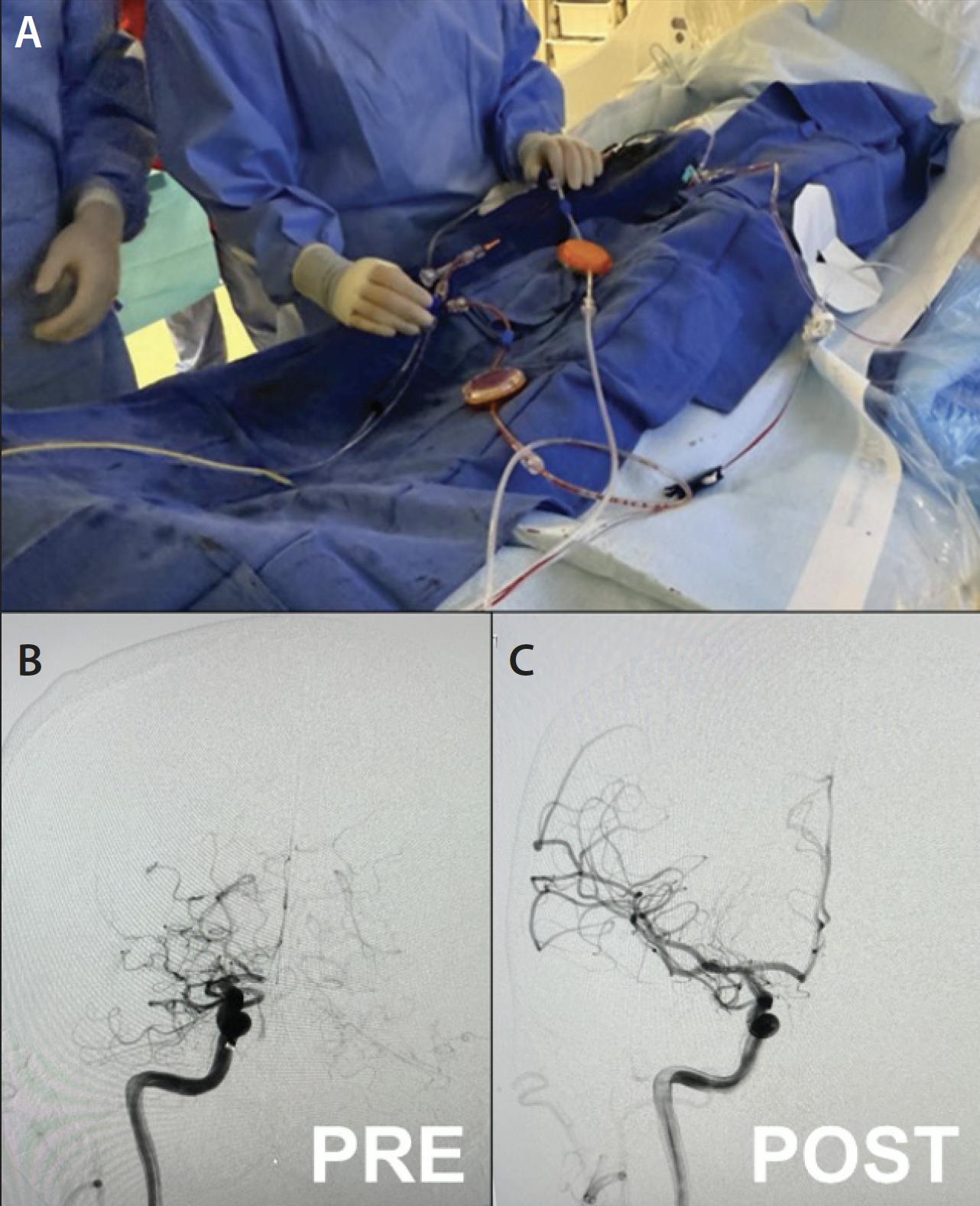
Figure 4. CDAT in action. Two Zoom POD aspiration tubing sets provide vacuum from Zoom 88 and Zoom 71 catheters during a MT procedure (A). Preaspiration angiogram of the right ICA shows little flow (B). Postaspiration imaging demonstrates revascularization in a procedure that lasted 10 minutes from puncture to TICI 3 (C).
In the OR, we achieved access through the femoral artery and navigated the Zoom 71 catheter to the clot face in 3 minutes. The Zoom 88 catheter was fed into the genu, and aspiration was applied to both catheters over the course of 3 to 4 minutes. Clot was captured by the Zoom 88 catheter, and a final run was completed at the 10 minute mark, confirming that we achieved TICI 3 reperfusion (Figure 4C). Additionally, a follow-up MRI showed no diffusion-weighted imaging lesions. This case was a textbook success—no bailout procedure, no vessel injury, and no distal emboli resulting from the procedure, likely due to CDAT, all in a short time frame with good patient recovery. My partner was impressed with the efficacy of the system, the setup of CDAT, and the potential benefits of CDAT at large.
THE FUTURE OF TREATING STROKE
Working with the Zoom Stroke System has given me the tools to achieve complete clot ingestion quickly and consistently. With the Zoom catheters, I can navigate to the occlusion quickly, and with CDAT technology and asymmetric aspiration, I have confidence that I can clear the whole clot in the first pass with minimal risk of vessel injury and complications.
1. Data on file at Imperative Care.
2. Vargas J, Blalock J, Venkatraman A, et al. Efficacy of beveled tip aspiration catheter in mechanical thrombectomy for acute ischemic stroke. J Neurointerv Surg. 2021;13:823-826. doi: 10.1136/neurintsurg-2020-016695
3. Zoom System [instructions for use]. Campbell (CA); Imperative Care, Inc. Accessed May 23, 2025. https://imperativecare.com/wp-content/uploads/2025/03/M002904-02.A-Zoom-Stroke-System-WIPCA.pdf
4. Data from major MT trials with reperfusion times reported: ARISE II, TIGER, PROST, PENUMBRA 3D, ASTER, COMPASS, DEFUSE 3, DAWN.
5. Mokin M. Presented at SVIN 2024; November 20-22, 2024; San Diego, California.
6. Milburn J. Presented at the Society of NeuroInterventional Surgery’s (SNIS) 19th annual meeting; July 25-29, 2022; Toronto, Canada.
7. Ezzeldin M, Ota R, Riha E, et al. Use of angled-tip aspiration catheters is associated with a lower cost of thrombectomy in patients with acute ischemic stroke secondary to large and medium vessel occlusions. Interv Neuroradiol. Published online October 10, 2023. doi: 10.1177/15910199231198914
8. Mokin M, Waqas M, Chin F, et al. Semi-automated measurement of vascular tortuosity and its implications for mechanical thrombectomy performance. Neuroradiology. 2021;63:381-389. doi: 10.1007/s00234-020-02525-6
9. Data from major MT trials with rescue rates reported: ASTER, COMPASS, ARISE II, TIGER, PROST.
Note: Individual trials are not directly comparable and data is presented for observational purposes only.
Rx only.
The Zoom System consists of the following devices: (71, 55, 45, 35) Catheters, Zoom 88 Large Distal Platform (Zoom 88), Zoom 88 Large Distal Platform Support (Zoom 88 Support), TracStar LDP Large Distal Platform (TracStar LDP), Zoom Aspiration Tubing when used with the Zoom Aspiration Pump (or equivalent vacuum pump), Zoom Aspiration Tubing and Zoom POD Aspiration Tubing, and Zoom Aspiration Pump. The Zoom System, when used with the Zoom Aspiration Pump (or equivalent vacuum pump), is indicated for use in the revascularization of patients with acute ischemic stroke secondary to intracranial large vessel occlusive disease (within the internal carotid, middle cerebral – M1 and M2 segments, basilar, and vertebral arteries) within 8 hours of last known well. Patients who are ineligible for intravenous thrombolytic drug therapy or who have not responded to thrombolytic drug therapy are candidates for treatment. Patients who are ineligible for intravenous thrombolytic drug therapy or who have not responded to thrombolytic drug therapy are candidates for treatment.
The Zoom 88, Zoom 88 Support, Zoom RDL Radial Access System (Zoom RDL) are indicated for the introduction of interventional devices into the peripheral, coronary, and neuro vasculature.
The Zoom 6F Insert Catheters are indicated for use in delivering radiopaque media to selected sites in the peripheral vascular system in conjunction with routine diagnostic procedures.
The Zoom Aspiration Pump is intended for general suction use in hospitals and clinics.
The Zoom Aspiration Tubing and the Zoom POD Aspiration Tubing are intended to connect to the Zoom (71, 55, 45, 35) Catheter, Zoom 88, Zoom 88 Support, TracStar LDP to the Zoom Canister of the Zoom Aspiration Pump (or equivalent vacuum pump) and to allow the user to control the fluid flow.
The Zoom Canister and Zoom DuoPort Canister are intended to collect aspirated fluids for disposal and prevent fluid ingress from damaging the Zoom Aspiration Pump.
There are no known contraindications.
The Zoom (71, 55, 45, 35) Catheters, Zoom 88, Zoom 88 Support, TracStar LDP should only be used by physicians who have received appropriate training in interventional techniques and treatment of acute ischemic stroke. The Zoom 88, Zoom 88 Support, TracStar LDP and Zoom RDL should only be used by physicians who have received appropriate training in interventional techniques and are proficient in using guide sheaths and catheters.
The Zoom 6F Insert Catheters should only be used by physicians who have received appropriate training in angiographic techniques device manipulation and observation under fluoroscopy, and are proficient in using introducer sheaths and guide catheters.
The pump should only be used by healthcare professionals. Only physicians familiar with standard interventional techniques for aspiration catheters and aspiration pumps should use the Zoom Aspiration Tubing.
For complete product information, including indications, contraindications, warnings, precautions and adverse events, see product IFU included in product packaging, contact Customer Service at +1-408-502-7548, CustomerService@ImperativeCare.com or visit bit.ly/3yWkfEJ.
Dr. Shakir is a paid consultant for Imperative Care.
M002946.B
Advertisement
Advertisement