Advertisement
Advertisement
June 2025
Middle Meningeal Artery Embolization in the Treatment of Chronic Headaches
Exploring middle meningeal artery embolization as a promising experimental therapy for chronic headaches, emphasizing the need for further clinical trials to validate efficacy, optimize patient selection and the technical approach, and ensure safety.
By Christopher H. Sollenberger, MS; Kyle Scott, MD; Aaron Anandarajah; Redi Rahmani, MD; Eric A. Kaiser, MD; Visish M. Srinivasan, MD; Jan Karl Burkhardt, MD, MBA; Seniha Ozudogru, MD; Bryan Pukenas, MD; and Joshua Catapano, MD
Chronic headaches, particularly migraine and tension-type headache (TTH), are among the most widespread and disabling neurologic disorders worldwide, affecting nearly half of the global adult population.1 Migraine alone has an age-standardized prevalence of roughly 15% globally, while TTH is more common at about 42%.1 These conditions impose a tremendous personal and societal burden. Migraine ranks as the second-leading cause of years lived with disability worldwide.2 Although typically less severe per episode, TTH accounts for roughly one-third of all headache-related disability.3 Patients often experience recurrent attacks that impair quality of life and productivity, often requiring them to miss work, school, or social activities.4
From an economic standpoint, the burden is equally striking. In the United States, migraine alone represents an annual economic burden of $78 billion,5 and the mean medical costs for a patient with migraine is nearly 1.7 times that of a patient without migraine.6 TTHs, being more common, also generate substantial cumulative costs due to their sheer prevalence, often due to lost productivity from missed workdays and reduced work efficiency.7
The physical, personal, and economic burden of headaches demand treatments beyond conventional pharmacotherapy. Many patients with migraines discontinue standard pharmacotherapy due to inadequate prophylactic efficacy or intolerable side effects,8 and in one study, up to 36% of patients were prescribed opioids, all underscoring an urgent need for more effective options.9
One such emerging intervention is middle meningeal artery embolization (MMAE), which is being explored for its potential to alleviate chronic migraine and TTH.
MMAE OVERVIEW
MMAE is a minimally invasive endovascular procedure that involves occlusion of the MMA.10 In an MMAE procedure, a microcatheter is navigated into the distal internal maxillary artery and selectively into the MMA, where an embolic agent is then delivered to permanently occlude the MMA, thereby cutting off blood flow to its distal branches in the dura.11,12 Embolic materials can include liquid embolics such as N-butyl cyanoacrylate glue or Onyx (Medtronic), particulate agents such as polyvinyl alcohol particles or microspheres, or coils.13-16 Each option has technical pros and cons regarding penetration of distal branches and risk of reflux.
The importance of the MMA in neurovascular disease is well recognized. Conditions as diverse as chronic subdural hematoma, intracranial tumors, and certain vascular malformations involve the MMA, either as part of their pathology or as a pathway for treatment.17,18 In this context, MMAE has emerged over the past several years as a safe and effective therapy for chronic subdural hemorrhage (cSDH), transforming the management of this common neurosurgical condition.19 EMBOLISE, a recent randomized trial, demonstrated that adding MMAE to standard surgical treatment of cSDH reduced recurrence or progression requiring reoperation to 4.1%, compared to 11.3% with surgery alone.20 Equally important, MMAE appears to carry a favorable safety profile, with low reported complication rates on the order of 1% to 2% in pooled analyses.21 This is a substantial improvement over the complication rates typically seen in surgical treatment of cSDH, such as burr-hole drainage, which can range from 5% to 25%.22,23 Moreover, serious adverse events such as stroke, cranial nerve palsy, or cortical embolization are rare in MMAE (1%-4%) when the procedure is performed with proper technique and attention to collateral anatomy.21
These findings have rapidly positioned MMAE as a standard adjunct or alternative in management of cSDH, and its growing adoption has enhanced surgeon familiarity and bolstered confidence in its safety. Its widespread use has also sparked interest in repurposing the technique for treating other conditions, such as headache.
THEORETICAL MECHANISM OF MMAE FOR CHRONIC MIGRAINE AND TTH
The rationale for employing MMAE to treat chronic headaches stems from the critical role of the dura mater and its vessels in headache pathophysiology. Migraine is a neurovascular pain syndrome involving the trigeminovascular pathway.24-27 Trigeminal nerve fibers, particularly the ophthalmic division, innervate the dura and meningeal blood vessels, including branches of the MMA.10 Although current research suggests that meningeal vasodilation is a secondary phenomenon rather than the primary cause of migraine pain, it still plays a significant role in sustaining the headache phase.28 The resulting vascular pulsations and neurogenic inflammation contribute to prolonged pain sensitization.10 Trigeminal activation leads to the release of potent vasodilatory neuropeptides, such as calcitonin gene-related peptide and pituitary adenylate cyclase-activating polypeptide, which promote sustained dilation of meningeal arteries and further exacerbate nociceptive signaling.29,30 By reducing blood flow and dampening vascular-mediated activation of dural nociceptors, MMAE offers a potential therapeutic strategy for migraine relief.
High-resolution imaging studies have reinforced the role of the MMA in migraine. Using 3T MRA during a migraine attack, researchers observed that at headache onset, only the MMA on the side of the headache showed a significant increase in circumference, whereas other intra- or extracranial arteries did not exhibit side-specific dilation.31,32 This selective unilateral dilation of the MMA during migraine raises the question that meningeal vasodilation and dural afferent activation may contribute to migraine pain.
Given this paradigm, occlusion of the MMA via embolization could theoretically interrupt the migraine pathway at its source and reset the neurovascular cascade (Figure 1). By embolizing the MMA, the primary conduit of blood and inflammatory mediators to the dura mater can be effectively eliminated, neurogenic inflammation can be reduced, and continuous sensory input from dural nociceptors might be blunted.33
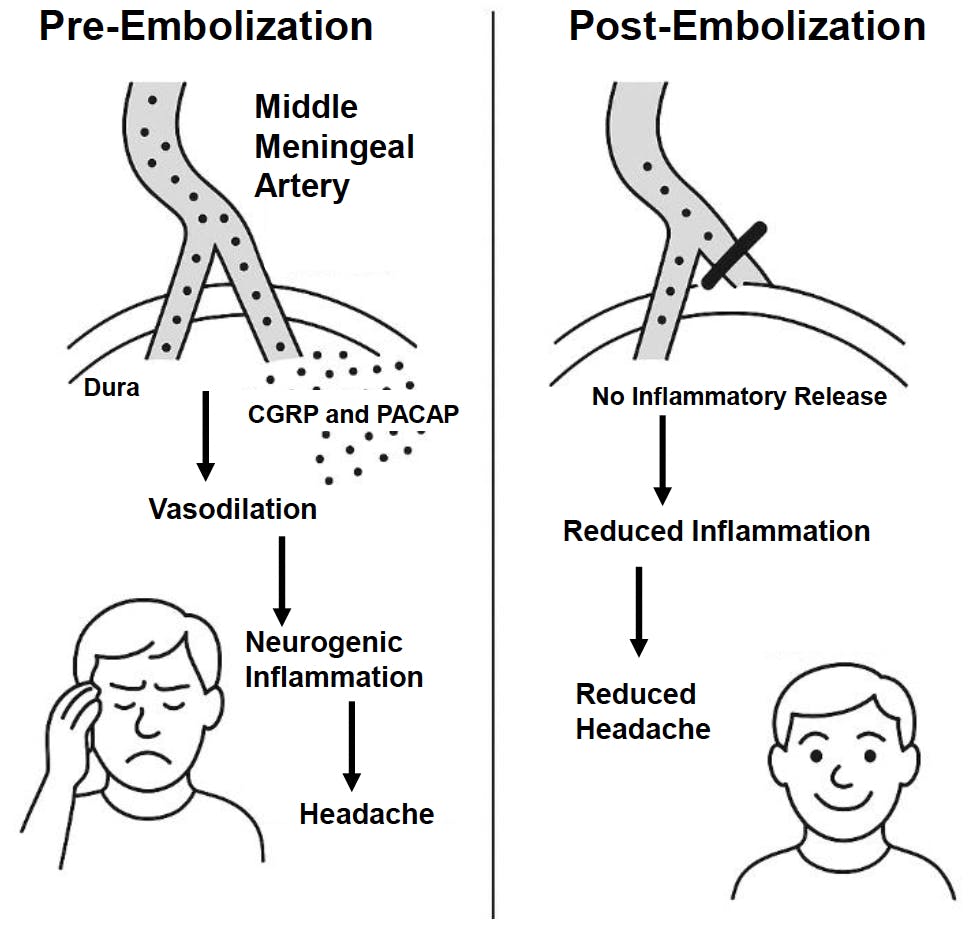
Figure 1. Schematic illustrating the proposed mechanism of headache relief after MMAE.
Although much of the mechanistic focus has been on migraine, these dural pathways may also be relevant in other chronic headaches. Although TTHs are typically attributed to pericranial muscle tension and central sensitization, chronic TTH shows evidence of trigeminal pathway sensitization similar to migraine.34,35 Repeated muscle tension can lower the pain threshold in central neurons that also receive dural afferent input, suggesting that the dura might serve as an accessory pain generator via convergent pathways in the trigeminocervical complex.36 Thus, eliminating pulsatile dural input through MMAE might raise the threshold for headache generation and relieve the persistent irritation contributing to pain maintenance.
EXISTING STUDIES ON MMAE FOR CHRONIC HEADACHE
Because the idea of treating chronic primary headaches with MMAE is novel, clinical evidence is limited but beginning to accumulate (Table 1).37-40 The first hints came serendipitously from a study of patients undergoing MMAE for cSDH with preexisting chronic headaches, where a striking improvement was found in long-standing headaches after MMAE.37 In this retrospective study, 46 patients who underwent MMAE for cSDH were surveyed; of these, nine patients had a history of chronic headaches. After MMAE, with a mean follow-up of 489 ± 173 days, eight of the nine (89%) patients reported significant improvement in headache frequency and intensity, and seven reported complete resolution of their chronic headaches, as corroborated by quantitative headache scores.37 This study suggests that MMAE can durably ameliorate chronic headache symptoms, at least in a subset of patients.
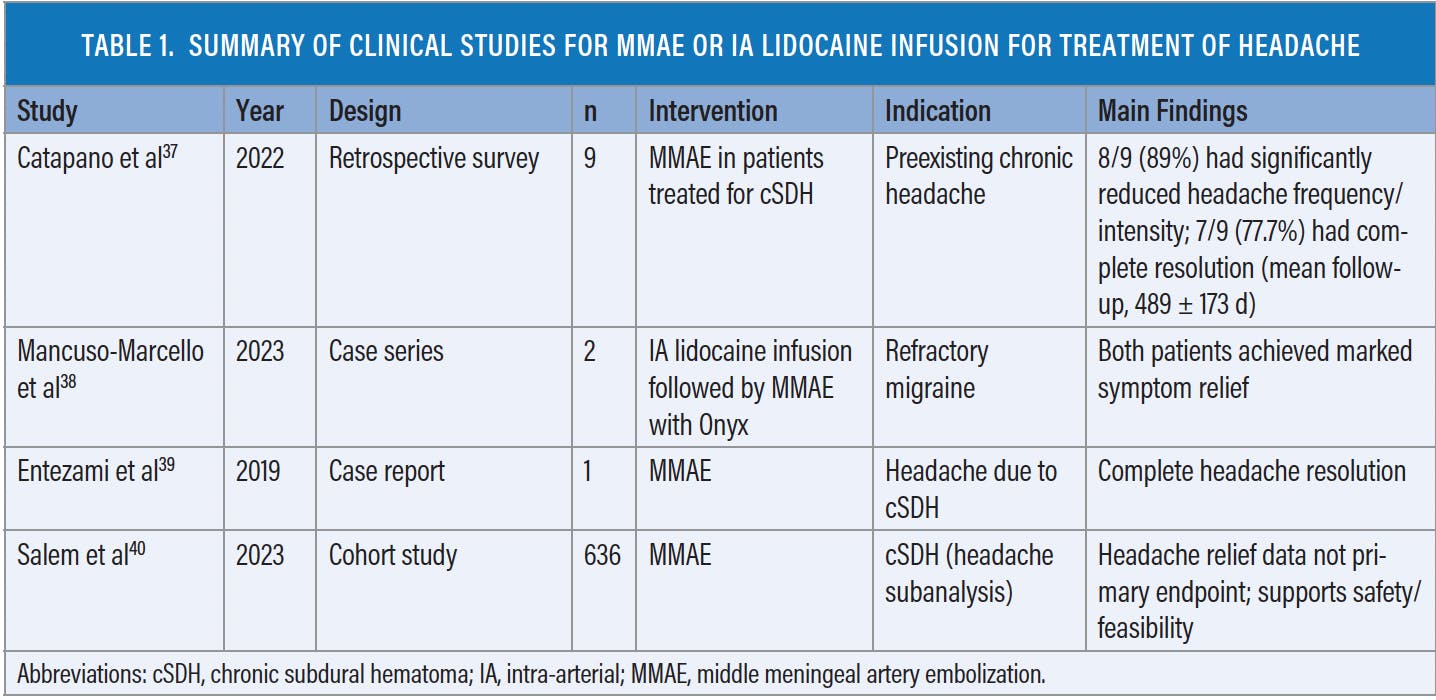
Beyond incidental findings, there have been initial pilot interventions specifically targeting MMAE for primary headache. At least two cases have been presented in which patients with severe, refractory migraine underwent intra-arterial lidocaine infusion into the MMA, followed by definitive MMAE with Onyx if the lidocaine produced improvement.38 This advanced two-step approach led to relief of migraine symptoms in both cases, demonstrating feasibility of the procedure in patients with chronic headache as well as potential efficacy.38 Additional case reports and small series have highlighted the potential of MMAE in alleviating other types of chronic head pain beyond migraine,39,40 suggesting that the therapeutic mechanism—namely, disruption of dural nociceptive input—may have broader applicability.
To date, no large-scale randomized controlled trial has published results on MMAE for primary headaches, but ongoing research is actively evaluating this intervention.
It is worth noting that all existing studies and reports on this topic, while encouraging, also emphasize the limitations and open questions. Mainly, these studies are limited by small sample sizes, limited longitudinal follow-up, lack of headache etiology specification, and potential selection bias (as in some cases, patients were selected for MMAE due to cSDH, not purely for headache indications).37 Nonetheless, the consistency of headache improvement observed in disparate settings provides a proof of concept.
FUTURE DIRECTIONS
Although preliminary, the current evidence collectively indicates that MMAE can lead to meaningful reductions in headache frequency and severity in patients with chronic migraine or other head pain, especially when conventional treatments have failed. This sets the stage for more rigorous investigation to validate efficacy, optimize patient selection, and ensure safety in the headache population.
Prospective clinical trials are essential to establish efficacy and safety, and several studies are already underway. For example, a multicenter feasibility trial is enrolling patients with refractory chronic migraine to undergo bilateral MMAE using liquid embolics, with outcomes measured in migraine frequency and severity (NCT06735833). Additionally, our group is planning a preliminary prospective pilot study to systematically assess the sustained symptomatic relief in patients with intractable chronic migraine undergoing MMAE. This study aims to enroll patients who have failed multiple lines of pharmacotherapy for chronic headache disorders. Over a follow-up period of 6 to 12 months, we will evaluate changes in headache frequency and intensity, using validated tools (eg, Headache Impact Test-6 and visual analog scale) and overall quality of life.41,42 In addition, advanced imaging will be employed pre- and postintervention to correlate clinical improvement with changes in dural vessel caliber and collateral flow. Data from this pilot study will provide critical insight into the safety, feasibility, and potential efficacy of MMAE for chronic headache relief, thereby laying the groundwork for future larger-scale, randomized controlled trials. Future randomized trials will be critical to meet evidence-based standards.
Beyond these studies, future investigations should incorporate refined imaging metrics and quantitative analyses of dural vessel caliber to clarify the relationship between embolic agent performance and headache relief. Such studies could integrate advanced CTA analytics with machine learning algorithms to quantify collateral flow accurately and measure the degree of vessel narrowing.
It is also essential to examine technical factors, such as determining the optimal approach and comparing various embolic materials, to establish which combination offers the best balance of efficacy, safety, and minimal risk of collateral embolization. For instance, bilateral embolization might prove advantageous for patients with alternating or predominantly unilateral pain, but the ideal embolic agent has not been definitively determined.
Patient selection is equally critical. Identifying subgroups, such as those who have failed multiple medication regimens, exhibit imaging evidence of dural abnormalities, or respond favorably to a diagnostic MMA block, could help tailor therapy and avoid unnecessary procedures. Moreover, long-term follow-up is necessary to ascertain whether the benefits of MMAE are durable or if collateral vessel development eventually necessitates repeat treatments.
CONCLUSION
MMAE for chronic headaches remains a promising but experimental therapy. Ultimately, multidisciplinary collaboration and rigorously designed clinical trials are essential to fully integrate MMAE into standard care protocols for refractory chronic headaches, paving the way for personalized treatment approaches and improved patient outcomes.
1. Zhang YJ, Li XY, Guo ZL. Temporal trends of migraine and tension-type headache burden across the BRICS: implications from the Global Burden of Disease study 2019. Front Neurol. 2023;14:1307413. doi: 10.3389/fneur.2023.1307413
2. Li XY, Yang CH, Lv JJ, et al. Global, regional, and national epidemiology of migraine and tension-type headache in youths and young adults aged 15-39 years from 1990 to 2019: findings from the global burden of disease study 2019. J Headache Pain. 2023;24:126. doi: 10.1186/s10194-023-01659-1
3. Derry S, Wiffen PJ, Moore RA, Bendtsen L. Ibuprofen for acute treatment of episodic tension-type headache in adults. Cochrane Database Syst Rev. 2015;2015:CD011474. doi: 10.1002/14651858.CD011474.pub2
4. Malmberg-Ceder K, Soinila S, Korhonen PE, et al. Headache and quality of life in Finnish female municipal employees. Scand J Pain. 2022;22:457-463. doi: 10.1515/sjpain-2021-0109
5. Gooch CL, Pracht E, Borenstein AR. The burden of neurological disease in the United States: a summary report and call to action. Ann Neurol. 2017;81:479-484. doi: 10.1002/ana.24897
6. Polson M, Williams TD, Speicher LC, et al. Concomitant medical conditions and total cost of care in patients with migraine: a real-world claims analysis. Am J Manag Care. 2020;26(1 suppl):S3-S7. doi: 10.37765/ajmc.2020.42543
7. Yang Y, Cao Y. Rising trends in the burden of migraine and tension-type headache among adolescents and young adults globally, 1990 to 2019. J Headache Pain. 2023;24:94. doi: 10.1186/s10194-023-01634-w
8. Blumenfeld AM, Bloudek LM, Becker WJ, et al. Patterns of use and reasons for discontinuation of prophylactic medications for episodic migraine and chronic migraine: results from the second international burden of migraine study (IBMS-II). Headache. 2013;53:644-655. doi: 10.1111/head.12055
9. Lipton RB, Schwedt TJ, Friedman BW, et al. Demographics, headache characteristics, and other factors associated with opioid use in people with migraine: results from the CaMEO study (S59.006). Neurology. 2019;92(15 suppl):S59.006. doi: 10.1212/WNL.92.15_supplement.S59.006
10. Yu J, Guo Y, Xu B, Xu K. Clinical importance of the middle meningeal artery: a review of the literature. Int J Med Sci. 2016;13:790-799. doi: 10.7150/ijms.16489
11. Duangprasert G, Sukhor S, Noiphithak R, Tantongtip D. Comparison of adjunctive middle meningeal artery embolization using embosphere particles versus surgical drainage alone for the treatment of chronic subdural hematoma: a prospective study. J Clin Neurosci. 2024;128:110808. doi: 10.1016/j.jocn.2024.110808
12. Hoffman H, Sims JJ, Nickele C, et al. Middle meningeal artery embolization with standalone or adjunctive coiling for treatment of chronic subdural hematoma: systematic review and meta-analysis. Interv Neuroradiol. Published online December 12, 2024. doi: 10.1177/15910199241304852
13. Hill H, Chick JFB, Hage A, Srinivasa RN. N-butyl cyanoacrylate embolotherapy: techniques, complications, and management. Diagn Interv Radiol. 2018;24:98-103. doi: 10.5152/dir.2018.17432
14. Né R, Chevallier O, Falvo N, et al. Embolization with ethylene vinyl alcohol copolymer (Onyx®) for peripheral hemostatic and non-hemostatic applications: a feasibility and safety study. Quant Imaging Med Surg. 2018;8:280-290. doi: 10.21037/qims.2018.04.03
15. Rana MM, Melancon MP. Emerging polymer materials in trackable endovascular embolization and cell delivery: from hype to hope. Biomimetics (Basel). 2022;7:77. doi: 10.3390/biomimetics7020077
16. Ahn JB, Shin HS. Coil embolization for ruptured and unruptured very small intracranial aneurysms: a retrospective review of a 10-year single-center experience. Medicine (Baltimore). 2023;102:e34493. doi: 10.1097/md.0000000000034493
17. Shah A, Choudhri O, Jung H, Li G. Preoperative endovascular embolization of meningiomas: update on therapeutic options. Neurosurg Focus. 2015;38:E7. doi: 10.3171/2014.12.FOCUS14728
18. Griessenauer CJ, He L, Salem M, et al. Middle meningeal artery: gateway for effective transarterial Onyx embolization of dural arteriovenous fistulas. Clin Anat. 2016;29:718-728. doi: 10.1002/ca.22733
19. Mohamed S, Villabona A, Kennion O, et al. Middle meningeal artery embolisation for chronic subdural haematomas: the first prospective UK study. Br J Neurosurg. 2022;36:786-791. doi: 10.1080/02688697.2022.2097200
20. Davies JM, Knopman J, Mokin M, et al. Adjunctive middle meningeal artery embolization for subdural hematoma. N Engl J Med. 2024;391:1890-1900. doi: 10.1056/NEJMoa2313472
21. Ellens NR, Schartz D, Kohli G, et al. Safety and efficacy comparison of embolic agents for middle meningeal artery embolization for chronic subdural hematoma. J Cerebrovasc Endovasc Neurosurg. 2024;26:11-22. doi: 10.7461/jcen.2023.E2023.04.002
22. Watanabe S, Kato N, Sato M, et al. Treatment outcomes of burr-hole surgery for chronic subdural hematoma in the elderly living beyond life expectancy: a study comparing cure, recurrence, and complications in patients aged ≥80 years versus ≤79 years. World Neurosurg. 2019;132:e812-e819. doi: 10.1016/j.wneu.2019.08.003
23. Lee HS, Song SW, Chun YI, et al. Complications following burr hole craniostomy and closed-system drainage for subdural lesions. Korean J Neurotrauma. 2018;14:68-75. doi: 10.13004/kjnt.2018.14.2.68
24. Goadsby PJ, Holland PR, Martins-Oliveira M, et al. Pathophysiology of migraine: a disorder of sensory processing. Physiol Rev. 2017;97:553-622. doi: 10.1152/physrev.00034.2015
25. Edvinsson L, Haanes KA, Warfvinge K, Krause DN. CGRP as the target of new migraine therapies–successful translation from bench to clinic. Nat Rev Neurol. 2018;14:338-350. doi: 10.1038/s41582-018-0003-1
26. Hargreaves R. New migraine and pain research. Headache. 2007;47(suppl 1):S26-S43. doi: 10.1111/j.1526-4610.2006.00675.x
27. Schuster NM, Rapoport AM. Calcitonin gene-related peptide-targeted therapies for migraine and cluster headache: a review. Clin Neuropharmacol. 2017;40:169-174. doi: 10.1097/wnf.0000000000000227
28. Mason BN, Russo AF. Vascular contributions to migraine: time to revisit? Front Cell Neurosci. 2018;12:233. doi: 10.3389/fncel.2018.00233
29. Asghar MS, Hansen AE, Kapijimpanga T, et al. Dilation by CGRP of middle meningeal artery and reversal by sumatriptan in normal volunteers. Neurology. 2010;75:1520-1526. doi: 10.1212/WNL.0b013e3181f9626a
30. Guo S, Jansen-Olesen I, Olesen J, Christensen SL. Role of PACAP in migraine: an alternative to CGRP? Neurobiol Dis. 2023;176:105946. doi: 10.1016/j.nbd.2022.105946
31. Khan S, Amin FM, Christensen CE, et al. Meningeal contribution to migraine pain: a magnetic resonance angiography study. Brain. 2019;142:93-102. doi: 10.1093/brain/awy300
32. Asghar MS, Hansen AE, Amin FM, et al. Evidence for a vascular factor in migraine. Ann Neurol. 2011;69:635-645. doi: 10.1002/ana.22292
33. Mortezaei A, Essibayi MA, Osama M, et al. Middle meningeal artery embolization in migraine: from concept to reality. Interv Neuroradiol. Published online December 18, 2024. doi: 10.1177/15910199241305928
34. Bendtsen L, Jensen R. Tension-type headache. Neurol Clin. 2009;27:525-535. doi: 10.1016/j.ncl.2008.11.010
35. Steel SJ, Robertson CE, Whealy MA. Current understanding of the pathophysiology and approach to tension-type headache. Curr Neurol Neurosci Rep. 2021;21:56. doi: 10.1007/s11910-021-01138-7
36. Burstein R, Cutrer MF, Yarnitsky D. The development of cutaneous allodynia during a migraine attack clinical evidence for the sequential recruitment of spinal and supraspinal nociceptive neurons in migraine. Brain. 2000;123:1703-1709. doi: 10.1093/brain/123.8.1703
37. Catapano JS, Karahalios K, Srinivasan VM, et al. Chronic headaches and middle meningeal artery embolization. J Neurointerv Surg. 2022;14:301-303. doi: 10.1136/neurintsurg-2021-017602
38. Mancuso-Marcello M, Qureshi AI, Nikola C, et al. Intra-arterial lidocaine therapy via the middle meningeal artery for migraine headache: theory, current practice and future directions. Interv Neuroradiol. Published online August 13, 2023. doi: 10.1177/15910199231195470
39. Entezami P, Nourollahzadeh E, Dalfino J. Embolization of middle meningeal artery for the treatment of headaches induced by chronic subdural hematoma: a case report. Headache. 2019;59:615-618. doi: 10.1111/head.13519
40. Salem MM, Kuybu O, Nguyen Hoang A, et al. Middle meningeal artery embolization for chronic subdural hematoma: predictors of clinical and radiographic failure from 636 embolizations. Radiology. 2023;307:e222045. doi: 10.1148/radiol.222045
41. Kosinski M, Bayliss MS, Bjorner JB, et al. A six-item short-form survey for measuring headache impact: the HIT-6. Qual Life Res. 2003;12:963-974. doi: 10.1023/a:1026119331193
42. Price DD, McGrath PA, Rafii A, Buckingham B. The validation of visual analogue scales as ratio scale measures for chronic and experimental pain. Pain. 1983;17:45-56. doi: 10.1016/0304-3959(83)90126-4
Advertisement
Advertisement