Advertisement
Advertisement
June 2025
Neuroprotection: Where Do We Stand?
Advantages, disadvantages, what we can learn from the most common neuroprotection strategies, and future directions for the field.
Pathological thrombotic or embolic occlusion of an intracranial artery causing acute ischemic stroke (AIS) does not only lead to ischemic necrosis of brain tissue—the subsequent events also lead to inflammation and secondary effects that compound tissue damage and cell death. AIS affects > 12 million people annually worldwide and remains the leading cause of combined morbidity and mortality.1 Current therapies for AIS center around revascularization, either by fibrinolysis with alteplase or tenecteplase (both recombinant tissue plasminogen activators) or by endovascular thrombectomy (EVT). Despite these approved therapies, a majority of patients remain functionally disabled after experiencing an AIS.
NEUROPROTECTION STRATEGIES
The challenges with approval of previous cytoprotection strategies follow those faced with developing therapies in AIS. These include the following:
- Translating preclinical models: Rodents are the preferred small animal model for preclinical testing in AIS therapy. Many of these studies are done in young adult mice or rats rather than aged animals. Moreover, therapies administered in these preclinical models are done at a short interval, usually within 1 hour, between inducing the stroke and administering therapy.
- Target: Most neuroprotective agents inhibit a single inflammatory pathway. However, there are multiple signaling cascades in ischemic stroke, including excitotoxicity, oxidative stress, inflammation, and apoptosis. It may be that the ideal neuroprotective strategy involves tackling more than one of these signaling pathways.
- Sufficient drug delivery to the brain: The protective agents must cross the blood–brain barrier in sufficient concentration to inhibit their target. Blood–brain barrier permeability in AIS is variable, leading to challenges in finding the optimal dose.
- Clinical trial design and execution: Isolating a homogeneous population to test a neuroprotective strategy can be difficult. This includes patients who have received reperfusion therapy, either through fibrinolysis or EVT. It can be difficult to identify who will benefit from neuroprotection based on age, sex, and the typical comorbidities in patients who present with AIS.
A neuroprotectant may be broadly considered to target ischemia-related injury occurring before and after reperfusion. Although reperfusion is effective, it is clear that much of the morbidity and mortality from stroke still occurs despite, and perhaps because of, reperfusion. Diminished blood flow to an area of the brain first induces cellular excitotoxicity. This subsequently leads to oxidative stress, mitochondrial dysfunction, upregulation of inflammatory and immune markers, tissue necrosis, and blood–brain barrier dysregulation. These processes may be modified by reperfusion or may, in some cases, be worsened by reperfusion but continue for many hours or even days after ischemic onset.
Neuroprotection strategies depend upon the cellular or molecular target and the timing of their delivery in the context of ischemia duration and degree, as well as the timing and success of reperfusion therapy. Strategies have included direct current stimulation, low-frequency pulsed electromagnetic fields, hypothermia, calcium channel blockers, and numerous targeted drug therapies. Defining the optimal neuroprotection drug strategy involves the drug target, the appropriate population of patients presenting with AIS, the optimal dose, temporal administration from the onset of the stroke, and potential drug-drug interactions with standard-of-care AIS treatment. Currently, there are no FDA-approved neuroprotectants to treat patients presenting with AIS. In Asia, some putative neuroprotective agents are available and prescribed for stroke, including edaravone dexborneol and butyl phthalate. However, the existing randomized trial evidence for the efficacy of these agents is unconvincing.
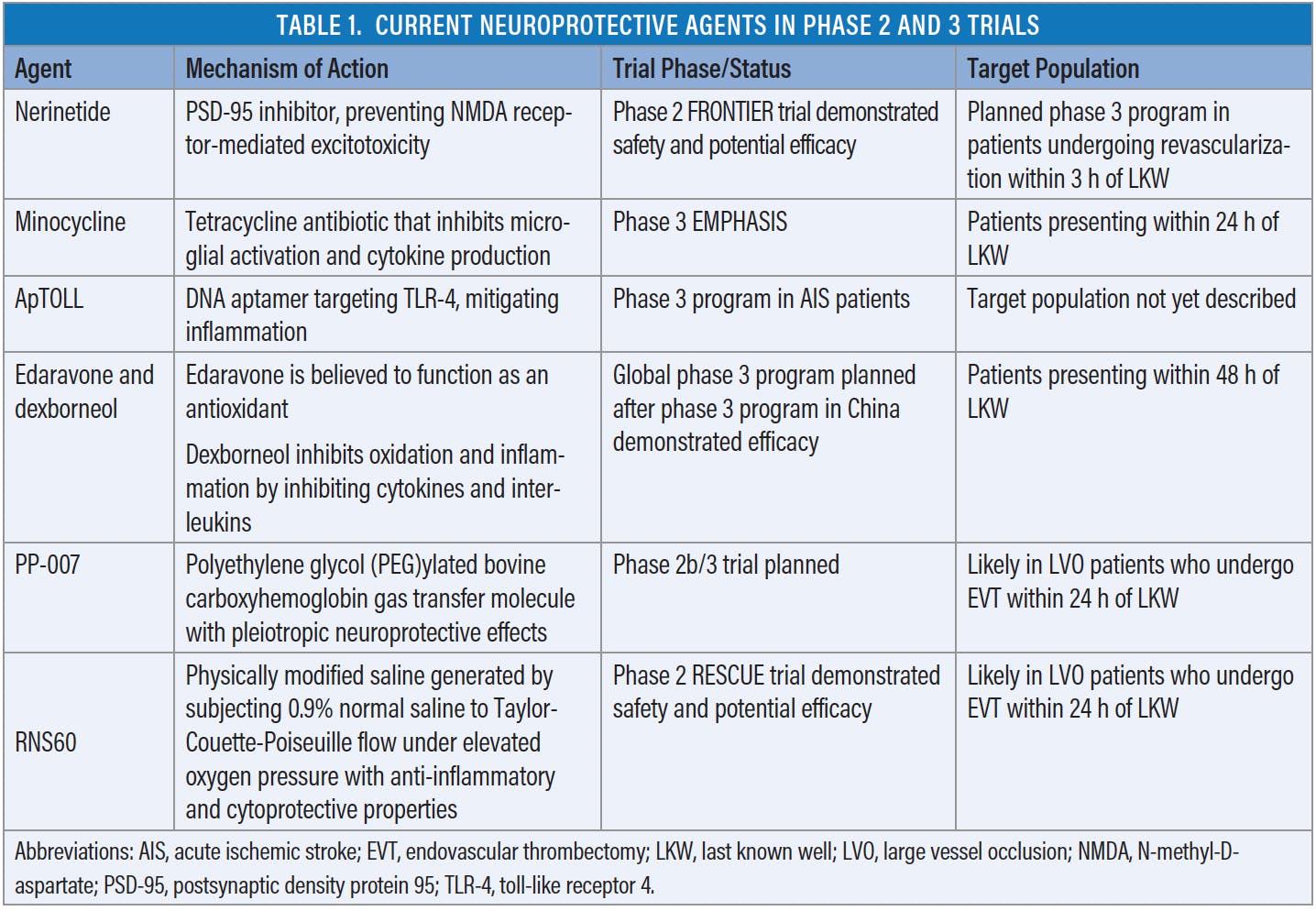
Over 1,000 agents have been through preclinical studies, and almost 200 clinical trials have focused on neuroprotective agents. Several exciting programs could offer improved outcomes in stroke in addition to fibrinolysis and EVT (Table 1).
Nerinetide
Nerinetide is a recombinant peptide that targets N-methyl-D-aspartate receptor postsynaptic density protein 95, disrupting their binding to one another and thereby inhibiting the endogenous and toxic nitric oxide production that occurs with calcium-mediated excitotoxicity. It has been a leading program in neuroprotection, and its development through clinical trials has paved the way for other programs to gain traction. The challenges of nerinetide have engendered thoughtful consideration of issues around administration, dose, and drug interactions. ESCAPE-NA1 yielded unexpected results of a negative drug interaction between nerinetide and alteplase, where fibrinolysis with intravenous (IV)alteplase resulted in inactivation of nerinetide, ultimately blunting its beneficial effect in the study population.2 The subsequent ESCAPE-NEXT trial, in which patients were randomized to placebo control or drug in the absence of IV thrombolysis (with alteplase or tenecteplase), yielded a neutral result overall but suggested benefit in patients who received the drug within 3 hours of symptoms onset.3 The FRONTIER trial studied nerinetide administration by paramedics in the field within 3 hours of symptom onset.4 Although it was a neutral trial overall, it was suggested that patients who received IV thrombolysis or EVT along with nerinetide had improved functional outcome at 90 days as compared with placebo. A recently published post hoc meta-analysis of patients from all three trials demonstrated that patients who were enrolled within 3 hours of AIS onset and received fibrinolysis, EVT, or both benefited from nerinetide as compared with placebo.5 A phase 3 program focused on this patient population will attempt to validate the post hoc analysis.
Minocycline
Minocycline is a tetracycline antibiotic currently approved to treat severe acne and leprosy. It is effective in the treatment of clinical isolated syndromes (multiple sclerosis) and known to inhibit matrix metalloproteinase-9 activity. Minocycline inhibits microglial activation, which in turn inhibits cytokine production. These anti-inflammatory effects are potentially beneficially in the first hours to days after stroke onset, targeting the postinjury inflammatory component of stroke progression. It is currently being tested in EMPHASIS, a phase 3 clinical trial in patients who present within 24 hours of stroke onset.
ApTOLL
ApTOLL is a single-stranded DNA aptamer targeting toll-like receptor 4 (TLR-4). TLR-4 activates the innate immune response and is responsible for initiating inflammation. Having completed phase 1 and phase 2 clinical trial programs, a phase 3 clinical trial is planned for testing in AIS patients.
Edaravone and Dexborneol
Edaravone is a small molecule that may act as a free radical scavenger; it is currently approved (but rarely used) for the treatment of patients with amyotrophic lateral sclerosis. It is entirely possible that the small clinical trial that served as the basis for approval was simply incorrect, because the small or nonexistent clinical effect size observed in real-world practice has substantially diminished enthusiasm for its use. Nevertheless, as noted previously, edaravone is used to treat stroke in Asia. Although its precise mechanism of action has not been described, it may function as an antioxidant.
Dexborneol is a naturally occurring bicyclic monoterpene agent that mitigates oxidation and inflammation and inhibits inflammatory cytokines and interleukins. It activates GABAA receptors, which block cyclic amplification of inflammation. Finally, dexborneol inhibits nuclear factor kappa B signaling and NOD receptor and pyrin domain containing protein 3 inflammasome complex, which is responsible for triggering both inflammation and programmed cell death or pyroptosis.
Edaravone and dexborneol have been tested together intravenously in a phase 3 program in China (TASTE) in patients up to 48 hours from stroke onset.6 More recently, a sublingual formulation of this combination therapy has been developed and granted breakthrough designation by the FDA, after a phase 3 program in China (TASTE-SL) demonstrated improvement in patients who received the drug up to 48 hours from stroke onset.7 The data from these trials are mixed and the proposed benefit is likely to be smaller than espoused.
PP-007
PP-007 is a polyethylene glycol (PEG)ylated bovine carboxyhemoglobin gas transfer molecule with pleiotropic neuroprotective effects. It increases blood flow in the pial collateral network of the brain, optimizes oxygen transport to ischemic tissue, and reduces inflammation by the carbon monoxide moiety, which inhibits cytokine production. Formerly known as SANGUINATE, PP-007 demonstrated safety in HEMERA-1 in AIS patients with large vessel occlusion who underwent EVT within 24 hours of last known well (LKW).8 Prolong Pharmaceuticals is currently planning a phase 2b/3 program, likely in a similar population as the phase 1 trial.
RNS60
RNS60 is a saline solution that has undergone physical modification generated by subjecting 0.9% normal saline to TCP (Taylor-Couette-Poiseuille) flow under elevated oxygen pressure. Although the exact mechanism has not been completely elucidated, it has demonstrated anti-inflammatory and cytoprotective properties. In the phase 2 randomized trial RESCUE, this oxygen-enriched drug was infused over 48 hours and compared to a placebo in patients who underwent EVT within 24 hours of LKW.9 Revalesio is developing RNS60, and a phase 3 program is currently in development.
WHERE WE ARE NOW AND FUTURE DIRECTIONS
After the approval of alteplase in 1995, there was a long drought for new treatments in AIS. The five randomized studies published in 2015 (MR CLEAN, ESCAPE, SWIFT PRIME, REVASCAT, and EXTEND-IA) demonstrated the benefit of EVT in patients who presented with large vessel occlusion stroke within 6 hours of LKW, ushering in a new era of stroke treatment, similar to percutaneous coronary intervention in the 1990s and 2000s. This also reignited enthusiasm for drug treatment for AIS, including neuroprotection, precisely because the EVT era has ushered in a human version of a true ischemia-reperfusion model. The vast majority of compounds that are effective in curing stroke in preclinical animal models are effective in one or more variants of the ischemia-reperfusion model.
We now have class I evidence to support EVT up to 24 hours from stroke onset in patients with large core infarcts and effectiveness in both the anterior and posterior circulation. Only in 2025, 10 years after the first successful trials of EVT, have we seen neutral results in the ESCAPE-MeVO and DISTAL trials, showing no benefit of EVT in patients who present with medium or distal vessel occlusions. This may provide the window for drug therapy to improve outcomes further. The drug target, timing, stroke subpopulation, and duration of treatment will all play a role in finding new therapies.
Multiple efforts are now underway to examine neuroprotective or adjuvant therapies for AIS. Learning from the experience with nerinetide and edaravone dexborneal, along with the further refinement of reperfusion treatments, it is clear that the near future will focus on the human ischemia-reperfusion model. Neuroprotection with agents such as nerinetide or physical agents such as oxygen using simple normobaric hyperoxia may be useful in buying time for transport until definitive reperfusion can be achieved. It is clear that such trials will be difficult to orchestrate, and the target population may be smaller than previously thought. Others will focus on the inflammatory cascade that occurs after some degree of ischemic injury has resulted in permanent tissue damage and therefore focus on prevention of secondary injury.
We look forward to the upcoming clinical programs in stroke and to the day when neuroprotectants can be among the FDA-approved therapies. Onward and forward.
1. Ghozy S, Reda A, Varney J, et al. Neuroprotection in acute ischemic stroke: a battle against the biology of nature. Front Neurol. 2022;13:870141. Published May 31, 2022. doi:10.3389/fneur.2022.870141
2. Hill MD, Goyal M, Menon BK, et al; ESCAPE-NA1 Investigators. Efficacy and safety of nerinetide for the treatment of acute ischaemic stroke (ESCAPE-NA1): a multicentre, double-blind, randomised controlled trial. Lancet. 2020;395:878-887. doi: 10.1016/S0140-6736(20)30258-0
3. Hill MD, Goyal M, Demchuk AM, et al; ESCAPE-NEXT investigators. Efficacy and safety of nerinetide in acute ischaemic stroke in patients undergoing endovascular thrombectomy without previous thrombolysis (ESCAPE-NEXT): a multicentre, double-blind, randomised controlled trial. Lancet. 2025;405:560-570. doi: 10.1016/S0140-6736(25)00194-1
4. Christenson J, Hill MD, Swartz RH, et al. Efficacy and safety of intravenous nerinetide initiated by paramedics in the field for acute cerebral ischaemia within 3 h of symptom onset (FRONTIER): a phase 2, multicentre, randomised, double-blind, placebo-controlled study. Lancet. 2025;405:571-582. doi: 10.1016/S0140-6736(25)00193-X
5. Tymianski M, Hill MD, Goyal M, et al; ESCAPE-NA1, ESCAPE-NEXT, and FRONTIER Investigators. Safety and efficacy of nerinetide in patients with acute ischaemic stroke enrolled in the early window: a post-hoc meta-analysis of individual patient data from three randomised trials. Lancet Neurol. 2025;24:208-217. doi: 10.1016/S1474-4422(24)00515-5
6. Xu J, Wang A, Meng X, et al; TASTE Trial Investigators. Edaravone dexborneol versus edaravone alone for the treatment of acute ischemic stroke: a phase iii, randomized, double-blind, comparative trial. Stroke. 2021;52:772-780. doi: 10.1161/STROKEAHA.120.031197
7. Fu Y, Wang A, Tang R, et al. Sublingual edaravone dexborneol for the treatment of acute ischemic stroke: the TASTE-SL randomized clinical trial. JAMA Neurol. 2024;81:319-326. doi: 10.1001/jamaneurol.2023.5716
8. Linfante I, Clark W, Haussen DC, et al. HEMERA 1 carboxyhemoglobin oxygen delivery for revascularization in acute stroke: a prospective, randomized phase 1 clinical trial. Stroke Vasc Interv Neurol. Published online April 23, 2024. https://doi.org/10.1161/SVIN.123.001246
9. Ghosh S, Dubow J, Sutherland J, et al. RESCUE: A randomized, blinded, placebo-controlled, parallel group study design to determine the safety of rns60 in large vessel occlusion stroke patients undergoing endovascular thrombectomy (P10-5.029). Neurology. Published online April 9, 2024. https://doi.org/10.1212/WNL.0000000000206509
Advertisement
Advertisement