Advertisement
Advertisement
June 2025
Recent Advances in Preclinical Testing of Novel Devices
A summary of preclinical evaluation methods for neuroendovascular devices, including in vitro techniques, 3D-printed vascular models, in silico simulations, and in vivo models.
Endovascular therapy has evolved with each new generation of novel devices. In the neuroendovascular field, physicians now have access to a wide array of devices, from detachable coils, flow diverters, intra-aneurysmal disruptors for aneurysms, stent retrievers and aspiration catheters for acute ischemic stroke, and liquid embolic materials for shunt diseases, each designed to address the brain’s complex vascular pathologies. Nevertheless, unmet challenges continue to spur the emergence of novel devices. Before any medical device can be used in humans, comprehensive preclinical studies are needed to evaluate its potential benefits and risks.
Preclinical testing encompasses a spectrum of methods for evaluating a device, including laboratory-based in vitro experiments, computational in silico simulations, tests with vascular replica models, and in vivo animal studies (Table 1). Each approach provides unique insights, from basic biocompatibility and mechanical function in controlled environments to complex performance in living circulatory systems. By combining data from all these approaches, a comprehensive safety and performance profile of endovascular devices can be established prior to clinical testing.
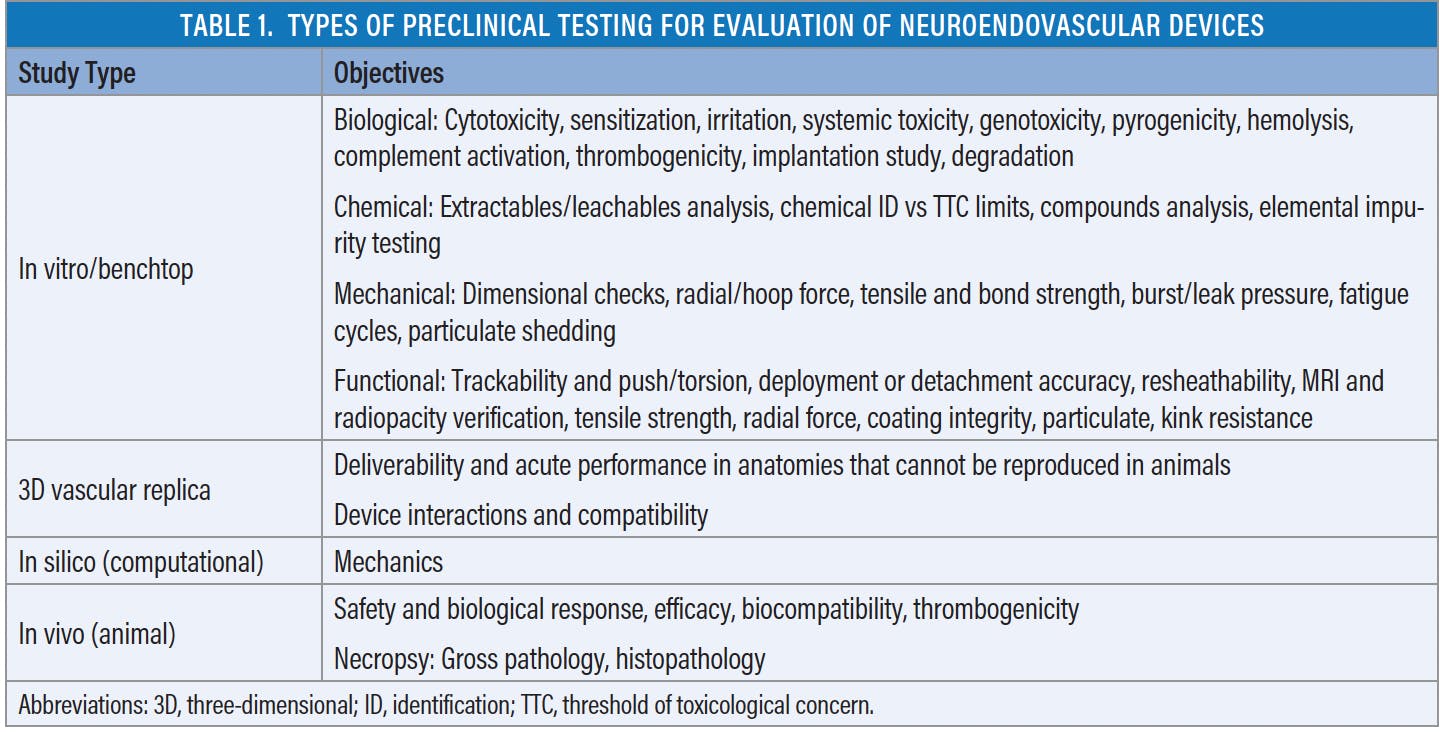
This article highlights recent advances in each preclinical testing modality, including in vitro techniques, three-dimensional (3D)–printed vascular models, and in silico simulations.1
IN VITRO AND BENCHTOP MODELS
In vitro and benchtop testing serve as the foundation of preclinical evaluation. These laboratory experiments, performed outside a living organism, are critical for examining a new device’s biocompatibility and basic functionality under controlled conditions.1 For example, material samples from devices can be immersed in cell culture to ensure they do not cause toxicity or inflammation to human cultured cells. Tests like these allow early detection of any cytotoxic or inflammatory reaction from device materials. Basic mechanical checks also fall under in vitro testing; a stent’s expansion force might be measured on the bench before any animal studies.
The FDA is promoting new in vitro platforms, called new approach methodologies (NAMs), to reduce traditional animal testing.2 One such advance is the organ-on-a-chip, a microfluidic device lined with living human cells that simulates aspects of an organ’s environment with microscale channels to culture human cells under flow, mimicking conditions in a real blood vessel or organ. The FDA has begun to accept organ chip data, signaling growing confidence in these approaches, especially for new drug evaluations.
The advantages of in vitro methods are control and specificity: Researchers can isolate certain variables and use human-derived cells or blood to get relevant results quickly. Tests are relatively low cost and avoid the ethical complexities of animal work. However, their limitation is the lack of full-body complexity. A culture dish or microchip cannot replicate the interplay of circulating immune cells, multiple organ systems, and long-term healing processes. Thus, while in vitro findings are invaluable for screening and guiding device refinement, they are typically followed by more complex evaluations as development progresses.
VASCULAR REPLICA MODELS
Vascular replica models are physical phantoms that reproduce human blood vessel anatomy. Thanks to the decreasing cost of 3D printers, they can be produced rapidly and at low expense (Figure 1).3 These models are typically made of silicone, closely simulating the diameter and tortuosity of human cerebral arteries. Flow conditions can be precisely controlled by circulating a blood-mimicking fluid adjusted to physiologic viscosity and osmolarity under regulated pressure, while high-speed imaging captures device behavior in detail. Because these phantoms can replicate the complex bends and branch points that animal models cannot, investigators can evaluate multiple devices under identical conditions. The lower cost relative to large animal studies has made vascular replicas an indispensable first step in preclinical performance evaluation.
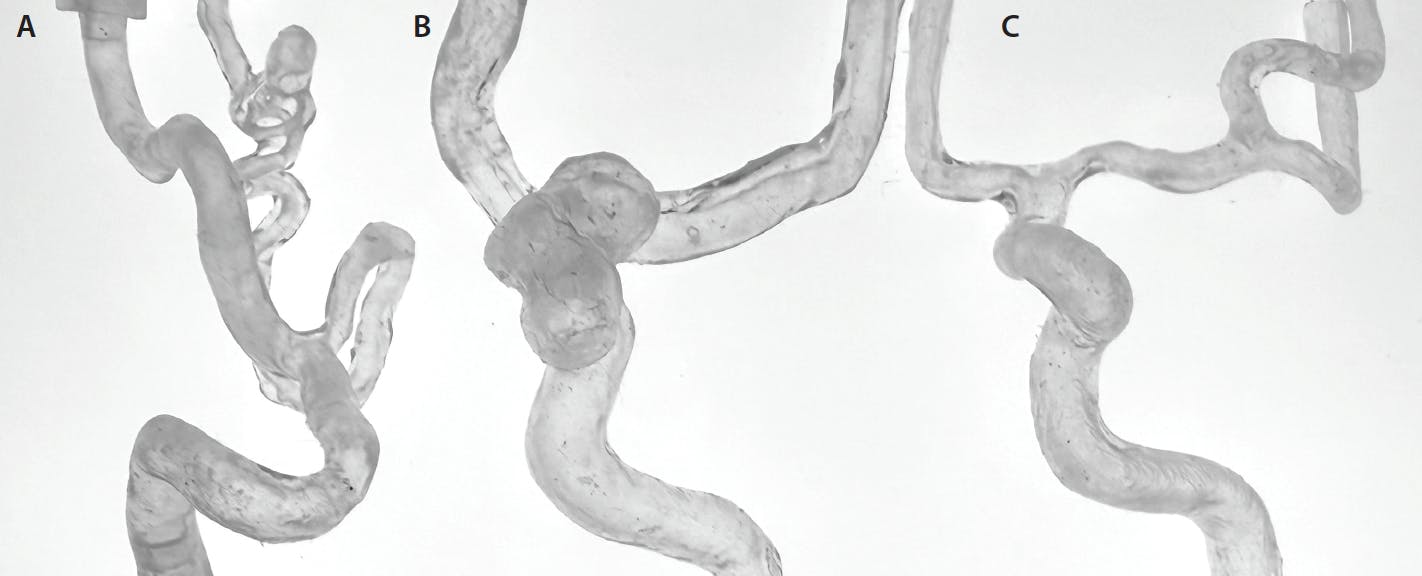
Figure 1. Transparent, patient-specific cerebral vascular phantom for testing of neuroendovascular devices. The models were generated from 3D rotational angiograms, 3D printed as a lost wax mold, and cast in optically clear silicone. It reproduces an arteriovenous malformation from the posterior inferior cerebellar artery (A), an internal carotid artery aneurysm (B), and a middle cerebral artery stenosis (C) under realistic tortuosity.
Cerebral aneurysms vary widely in location, size, and morphology, and modern 3D printing techniques enable the creation of patient-specific silicone models that capture this diversity.4 Flow diverters such as Pipeline (Medtronic), Surpass (Stryker), and FRED (Terumo Neuro) have been tested in silicone replicas in the preclinical studies. These evaluations assessed device navigability, deployment accuracy, and particulate generation. Similarly, intrasaccular aneurysm treatment devices like the Woven EndoBridge (Terumo Neuro) underwent testing within silicone aneurysm domes. These models allow precise measurement of device deployment forces and aneurysm wall interactions.
Mechanical thrombectomy devices are routinely tested in transparent silicone replicas that are seeded with clot analogues and perfused under physiologic flow. In these realistic vascular models, stent retrievers and aspiration catheters are evaluated for trackability, first-pass recanalization, distal embolic generation, and resheathability, while high-speed cameras reveal stent-clot interactions that are invisible under fluoroscopy.5,6 By combining fibrin-rich clot analogues with replicas featuring arterial tortuosity, investigators can recreate and analyze the challenging clinical scenarios.5 Cost-effective, reproducible, and radiation-free, these phantoms have become essential for mechanical thrombectomy device development.
Furthermore, liquid embolic materials for arteriovenous malformations benefit from testing in transparent vascular replicas.7 These clear models facilitate real-time visualization and analysis of embolic material distribution and potential for migration, significantly enhancing predictive understanding of clinical performance.
The main limitation of vascular replica models is that no synthetic model perfectly mimics living tissue: Silicone vessels lack true elasticity and cannot model biological responses or complications such as rupture, vasospasm, or thrombosis. Although conventional animal models remain the gold standard for safety, they are difficult to modify once established. Highly customizable 3D-printed vascular models are becoming increasingly important for exploring the unique properties of next-generation endovascular devices before moving to in vivo studies for safety evaluation.
IN SILICO SIMULATION
In silico simulation refers to the use of computer modeling to evaluate devices, and advances in computational power have made these techniques increasingly accurate. Regulators now expect sponsors to follow the American Society of Mechanical Engineers V&V 40 framework so that every model is verified and validated against bench or animal data before any regulatory submission.8 In the stents field for cerebral aneurysms, finite element analysis is applied to simulate structural mechanics during delivery expansion and long-term arterial pulsation; the analyst meshes each wire, applies realistic pulsatile pressure, calculates hoop stresses and strains, and then runs a fatigue analysis that projects 10-year equivalent cycle counts so that worst case stresses and safety factors can be virtually tested.
Benefits of in silico testing include the ability to explore many scenarios rapidly. These in silico studies guide design tweaks such as wire thickness, braid angle, and flare length; allow comparison of alternate heat set profiles; and can rank deployment scenarios that would be difficult or unethical to reproduce in animals. This makes optimization faster and can reduce the number of physical prototypes and animal tests needed.
The limitations of simulations are tied to their assumptions. Simulations cannot yet capture complex biological responses such as clot formation or vessel remodeling after device deployment. Therefore, in silico findings must be corroborated with physical testing. Still, these techniques have become a powerful, cost-effective adjunct to preclinical research, offering insights into device behavior that complement in vitro and in vivo studies.
IN VIVO MODELS
Even after extensive in vitro, benchtop, vascular phantom, and in silico simulation, in vivo studies in animal models are usually required before first-in-human use. Animal models can reveal how a device interacts with real blood flow, vessel walls, and the full complexity of biology over time. In the neuroendovascular field, several well-established animal models are used to evaluate the safety of devices. The rabbit elastase aneurysm model provides a pulsatile circulation in which flow diverters or intrasaccular implants can be assessed for long-term aneurysm occlusion and endothelial healing.9 Large animals such as pigs are favored for thrombectomy device evaluation because their arterial calibers are similar to those of humans.10 Although intracranial clot insertion is impossible in swine owing to the rete mirabile, thrombectomy systems can still be evaluated for distal navigation and clot retrieval within branches of the external carotid artery. Moreover, the dense micro-vascular network of the swine rete mirabile, supplied by the ascending pharyngeal arteries, is used to test liquid embolic agents, as its intricate architecture serves as a useful surrogate for complex human vascular targets.11
Animal studies provide indispensable safety and performance data. Investigators evaluate feasibility and acute complications (eg, perforation, vasospasm, distal emboli) as well as chronic sequelae such as device migration, thrombosis, inflammation, and restenosis. For safety evaluations aimed at regulatory approval, animal studies must be conducted under GLP (Good Laboratory Practice) standards, which require prespecified protocols, rigorously quality-controlled data collection, and independent auditing, measures that give regulators confidence in the reproducibility and integrity of the results.
Animal models have limitations. No animal perfectly replicates human vascular anatomy or pathology. Animal vessel geometry is generally simpler than human intracranial vessels. Rabbits and pigs lack the chronic arterial disease (eg, advanced atherosclerosis with calcification) that is often present in human patients. Moreover, animal studies are expensive and ethically constrained. Despite these limitations, in vivo testing remains the definitive preclinical step to ensure that a device that has shown promise in vitro and in silico will behave safely in a living organism before proceeding to clinical trials.
CONCLUSION
The preclinical studies of novel endovascular devices are most effective when multiple approaches are appropriately chosen and used in tandem. Because new implants may introduce unique materials, delivery mechanisms, or modes of action, investigators must map all plausible benefits and risks to the test platform able to evaluate them and remain agile enough to develop custom methods or phantoms as design innovations require. In vitro, in silico, vascular replica, and in vivo methods each contribute complementary insights, from basic safety and mechanistic data to complex biological interactions. By integrating these insights, developers can thoroughly evaluate the risk of devices prior to human trials. This blended, flexible strategy accelerates innovation while maintaining a high standard of patient safety.
1. US Food and Drug Administration. Use of International Standard ISO 10993-1, biological evaluation of medical devices–part 1: evaluation and testing within a risk management process. Guidance for industry and Food and Drug Administration staff. September 8, 2023. Accessed May 1, 2025. https://www.fda.gov/media/142959/download
2. US Food and Drug Administration. Roadmap to reducing animal testing in preclinical safety studies. Accessed May 1, 2025. https://www.fda.gov/media/186092/download
3. Kaneko N, Mashiko T, Ohnishi T, et al. Manufacture of patient-specific vascular replicas for endovascular simulation using fast, low-cost method. Sci Rep. 2016;6:39168. doi: 10.1038/srep39168
4. Kaneko N, Minhas A, Tateshima S, et al. Pre-procedural simulation for precision stent-assisted coiling of cerebral aneurysm. Interv Neuroradiol. 2019;25:419-422. doi: 10.1177/1591019919831923
5. Kaneko N, Komuro Y, Yokota H, Tateshima S. Stent retrievers with segmented design improve the efficacy of thrombectomy in tortuous vessels. J Neurointerv Surg. 2019;11:119-122. doi: 10.1136/neurintsurg-2018-014061
6. Kaneko N, Ghovvati M, Komuro Y, et al. A new aspiration device equipped with a hydro-separator for acute ischemic stroke due to challenging soft and stiff clots. Interv Neuroradiol. 2022;28:43-49. doi: 10.1177/15910199211015060
7. Kaneko N, Ullman H, Ali F, et al. In vitro modeling of human brain arteriovenous malformation for endovascular simulation and flow analysis. World Neurosurg. 2020;141:e873-e879. doi: 10.1016/j.wneu.2020.06.084
8. US Food and Drug Administration. Assessing the credibility of computational modeling and simulation in medical device submissions. Guidance for industry and Food and Drug Administration staff. November 17, 2023. Accessed May 1, 2025. https://www.fda.gov/media/154985/download
9. Brinjikji W, Ding YH, Kallmes DF, Kadirvel R. From bench to bedside: utility of the rabbit elastase aneurysm model in preclinical studies of intracranial aneurysm treatment. J Neurointerv Surg. 2016;8:521-525. doi: 10.1136/neurintsurg-2015-011704
10. Liu Y, Abbasi M, Arturo Larco JL, et al. Preclinical testing platforms for mechanical thrombectomy in stroke: a review on phantoms, in-vivo animal, and cadaveric models. J Neurointerv Surg. 2021;13:816-822. doi: 10.1136/neurintsurg-2020-017133
11. Lylyk P, Viñuela F, Vinters HV, et al. Use of a new mixture for embolization of intracranial vascular malformations. Preliminary experimental experience. Neuroradiology. 1990;32:304-310. doi: 10.1007/BF00593050
Advertisement
Advertisement