Advertisement
Advertisement
March 2025
Anterior Saphenous Vein Reflux: Naming Considerations and Treatment Discussions
A conversation with Dr. Boyle on a recent societal push to drop “accessory” from “anterior accessory saphenous vein,” as well as common anterior saphenous vein reflux patterns, tips for avoiding misclassification and understanding treatment indicators, and more.

In 2024, you and colleagues simultaneously published a four-article series in both Journal of Vascular Surgery: Venous and Lymphatic Disorders and Phlebology wherein the American Vein & Lymphatic Society (AVLS), American Venous Forum (AVF), and International Union of Phlebology (UIP) jointly endorsed a shift in terminology from “anterior accessory saphenous vein” to “anterior saphenous vein.”1-8 What were the main challenges with the previous terminology?
It became evident to many specialists caring for venous patients that there was a lack of clarity regarding the terminology of the anterior accessory saphenous vein. The term “accessory” implied that the vein was a superficial tributary. However, its anatomic features, accepted treatment approaches, and clinical outcomes after treatment supported its role as a truncal vein, similar to the great saphenous vein (GSV) and small saphenous vein (SSV).
This discordance led to confusion about the optimal treatment modalities and restrictive payer coverage inconsistencies. Therefore, there was momentum to develop a process to evaluate whether the terminology should evolve to provide more clarity on this distinction. This led to the formation of a multispecialty working group with representatives from the AVLS, AVF, and UIP. Ultimately, a consensus was made to drop the term “accessory” and simply use the term anterior saphenous vein (ASV).
How does recognizing the ASV as a truncal vein rather than a tributary impact decision-making, treatment, and patient outcomes?
The ASV as a truncal vein like the GSV and SSV and not a branch tributary raises the question: What are the optimal treatment modalities for the long term? As a branch tributary vein, treatments like physician-compounded foam or phlebectomy might seem adequate. However, there is ample published evidence and expert consensus that the optimal long-term treatment modalities for ASV reflux are truncal ablation techniques such as radiofrequency ablation, cyanoacrylate closure, proprietary microfoam, and mechanochemical ablation. Providing clarity on this subject will hopefully help clinicians offer patients the optimal treatment plans for long-term outcomes and help guide payer policies to do the same.
What has been the overall reaction to the terminology change?
Overall, the reaction has been supportive and positive, in large part because what started as a grassroots effort was ultimately endorsed by the major societies, based on the evidence provided in the four publications, which built on the body of literature predating this effort.1-8
There were questions about whether clinicians can simply decide to make such a change by expert and society consensus. It was emphasized that “terminology” refers to specialized terms for a specific scientific field, such as venous specialists, while “nomenclature” is defined by strict anatomic standards and principles. This change was a clinically and evidence-driven terminology evolution led by clinical experts and endorsed by the leading vein specialty societies. It is anticipated that the anatomic nomenclature will follow, based on prior experiences where similar terminology changes were carried out for the GSV and SSV.
Can you briefly summarize some of the most common patterns of ASV reflux?
Those of us seeing patients with venous disorders commonly observe ASV reflux in primary patients presenting for treatment for the first time, as well as secondary patients seeking care after previous treatment of their veins. In primary patients, approximately 20% presenting for treatment of superficial venous reflux have reflux in the ASV. Often, this is noted concomitantly with GSV reflux, or it can be isolated ASV reflux with a normal GSV.
Branch tributary veins can extend laterally to the thigh, and this is the classic presentation on physical examination that suggests ASV reflux. However, the branches from the ASV can turn medially in the thigh, making it less obvious on physical exam.
One pattern described in the papers involves a dilated ASV with reflux in the upper thigh, while the proximal GSV is hypoplastic and without reflux until the distal thigh. Here, branch tributary veins cross over from the ASV to the GSV, resulting in significant distal GSV reflux with clusters of tributary veins in the medial calf. Recognizing the various patterns can help one optimize treatment planning for the best long-term outcomes.
Additionally, secondary patients who have previously undergone GSV ablation or stripping years prior often present with ASV reflux as one of the most common scenarios of recurrence after previous treatment. Typically, there is no evidence of a GSV from the groin to about the midcalf on venous duplex ultrasound, as it has been previously ablated. Instead, a dilated and refluxing ASV is the source of recurrent varicose veins years after the previous GSV treatment.
What are some tips for identifying ASV reflux and avoiding misclassification?
The most common anatomic features are detailed in terms of ASV origin and termination in our recent publication led by Dr. Alberto Caggiati, a premier vascular anatomist who has worked on terminology and nomenclature issues over the years.3,4
First and foremost is identifying its location within a saphenous sheath, which is the characteristic that makes it a truncal vein rather than a branch tributary vein. A number of anatomic variations are detailed in Caggiati et al. The ASV generally joins the GSV close to or at the saphenofemoral junction at the groin, either above or below the terminal valve; however, some terminate in pelvic veins or even lymph nodes. The ASV is generally seen running parallel and lateral to the GSV. A good way to distinguish the ASV from the GSV is what is known as the “alignment sign,” where on ultrasound, one notes the ASV courses immediately above the superficial projections of the femoral vessels, whereas the GSV courses along a more medial path (Figure 1). The ASV is sometimes long in length in the saphenous sheath and other times very short. Each of these features is important to consider when treatment planning.
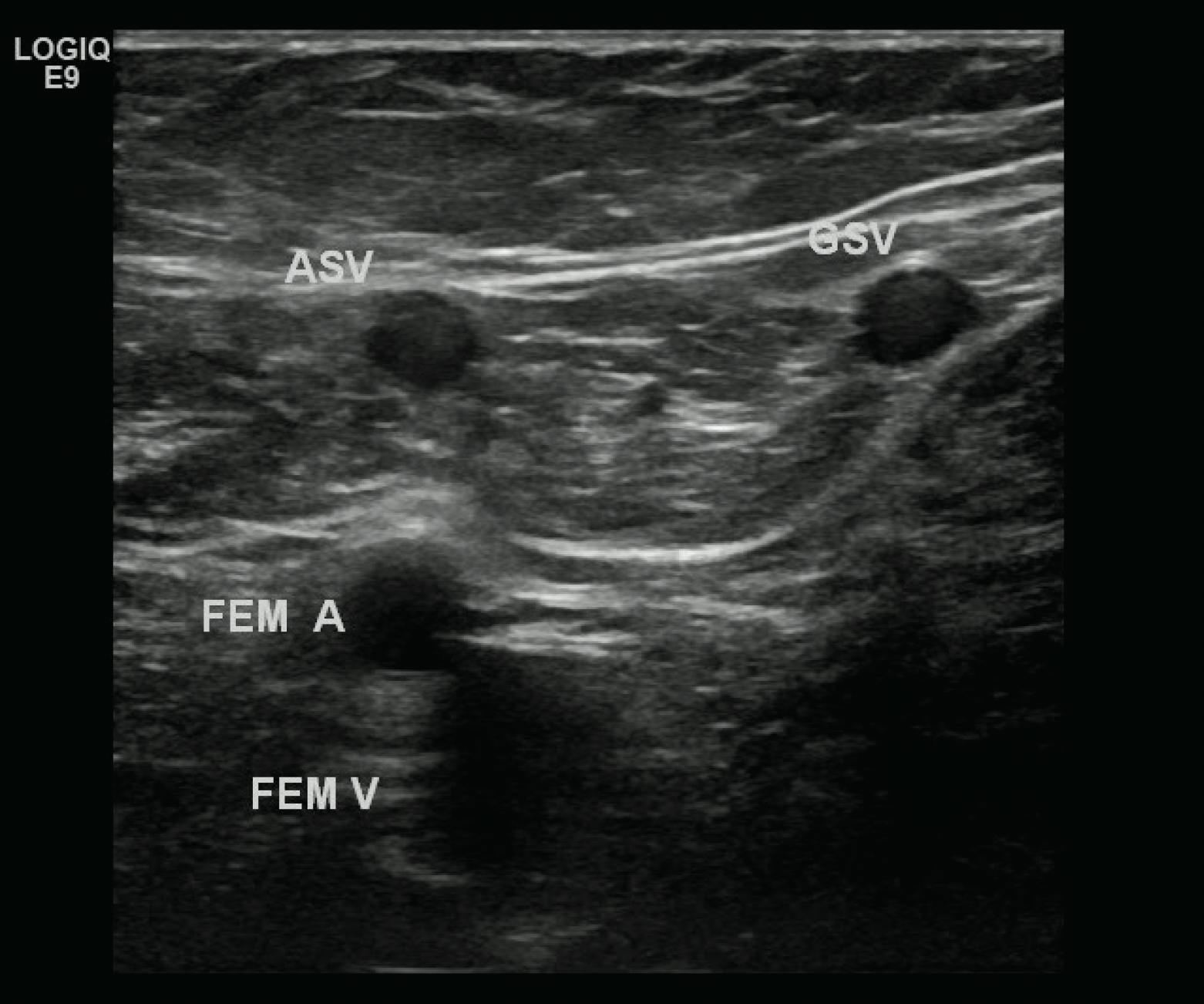
Figure 1. The alignment sign demonstrating the ASV in alignment with the deep femoral vessels, while the GSV is medial. (Image used with patient permission.)
How do you determine when ASV reflux does and does not require treatment? What are the major indicators?
As clinicians, we aim to treat the patient and their symptoms, not the ultrasound images. While many patients with refluxing ASV benefit from ablation, some may have ASV reflux without requiring treatment. I use a patient-centered approach by listening to patient’s history and then performing a physical exam and venous duplex ultrasound. I consider all of this together to consider whether the patient will benefit from treatment of the ASV with ablation. I generally start by offering to treat the patient conservatively, and if that does not help, I then discuss with the patient if a procedure is warranted, after an adequate trial of conservative approaches has failed.
When I consider that a treatment may be indicated and the patient agrees, I evaluate the size of the refluxing ASV and consider its role in the patient’s symptoms before offering treatment options. For example, if a patient has both GSV and ASV reflux with clear indications for treatment, I might choose not to treat a small-diameter, short ASV with few branches in a patient with a large refluxing GSV and numerous symptomatic branches. In such cases, I would ablate the GSV and treat its branches, leaving the ASV alone.
However, in cases with more advanced symptoms, skin changes, or a venous leg ulcer, especially where the ASV appears to play a significant role, I favor treating the ASV in the initial treatment plan over treating only the GSV reflux and leaving the ASV untreated to be reevaluated at a later time. Ultimately, I discuss the options with the patient and consider their treatment goals and expectations as a treatment plan is developed. When I do not treat the ASV, I make sure to emphasize to patients that this can be a source of recurrence in the future, and they should return to evaluate this if additional issues arise over time.
Why do providers often encounter issues obtaining authorization to treat ASV reflux, and what do you think are some possible solutions for this problem, beyond the terminology shift?
There appears to have been confusion and inconsistencies by payers regarding varicose vein treatment policies for many years, specifically whether the ASV is a truncal vein and thus requires a truncal vein treatment modality when indicated. As part of this project, a payer review was completed using the Policy Navigator from the AVF. Of the 226 insurance policies reviewed, about two-thirds allowed coverage for ASV ablation, while the rest either did not specify coverage or explicitly stated that ASV treatment was not covered. Of those that allowed ASV coverage, another two-thirds included restrictive criteria, such as requiring prior treatment of the GSV before authorizing ASV treatment.
As an example, a common policy condition for those providing restricted ASV coverage was that the ASV can only be treated after the GSV had been ablated. Some policies require waiting periods of 3 or 6 months before treating the ASV after GSV ablation. However, for many patients, this does not make clinical sense. For example, many patients presenting for first-time vein treatment have a refluxing ASV and a normal (nonrefluxing) GSV, indicating that only the ASV needs treatment. In other patients, both GSV and ASV reflux contribute to their symptoms, and both can be treated in the same session. Requiring GSV ablation first followed by an arbitrary waiting period, additional visits, and ultrasounds before ASV treatment can be requested for preauthorization seems unnecessary and leads to additional visits and time to complete treatment.
Our hope is that the terminology change, coupled with advocacy for a better understanding of various case scenarios, will allow the field to promote more sensible varicose vein treatment policies for ASV treatment by the payers. This may result in lower costs for both patients and payers in the short and long term.
1. Meissner M, Boyle EM, Labropoulos N, et al. The anterior saphenous vein. Part 1. A position statement endorsed by the American Vein and Lymphatic Society, the American Venous Forum, and the International Union of Phlebology. J Vasc Surg Venous Lymphat Disord. 2024 ;12:101721. doi: 10.1016/j.jvsv.2023.101721
2. Meissner M, Boyle EM, Labropoulos N, et al. The anterior saphenous vein. Part 1. A position statement endorsed by the American Vein and Lymphatic Society, the American Venous Forum, and the International Union of Phlebology. Phlebology. 2024;39:310-312. doi: 10.1177/02683555231224529
3. Caggiati A, Labropoulos N, Boyle EM, et al. The anterior saphenous vein. Part 2. Anatomic considerations in normal and refluxing patients. Endorsed by the American Vein and Lymphatic Society, the American Venous Forum, and the International Union of Phlebology. J Vasc Surg Venous Lymphat Disord. 2024;12:101855. doi: 10.1016/j.jvsv.2024.101855
4. Caggiati A, Labropoulos N, Boyle EM, et al. The anterior saphenous vein. Part 2. Anatomic considerations in normal and refluxing patients. Endorsed by the American Vein and Lymphatic Society, the American Venous Forum, and the International Union of Phlebology. Phlebology. 2024;39:313-324. doi: 10.1177/02683555231223055
5. Drgastin R, Boyle EM, Labropoulos N, et al. The anterior saphenous vein. Part 3. Systematic review of the literature and payor coverage policies. Endorsed by the American Vein and Lymphatic Society, the American Venous Forum, and the International Union of Phlebology. J Vasc Surg Venous Lymphat Disord. 2024;12:101856. doi: 10.1016/j.jvsv.2024.101856
6. Drgastin R, Boyle EM, Labropoulos N, et al. The anterior saphenous vein. Part 3. Systematic review of the literature and payor coverage policies. Endorsed by the American Vein and Lymphatic Society, the American Venous Forum and the International Union of Phlebology. Phlebology. 2024;39:325-332. doi: 10.1177/02683555231223281
7. Boyle EM, Drgastin R, Labropoulos N, et al. The anterior saphenous vein. Part 4. Clinical and technical considerations in treatment. Endorsed by the American Vein and Lymphatic Society, the American Venous Forum, and the International Union of Phlebology. J Vasc Surg Venous Lymphat Disord. 2024;12:101857. doi: 10.1016/j.jvsv.2024.101857
8. Boyle EM, Drgastin R, Labropoulos N, et al. The anterior saphenous vein. Part 4. Clinical and technical considerations in treatment. Endorsed by the American Vein and Lymphatic Society, the American Venous Forum, and the International Union of Phlebology. Phlebology. 2024;39:333-341. doi: 10.1177/02683555231223063
Advertisement
Advertisement