Advertisement
Advertisement
March 2025
Clinical Study Design for AAA Endovascular Grafts
The evolution of the safety and effectiveness evaluation of endovascular grafts intended for abdominal aortic aneurysm repair.
The views in this article are those of the authors and do not necessarily reflect those of Terumo Aortic.
Clinical studies of endovascular grafts intended for the repair of abdominal aortic aneurysms (AAAs) were initiated in the United States in the mid-1990s to provide data on this alternative treatment option to open surgical repair for patients with suitable anatomy. Pivotal studies have been completed for each respective endovascular graft to provide a reasonable assurance of safety and effectiveness, support that the benefits outweigh the risks for the labeled patient population, and allow for marketing approval from FDA. These pivotal study designs have evolved through the years as information has been gained on the critical performance attributes of these devices. As endovascular grafts are developed for more complex repairs, it is important that clinical study designs continue evolving, reflecting on the lessons learned from infrarenal endovascular repair to capture sufficient evidence to support device safety and effectiveness.
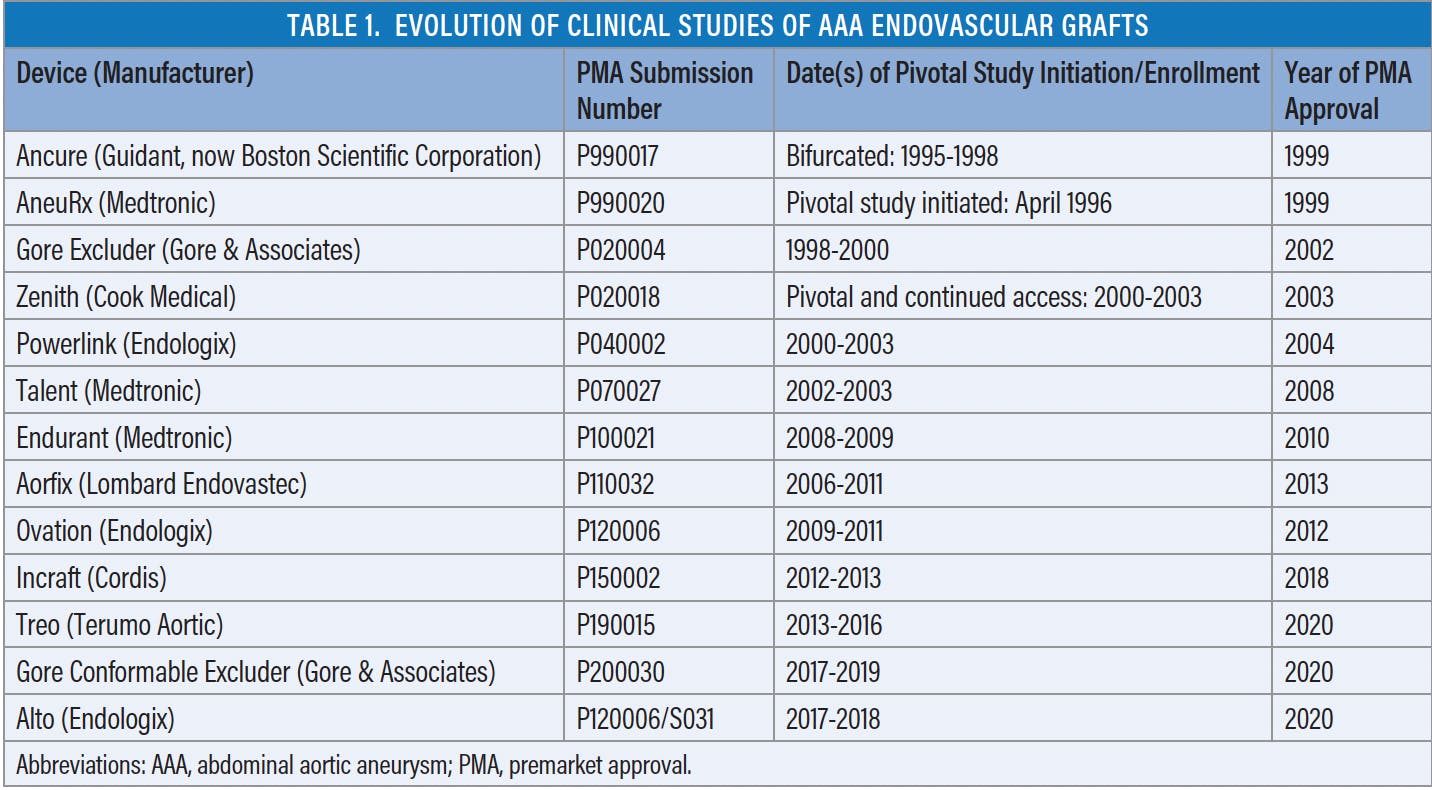
The clinical evaluation of AAA endovascular grafts includes both a safety evaluation and an effectiveness evaluation, as described in the proceeding sections. Table 1 outlines the evolution of clinical studies of AAA and their premarket approvals.
THE EVOLUTION OF THE SAFETY EVALUATION
The first AAA endovascular graft pivotal study was a randomized controlled trial comparing endovascular to open surgical repair to assess safety. Due to the lack of clinical equipoise, this study design was quickly abandoned, and subsequently, a concurrent open surgical control arm for the safety assessment was incorporated. If a potential study participant met all criteria for enrollment in the endovascular graft arm, they were enrolled in that arm.1 If they met all criteria with the exception of the endovascular graft anatomic criteria, they were enrolled in the control arm. This early study design methodology was applied to studies evaluating Ancure endograft system (Boston Scientific Corporation), AneuRx stent graft (Medtronic), Gore Excluder AAA endoprosthesis (Gore & Associates), Zenith AAA endovascular graft (Cook Medical), and Powerlink system (Endologix).
A subsequent study of the Talent abdominal stent graft system (Medtronic) used Society for Vascular Surgery (SVS) registry data from the open surgical repair control groups of multiple early pivotal studies. There was an attempt to perform a direct comparison between the endovascular graft study population and the open surgical control population using propensity score matching; however, numbers were inadequate for matching. Although the populations were acknowledged to have differences, the control data were used to put into perspective the data on the investigational device.
Current studies utilize a performance goal for the primary safety endpoint analysis. A performance goal is a numeric value that the primary endpoint is compared against using statistical methods. The performance goal is based on alternative treatment options, competitive devices for repair of the same lesion(s), and/or an earlier-generation device derived from the literature, the SVS registry, and/or internal, manufacturer data.
The primary safety endpoint has always been a composite endpoint evaluated at 30 days. Some early studies included mortality and major complications (eg, significant respiratory, cardiac, bleeding, bowel, wound, renal, arterial trauma, neurologic, and ischemic complications and death). Another study included mortality, rupture, conversion to open surgery, and serious adverse events.
The list of events included in the primary safety endpoint was refined during the development of the SVS control data with a collaboration between vascular surgeons, interventional radiologists, cardiothoracic surgeons, manufacturers, and FDA to include only major adverse events (MAEs) of most interest. These MAEs include the following: all-cause mortality, myocardial infarction, respiratory failure, bowel ischemia, renal failure, stroke, paraplegia, and blood loss ≥ 1,000 mL. This list of MAEs is still used for more recent endovascular graft studies (eg, Talent, Endurant [Medtronic], Ovation [Endologix], Incraft [Cordis], Treo [Terumo Aortic], Gore Conformable Excluder [Gore & Associates]).2 Thromboembolic events were also added to study endpoints (including the Gore Conformable Excluder study) as part of either the primary safety endpoint or primary effectiveness endpoint because a failed endovascular graft clinical study suggested that these events could be associated with significant device-related morbidity.
THE EVOLUTION OF THE EFFECTIVENESS EVALUATION
The primary effectiveness endpoint has always been a composite endpoint evaluated through 12 months and has included several components that have evolved over time (eg, the inclusion of technical success, the inclusion of all vs specific types of endoleaks). Early studies presented effectiveness measures descriptively with performance goals incorporated later.
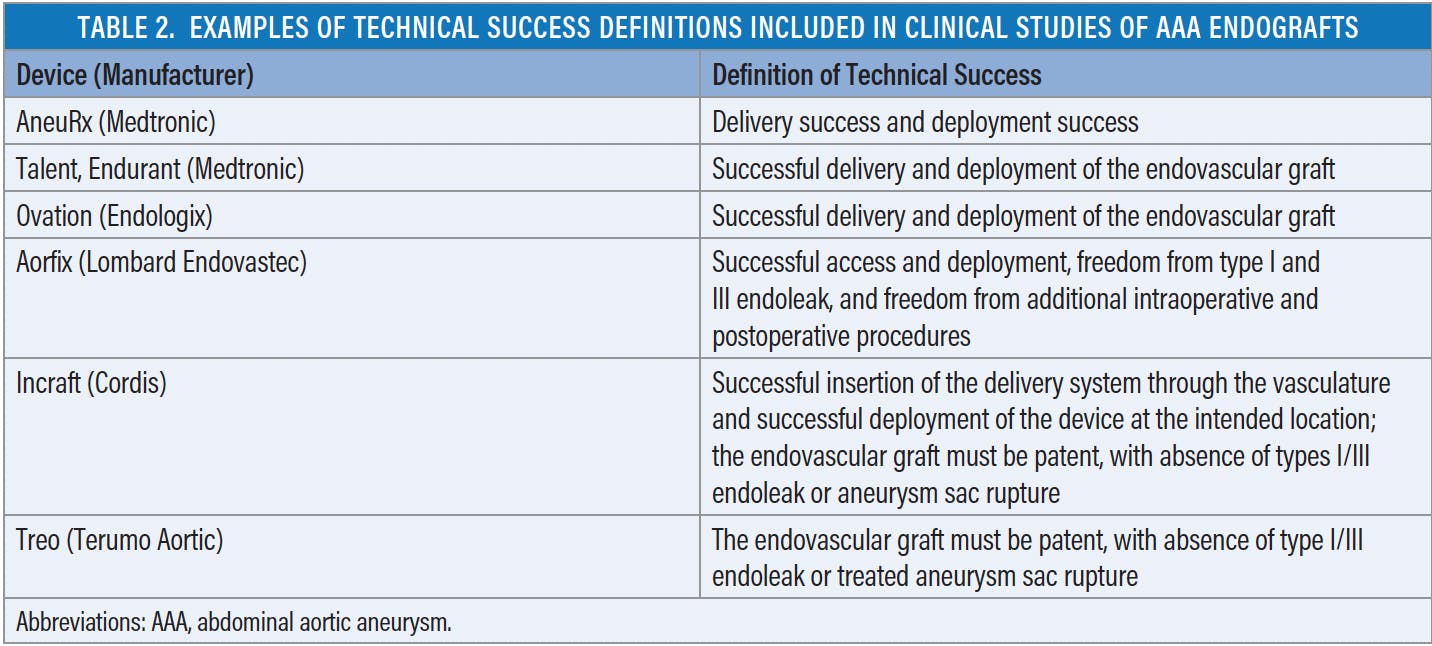
The technical success component was included in many earlier pivotal studies and continues to be incorporated into study endpoints in current studies. This endpoint was evaluated at the conclusion of the index procedure and definitions tended to vary (Table 2). In recent studies, the definitions were more detailed as to the specific aspects of the procedure, such as successful delivery, successful and accurate deployment, and successful withdrawal, without the need for unanticipated corrective reintervention related to these aspects (eg, Alto [Endologix]). Some also addressed patent device components, absence of type I and III endoleak, and successful access closure (eg, Gore Conformable Excluder) as an aspect of technical success.
Other components of effectiveness have varied widely from study to study. Early definitions included rupture, conversion, thrombosis/occlusion, perigraft flow, aneurysm expansion, migration, and intervention to address reduced limb patency (eg, Ancure). Other early studies (eg, AneuRx) included all types of endoleaks, including type II endoleak. As the primary endpoints were intended to focus on the events and observations most likely associated with device performance, the primary effectiveness endpoint was refined to include only endoleaks that could be considered associated with the device and likely to be associated with clinical sequelae (ie, type I/III endoleak). Further, more types of events and observations were included over time and continued to vary between pivotal studies. The events and observations considered for inclusion as a component of the primary effectiveness endpoint are aneurysm-related mortality, rupture, conversion to open surgery, secondary intervention (eg, due to fracture, kink, or thromboembolic events attributable to the stent graft), type I/III endoleak, aneurysm expansion (> 5 mm), loss of patency, migration, and/or loss of device integrity.
SECONDARY ENDPOINTS
Although the primary endpoints are defined to demonstrate a reasonable assurance of safety and effectiveness, clinical studies capture other safety- and effectiveness-related information. Additionally, secondary endpoints include the individual elements of the primary endpoints throughout the study and, for safety, MAEs over time. When making a marketing decision, FDA reviews the totality of the data available at the time of submission. This includes but is not limited to information on MAEs, all-cause mortality, aneurysm-related mortality, rupture, device-related and/or procedure-related adverse events, migration (> 10 mm and clinically relevant migration), all endoleaks, aneurysm size changes, patency-related observations, thromboembolic events, device integrity observations (eg, fracture, suture breaks), and secondary interventions related to the aneurysm and/or treated segment. At the time of marketing submission, clinical data are provided at all available time points, even though primary endpoint analyses are generally conducted at 30 days and through 12 months for safety and effectiveness, respectively.
REPORTING STANDARDS
Reporting standards have been developed and revised since the early days of endovascular repair in the United States. Early reporting standards provided recommendations on definitions for technical and clinical success; however, some were published after initial studies were initiated.3,4 These early reporting standards also evolved over time as industry knowledge on endovascular repair was gained. For example, early reporting standards included absence of perigraft endoleak as part of technical success, and this was later refined to the absence of type I/III endoleak. Similarly, the definition of clinical success also evolved, with early reporting standards including degeneration of the aorta proximal or distal to the device, which was later removed. Aneurysm-related mortality was also added in the 2002 reporting standards.
DISCUSSION
As endovascular repair was a completely new concept when introduced in the 1990s in the United States, early clinical study designs were proposed by individual manufacturers, with input from their clinical advisors. The components of the primary endpoints and their associated definitions differed across pivotal studies for all endovascular grafts. As lessons were learned from outcomes of the earlier studies, FDA encouraged changes to the primary endpoints. Further, societal guidelines have been developed and subsequently refined as knowledge has been gained in the field. These recommendations are currently taken into consideration when developing study endpoints.
The goal in evaluating AAA endovascular grafts is to obtain valid scientific evidence to support the safety and effectiveness of the devices. This is accomplished by conducting studies with clearly defined, relevant measures of safety and effectiveness. For the measures to be relevant, it has been critical for the evaluation strategies for these devices to evolve based on lessons learned from clinical use and studies over time.
Given the time it takes to conduct endovascular graft clinical studies, optimal endpoints and definitions can have changed by the time a study is completed. Regardless, FDA considers the totality of the data as well as the current understanding of critical performance parameters when determining whether the information provided supports a reasonable assurance of safety and effectiveness. Meeting or failing primary endpoints does not automatically mean that the device will or will not get approved. FDA will consider the benefits and risks associated with the use of the device in the proposed patient population and whether the population should be limited and/or warnings/precautions added to the labeling to allow for granting an approval.
CONCLUSION
The evaluation of AAA endovascular grafts should evolve over time, and thus, it is important for manufacturers to collaborate with FDA regarding clinical study design. It is equally important for manufacturers to continue to work with FDA while data are captured and as results are analyzed/prepared for the marketing submission.
1. Sapirstein W, Chandeysson P, Wentz C. The Food and Drug Administration approval of endovascular grafts for abdominal aortic aneurysm: an 18-month retrospective. J Vasc Surg. 2001;34:180-183. doi: 10.1067/mva.2001.116440
2. US Food and Drug Administration. FDA executive summary: Circulatory System Devices Panel meeting, November 3, 2021. General issues panel: real-world surveillance of AAA endovascular stent grafts. Accessed January 9, 2025. https://www.fda.gov/media/153647/download
3. Ahn SS, Rutherford RB, Johnston KW, et al. Reporting standards for infrarenal endovascular abdominal aortic aneurysm repair. Ad Hoc Committee for Standardized Reporting Practices in Vascular Surgery of The Society for Vascular Surgery/International Society for Cardiovascular Surgery. J Vasc Surg. 1997;25:405-410. doi: 10.1016/s0741-5214(97)70363-x
4. Chaikof EL, Blankensteijn JD, Harris PL, et al. Reporting standards for endovascular aortic aneurysm repair. J Vasc Surg. 2002;35:1048-1060. doi: 10.1067/mva.2002.123763
Advertisement
Advertisement