Advertisement
Advertisement
March 2025
Complete Femoral Access for Thoracoabdominal Branch Devices
Tips, tricks, and considerations for total transfemoral BEVAR.
Multibranched thoracoabdominal stent grafts have demonstrated broad applicability, especially for urgent repairs of symptomatic or large thoracoabdominal aortic aneurysms (TAAAs).1 Since the development of the Cook Zenith t-Branch (Cook Medical)—the first off-the-shelf branched endovascular aortic repair (BEVAR) device—other devices have followed with a similar caudally directed inner or outer branch design, intended for catheterization and bridging via upper extremity access.2-4 However, total transfemoral (TF) approaches have gained increasing popularity due to their procedural advantages, including early restoration of pelvic and lower extremity perfusion, elimination of arch manipulation, and potential reduction in neurologic complications.5,6 Although published data on total TF BEVAR primarily involves custom manufactured devices from Cook Medical or t-Branch devices, access to these devices in the United States has been restricted.
The recent FDA commercial approval of the Gore Excluder thoracoabdominal branch endoprosthesis (TAMBE; Gore & Associates) marked a significant milestone in the BEVAR technology. As the first commercially available, off-the-shelf, four-vessel BEVAR device, TAMBE has enabled more centers to access this advanced technology. The growing collective experience with BEVAR has resulted in technical refinements such as total TF BEVAR techniques, including those leveraging the preloaded wire system and staged deployment features. This article describes several options for total TF BEVAR, with their unique strengths and limitations.
VARIATIONS IN TECHNIQUES
Technique 1: TF BEVAR Using Steerable Sheaths
Watkins et al reported the first case of the total TF approach for t-Branch devices using a 16-F Aptus steerable sheath system (Medtronic). After the full deployment of the t-Branch and distal bifurcated aortic stent grafts, each side-arm branch cuff was sequentially accessed for target vessel stenting.7 Although the sheath’s stability is a key advantage of the 16-F Aptus sheath, its length can limit catheter choices and make wire and catheter exchanges more challenging. Alternatives, such as wire- or suture-reinforced 7- or 8-F steerable sheaths, have been introduced to address these challenges.
The same technique can be applied to the TAMBE device and involves withdrawing all removable guide tubes (RGTs) before fully deploying the device. After placement of the distal bifurcated component and ipsilateral iliac extension, a 12-F DrySeal sheath (Gor & Associates), combined with a 0.014-inch wire-reinforced, 8.5-F steerable sheath and coaxial 6-F Ansel sheath (Cook Medical), is deflected above the mesenteric portals. Branch catheterization and stenting are then performed sequentially for the celiac, superior mesenteric, and bilateral renal arteries using Gore VBX balloon-expandable stent grafts (Gore & Associates; Figure 1).
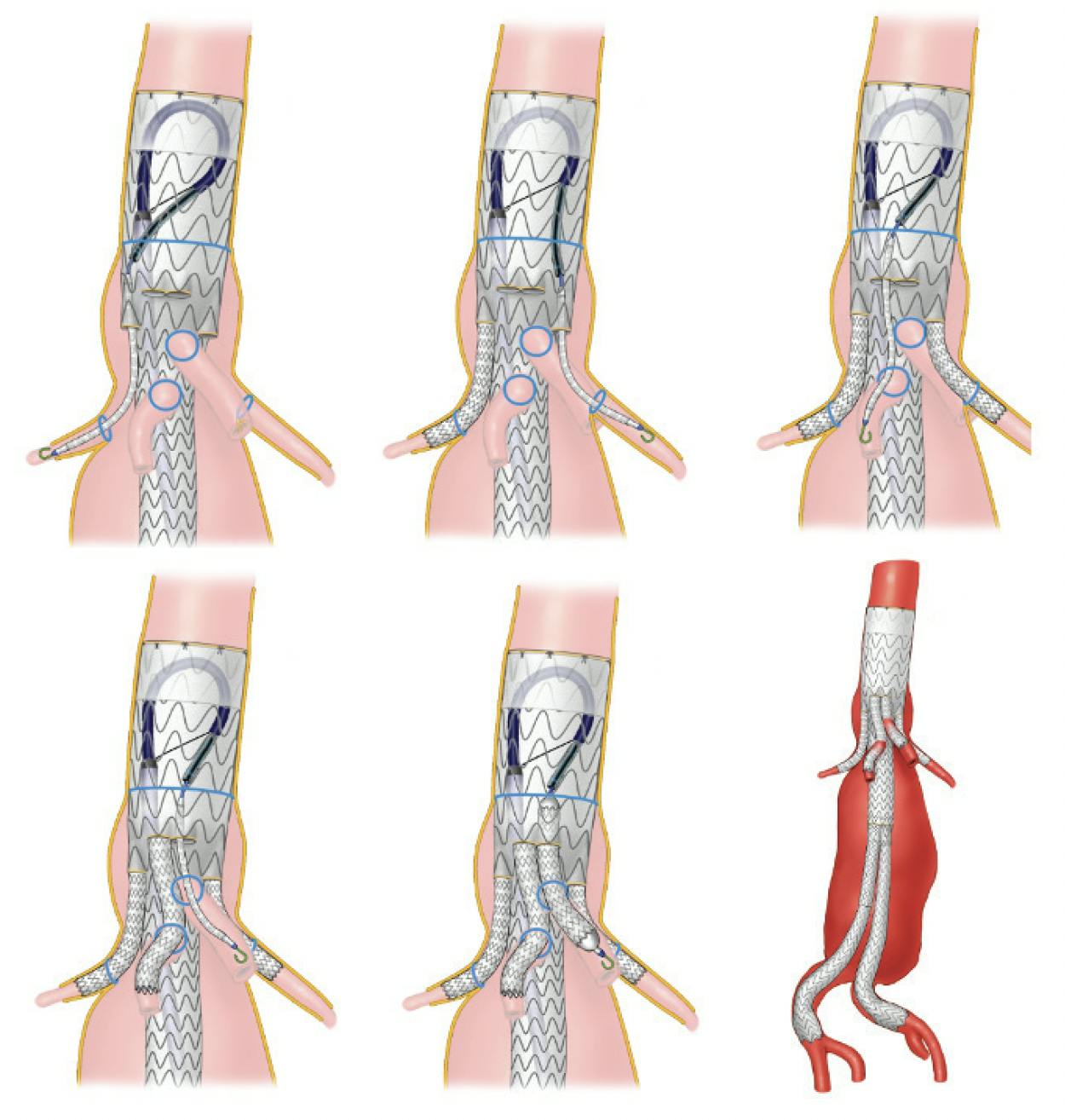
Figure 1. TF BEVAR using steerable sheaths. An 8.5-F steerable sheath with 0.014-inch wire reinforcement and a coaxial 6-F Ansel sheath is deflected above the target portal for sequential branch catheterization and stenting using Gore VBX balloon-expandable stent grafts. Reprinted from Journal of Vascular Surgery Cases, Innovations and Techniques, 10/6, Han SM, Pyum A, Oderich GS, Technical strategies and pitfalls for total transfemoral implantation of off-the-shelf four vessel thoracoabdominal multibranch endoprosthesis with or without utilization of preloaded wires 101615, Copyright 2024, with permission from Elsevier.
Technique 2: Parallel “Up-and-Over” TF Techniques With Preloaded Wire System for TAMBE
This technique utilizes preloaded wires to access TAMBE portals from the contralateral femoral approach. It may involve forming a through-and-through wire between the femoral accesses, advancing the TAMBE device to the thoracoabdominal aorta,8 or sequentially snaring each preloaded wire (Figure 2A-C). Using a steerable sheath alongside TAMBE allows catheterization and stenting of the target vessels (Figure 2D-H).
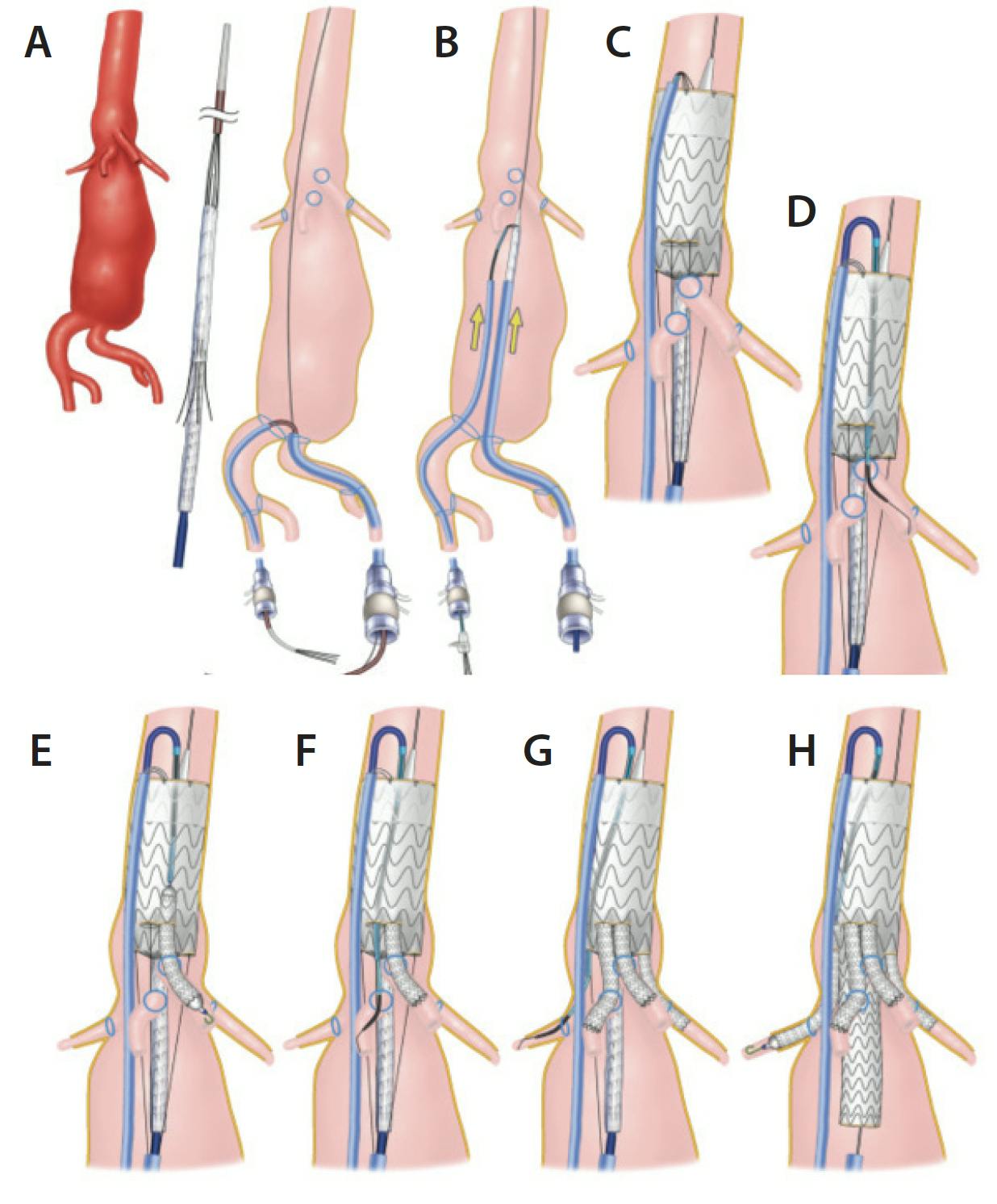
Figure 2. Parallel “up-and-over” TF techniques with a multiple preloaded wire system for TAMBE. This involves forming a through-and-through wire between the femoral accesses (A), advancing the device to the thoracoabdominal aorta (B), or sequentially snaring each preloaded wire (C). A steerable sheath is used alongside the TAMBE device (D-H). Reprinted from Journal of Vascular Surgery Cases, Innovations and Techniques, 10/6, Han SM, Pyum A, Oderich GS, Technical strategies and pitfalls for total transfemoral implantation of off-the-shelf four vessel thoracoabdominal multibranch endoprosthesis with or without utilization of preloaded wires, 101615, Copyright 2024, with permission from Elsevier.
The advantages include immediate access to portals as well as maintained control of the device during branch catheterization, allowing for correction of device malrotation. However, challenges include wire entanglement and the potential for gutter formation, which may compromise device stability and increase the risk of migration. Alternatively, a single wire can be utilized as a preload, with the sequential catheterization and stenting of each portal and the target vessel, while using the preload as a reinforcement wire (Figure 3). This variation of the parallel “up-and-over” technique avoids wire wrap and the need for multiple endovascular snaring; however, it requires additional time to catheterize individual portals and the target vessel.
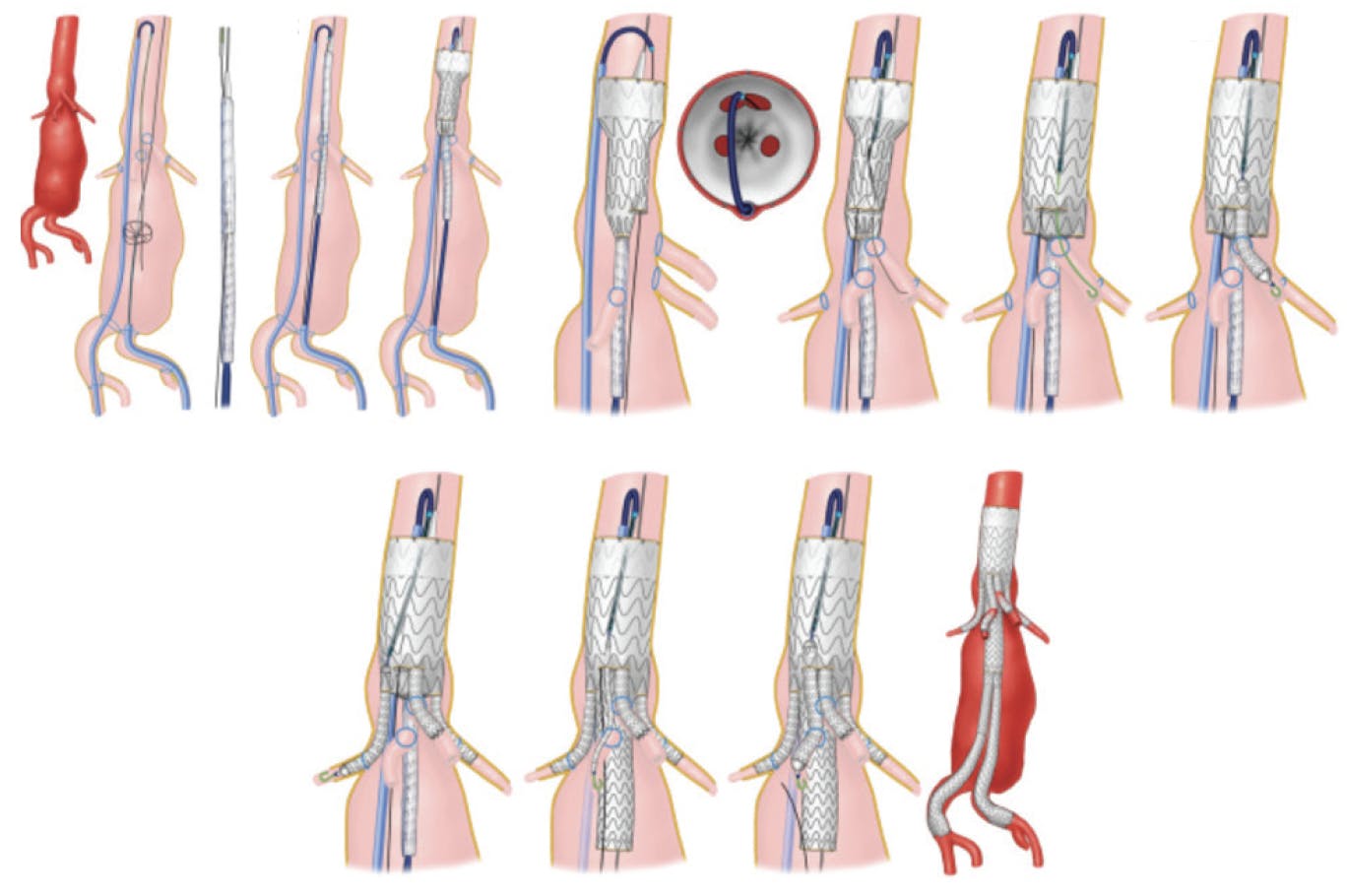
Figure 3. A variation of the parallel “up-and-over” technique that avoids wire wrap and the need for multiple endovascular snaring. A single wire is utilized as a preload, with the sequential catheterization and stenting of each portal and the target vessel, while utilizing the preload as a reinforcement wire. Reprinted from Journal of Vascular Surgery Cases, Innovations and Techniques, 10/6, Han SM, Pyum A, Oderich GS, Technical strategies and pitfalls for total transfemoral implantation of off-the-shelf four vessel thoracoabdominal multibranch endoprosthesis with or without utilization of preloaded wires, 101615, Copyright 2024, with permission from Elsevier.
Technique 3: Internal “Up-and-Over” TF Techniques With Preloaded Wire System for TAMBE
As an alternative to the parallel “up-and-over” technique, preloaded wires can be introduced to create an internal up-and-over configuration. This involves reverse loading a renal portal RGT with an 0.018-inch wire, which is then routed through a visceral portal (Figure 4A). The renal end of the preloaded wire is passed to the contralateral femoral access via a through-and-through catheter. Then, the TAMBE device is advanced while reducing any wire wrap and deployed through the second stage (Figure 4B). The steerable sheath is advanced internally over the preloaded wire and formed inside the TAMBE device through the renal portal (Figure 4C). Using a buddy catheter through the formed steerable sheath, the visceral and other renal arteries can be sequentially cannulated and bridged (Figure 4D). With three branches bridged, the TAMBE is fully deployed. The last renal portal can be accessed by snaring the wire advanced through the steerable sheath (Figure 4E). The steerable sheath is then removed from the contralateral femoral access and reloaded at the ipsilateral femoral sheath over the through-and-through wire. The last renal artery is catheterized using the buddy catheter technique via a coaxial 6-F sheath (Figure 4F-H).8 A distal bifurcated component and iliac limbs are then deployed to complete the repair (Figure 4I).
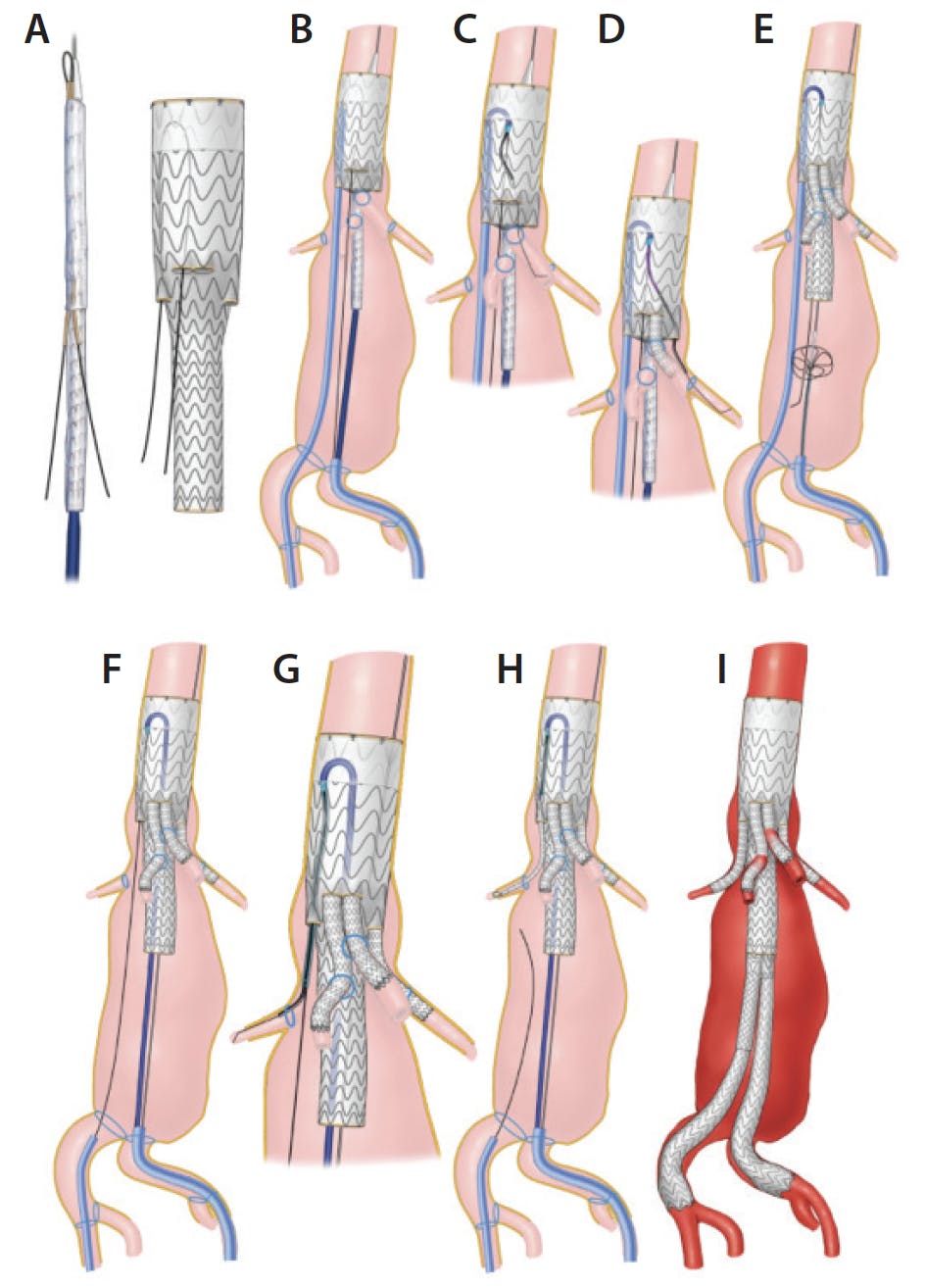
Figure 4. Internal “up-and-over” TF technique with preloaded wire system for TAMBE. The renal portal RGT is reverse loaded with an 0.018-inch wire, which is then routed through a visceral portal (A). The TAMBE device is advanced while reducing any wire wrap and deployed through the second stag (B). The steerable sheath is advanced internally over the preloaded wire and formed inside the device through the renal portal (C). Using a buddy catheter through the formed steerable sheath, the arteries can be sequentially cannulated and bridged (D). The last renal portal is accessed by snaring the wire advanced through the steerable sheath (E). The last renal artery is catheterized using the buddy catheter technique via a coaxial 6-F sheath (F-H). A distal bifurcated component and iliac limbs are deployed to complete the repair (I). Reprinted from Journal of Vascular Surgery Cases, Innovations and Techniques, 10/6, Han SM, Pyum A, Oderich GS, Technical strategies and pitfalls for total transfemoral implantation of off-the-shelf four vessel thoracoabdominal multibranch endoprosthesis with or without utilization of preloaded wires, 101615, Copyright 2024, with permission from Elsevier.
The latest iteration of the TF TAMBE technique involves a double internal up-and-over loading. In this approach, the TAMBE device is preloaded with two 0.018-inch wires, each reverse loaded through the renal and into the adjacent visceral portals (Figure 5A). The TAMBE device is advanced with the preloaded wires and deployed (Figure 5B). A steerable sheath is guided through the left renal portal and up and over to exit via the celiac portal (Figure 5C), where a buddied catheter and wire are used to cannulate and bridge the celiac artery (Figure 5D and 5E). The celiac preloaded wire is retracted just before stent inflation. The retracted wire is then snared using an over-the-wire endovascular snare via the ipsilateral sheath (Figure 5F). The 8-F steerable sheath is retracted from the renal portal and readvanced over the newly exteriorized end of the wire to go up and over, this time exiting the left renal portal, where a buddied catheter and wire are used for left renal artery cannulation and stenting (Figure 5G and 5H). This process is repeated sequentially for the superior mesenteric artery and the right renal artery (Figure 5I-L). Finally, a bifurcated endovascular aneurysm repair device (eg, a 31 X 14 mm X 14 cm Gore Excluder) is deployed to complete the repair (Figure 5M). This technique is particularly well-suited for emergent ruptured TAAA repair, as it preserves contralateral femoral access for supraceliac aortic balloon occlusion (Figure 6).
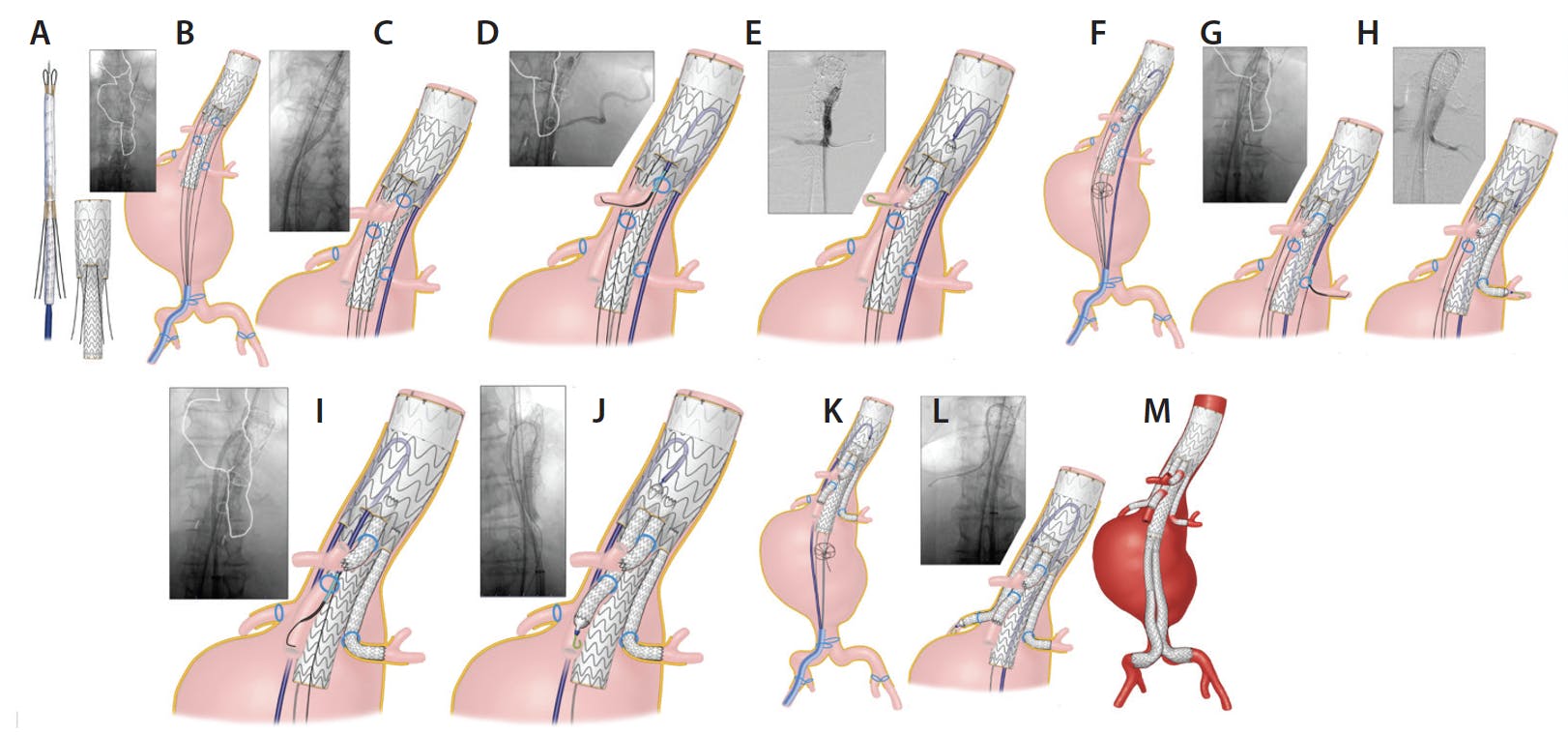
Figure 5. Double internal “up-and-over” TF techniques with preloaded wire system for TAMBE. The device is preloaded with two 0.018-inch wires, each reverse loaded through the renal and into the adjacent visceral portals (A). The device is advanced with the preloaded wires and deployed (B). A steerable sheath is guided through the left renal portal and up and over to exit via the celiac portal (C), where a buddied catheter and wire are used to cannulate and bridge the celiac artery (D, E). The celiac preloaded wire is retracted and then snared using an over-the-wire endovascular snare via the ipsilateral sheath (F). The 8-F steerable sheath is retracted from the renal portal and readvanced over the newly exteriorized end of the wire to go up and over, exiting the left renal portal, where a buddied catheter and wire are used for left renal artery cannulation and stenting (G, H). This process is repeated sequentially for the superior mesenteric artery and the right renal artery (I-L). A bifurcated EVAR device is deployed to complete the repair (M). Reprinted from Journal of Vascular Surgery Cases, Innovations and Techniques, Han SM, McElroy I, Oderich GS, Double preloaded internal up-and-over technique for total transfemoral four vessel thoracoabdominal multibranch endoprosthesis with temporary aortic balloon occlusion for ruptured complex abdominal aortic aneurysm, 101737, Copyright 2025, with permission from Elsevier.
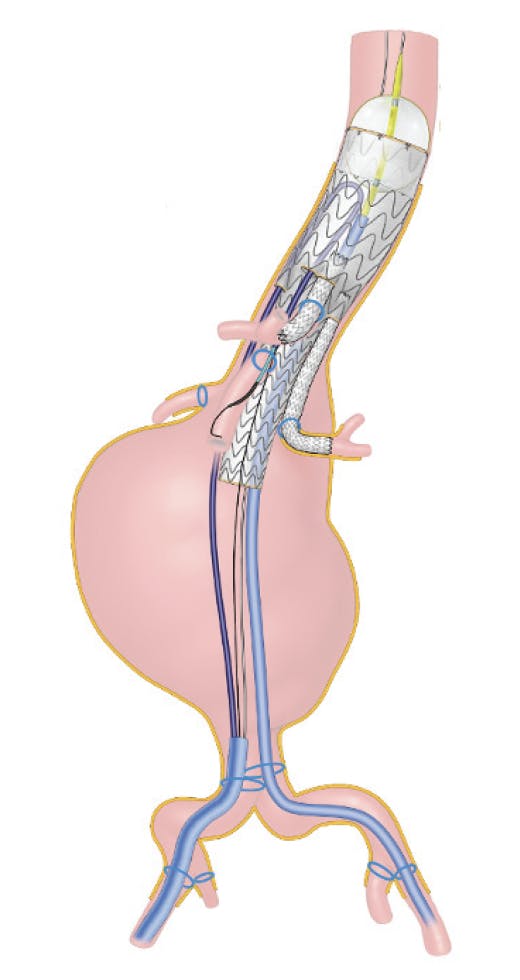
Figure 6. The double internal “up-and-over” TF technique with contralateral supraceliac aortic balloon occlusion. Reprinted from Journal of Vascular Surgery Cases, Innovations and Techniques, 10, Han SM, McElroy I, Oderich GS, Double preloaded internal up-and-over technique for total transfemoral four vessel thoracoabdominal multibranch endoprosthesis with temporary aortic balloon occlusion for ruptured complex abdominal aortic aneurysm, 101737, Copyright 2025, with permission from Elsevier.
TIPS AND PITFALLS
The technical aspect of applying the conventional reinforced steerable sheath to TAMBE does not differ significantly from techniques previously described elsewhere for other branch devices. However, several key differences between the t-Branch and TAMBE devices deserve attention. First, the proximal seal length of TAMBE is much shorter (5 cm) compared to t-Branch, making it more suspectable to caudal migration or rotation while traversing the portal with a coaxial 6-F sheath. Gentle manipulation of sheaths around the portal and any other contact points during branch catheterization is mandatory. We recommend using the “balloon swallow” technique rather than forceful advancement over a dilator. Second, the vertical orientation of the portals combined with closer spacing of the renal portals to the visceral portals of TAMBE could result in a longer, more angulated path to renal arteries. This could result in challenging bridging stent advancement in patients with aortic angulation and upgoing renal arteries. Third, the tightly spaced nitinol wire of the TAMBE main body compared to the Z-stents of t-Branch can make the portal difficult to visualize and time-consuming to catheterize.
The parallel “up-and-over” TF TAMBE technique utilizes one or multiple preloaded wire systems to gain access to the device and portals from the contralateral femoral approach. The main advantage of this approach includes immediate access through the portals using the preloaded wires, while maintaining control of the TAMBE main body during branch catheterization. This could provide the ability to correct malrotation during branch catheterization. Although both techniques avoid arch manipulation, the “up-and-over” TAMBE does not restore pelvic and lower extremity perfusion early. This technique can be more technically demanding, requiring coordination of multiple wires during advancement of preloaded TAMBE. Gutters created by the up-and-over sheath can potentially result in the TAMBE main body being less secure and more prone to caudal migration. For this reason, our preference is to secure the celiac branch first in all four techniques. The internal “up-and-over” technique avoids gutter creation and achieves proximal TAMBE apposition; however, the last renal portal catheterization and bridging requires full TAMBE deployment. Therefore, enough working space around the portal to the target vessel is required. It should be noted that any variation of the up-and-over preloaded technique can be abandoned and converted to the standard TF technique leveraging the steerable sheath during the operation.
The double internal up-and-over technique utilizes a single 22-F sheath for both the TAMBE main body and branch stent deployment. This minimizes the potential for wire entanglement while leaving the contralateral femoral access available for balloon occlusion. Therefore, this technique is particularly suitable for ruptured cases. Maintaining preloaded wires across the pararenal and paravisceral segments enables advanced bridging maneuvers such as the “snare-ride” technique from a single femoral access point (Figure 7). Finally, in a stable patient who does not require an occlusion balloon from the contralateral femoral access, the entire procedure can be completed using a single femoral access.
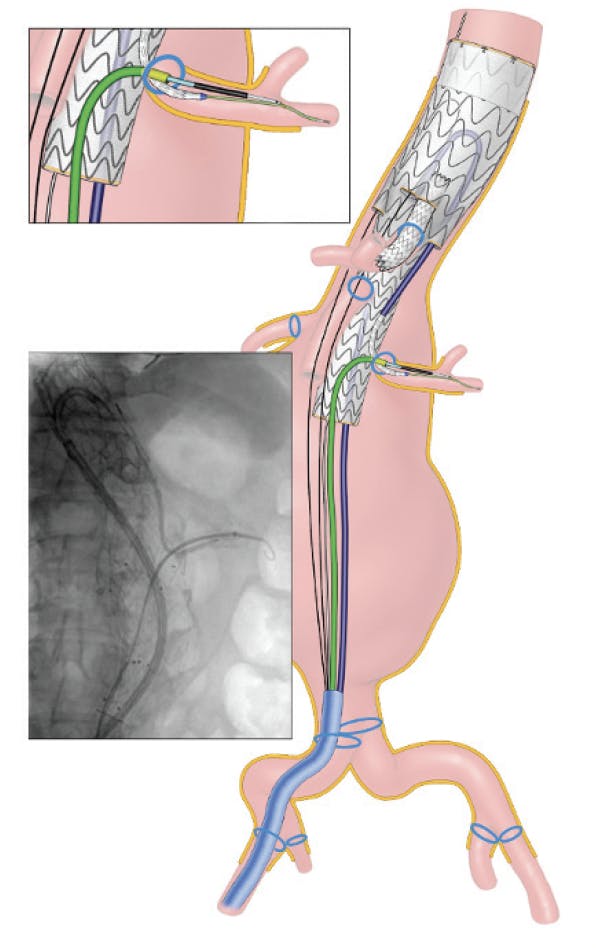
Figure 7. The “snare-ride” technique. Reprinted from Journal of Vascular Surgery Cases, Innovations and Techniques, Han SM, McElroy I, Oderich GS, Double preloaded internal up-and-over technique for total transfemoral four vessel thoracoabdominal multibranch endoprosthesis with temporary aortic balloon occlusion for ruptured complex abdominal aortic aneurysm, 101737, Copyright 2025, with permission from Elsevier.
With growing TAMBE experience using the total TF approach, several technical lessons emerged. First, our preferred preloaded wire is the hydrophilic Glidewir M (Terumo Interventional Systems), which has shown a lower tendency to kink when stent graft rotation is required to reduce wire wrap. Second, caution is essential when advancing the 8-F sheath in and out of the portals to avoid excessive tension on the fully deployed TAMBE main body, which could result in device migration or rotation. Finally, the position of the TAMBE device is fully committed from the beginning. Therefore, nuanced understanding of portal misalignment and advanced branch catheterization skills, in addition to familiarity of not only fenestrated-branched EVAR (FB-EVAR) procedures but also the TAMBE device, is essential in successful outcome.
Although some centers of excellence have moved to the total TF approach as the primary FB-EVAR techniques, with outstanding results, we have been using upper extremity access for TAMBE as the default approach per its instructions for use and reserving TF approaches for patients with hostile arch and challenging upper extremity. Noting the advantages and disadvantages of each technique, we cannot yet recommend a single best technique over others in our early experience. Future refinements with variations of the TF technique may generate similar improvements in procedural efficiency and safety, justifying wider adoption of this approach.
1. Chuter T, Greenberg RK. Standardized off-the-shelf components for multibranched endovascular repair of thoracoabdominal aortic aneurysms. Perspect Vasc Surg Endovasc Ther. 2011;23:195-201. doi: 10.1177/1531003511430397
2. Eleshra A, Hatm M, Spanos K, et al. Early outcomes of t-Branch off-the-shelf multibranched stent graft in urgent and emergent repair of thoracoabdominal aortic aneurysms. J Vasc Surg. 2022;75:416-424.e2. doi: 10.1016/j.jvs.2021.07.237
3. Zimmermann A, Menges AL, Rancic Z, et al. E-nside off-the-shelf inner branch stent graft: technical aspects of planning and implantation. J Endovasc Ther. 2022;29:167-174. doi: 10.1177/15266028211047967
4. Oderich GS, Farber MA, Silveira PG, et al. Technical aspects and 30-day outcomes of the prospective early feasibility study of the GORE EXCLUDER Thoracoabdominal Branched Endoprosthesis (TAMBE) to treat pararenal and extent IV thoracoabdominal aortic aneurysms. J Vasc Surg. 2019;70:358-368.e6. doi: 10.1016/j.jvs.2018.10.103
5. Chamseddin K, Timaran CH, Oderich GS, et al. Comparison of upper extremity and transfemoral access for fenestrated-branched endovascular aortic repair. J Vasc Surg. 2023;77:704-711. doi: 10.1016/j.jvs.2022.10.009
6. Mesnard T, Vacirca A, Baghbani-Oskouei A, et al. Prospective evaluation of upper extremity access and total transfemoralapproach during fenestrated and branched endovascular repair. J Vasc Surg. 2024;79:1013-1023.e3. doi: 10.1016/j.jvs.2023.12.033
7. Watkins AC, Avramenko A, Soler R, et al. A novel all-retrograde approach for t-Branch implantation in ruptured thoracoabdominal aneurysm. J Vasc Surg Cases Innov Tech. 2018;4:301-304. doi: 10.1016/j.jvscit.2018.09.002
8. Han SM, Pyun A, Oderich GS. Technical strategies and pitfalls for total transfemoral implantation of off-the-shelf four vessel thoracoabdominal multibranch endoprosthesis with or without utilization of preloaded wires. J Vasc Surg Cases Innov Tech. 2024;6:101615. https://doi.org/10.1016/j.jvscit.2024.101615
Advertisement
Advertisement