Advertisement
Advertisement

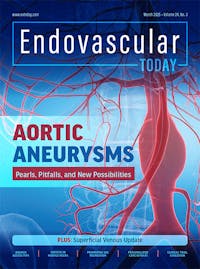
It is a wonderful honor to serve as Guest Editor of this issue of Endovascular Today focused on endovascular aortic aneurysm disease management and collaborate with its outstanding authors and editorial staff. Aortic disease management has evolved with advancing techniques, as well as refinement of our understanding of its pathology over the last several decades in terms of innovation, collaboration, and evidence. This Endovascular Today issue is decidedly future-focused, with insightful pieces that address key pearls in understanding the pathophysiology and potential possibilities using artificial intelligence (AI), all with the single purpose to improve clinical care and optimize patient outcomes.
Our issue begins with an article from Sukgu M. Han, MD, and Alyssa J. Pyun, MD, who describe several options for total transfemoral branched endovascular aortic repair, highlighting their unique strengths and limitations. Next, Jeanwan Kang, MD, discusses preoperative planning, deployment tips, device limitations, and strategies for navigating a hostile neck during “must-EVAR” situations. Beatrix H. Choi, MD; Thomas FX O’Donnell, MD; and Virendra I. Patel, MD, then explore a more active approach toward aneurysm sac management.
This issue also features an interview with Kak Khee Yeung, MD, who addresses key questions surrounding the potential for AI in personalized medicine, specifically concerning complex thoracoabdominal aortic repair and endoleak detection.
Next, Valerie M. Merkle, PhD, and Dorothy B. Abel assess the changing landscape of clinical studies on endovascular grafts for the repair of abdominal aortic aneurysms. They cover evolving safety and effectiveness endpoints, secondary endpoints evaluated, and standards for data reporting.
In addition to our feature on aortic aneurysms, the Endovascular Today editors have compiled a series of insightful articles revolving around improving treatment of superficial venous disease. First, Edward M. Boyle, MD, shares his thoughts on the evolving approaches to anterior saphenous vein reflux. Then, Sheila N. Blumberg, MD; Ramona Gupta, MD; and Kimberly Scherer, DO, provide their top tips and tricks for varicose vein treatment planning. Finally, Eri Fukaya, MD, and Raghu Kolluri, MD, break down their recent overview in The New England Journal of Medicine of the nonsurgical management of chronic venous insufficiency and its potential impact on both vascular and nonvascular physicians.
To conclude the issue, Daniel A.F. van den Heuvel, MD, expounds on his research on chronic limb-threatening ischemia and pulmonary artery vascular disease, the importance of the multidisciplinary team, and more.
I am proud of the editorial team and our authors in bringing this fantastic issue to you, and we hope you will enjoy reading it as much as we did putting this together. I am certain all our readers will find something to take away from our issue to incorporate into their practice or research.
Javairiah Fatima, MD, FACS, DFSVS
Guest Chief Medical Editor
Advertisement
Advertisement